steering CHEVROLET KODIAK 2004 Owner's Manual
[x] Cancel search | Manufacturer: CHEVROLET, Model Year: 2004, Model line: KODIAK, Model: CHEVROLET KODIAK 2004Pages: 366, PDF Size: 6.87 MB
Page 197 of 366
Unless you have the anti-lock braking system, you will
want to brake very gently, too. If you do have anti-lock,
seeBraking on page 4-6. This system improves your
vehicle’s stability when you make a hard stop on a
slippery road. Whether you have the anti-lock braking
system or not, you will want to begin stopping
sooner than you would on dry pavement. Without
anti-lock brakes, if you feel your vehicle begin to slide,
let up on the brakes a little. Push the brake pedal
down steadily to get the most traction you can.
Remember, unless you have anti-lock, if you brake so
hard that your wheels stop rolling, you will just slide.
Brake so your wheels always keep rolling and you can
still steer.
•Whatever your braking system, allow greater
following distance on any slippery road.
•Watch for slippery spots. The road might be fine
until you hit a spot that is covered with ice. On
an otherwise clear road, ice patches may appear in
shaded areas where the sun can not reach:
around clumps of trees, behind buildings or under
bridges. Sometimes the surface of a curve or
an overpass may remain icy when the surrounding
roads are clear. If you see a patch of ice ahead
of you, brake before you are on it. Try not to brake
while you are actually on the ice, and avoid
sudden steering maneuvers.
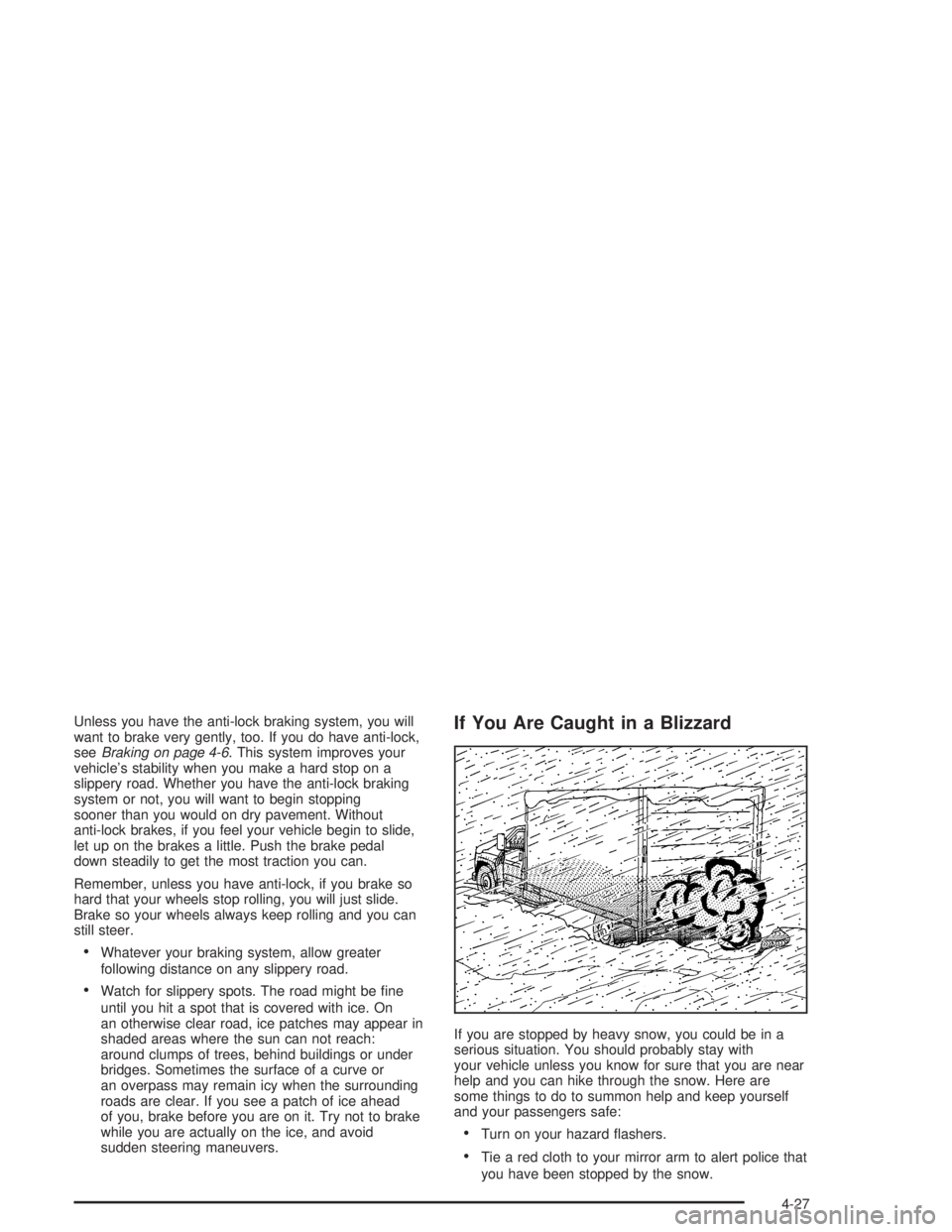
If You Are Caught in a Blizzard
If you are stopped by heavy snow, you could be in a
serious situation. You should probably stay with
your vehicle unless you know for sure that you are near
help and you can hike through the snow. Here are
some things to do to summon help and keep yourself
and your passengers safe:
•Turn on your hazard flashers.
•Tie a red cloth to your mirror arm to alert police that
you have been stopped by the snow.
4-27
Page 200 of 366
Rocking Your Vehicle To Get It Out
First, turn your steering wheel left and right. That will
clear the area around your front wheels. If your vehicle
has traction control, you should turn the traction
control system off. SeeTraction Control System (TCS)
on page 4-11. Then shift back and forth between
REVERSE (R) and a forward gear (or with a manual
transmission, between FIRST (1) or SECOND (2)
and REVERSE (R)), spinning the wheels as little as
possible. Release the accelerator pedal while you shift,
and press lightly on the accelerator pedal when the
transmission is in gear. By slowly spinning your wheels
in the forward and reverse directions, you will cause
a rocking motion that may free your vehicle. If that does
not get you out after a few tries, you may need to be
towed out. If you do need to be towed out, seeTowing
Your Vehicle on page 4-31.
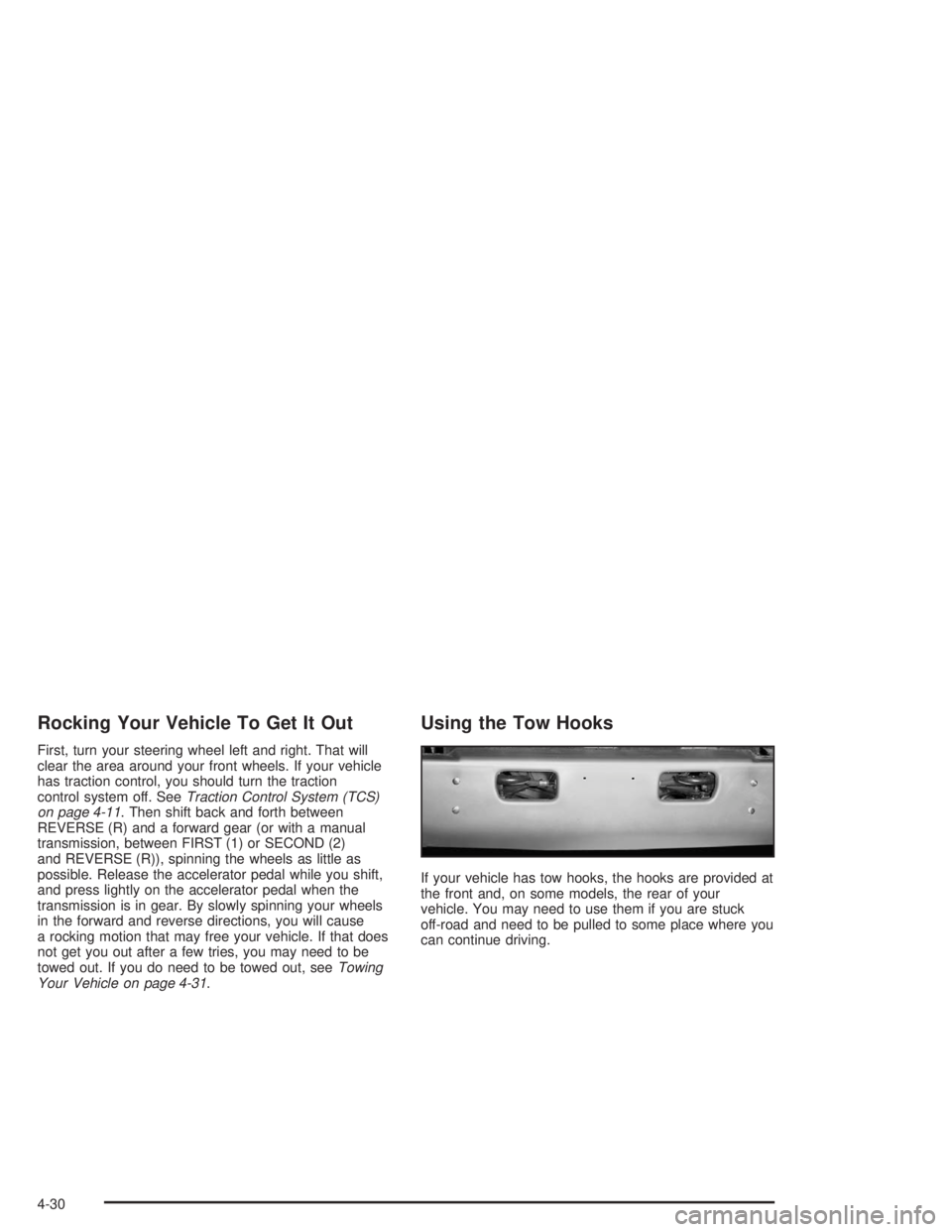
Using the Tow Hooks
If your vehicle has tow hooks, the hooks are provided at
the front and, on some models, the rear of your
vehicle. You may need to use them if you are stuck
off-road and need to be pulled to some place where you
can continue driving.
4-30
Page 207 of 366
Service............................................................5-3
Doing Your Own Service Work.........................5-4
Two Safety Cautions about Engine Fan
Breakage...................................................5-5
Fuel................................................................5-6
Gasoline Octane............................................5-6
Gasoline Specifications....................................5-6
Additives.......................................................5-7
Diesel Engine Fuel.........................................5-8
What Fuel to Use...........................................5-8
Very Cold Weather Operation.........................5-10
Water in Fuel...............................................5-10
Running Out of Fuel.....................................5-15
Fuel Filter Replacement.................................5-15
Fuels in Foreign Countries.............................5-16
Filling Your Tank..........................................5-17
Filling a Portable Fuel Container.....................5-18
Checking Things Under the Hood....................5-18
Hood Latches...............................................5-19
Engine Oil (Caterpillar
®Diesel Engine).............5-20
Engine Oil (Gasoline Engine)..........................5-20
Engine Oil (DURAMAX™ Diesel).....................5-25
Engine Air Cleaner/Filter................................5-30
Automatic Transmission Fluid.........................5-31
Manual Transmission Fluid.............................5-32Engine Coolant (Gas and
DURAMAX™ engines)................................5-32
Engine Coolant (Caterpillar
®Diesel Engines).....5-35
Coolant Surge Tank Pressure Cap..................5-35
Engine Overheating.......................................5-36
Cooling System............................................5-38
Engine Fan Noise.........................................5-43
Power Steering Fluid.....................................5-43
Windshield Washer Fluid................................5-44
Brakes........................................................5-46
Battery........................................................5-55
Jump Starting...............................................5-56
Rear Axle.......................................................5-61
Rear Axle Shift Motor....................................5-61
Noise Control System.....................................5-62
Tampering with Noise Control System
Prohibited.................................................5-62
Bulb Replacement..........................................5-63
Replacement Bulbs.......................................5-63
Windshield Wiper Blade Replacement..............5-63
Other Service Items........................................5-64
Fuel Filter....................................................5-64
Primary Fuel Filter and Water Separator..........5-65
Secondary Fuel Filter and Water
Separator/Heater.......................................5-66
Section 5 Service and Appearance Care
5-1
Page 249 of 366
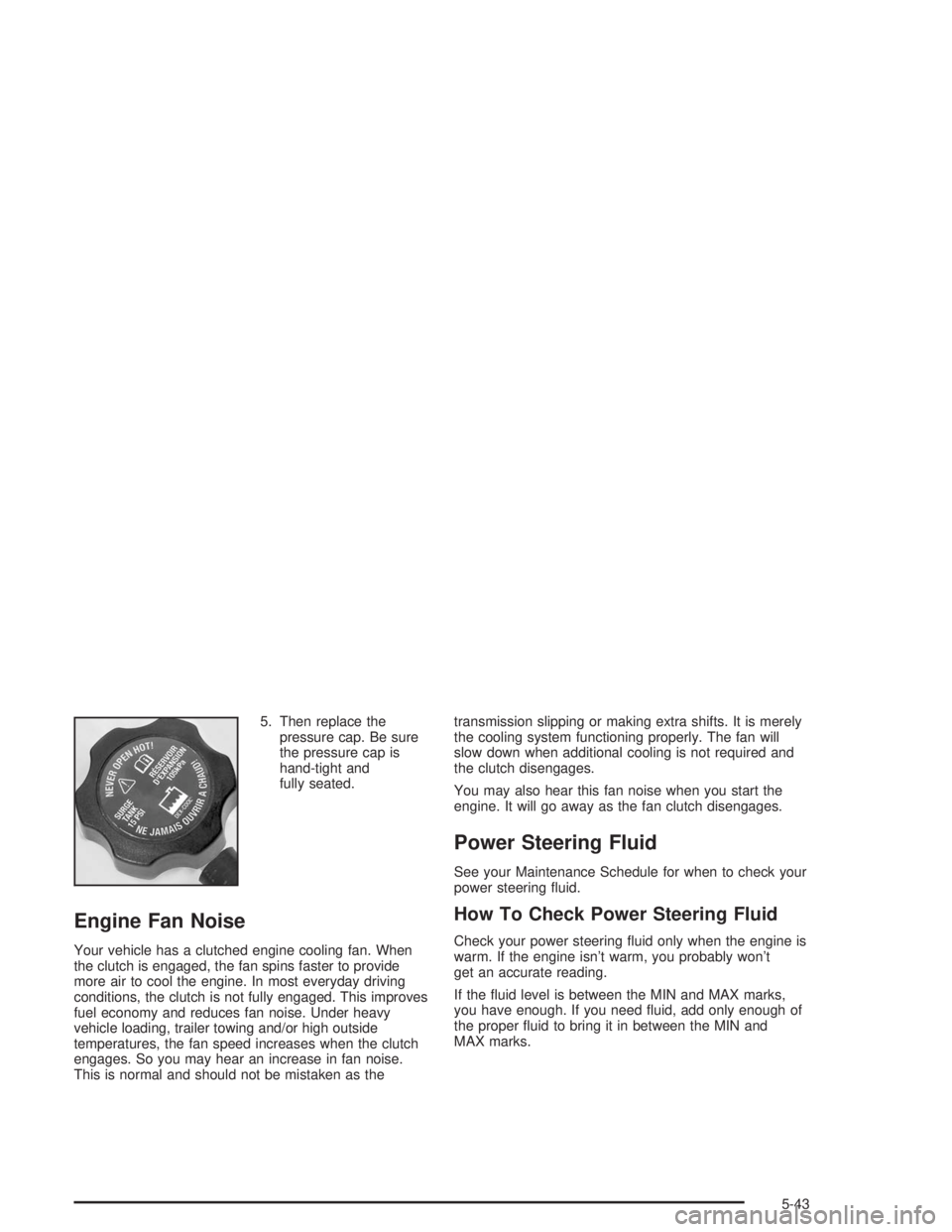
5. Then replace the
pressure cap. Be sure
the pressure cap is
hand-tight and
fully seated.
Engine Fan Noise
Your vehicle has a clutched engine cooling fan. When
the clutch is engaged, the fan spins faster to provide
more air to cool the engine. In most everyday driving
conditions, the clutch is not fully engaged. This improves
fuel economy and reduces fan noise. Under heavy
vehicle loading, trailer towing and/or high outside
temperatures, the fan speed increases when the clutch
engages. So you may hear an increase in fan noise.
This is normal and should not be mistaken as thetransmission slipping or making extra shifts. It is merely
the cooling system functioning properly. The fan will
slow down when additional cooling is not required and
the clutch disengages.
You may also hear this fan noise when you start the
engine. It will go away as the fan clutch disengages.
Power Steering Fluid
See your Maintenance Schedule for when to check your
power steering fluid.
How To Check Power Steering Fluid
Check your power steering fluid only when the engine is
warm. If the engine isn’t warm, you probably won’t
get an accurate reading.
If the fluid level is between the MIN and MAX marks,
you have enough. If you need fluid, add only enough of
the proper fluid to bring it in between the MIN and
MAX marks.
5-43
Page 250 of 366
If your power steering fluid level is low, this can cause
the brake or service brake soon warning lights to
come on. In addition, the steering effort and emergency
brake distance could increase.
If either light remains on after you have added power
steering fluid to the proper level, then shut off the engine
for 10 seconds. This should reset the brake warning
lights. If one or both lights stay on though, see
“Hydraulic Brake System Warning Lights” underBrake
System Warning Light on page 3-31for more
information.
What to Use
To determine what kind of fluid to use, seePart C:
Recommended Fluids and Lubricants on page 6-29.
Notice:When adding power steering uid or
making a complete uid change, always use the
proper uid. Failure to use the proper uid can
cause leaks and damage hoses and seals.
Windshield Washer Fluid
What to Use
When you need windshield washer fluid, be sure to read
the manufacturer’s instructions before use. If you will
be operating your vehicle in an area where the
temperature may fall below freezing, use a fluid that has
sufficient protection against freezing.
Adding Washer Fluid
Your vehicle has a low
washer fluid light that lets
you know when to add
washer fluid.
5-44
Page 259 of 366
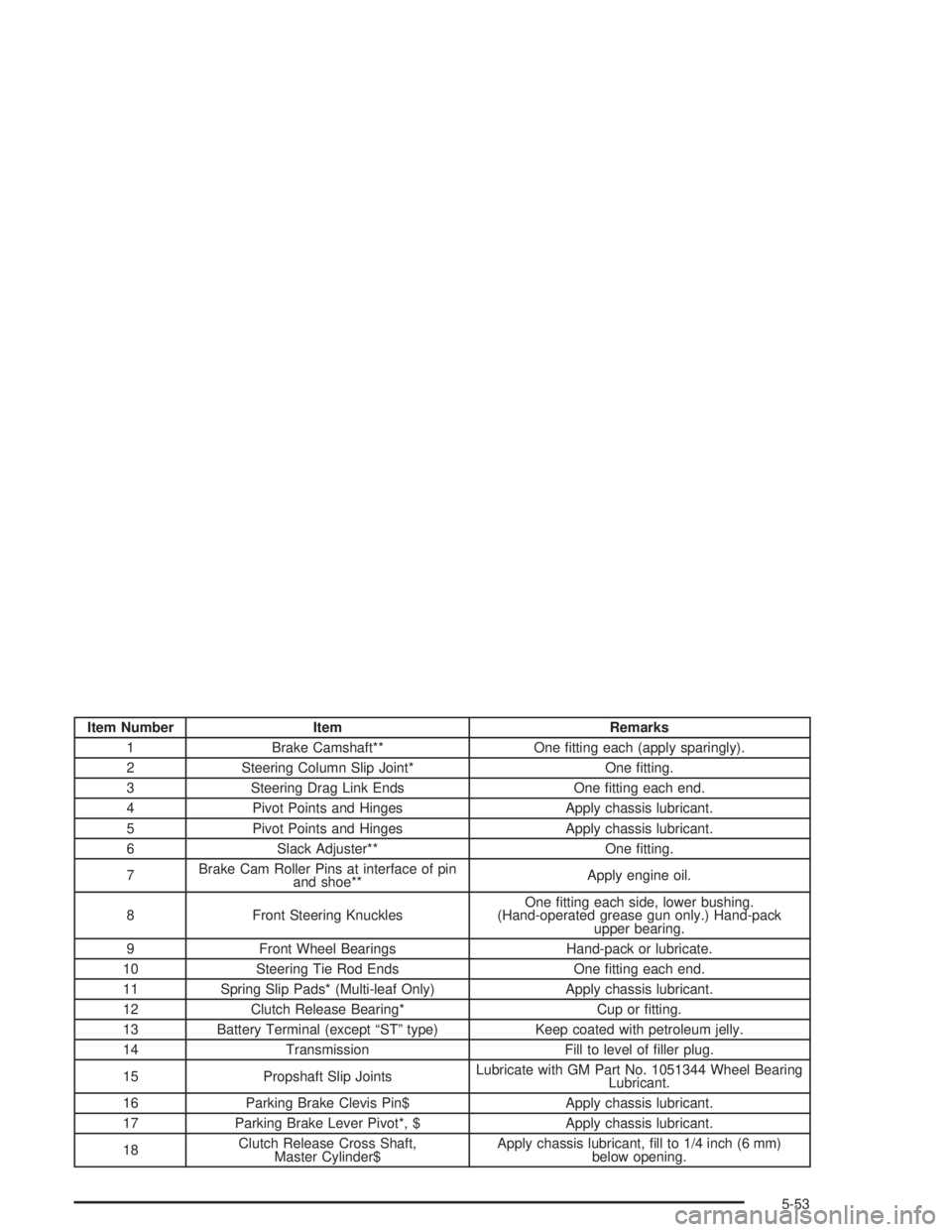
Item Number Item Remarks
1 Brake Camshaft** One fitting each (apply sparingly).
2 Steering Column Slip Joint* One fitting.
3 Steering Drag Link Ends One fitting each end.
4 Pivot Points and Hinges Apply chassis lubricant.
5 Pivot Points and Hinges Apply chassis lubricant.
6 Slack Adjuster** One fitting.
7Brake Cam Roller Pins at interface of pin
and shoe**Apply engine oil.
8 Front Steering KnucklesOne fitting each side, lower bushing.
(Hand-operated grease gun only.) Hand-pack
upper bearing.
9 Front Wheel Bearings Hand-pack or lubricate.
10 Steering Tie Rod Ends One fitting each end.
11 Spring Slip Pads* (Multi-leaf Only) Apply chassis lubricant.
12 Clutch Release Bearing* Cup or fitting.
13 Battery Terminal (except “ST” type) Keep coated with petroleum jelly.
14 Transmission Fill to level of filler plug.
15 Propshaft Slip JointsLubricate with GM Part No. 1051344 Wheel Bearing
Lubricant.
16 Parking Brake Clevis Pin$ Apply chassis lubricant.
17 Parking Brake Lever Pivot*, $ Apply chassis lubricant.
18Clutch Release Cross Shaft,
Master Cylinder$Apply chassis lubricant, fill to 1/4 inch (6 mm)
below opening.
5-53
Page 277 of 366
Proper front wheel alignment must be maintained in
order to ensure efficient steering, good directional
stability, and prevent abnormal tire wear. If you notice
unusual tire wear or your vehicle is pulling one way
or the other, the alignment may need to be reset. If you
notice your vehicle vibrating when driving on a smooth
road, your wheels may need to be balanced.
Tightening the Wheel Nuts
{CAUTION:
Wheel nuts that are not tight can work loose. If
all the nuts on a wheel come off, the wheel can
come off the vehicle, causing a crash. All
wheel nuts must be properly tightened. Follow
the rules in this section to be sure they are.
This section lets you know how often to check the
tightness of the wheel nuts on your vehicle and how tight
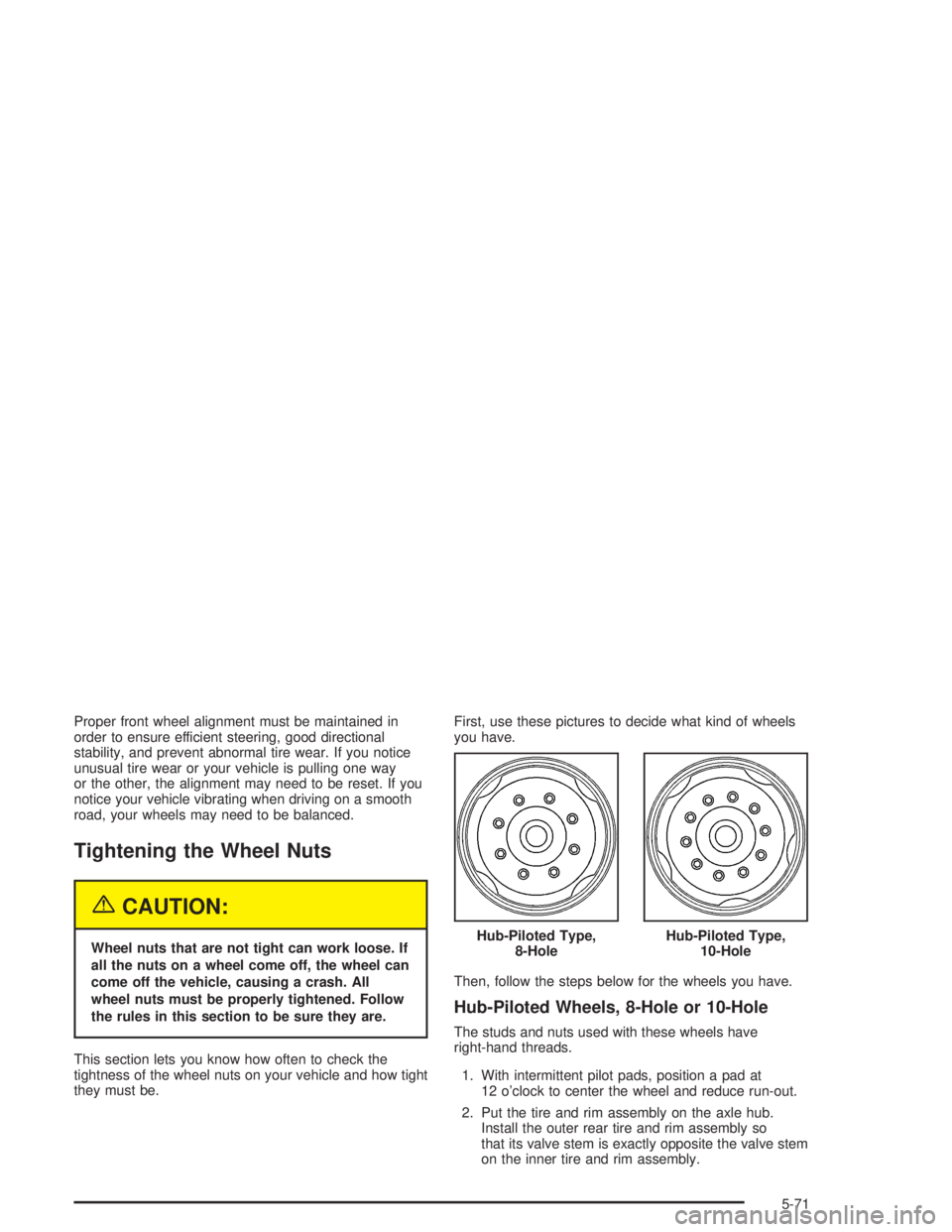
they must be.First, use these pictures to decide what kind of wheels
you have.
Then, follow the steps below for the wheels you have.
Hub-Piloted Wheels, 8-Hole or 10-Hole
The studs and nuts used with these wheels have
right-hand threads.
1. With intermittent pilot pads, position a pad at
12 o’clock to center the wheel and reduce run-out.
2. Put the tire and rim assembly on the axle hub.
Install the outer rear tire and rim assembly so
that its valve stem is exactly opposite the valve stem
on the inner tire and rim assembly. Hub-Piloted Type,
8-Hole
Hub-Piloted Type,
10-Hole
5-71
Page 281 of 366
Used Replacement Wheels
{CAUTION:
Putting a used wheel on your vehicle is
dangerous. You can’t know how it’s been used
or how far it’s been driven. It could fail
suddenly and cause a crash. If you have to
replace a wheel, use a new GM original
equipment wheel.
If a Tire Goes Flat
It’s unusual for a tire to “blow out” while you’re driving,
especially if you maintain your tires properly. If air
goes out of a tire, it’s much more likely to leak out
slowly. But if you should ever have a “blow out,” here
are a few tips about what to expect and what to do:
If a front tire fails, the flat tire will create a drag that pulls
the vehicle toward that side. Take your foot off the
accelerator pedal and grip the steering wheel firmly.
Steer to maintain lane position, and then gently brake to
a stop well out of the traffic lane.
A rear blowout, particularly on a curve, acts much like a
skid and may require the same correction you’d use
in a skid. In any rear blowout, remove your foot from the
accelerator pedal. Get the vehicle under control by
steering the way you want the vehicle to go. It may be
very bumpy and noisy, but you can still steer. Gently
brake to a stop –– well off the road if possible.
If a tire goes flat, avoid further tire and wheel damage
by driving slowly to a level place and turn on your
hazard warning flashers. The next part tells you what
to do.
5-75
Page 307 of 366
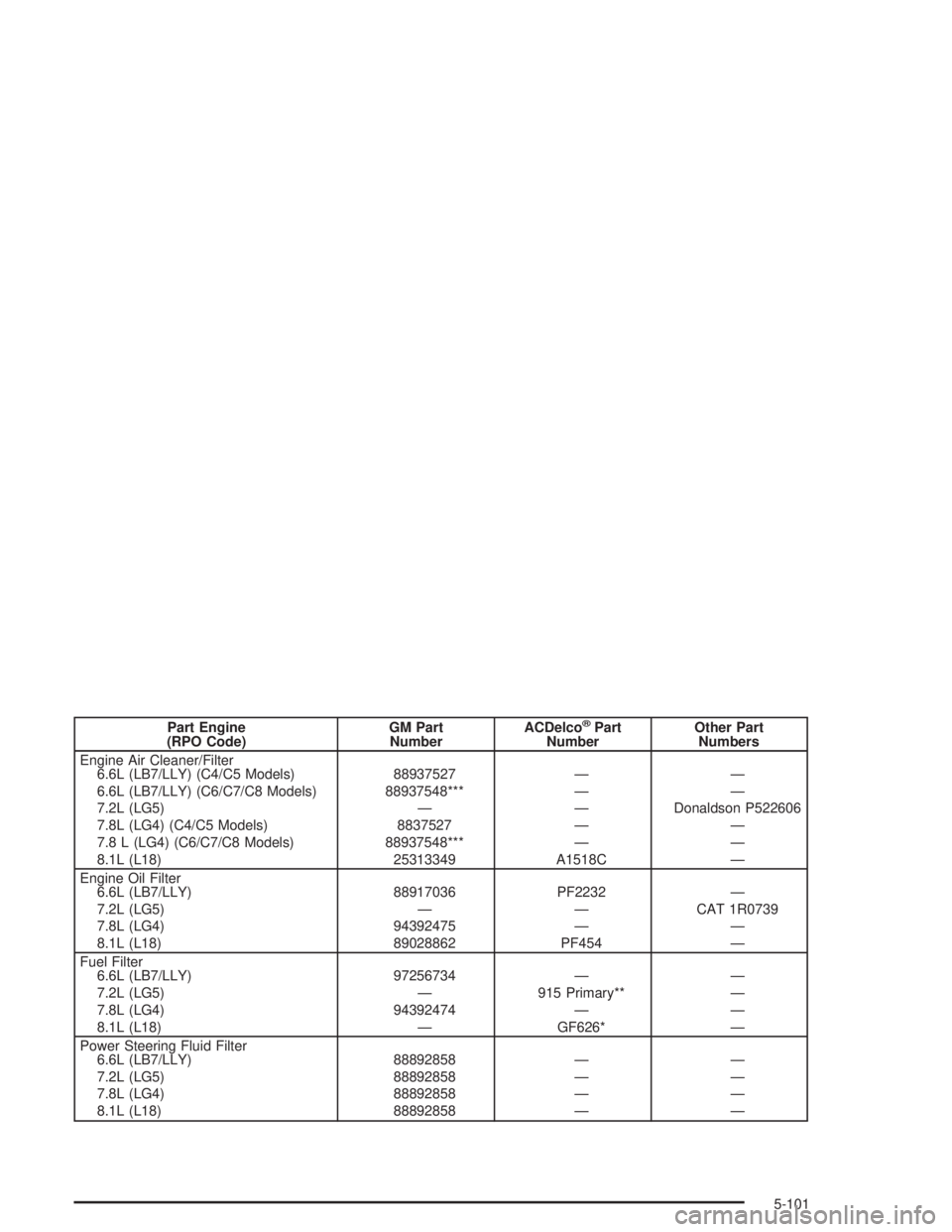
Part Engine
(RPO Code)GM Part
NumberACDelco®Part
NumberOther Part
Numbers
Engine Air Cleaner/Filter
6.6L (LB7/LLY) (C4/C5 Models)
6.6L (LB7/LLY) (C6/C7/C8 Models)
7.2L (LG5)
7.8L (LG4) (C4/C5 Models)
7.8 L (LG4) (C6/C7/C8 Models)
8.1L (L18)88937527
88937548***
—
8837527
88937548***
25313349—
—
—
—
—
A1518C—
—
Donaldson P522606
—
—
—
Engine Oil Filter
6.6L (LB7/LLY)
7.2L (LG5)
7.8L (LG4)
8.1L (L18)88917036
—
94392475
89028862PF2232
—
—
PF454—
CAT 1R0739
—
—
Fuel Filter
6.6L (LB7/LLY)
7.2L (LG5)
7.8L (LG4)
8.1L (L18)97256734
—
94392474
——
915 Primary**
—
GF626*—
—
—
—
Power Steering Fluid Filter
6.6L (LB7/LLY)
7.2L (LG5)
7.8L (LG4)
8.1L (L18)88892858
88892858
88892858
88892858—
—
—
——
—
—
—
5-101
Page 316 of 366
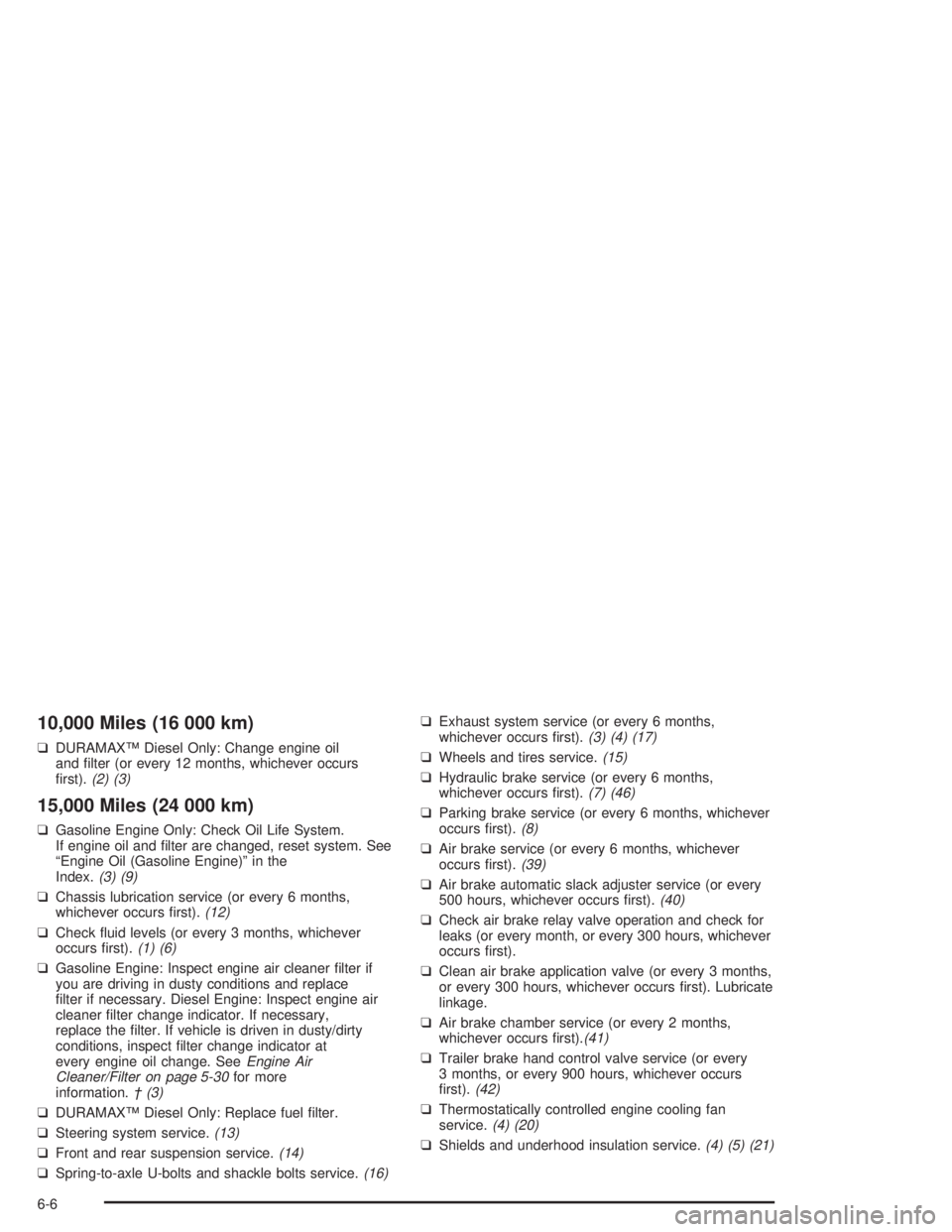
10,000 Miles (16 000 km)
❑DURAMAX™ Diesel Only: Change engine oil
and filter (or every 12 months, whichever occurs
first).(2) (3)
15,000 Miles (24 000 km)
❑Gasoline Engine Only: Check Oil Life System.
If engine oil and filter are changed, reset system. See
“Engine Oil (Gasoline Engine)” in the
Index.(3) (9)
❑Chassis lubrication service (or every 6 months,
whichever occurs first).(12)
❑Check fluid levels (or every 3 months, whichever
occurs first).(1) (6)
❑Gasoline Engine: Inspect engine air cleaner filter if
you are driving in dusty conditions and replace
filter if necessary. Diesel Engine: Inspect engine air
cleaner filter change indicator. If necessary,
replace the filter. If vehicle is driven in dusty/dirty
conditions, inspect filter change indicator at
every engine oil change. SeeEngine Air
Cleaner/Filter on page 5-30for more
information.† (3)
❑DURAMAX™ Diesel Only: Replace fuel filter.
❑Steering system service.(13)
❑Front and rear suspension service.(14)
❑Spring-to-axle U-bolts and shackle bolts service.(16)❑Exhaust system service (or every 6 months,
whichever occurs first).(3) (4) (17)
❑Wheels and tires service.(15)
❑Hydraulic brake service (or every 6 months,
whichever occurs first).(7) (46)
❑Parking brake service (or every 6 months, whichever
occurs first).(8)
❑Air brake service (or every 6 months, whichever
occurs first).(39)
❑Air brake automatic slack adjuster service (or every
500 hours, whichever occurs first).(40)
❑Check air brake relay valve operation and check for
leaks (or every month, or every 300 hours, whichever
occurs first).
❑Clean air brake application valve (or every 3 months,
or every 300 hours, whichever occurs first). Lubricate
linkage.
❑Air brake chamber service (or every 2 months,
whichever occurs first).(41)
❑Trailer brake hand control valve service (or every
3 months, or every 900 hours, whichever occurs
first).(42)
❑Thermostatically controlled engine cooling fan
service.(4) (20)
❑Shields and underhood insulation service.(4) (5) (21)
6-6