ignition CHEVROLET KODIAK 2004 Service Manual
[x] Cancel search | Manufacturer: CHEVROLET, Model Year: 2004, Model line: KODIAK, Model: CHEVROLET KODIAK 2004Pages: 366, PDF Size: 6.87 MB
Page 168 of 366
The cut tape detection feature of your cassette tape
player may identify the cleaning cassette as a damaged
tape. To prevent the cleaning cassette from being
ejected, use the following steps:
1. Turn the ignition on.
2. Turn the radio off.
3. Press and hold the TAPE button for two seconds
until the radio produces one beep. CAS will flash
on the display for five seconds.
4. Insert the scrubbing action cleaning cassette.
5. Eject the cleaning cassette after the manufacturer’s
recommended cleaning time.
After the cleaning cassette is ejected, the cut tape
detection feature will be active again.You may also choose a non-scrubbing action, wet-type
cleaner which uses a cassette with a fabric belt to
clean the tape head. This type of cleaning cassette will
not eject on its own. A non-scrubbing action cleaner
may not clean as thoroughly as the scrubbing type
cleaner. The use of a non-scrubbing action, dry-type
cleaning cassette is not recommended.
After you clean the player, press and hold the eject
button for three seconds to reset the CLN indicator. The
radio will display --- to show the indicator was reset.
Cassettes are subject to wear and the sound quality may
degrade over time. Always make sure the cassette
tape is in good condition before you have your
tape player serviced.
3-58
Page 169 of 366
Care of Your CDs
Handle CDs carefully. Store them in their original cases
or other protective cases and away from direct
sunlight and dust. If the surface of a CD is soiled,
dampen a clean, soft cloth in a mild, neutral detergent
solution and clean it, wiping from the center to the edge.
Be sure never to touch the side without writing when
handling CDs. Pick up CDs by grasping the outer edges
or the edge of the hole and the outer edge.
Care of Your CD Player
The use of CD lens cleaners for CDs is not advised,
due to the risk of contaminating the lens of the CD optics
with lubricants internal to the CD mechanism.
Fixed Mast Antenna
The fixed mast antenna can withstand most car washes
without being damaged. If the mast should ever
become slightly bent, you can straighten it out by hand.
If the mast is badly bent, you should replace it.
Check occasionally to be sure the mast is still tightened
to the fender. If tightening is required, tighten by
hand, then with a wrench one quarter turn.
Chime Level Adjustment
The radio is the vehicle chime producer. The chime is
produced from the driver’s side front door speakers.
To change the volume level, press and hold
pushbutton 6 with the ignition on and the radio power
off. The chime volume level will change from the normal
level to loud, and HI will be displayed on the radio.
To change back to the default or normal setting, press
and hold pushbutton 6 again. The chime level will
change from the loud level to normal, and LO will be
displayed. Each time the chime volume is changed,
three chimes will sound as an example of the new
volume selected. Removing the radio and not replacing
it with a factory radio or chime module will disable
vehicle chimes.
3-59
Page 194 of 366
Here are some tips that can make your drive through
steep country safer:
•Keep the vehicle in good shape. Check all fluid
levels and also the brakes, tires, cooling system
and transmission. These parts can work hard
on mountain roads.
•Know how to go down hills. The most important
thing to know is this: let your engine do some of
the slowing down. Shift to a lower gear when you go
down a steep or long hill.
{CAUTION:
If you do not shift down, your brakes could get
so hot that they would not work well. You
would then have poor braking or even none
going down a hill. You could crash. Shift down
to let your engine assist your brakes on a
steep downhill slope.
{CAUTION:
Coasting downhill in NEUTRAL (N) or with the
ignition off is dangerous. Your brakes will have
to do all the work of slowing down. They could
get so hot that they would not work well. You
would then have poor braking or even none
going down a hill. You could crash. Always
have your engine running and your vehicle in
gear when you go downhill.
•Know how to go uphill. Use lower gears. They help
cool your engine and transmission, and you can
climb the hill better.
•Stay in your own lane when driving on two-lane
roads in hills or mountains. Do not swing wide
or cut across the center of the road. Drive at speeds
that let you stay in your own lane.
•As you go over the top of a hill, be alert. There
could be something in your lane, like a stalled car or
an accident.
•You may se highway signs on mountains that warn
of special problems. Examples are long grades,
passing or no-passing zones, a falling rocks area,
winding roads and special truck lanes. Be alert
to these and take appropriate action.
4-24
Page 221 of 366
Running Out of Fuel
If the diesel engine stalls and you think that you’ve run
out of fuel, do this:
{CAUTION:
Diesel fuel is ammable. It could start a re if
it gets on hot engine parts. You could be
burned. Do not let too much fuel ow from the
air bleed valve, and wipe up any spilled fuel
with a cloth.
To restart your engine:
1. If you’re parked on a level surface, add at least
two gallons of fuel. However, if you’re parked on
a slope, you may need to add up to five gallons
of fuel.
2. Follow the fuel priming procedure earlier in this
section to prime the fuel filter.
3. Close the air bleed valve.4. Turn the ignition key to START for 10 to
15 seconds at a time until your engine starts. If the
engine tries to run, but does not run smoothly,
increase the rpm a little using the accelerator pedal.
This will help force air through the system.
Fuel Filter Replacement
If you want to change the diesel engine fuel filter
yourself, here’s how to do it:
{CAUTION:
Diesel fuel is ammable. It could start a re if
something ignites it, and you could be burned.
Do not let it get on hot engine parts, and keep
matches or other ignition sources away.
First, drain any water from the filter following the
procedure for draining water listed previously.
Your vehicle’s engine should be off until the end of this
procedure.
5-15
Page 230 of 366
When to Change Engine Oil (GM Oil
Life System)
Your vehicle has a computer system that lets you know
when to change the engine oil and filter. This is
based on engine revolutions and engine temperature,
and not on mileage. Based on driving conditions,
the mileage at which an oil change will be indicated can
vary considerably. For the oil life system to work
properly, you must reset the system every time the oil is
changed.
When the system has calculated that oil life has been
diminished, it will indicate that an oil change is
necessary. A change engine oil light will come on.
Change your oil as soon as possible within the next two
times you stop for fuel. It is possible that, if you are
driving under the best conditions, the oil life system may
not indicate that an oil change is necessary for over a
year. However, your engine oil and filter must be
changed at least once a year and at this time the system
must be reset. Your dealer has GM-trained service
people who will perform this work using genuine GM
parts and reset the system. It is also important to check
your oil regularly and keep it at the proper level.
If the system is ever reset accidentally, you must change
your oil at 3,000 miles (5 000 km) since your last oil
change. Remember to reset the oil life system whenever
the oil is changed.
How to Reset the Change Engine Oil Light
The GM Oil Life System calculates when to change
your engine oil and filter based on vehicle use. Anytime
your oil is changed, reset the system so it can
calculate when the next oil change is required. If a
situation occurs where you change your oil prior to a
change engine oil light being turned on, reset the
system.
To reset the change engine oil light, do the following:
1. Turn the ignition key to RUN with the engine off.
2. Fully press and release the accelerator pedal slowly
three times within 10 seconds.
If the change engine oil light flashes for five
seconds, the system is resetting.
3. Turn the key to OFF.
If the change engine oil light comes back on when you
start your vehicle, the engine oil life system has not
reset. Repeat the procedure.
5-24
Page 253 of 366
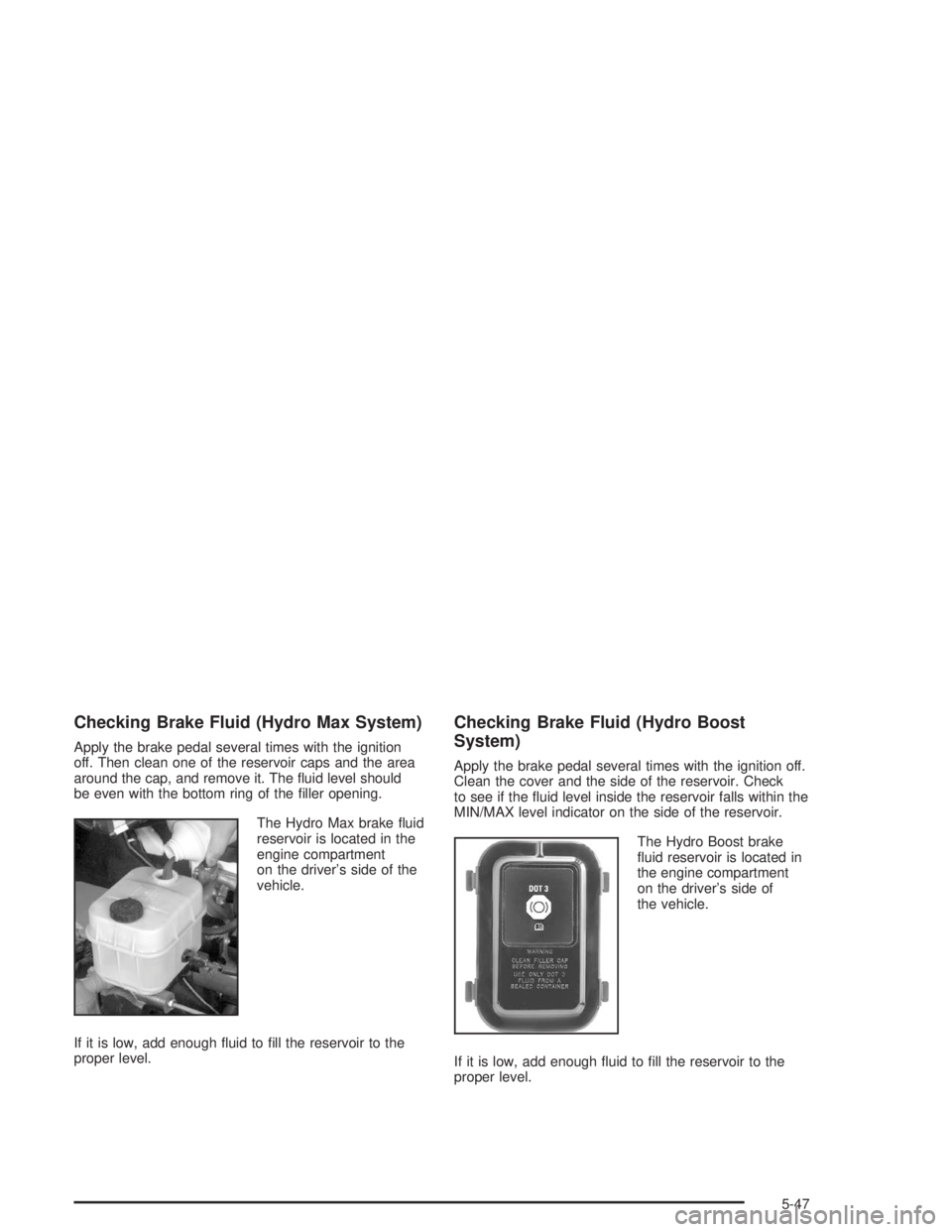
Checking Brake Fluid (Hydro Max System)
Apply the brake pedal several times with the ignition
off. Then clean one of the reservoir caps and the area
around the cap, and remove it. The fluid level should
be even with the bottom ring of the filler opening.
The Hydro Max brake fluid
reservoir is located in the
engine compartment
on the driver’s side of the
vehicle.
If it is low, add enough fluid to fill the reservoir to the
proper level.
Checking Brake Fluid (Hydro Boost
System)
Apply the brake pedal several times with the ignition off.
Clean the cover and the side of the reservoir. Check
to see if the fluid level inside the reservoir falls within the
MIN/MAX level indicator on the side of the reservoir.
The Hydro Boost brake
fluid reservoir is located in
the engine compartment
on the driver’s side of
the vehicle.
If it is low, add enough fluid to fill the reservoir to the
proper level.
5-47
Page 263 of 366
3. Turn off the ignition on both vehicles. Unplug
unnecessary accessories plugged into the cigarette
lighter or accessory power outlets. Turn off the
radio and all lamps that aren’t needed. This
will avoid sparks and help save both batteries, and
it could save your radio!
4. Open the hood of the other vehicle and locate the
battery. Find the positive (+) and negative (−)
terminals on that battery.
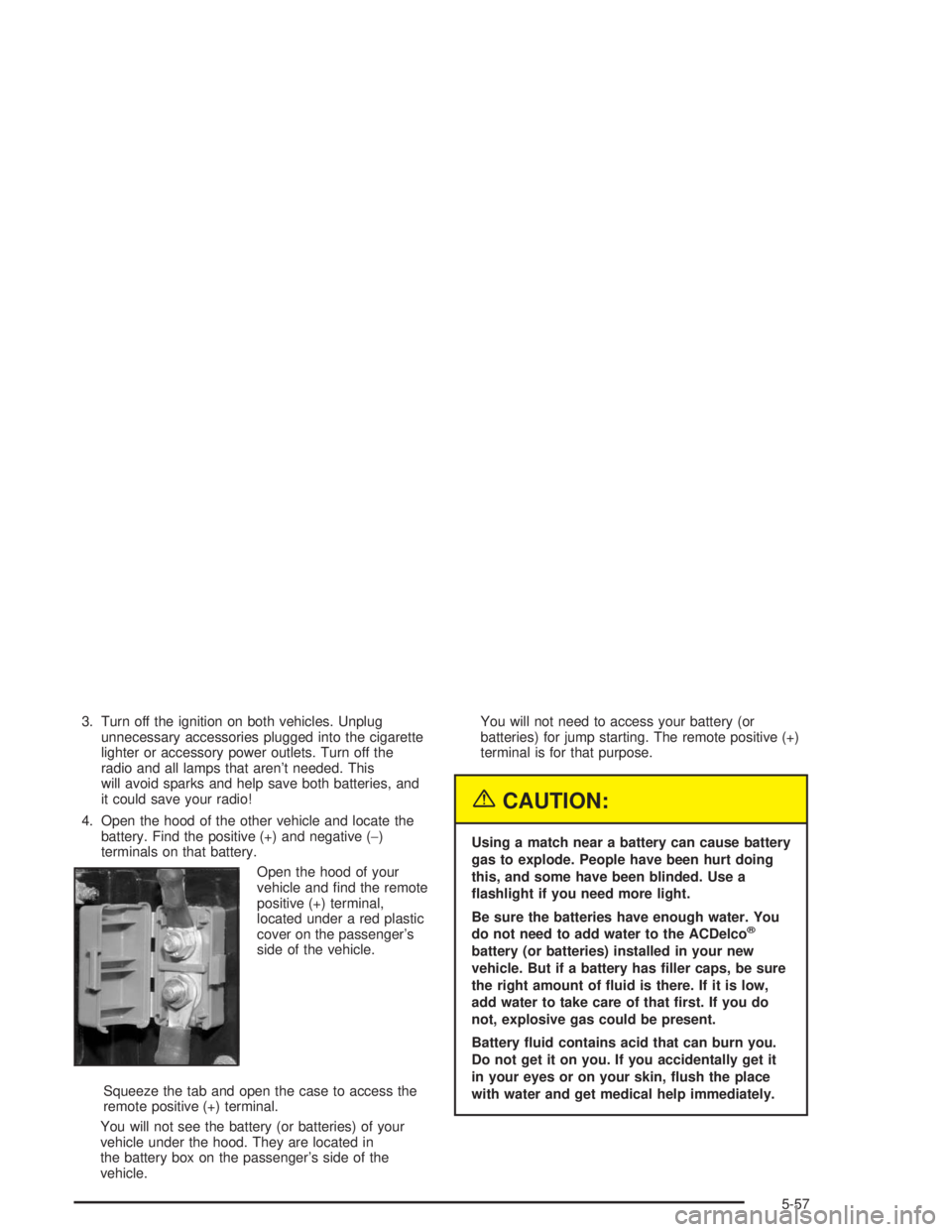
Open the hood of your
vehicle and find the remote
positive (+) terminal,
located under a red plastic
cover on the passenger’s
side of the vehicle.
Squeeze the tab and open the case to access the
remote positive (+) terminal.
You will not see the battery (or batteries) of your
vehicle under the hood. They are located in
the battery box on the passenger’s side of the
vehicle.You will not need to access your battery (or
batteries) for jump starting. The remote positive (+)
terminal is for that purpose.
{CAUTION:
Using a match near a battery can cause battery
gas to explode. People have been hurt doing
this, and some have been blinded. Use a
ashlight if you need more light.
Be sure the batteries have enough water. You
do not need to add water to the ACDelco
®
battery (or batteries) installed in your new
vehicle. But if a battery has ller caps, be sure
the right amount of uid is there. If it is low,
add water to take care of that rst. If you do
not, explosive gas could be present.
Battery uid contains acid that can burn you.
Do not get it on you. If you accidentally get it
in your eyes or on your skin, ush the place
with water and get medical help immediately.
5-57
Page 295 of 366
Fuse Usage
RH PARK LP Right-hand Parking Lamps
LH PARK LP Left-hand Parking Lamps
RADIO U Radio
PWR WINDOW Power Windows
BRAKE ISO Brake Warning Lamp
SPARE Spare Fuse
L-RR TRUCK Left Rear Trailer Wiring
SPARE Spare Fuse
SPARE Spare Fuse
SPARE Spare Fuse
R-RR TRUCK Right Rear Trailer Wiring
SPARE Spare Fuse
Relay Usage
BRAKE LAMPC4/C5 Brake Lamps,
C6/C7/C8 Tractor/Trailer Wiring
IGN 4 IgnitionRelay Usage
MARKER LP Sidemarker and Clearance Lamps
HTD FUEL LB7/LG4 Heated Fuel
AIR HTR LG4 Air Heater
ECU MAINTAIN LG4 Electronic Control Unit
DRL Daytime Running Lamps
CHMSL ISO Center High Mounted Stop Lamp
HTD MIRR Heated Mirrors
R-TRN TLR Right Trailer Turn Signal
L-TRN TLR Left Trailer Turn Signal
SPARE Spare Relay
SPARE Spare Relay
SPARE Spare Relay
5-89
Page 296 of 366
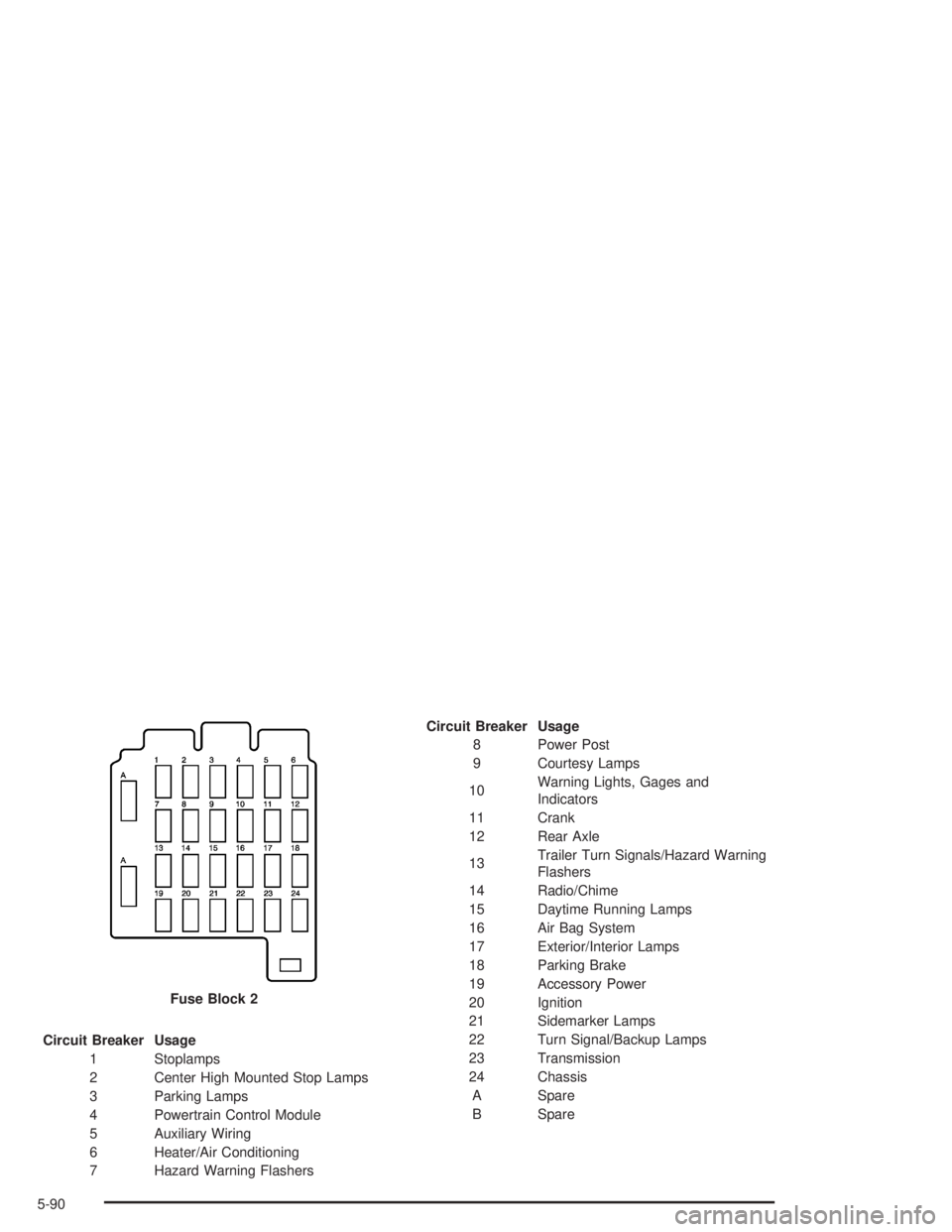
Circuit Breaker Usage
1 Stoplamps
2 Center High Mounted Stop Lamps
3 Parking Lamps
4 Powertrain Control Module
5 Auxiliary Wiring
6 Heater/Air Conditioning
7 Hazard Warning FlashersCircuit Breaker Usage
8 Power Post
9 Courtesy Lamps
10Warning Lights, Gages and
Indicators
11 Crank
12 Rear Axle
13Trailer Turn Signals/Hazard Warning
Flashers
14 Radio/Chime
15 Daytime Running Lamps
16 Air Bag System
17 Exterior/Interior Lamps
18 Parking Brake
19 Accessory Power
20 Ignition
21 Sidemarker Lamps
22 Turn Signal/Backup Lamps
23 Transmission
24 Chassis
A Spare
B Spare Fuse Block 2
5-90
Page 297 of 366
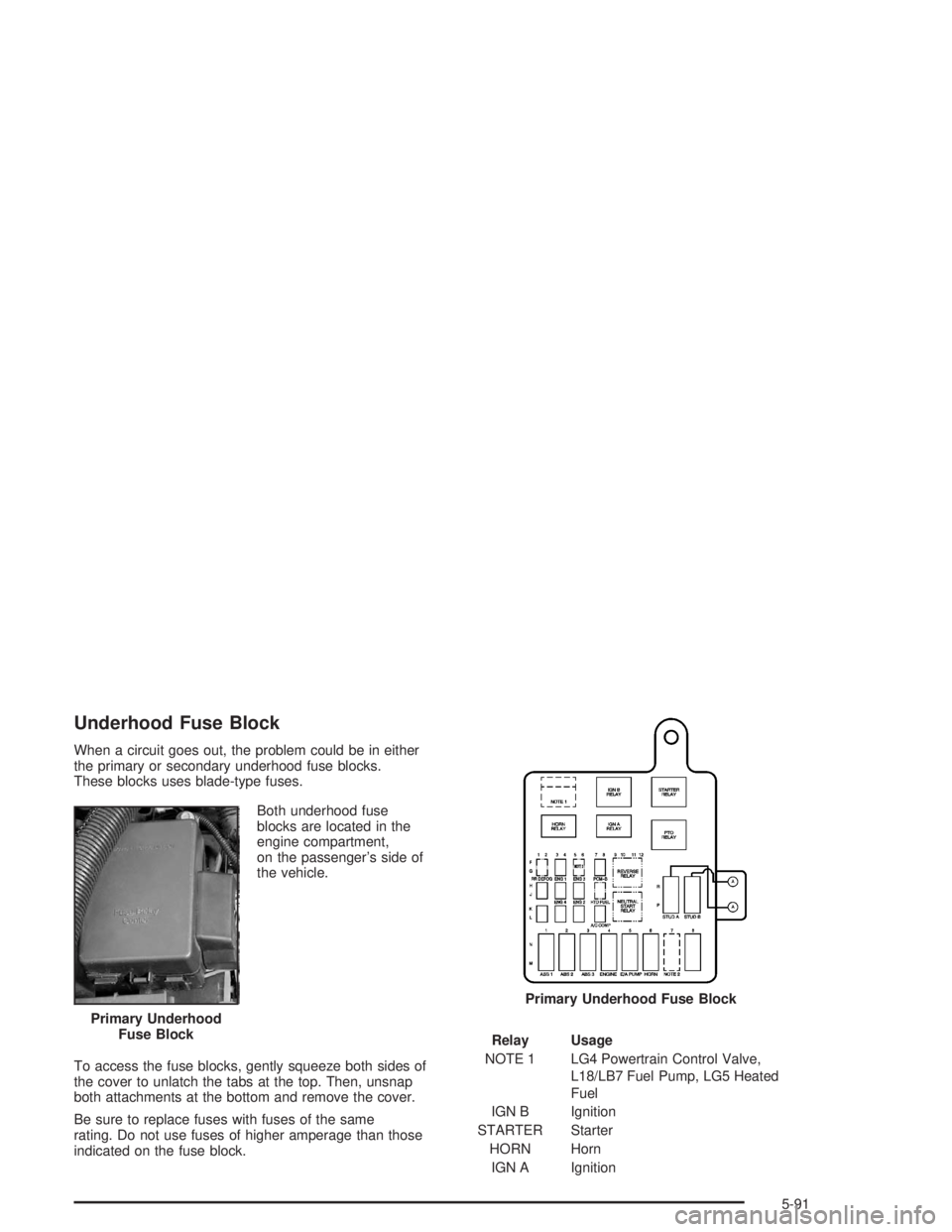
Underhood Fuse Block
When a circuit goes out, the problem could be in either
the primary or secondary underhood fuse blocks.
These blocks uses blade-type fuses.
Both underhood fuse
blocks are located in the
engine compartment,
on the passenger’s side of
the vehicle.
To access the fuse blocks, gently squeeze both sides of
the cover to unlatch the tabs at the top. Then, unsnap
both attachments at the bottom and remove the cover.
Be sure to replace fuses with fuses of the same
rating. Do not use fuses of higher amperage than those
indicated on the fuse block.Relay Usage
NOTE 1 LG4 Powertrain Control Valve,
L18/LB7 Fuel Pump, LG5 Heated
Fuel
IGN B Ignition
STARTER Starter
HORN Horn
IGN A Ignition Primary Underhood
Fuse Block
Primary Underhood Fuse Block
5-91