ignition CHEVROLET KODIAK 2004 User Guide
[x] Cancel search | Manufacturer: CHEVROLET, Model Year: 2004, Model line: KODIAK, Model: CHEVROLET KODIAK 2004Pages: 366, PDF Size: 6.87 MB
Page 83 of 366
Restarting the Diesel Engine While
Moving (Automatic Transmission)
If you have to restart the engine while the vehicle is
moving, you’ll first have to shift the automatic
transmission to NEUTRAL (N). This safety feature
prevents starting the engine when the transmission is in
a drive gear.
Stopping the Diesel Engine
If you have a Caterpillar®diesel engine, see your
Caterpillar®Diesel Engine Operation & Maintenance
Manual.
1. Set the parking brake and shift to NEUTRAL (N) or
PARK (P).
2. Turn the ignition key to OFF.
If your vehicle has a two-speed axle, see
Two-Speed Rear Axle Electric Shift Control on
page 2-26.
Cold Weather Starting
(Caterpillar®Diesel)
Because the diesel engine uses compression ignition, it
is harder to start in cold weather than a gasoline
engine. The air intake heater and use of the proper
engine oil, optional engine coolant heaters and optional
ether injection systems help cold weather starting.
See the Caterpillar
®Diesel Engine Operation &
Maintenance Manual for more information.
Notice:Your diesel engine has an electric air
intake heater system which reduces white smoke
and helps start the engine in cold weather. Do
not spray starting uid into the air intake where it
can contact the heater elements.
If you do not have the GM Automatic Ether Injection
System, do not use starting uid or you could
damage your engine. If you have the GM system,
use only GM approved starting uid that has
been tested to establish compatibility with the air
inlet heater system.
2-15
Page 86 of 366
The manual high idle feature is activated by pressing
the switch on the instrument panel. When the switch is
pressed again, or any of the previous conditions are
not met, manual high idle will be deactivated.
The manual high idle has been preset at the factory.
Your dealer may change the setting to fit your needs.
For vehicles with Caterpillar
®diesel engines, manual
high idle can be used to set any desired high idle speed.
To set a new temporary engine idle speed:
1. Make sure all of the previously described conditions
are met.
2. Press the accelerator pedal to the desired engine
speed.
3. Momentarily press the manual high idle switch.
The temporary high idle speed will be set. This new high
idle rpm level will be remembered by the system until
either the ignition is turned to OFF or a new high
idle speed is set.
Exhaust Restrictor (Diesel Engines)
If your vehicle is equipped with this feature, there is an
exhaust restrictor valve located in the exhaust stream.
The valve closes to provide back pressure to the engine
for the purpose of warming the engine quickly.The exhaust restrictor operates:
•while the engine is running.
•while the vehicle is not moving.
•while the accelerator, brake and clutch pedals are
not pressed.
•while idling or driving in cold temperatures.
•when the shift lever is in NEUTRAL (N) or
PARK (P).
On vehicles equipped with a diesel engine exhaust
brake, the exhaust brake switch must be on. The
indicator in the exhaust brake switch will be lit when the
exhaust restrictor is active. The exhaust brake
indicator light in the center of the instrument panel will
also be lit whenever the exhaust restrictor is active.
When the engine coolant temperature is below 149°F
(65°C) and the outside temperature is below 50°F
(10°C), the exhaust restrictor will come on within
45 seconds of starting the engine. After running the
engine for an additional 45 seconds, the engine idle will
increase.
The exhaust restrictor will shut off and engine idle will
return to normal once the engine is warmed up, or
the transmission is shifted into range.
2-18
Page 87 of 366
Starting Your DURAMAX™ Diesel
Engine
Your diesel engine starts differently than a gasoline
engine.
Automatic Transmission
Move your shift lever to PARK (P) or NEUTRAL (N).
Your engine won’t start in any other position – that’s a
safety feature. To restart when you’re already moving,
use NEUTRAL (N) only.
Notice:Do not try to shift to PARK (P) if your
vehicle is moving. If you do, you could damage the
transmission. Shift to PARK (P) only when your
vehicle is stopped.
Manual Transmission
Move your shift lever to neutral and hold the clutch
pedal to the floor while starting the engine. Your
vehicle won’t start if the clutch pedal is not all the way
down –that’s a safety feature.
Starting Your Engine
1. Turn your ignition key to RUN.
Observe the wait to start light. SeeWait to Start
Indicator on page 3-36. (This light may not come on
if the engine is hot.)
2. As soon as the wait to start light goes off,
IMMEDIATELY turn the ignition key to START.
When the engine starts, let go of the key.
If your vehicle is equipped with the RPO LLY
engine, it has a fast warm-up glow plug system.
The wait to start light will illuminate for a much
shorter time than most diesel engines, due to the
rapid heating of the glow plug system.
Notice:Holding your key in START for longer than
15 seconds at a time will cause your battery to
be drained much sooner. And the excessive heat
can damage your starter motor.
Notice:If the WAIT TO START light stays on, it
means that your vehicle could have one of several
problems, so you should have it serviced right away.
3. If the engine does not start after 15 seconds of
cranking, turn the ignition key to OFF. Wait one
minute for the starter to cool, then try the same
steps again.
2-19
Page 88 of 366
If you’re trying to start your engine after you’ve run out
of fuel, seeRunning Out of Fuel on page 5-15.
When your engine is cold, let it run for a few minutes
before you move your vehicle. This lets oil pressure
build up. Your engine will sound louder when it’s cold.
Notice:If you are not in an idling vehicle and
the engine overheats, you would not be there to see
the overheated engine indication. This could
damage your vehicle. Do not let your engine run
when you are not in your vehicle.
Cold Weather Starting (Diesel Engine)
The following tips will help you get good starting in
cold weather.
Use the recommended engine oil when the outside
temperature drops below freezing. SeeEngine Oil
(Caterpillar
®Diesel Engine) on page 5-20orEngine Oil
(Gasoline Engine) on page 5-20orEngine Oil
(DURAMAX™ Diesel) on page 5-25. When the outside
temperature drops below 0°F (−18°C), use of the
engine coolant heater is recommended.If you experience longer cranking times, notice an
unusual amount of exhaust smoke or are at higher
altitudes (over 7,000 ft. or 2 135 m), you may use your
engine coolant heater. SeeEngine Coolant Heater
on page 2-23.
SeeWhat Fuel to Use on page 5-8for information on
what fuel to use in cold weather.
If Your Diesel Engine Won’t Start
If you’ve run out of fuel, seeRunning Out of Fuel on
page 5-15.
If you’re not out of fuel, and your engine won’t start,
do this:
Turn your ignition key to RUN. IMMEDIATELY after
the wait to start light goes off, turn the ignition key
to START.
If the light doesn’t go off, wait a few seconds, then try
starting your engine again. And, see your dealer as soon
as you can for a starting system check.
If the light comes on and then goes off and you know
your batteries are charged, but your engine still
won’t start, your vehicle needs service.
If the light does not come on when the engine is cold,
your vehicle needs service.
2-20
Page 89 of 366
If your batteries don’t have enough charge to start your
engine, seeBattery on page 5-55.
Be sure you have the right oil for your engine, and that
you’ve changed the oil at the proper times. If you
use the wrong oil, your engine may be harder to start.
Be sure you are using the proper fuel for existing
weather conditions. SeeWhat Fuel to Use on page 5-8.
If the engine starts, runs a short time, then stops,
your vehicle needs service.
{CAUTION:
Do not use gasoline or starting “aids” such as
ether, in the air intake. They could damage
your engine. There could also be a re, which
could cause serious personal injury.
Elevated Idle/Exhaust Restrictor
If your vehicle is equipped with the RPO LLY engine, it
has a cold temperature high idle and exhaust restrictor
feature which elevates the engines idle speed from
680 to 1200 rpms, and restricts the exhaust gas flow,
when outside temperatures are below 41°F (5°C),
and the engine coolant temperature is below
150°F (65°C.)
This feature enhances heater performance by raising
the engine coolant temperature faster. When the vehicle
is started in outside temperatures below 41°F (5°C),
and the engine coolant temperature is below 150°F
(65°C), the engine will idle at 1200 rpms and the
variable nozzle turbocharger will restrict the
exhaust flow.
To turn on this feature:
1. Turn the ignition to the run position, with the
vehicle off.
2. Press the accelerator pedal to the floor and hold
while quickly pressing the brake pedal three times
in less than eight seconds.
3. Release the accelerator pedal and start the engine.
2-21
Page 91 of 366
•If you have air brakes, the dual-needle air pressure
gage should read at least 115 psi (790 kPa) for
both service systems before you try to move
the vehicle. When air pressure is below 60 psi
(420 kPa), the LOW AIR light will come on and you
will hear a tone alarm. If the pressure doesn’t
build up or drops during warm-up, stop the engine
and find the cause before you try to move the
vehicle. Recommended air pressure before actually
driving away is 120 psi (830 kPa).
•The charging system light should come on when
the ignition key is turned to RUN or START and
should go out when the engine is running above
idle. If the light doesn’t go out or comes back
on during normal engine operation, have the
charging system checked right away. (This light
tells you if the generator is not charging; it doesn’t
reflect the condition of the battery.)
•The voltmeter charge indicator gage tells you the
condition of your battery’s charge. The gage
should be in the center area during engine
operation. The red area on the left indicates an
undercharge condition; the red area on the
right indicates an overcharge. If the gage is in
either red area, have the battery and charging
system checked right away.Notice:For diesel engines, don’t allow the engine
to operate at low idle for more than ve minutes.
This can cause low engine operating temperatures
which can affect engine operation and reduce
engine life. Engine idle speed should be increased
to 1200 rpm whenever extended idle is required.
Once started, the engine should be placed under
load to allow the engine coolant temperature
to reach 150°F (66°C) before shutting off the engine.
Engine Coolant Heater
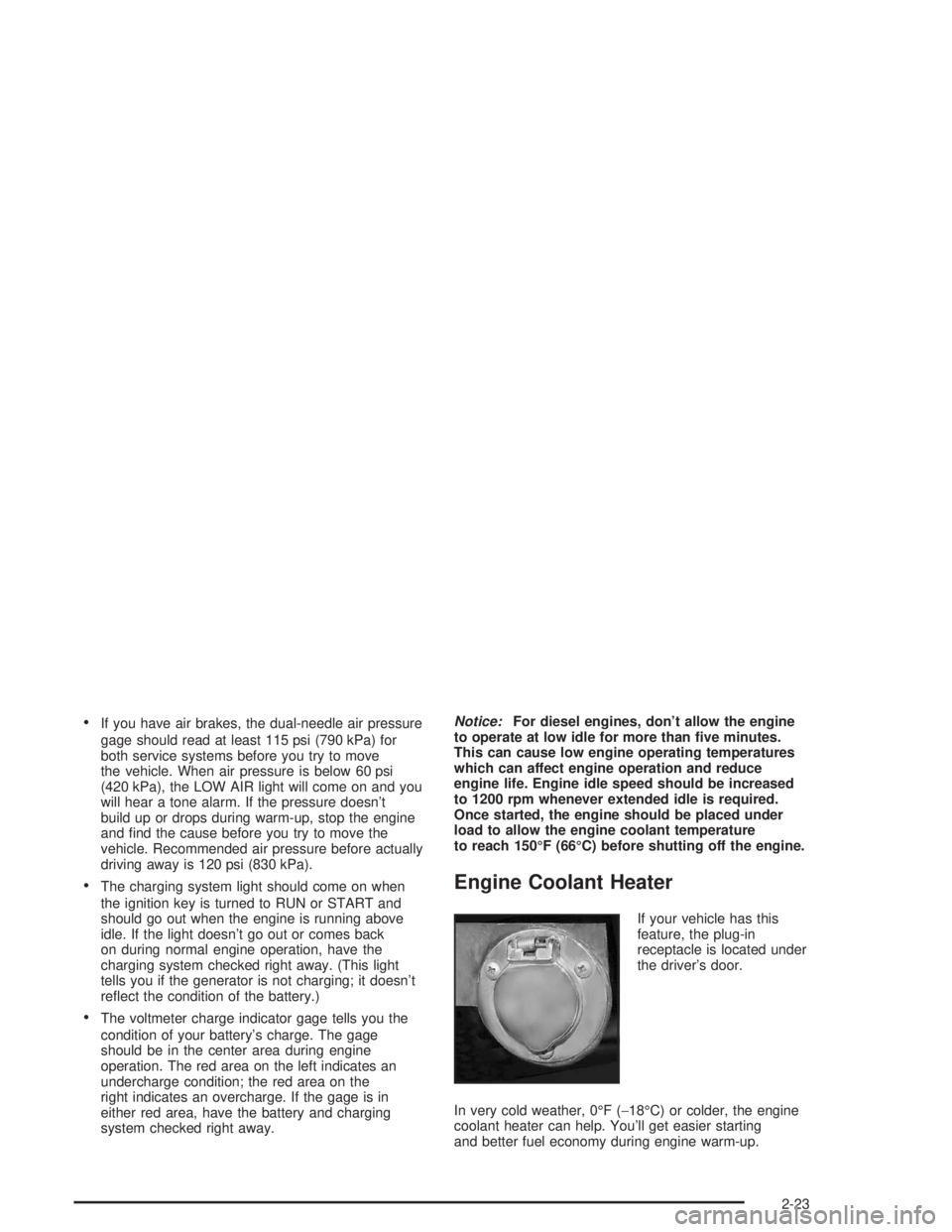
If your vehicle has this
feature, the plug-in
receptacle is located under
the driver’s door.
In very cold weather, 0°F (−18°C) or colder, the engine
coolant heater can help. You’ll get easier starting
and better fuel economy during engine warm-up.
2-23
Page 102 of 366
To set the hand lever parking brake, hold the regular
brake pedal down with your right foot. Pull up on
the handle with your right hand, until it stops.
If the ignition is on when the parking brake is set, the
brake system warning light will come on.
To release the foot pedal parking brake, hold the
regular brake pedal down. Pull the brake release handle,
located just above the parking brake pedal, to release
the parking brake.
To release the hand lever parking brake, hold the
regular brake pedal down and push down on the handle
until it stops.
If the ignition is on when the parking brake is released,
the brake system warning light will go off.
Propshaft Park Brake Burnish
Procedure
It is recommended that the propshaft-mounted parking
brake be burnished as part of the new vehicle
break-in. The parking brake will work best after it has
been burnished following these instructions:
Make 10 stops, using the parking brake hand lever or
foot pedal, from 20 mph (32 km/h) about 2 1/2 miles
(4 km) apart. Between stops, drive the vehicle at 20 mph
(32 km/h) to allow the brake to cool.Notice:Driving with the parking brake on can
damage the transmission and brake system parts.
Verify that the parking brake is fully released and the
brake warning light is off before driving.
Rear Wheel Park Brake Burnish
Procedure
It is recommended that the rear wheel mounted parking
brake be burnished as part of the new vehicle
break-in. The parking brake will work best after it has
been burnished following these instructions:
Make one or two stops using the parking brake hand
lever of foot pedal from 55 mph (92 km/h) to a stop with
moderate apply. Each stop should occur within 1/4 of
a mile.
Notice:Driving with the parking brake on can
overheat the brake system and cause premature
wear or damage to brake system parts. Verify that
the parking brake is fully released and the brake
warning light is off before driving.
2-34
Page 122 of 366
Reducing Speed While Using Cruise
Control
Press in the button at the end of the lever until you
reach the lower speed you want, then release it.
To slow down in very small amounts, tap the button
briefly. Each time you do this, you’ll go 1 mph (1.6 km/h)
slower.
Passing Another Vehicle While Using
Cruise Control
Use the accelerator pedal to increase your speed.
When you take your foot off the pedal, your vehicle will
slow down to the cruise control speed you set earlier.
Using Cruise Control on Hills
How well your cruise control will work on hills depends
upon your speed, load and the steepness of the
hills. When going up steep hills, you may want to step
on the accelerator pedal to maintain your speed.
When going downhill, you may have to brake or shift to
a lower gear to keep your speed down. Of course,
applying the brake or clutch takes you out of cruise
control. Many drivers find this to be too much trouble
and don’t use cruise control on steep hills.
Ending Cruise Control
There are four different ways to turn off the cruise
control:
•Step lightly on the brake pedal (manual and
automatic transmissions).
•Press the clutch pedal to the floor (manual
transmissions).
•Move the cruise switch to off, or
•Shift the transmission to NEUTRAL (N).
Erasing Speed Memory
When you turn off the ignition, your cruise control set
speed memory is erased.
3-12
Page 123 of 366
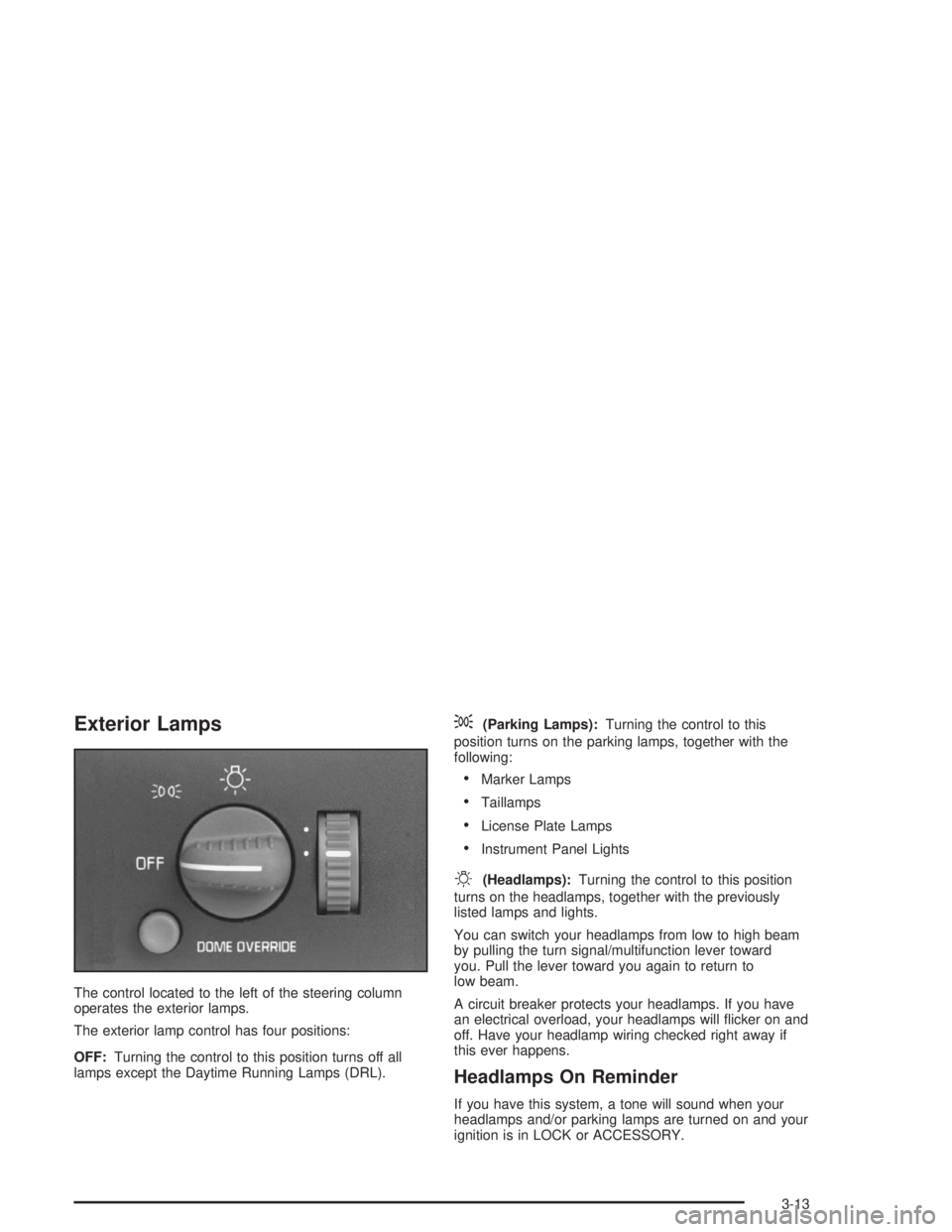
Exterior Lamps
The control located to the left of the steering column
operates the exterior lamps.
The exterior lamp control has four positions:
OFF:Turning the control to this position turns off all
lamps except the Daytime Running Lamps (DRL).
;(Parking Lamps):Turning the control to this
position turns on the parking lamps, together with the
following:
•Marker Lamps
•Taillamps
•License Plate Lamps
•Instrument Panel Lights
O(Headlamps):Turning the control to this position
turns on the headlamps, together with the previously
listed lamps and lights.
You can switch your headlamps from low to high beam
by pulling the turn signal/multifunction lever toward
you. Pull the lever toward you again to return to
low beam.
A circuit breaker protects your headlamps. If you have
an electrical overload, your headlamps will flicker on and
off. Have your headlamp wiring checked right away if
this ever happens.
Headlamps On Reminder
If you have this system, a tone will sound when your
headlamps and/or parking lamps are turned on and your
ignition is in LOCK or ACCESSORY.
3-13
Page 124 of 366

Daytime Running Lamps
Daytime Running Lamps (DRL) can make it easier for
others to see the front of your vehicle during the
day. DRL can be helpful in many different driving
conditions, but they can be especially helpful in the short
periods after dawn and before sunset. Fully functional
daytime running lamps are required on all vehicles
first sold in Canada.
The DRL system will make your headlamps come on at
reduced brightness when the following conditions are met:
•The ignition is on,
•the exterior lamp control is off, and
•the parking brake is released.
When the DRL are on, only your headlamps will be on.
The taillamps, sidemarker and other lamps won’t be
on. Your instrument panel won’t be lit up either.
When it begins to get dark,
your DRL indicator light is
a reminder to turn the
headlamps on. The other
lamps that come on
with your headlamps, will
also come on.
When you turn the headlamps off, the regular lamps will
go off, and your low-beam headlamps will change to
the reduced brightness of DRL.To idle your vehicle with the DRL off, set the parking
brake. The DRL will stay off until you release the
parking brake.
As with any vehicle, you should turn on the regular
headlamp system when you need it.
Marker Lamp Defeat Switch
If your vehicle has this feature, you can manually blink
the marker and clearance lamps.
The marker lamp defeat
switch is located in the
instrument panel
switchbank.
Press and hold the bottom of the switch to turn off the
marker and clearance lamps. When you release
the switch, the marker and clearance lamps will come
back on.
3-14