transmission CHEVROLET KODIAK 2004 Service Manual
[x] Cancel search | Manufacturer: CHEVROLET, Model Year: 2004, Model line: KODIAK, Model: CHEVROLET KODIAK 2004Pages: 366, PDF Size: 6.87 MB
Page 262 of 366
Jump Starting
If your battery (or batteries) has run down, you may
want to use another vehicle and some jumper cables to
start your vehicle. Be sure to follow the steps below
to do it safely.
{CAUTION:
Batteries can hurt you. They can be dangerous
because:
They contain acid that can burn you.
They contain gas that can explode or
ignite.
They contain enough electricity to
burn you.
If you do not follow these steps exactly, some
or all of these things can hurt you.
Notice:Ignoring these steps could result in costly
damage to your vehicle that would not be covered
by your warranty.
Trying to start your vehicle by pushing or pulling it
will not work, and it could damage your vehicle.
1. Check the other vehicle. It must have a 12-volt
battery (or batteries) with a negative ground system.Notice:If the other vehicle’s system is not a 12-volt
system with a negative ground, both vehicles can
be damaged. Only use vehicles with 12-volt systems
with negative grounds to jump start your vehicle.
If you have a diesel engine vehicle with two
batteries (or more), you should know before you
begin that, especially in cold weather, you may not
be able to get enough power from a single
battery in another vehicle to start your diesel engine.
If your vehicle has more than one battery, use the
one closest to the starter – this will reduce electrical
resistance.
2. Get the vehicles close enough so the jumper cables
can reach, but be sure the vehicles aren’t touching
each other. If they are, it could cause a ground
connection you don’t want. You wouldn’t be able to
start your vehicle, and the bad grounding could
damage the electrical systems.
To avoid the possibility of the vehicles rolling, set
the parking brake firmly on both vehicles involved in
the jump start procedure. Put an automatic
transmission in PARK (P) or a manual transmission
in neutral before setting the parking brake.
Notice:If you leave your radio or other accessories
on during the jump starting procedure, they could
be damaged. The repairs would not be covered
by your warranty. Always turn off your radio and
other accessories when jump starting your vehicle.
5-56
Page 296 of 366
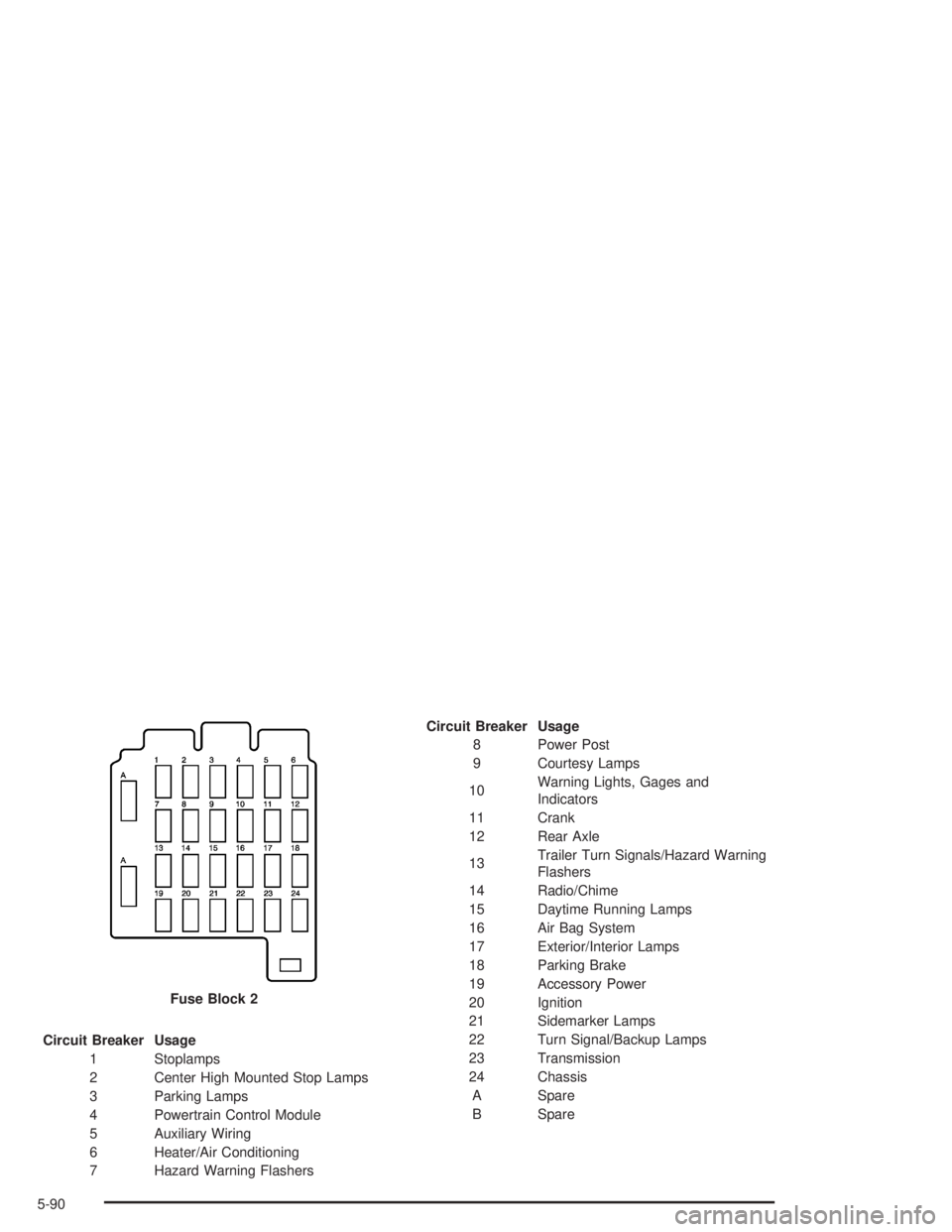
Circuit Breaker Usage
1 Stoplamps
2 Center High Mounted Stop Lamps
3 Parking Lamps
4 Powertrain Control Module
5 Auxiliary Wiring
6 Heater/Air Conditioning
7 Hazard Warning FlashersCircuit Breaker Usage
8 Power Post
9 Courtesy Lamps
10Warning Lights, Gages and
Indicators
11 Crank
12 Rear Axle
13Trailer Turn Signals/Hazard Warning
Flashers
14 Radio/Chime
15 Daytime Running Lamps
16 Air Bag System
17 Exterior/Interior Lamps
18 Parking Brake
19 Accessory Power
20 Ignition
21 Sidemarker Lamps
22 Turn Signal/Backup Lamps
23 Transmission
24 Chassis
A Spare
B Spare Fuse Block 2
5-90
Page 300 of 366
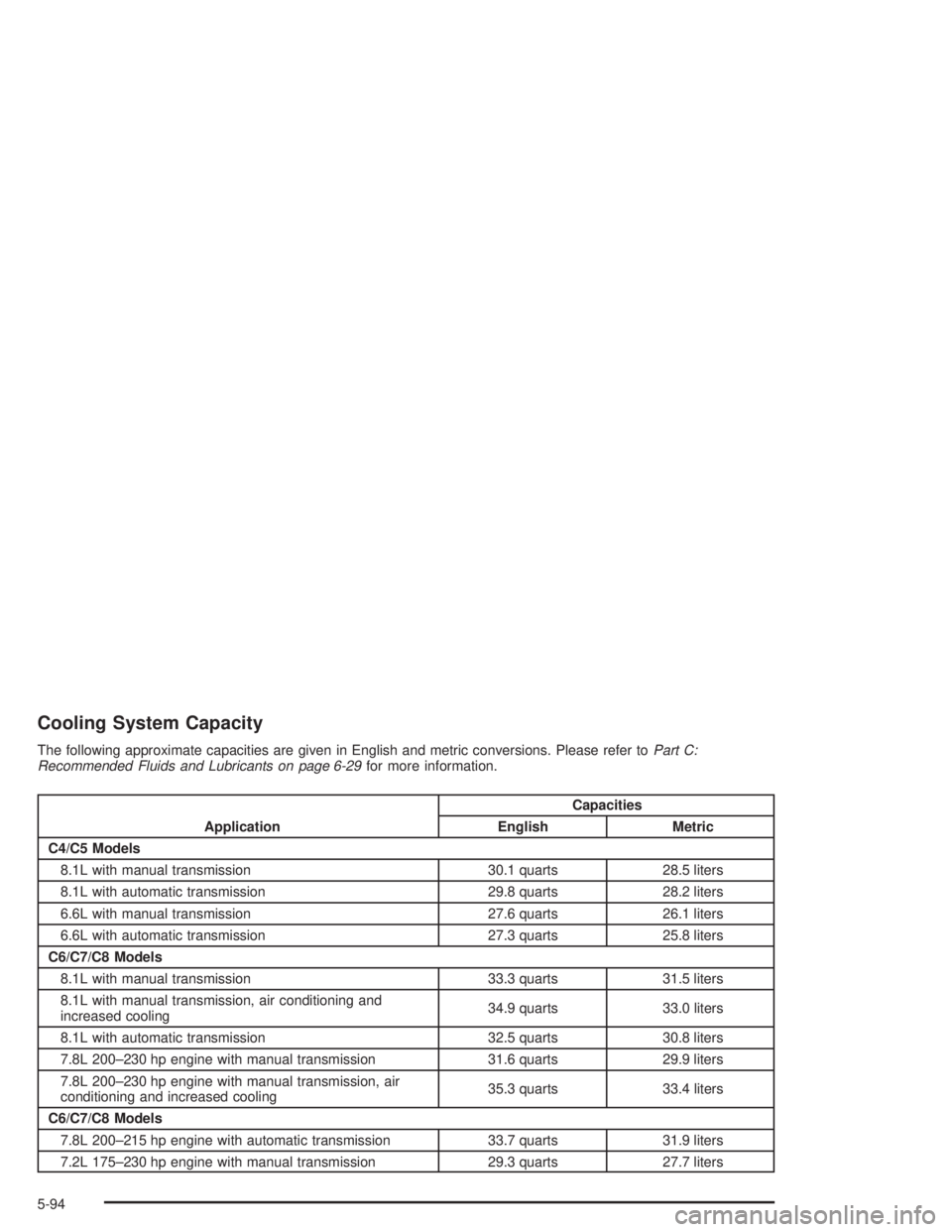
Cooling System Capacity
The following approximate capacities are given in English and metric conversions. Please refer toPart C:
Recommended Fluids and Lubricants on page 6-29for more information.
ApplicationCapacities
English Metric
C4/C5 Models
8.1L with manual transmission 30.1 quarts 28.5 liters
8.1L with automatic transmission 29.8 quarts 28.2 liters
6.6L with manual transmission 27.6 quarts 26.1 liters
6.6L with automatic transmission 27.3 quarts 25.8 liters
C6/C7/C8 Models
8.1L with manual transmission 33.3 quarts 31.5 liters
8.1L with manual transmission, air conditioning and
increased cooling34.9 quarts 33.0 liters
8.1L with automatic transmission 32.5 quarts 30.8 liters
7.8L 200–230 hp engine with manual transmission 31.6 quarts 29.9 liters
7.8L 200–230 hp engine with manual transmission, air
conditioning and increased cooling35.3 quarts 33.4 liters
C6/C7/C8 Models
7.8L 200–215 hp engine with automatic transmission 33.7 quarts 31.9 liters
7.2L 175–230 hp engine with manual transmission 29.3 quarts 27.7 liters
5-94
Page 301 of 366
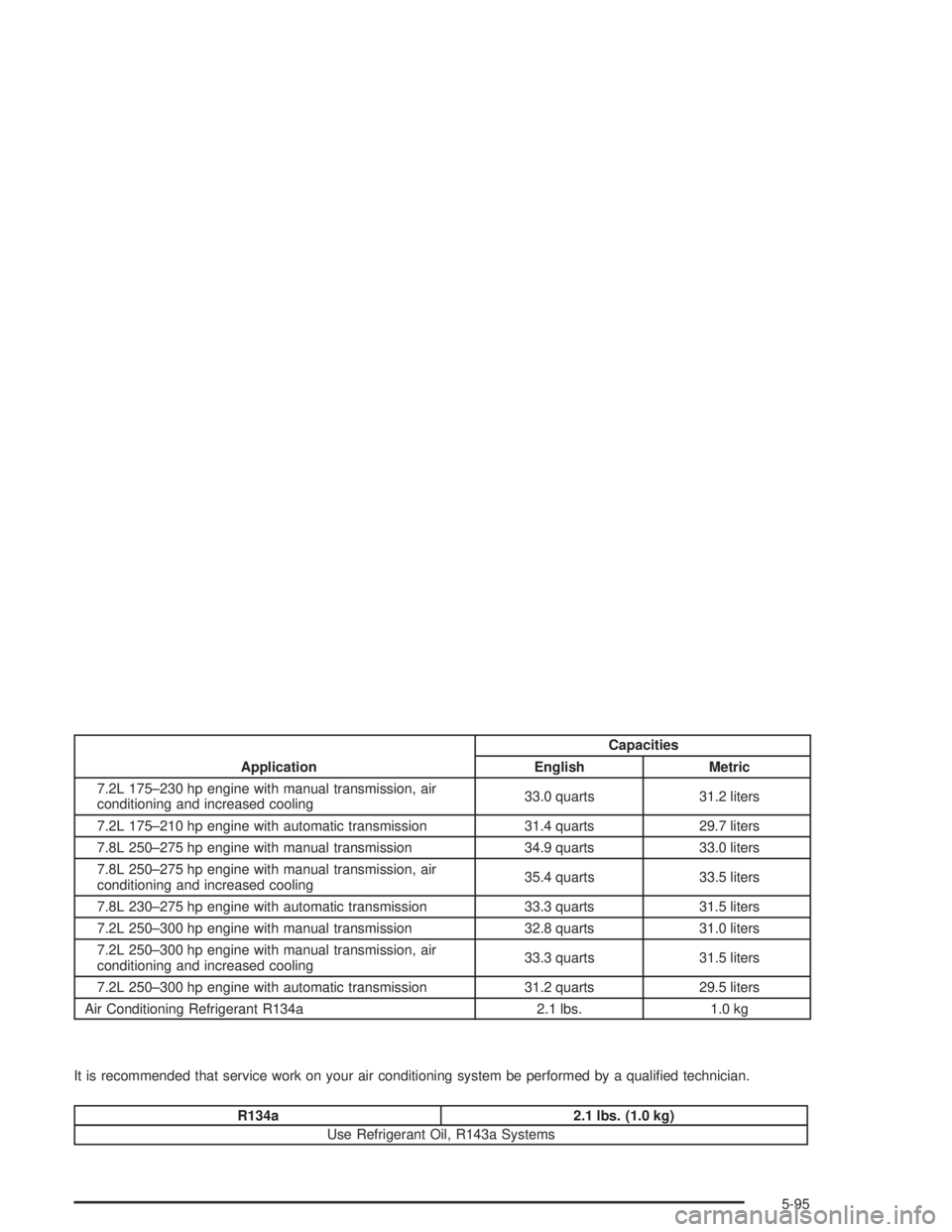
ApplicationCapacities
English Metric
7.2L 175–230 hp engine with manual transmission, air
conditioning and increased cooling33.0 quarts 31.2 liters
7.2L 175–210 hp engine with automatic transmission 31.4 quarts 29.7 liters
7.8L 250–275 hp engine with manual transmission 34.9 quarts 33.0 liters
7.8L 250–275 hp engine with manual transmission, air
conditioning and increased cooling35.4 quarts 33.5 liters
7.8L 230–275 hp engine with automatic transmission 33.3 quarts 31.5 liters
7.2L 250–300 hp engine with manual transmission 32.8 quarts 31.0 liters
7.2L 250–300 hp engine with manual transmission, air
conditioning and increased cooling33.3 quarts 31.5 liters
7.2L 250–300 hp engine with automatic transmission 31.2 quarts 29.5 liters
Air Conditioning Refrigerant R134a 2.1 lbs. 1.0 kg
It is recommended that service work on your air conditioning system be performed by a qualified technician.
R134a 2.1 lbs. (1.0 kg)
Use Refrigerant Oil, R143a Systems
5-95
Page 304 of 366
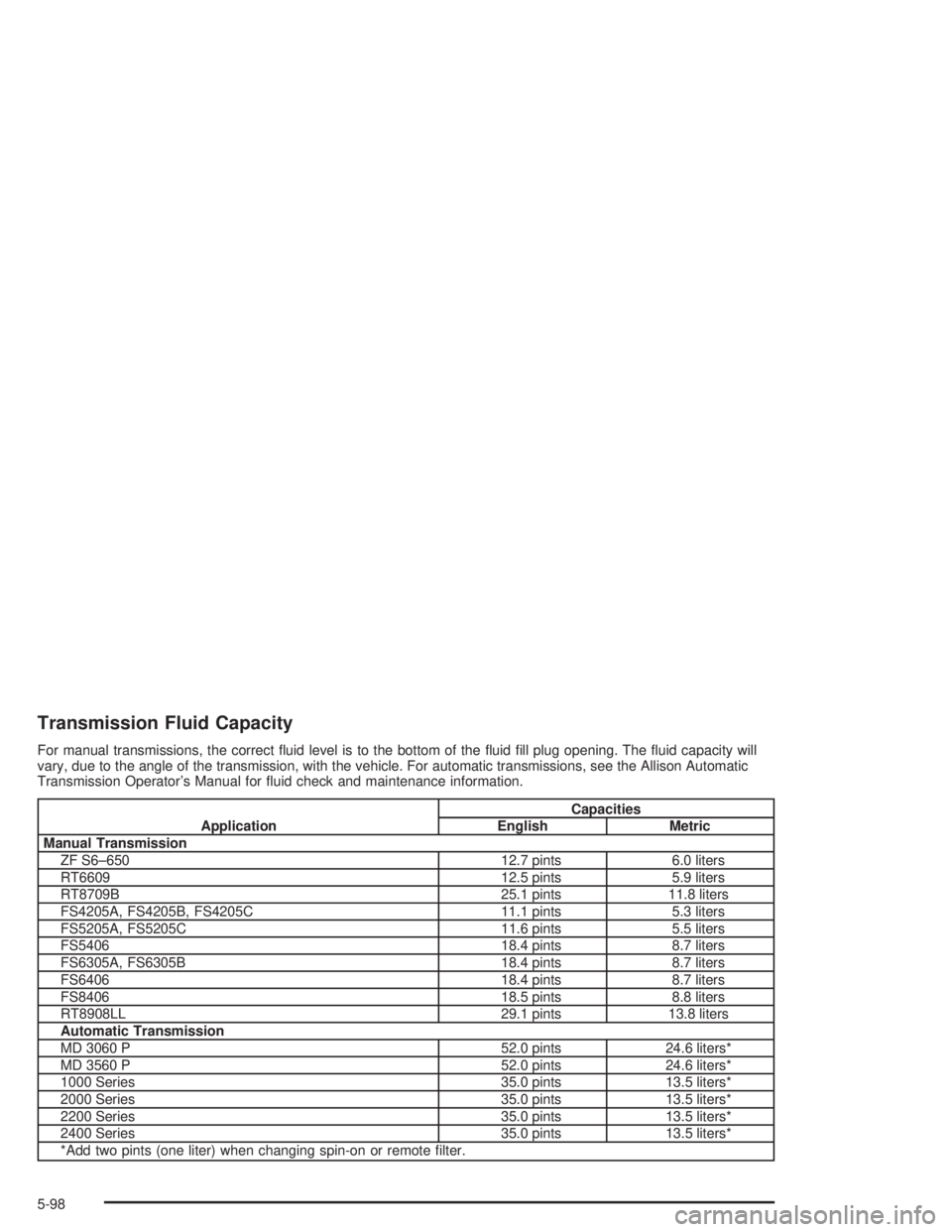
Transmission Fluid Capacity
For manual transmissions, the correct fluid level is to the bottom of the fluid fill plug opening. The fluid capacity will
vary, due to the angle of the transmission, with the vehicle. For automatic transmissions, see the Allison Automatic
Transmission Operator’s Manual for fluid check and maintenance information.
ApplicationCapacities
English Metric
Manual Transmission
ZF S6–650 12.7 pints 6.0 liters
RT6609 12.5 pints 5.9 liters
RT8709B 25.1 pints 11.8 liters
FS4205A, FS4205B, FS4205C 11.1 pints 5.3 liters
FS5205A, FS5205C 11.6 pints 5.5 liters
FS5406 18.4 pints 8.7 liters
FS6305A, FS6305B 18.4 pints 8.7 liters
FS6406 18.4 pints 8.7 liters
FS8406 18.5 pints 8.8 liters
RT8908LL 29.1 pints 13.8 liters
Automatic Transmission
MD 3060 P 52.0 pints 24.6 liters*
MD 3560 P 52.0 pints 24.6 liters*
1000 Series 35.0 pints 13.5 liters*
2000 Series 35.0 pints 13.5 liters*
2200 Series 35.0 pints 13.5 liters*
2400 Series 35.0 pints 13.5 liters*
*Add two pints (one liter) when changing spin-on or remote filter.
5-98
Page 306 of 366
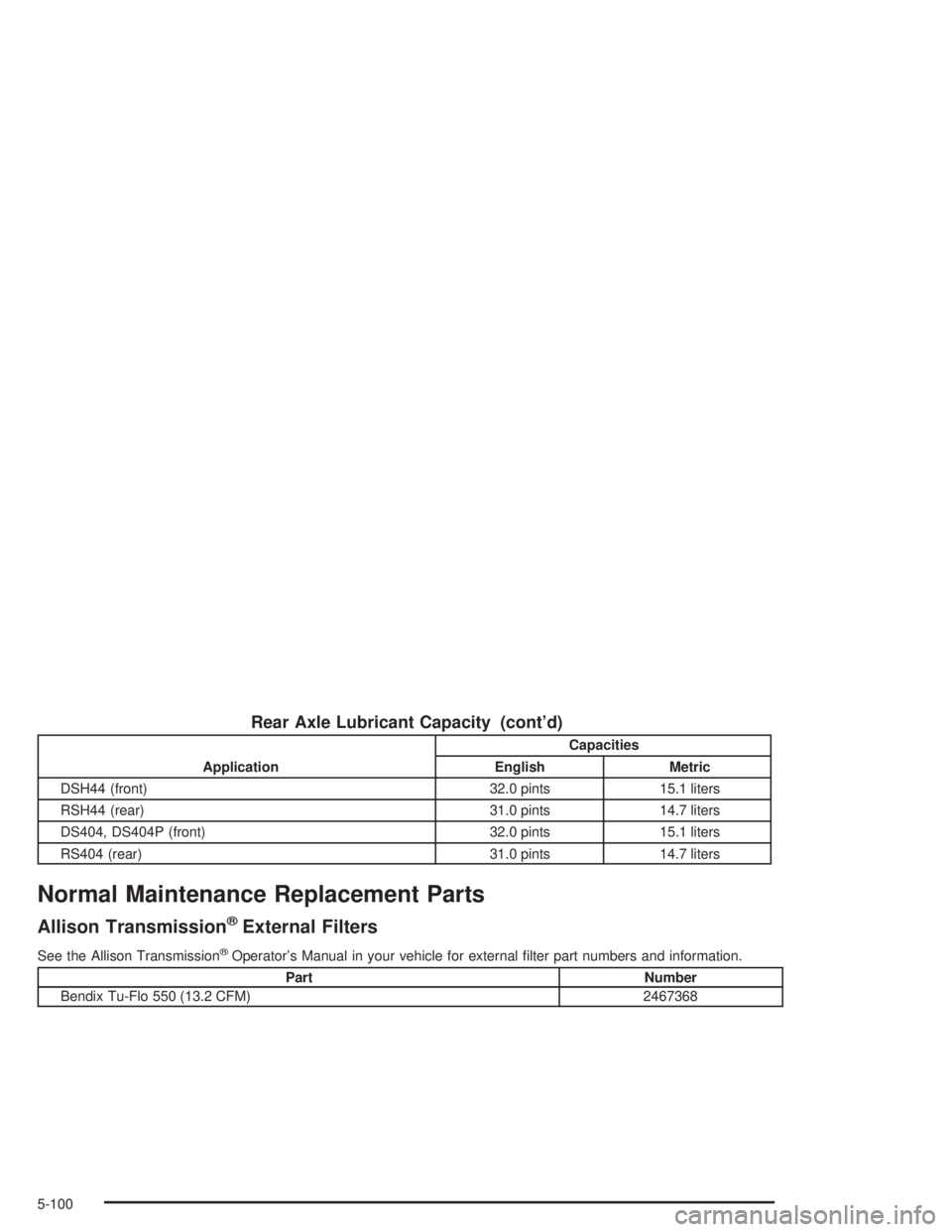
Rear Axle Lubricant Capacity (cont’d)
ApplicationCapacities
English Metric
DSH44 (front) 32.0 pints 15.1 liters
RSH44 (rear) 31.0 pints 14.7 liters
DS404, DS404P (front) 32.0 pints 15.1 liters
RS404 (rear) 31.0 pints 14.7 liters
Normal Maintenance Replacement Parts
Allison Transmission®External Filters
See the Allison Transmission®Operator’s Manual in your vehicle for external filter part numbers and information.
Part Number
Bendix Tu-Flo 550 (13.2 CFM) 2467368
5-100
Page 314 of 366
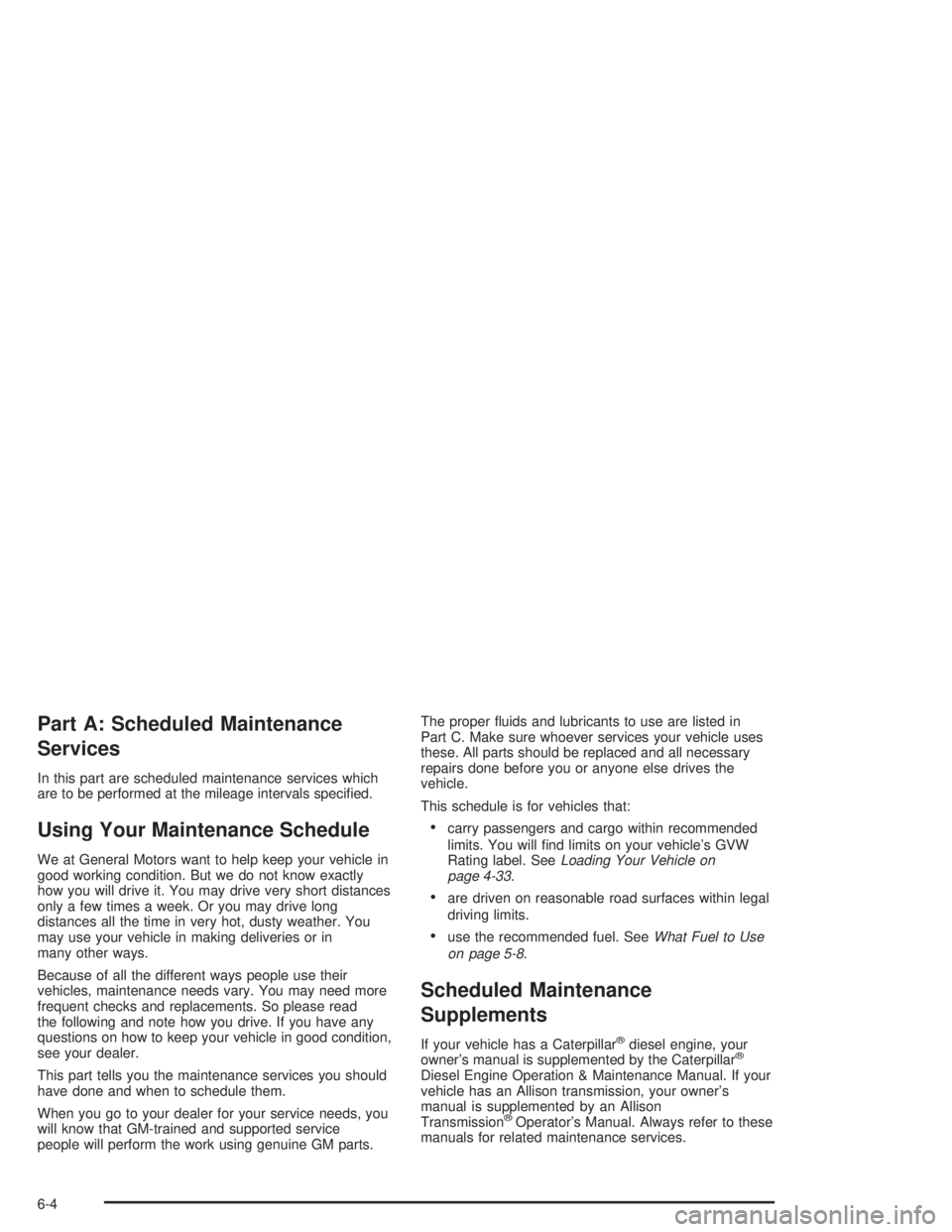
Part A: Scheduled Maintenance
Services
In this part are scheduled maintenance services which
are to be performed at the mileage intervals specified.
Using Your Maintenance Schedule
We at General Motors want to help keep your vehicle in
good working condition. But we do not know exactly
how you will drive it. You may drive very short distances
only a few times a week. Or you may drive long
distances all the time in very hot, dusty weather. You
may use your vehicle in making deliveries or in
many other ways.
Because of all the different ways people use their
vehicles, maintenance needs vary. You may need more
frequent checks and replacements. So please read
the following and note how you drive. If you have any
questions on how to keep your vehicle in good condition,
see your dealer.
This part tells you the maintenance services you should
have done and when to schedule them.
When you go to your dealer for your service needs, you
will know that GM-trained and supported service
people will perform the work using genuine GM parts.The proper fluids and lubricants to use are listed in
Part C. Make sure whoever services your vehicle uses
these. All parts should be replaced and all necessary
repairs done before you or anyone else drives the
vehicle.
This schedule is for vehicles that:
•carry passengers and cargo within recommended
limits. You will find limits on your vehicle’s GVW
Rating label. SeeLoading Your Vehicle on
page 4-33.
•are driven on reasonable road surfaces within legal
driving limits.
•use the recommended fuel. SeeWhat Fuel to Use
on page 5-8.
Scheduled Maintenance
Supplements
If your vehicle has a Caterpillar®diesel engine, your
owner’s manual is supplemented by the Caterpillar®
Diesel Engine Operation & Maintenance Manual. If your
vehicle has an Allison transmission, your owner’s
manual is supplemented by an Allison
Transmission
®Operator’s Manual. Always refer to these
manuals for related maintenance services.
6-4
Page 328 of 366
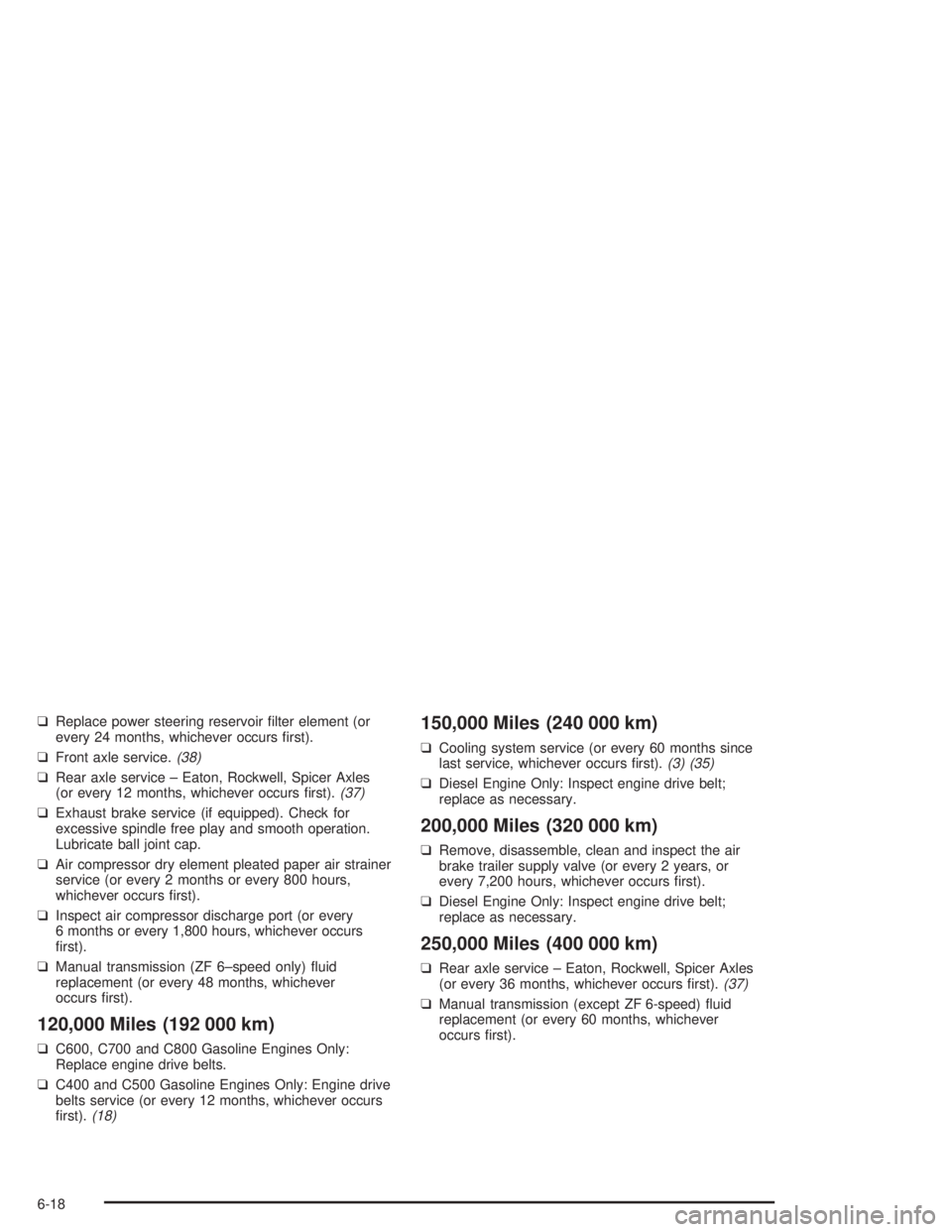
❑Replace power steering reservoir filter element (or
every 24 months, whichever occurs first).
❑Front axle service.(38)
❑Rear axle service – Eaton, Rockwell, Spicer Axles
(or every 12 months, whichever occurs first).(37)
❑Exhaust brake service (if equipped). Check for
excessive spindle free play and smooth operation.
Lubricate ball joint cap.
❑Air compressor dry element pleated paper air strainer
service (or every 2 months or every 800 hours,
whichever occurs first).
❑Inspect air compressor discharge port (or every
6 months or every 1,800 hours, whichever occurs
first).
❑Manual transmission (ZF 6–speed only) fluid
replacement (or every 48 months, whichever
occurs first).
120,000 Miles (192 000 km)
❑C600, C700 and C800 Gasoline Engines Only:
Replace engine drive belts.
❑C400 and C500 Gasoline Engines Only: Engine drive
belts service (or every 12 months, whichever occurs
first).(18)
150,000 Miles (240 000 km)
❑Cooling system service (or every 60 months since
last service, whichever occurs first).(3) (35)
❑Diesel Engine Only: Inspect engine drive belt;
replace as necessary.
200,000 Miles (320 000 km)
❑Remove, disassemble, clean and inspect the air
brake trailer supply valve (or every 2 years, or
every 7,200 hours, whichever occurs first).
❑Diesel Engine Only: Inspect engine drive belt;
replace as necessary.
250,000 Miles (400 000 km)
❑Rear axle service – Eaton, Rockwell, Spicer Axles
(or every 36 months, whichever occurs first).(37)
❑Manual transmission (except ZF 6-speed) fluid
replacement (or every 60 months, whichever
occurs first).
6-18
Page 329 of 366
300,000 Miles (480 000 km)
❑Remove, disassemble, clean and inspect the air
brake air dryer (or every 3 years, or 10,800 hours,
whichever occurs first). Replace desiccant on
Bendix-Westinghouse units.
Footnotes
† = The U.S. Environmental Protection Agency or the
California Air Resources Board has determined that the
failure to perform this maintenance item will not nullify
the emission warranty or limit recall liability prior to
the completion of the vehicle’s useful life. We, however,
urge that all recommended maintenance services be
performed at the indicated intervals and the
maintenance be recorded.
(1)= If your vehicle has an Allison automatic
transmission, your GM owner’s manual is supplemented
by an Allison Transmission
®Operator’s Manual.
Always refer to these manuals for related maintenance
services.
(2)= Refer to the Caterpillar
®Diesel Engine Operation
and Maintenance Manual for oil recommendations
and change intervals.
(3)= An Emission Control Service.
(4)= A Noise Emission Control Device.
(5)= Applies only to vehicles sold in the United States.(6)= Check fluid level in brake master cylinder, power
steering pump, axle, transmission and hydraulic
spring parking brake pump (if equipped). A low fluid
level in the brake master cylinder can indicate
worn brake linings and should be checked accordingly.
(7)= Inspect brake lines and hoses for proper
hook-up, binding, leaks, cracks, chafing, etc. Inspect
disc brake pads for wear and rotors for surface
condition. Inspect caliper assemblies. Check brake
pedal for excessive free play or travel (or every
6 months, whichever occurs first) and have serviced if
needed. Check brakes more often if driving habits
and conditions result in frequent braking.
(8)= Inspect parking brake drum and linings for wear or
cracks and check linkage and adjustment.
(9)= This vehicle has the GM Oil Life System. This
system will show you when to change the engine oil and
filter – usually between 3,000 miles (5 000 km) and
7,500 miles (12 000 km) since your last oil change.
Under severe conditions, the indicator may come on
before 3,000 miles (5 000 km). Never drive your vehicle
more than 7,500 miles (12 000 km) or 12 months
without an oil and filter change.
Remember to reset the Oil Life System whenever the oil
is changed. For more information, seeChange Engine
Oil Light on page 3-39.
6-19
Page 330 of 366
(11)= Inspect rear axle air shift motor for fluid leaks.
Remove plug to check fluid level. Inspect air lines
and hoses for proper hook-up, binding, leaks, etc.
Inspect at 1,000 miles (1 600 km) and 22,500 miles
(36 000 km) and then every 22,500 miles (36 000 km)
thereafter.
(12)= Chassis Lubrication Service: Lubricate all grease
fittings in front suspension, front axle and steering
linkage. DO NOT lubricate kingpin bushings with air
pressure equipment; instead, use a hand grease gun to
ensure complete purge and eliminate sealer cap
distortion. Front axle tie rod ends, both upper and lower
kingpin fittings and both steering linkage relay rod
ends should be greased with the vehicle loaded on the
ground and wheels turned straight ahead, NOT with
the vehicle on a hoist. Apply kingpin bushing lubricant to
both upper and lower kingpin grease fittings until new
lubricant purges from between the upper shim pack and
thrust bearing. Lubricate transmission and shift
linkage, hood latches and hood hinges, parking brake
lever pivot, clevis pins and linkage, disc brake caliper
rails, clutch linkage and release bearing (if equipped),
bearing pads, propshaft universal joints, brake camshaft
bracket, slack adjusters, pedal shaft, clutch cross
shaft, clutch pedal springs and clutch cable bushing at
transmission. Lubricate suspension, axle and steeringlinkage more often when operating under dusty or
muddy conditions and in excessive off-road use.
Frequently power-washed vehicles will require more
frequent lubrication.
(13)= Check steering system:
•Look for damaged, loose or missing parts. Inspect
the steering linkage relay rod and tie rod ends for
looseness or lack of lubricant. Also look for
parts showing signs of wear or lack of lubrication.
Replace parts as needed. Also check steering gear
mounting bolts, pitman arm nut, gear housing
upper cover and side cover attaching bolts, steering
column mounting bolts and cardan joint clamp
bolts; tighten if necessary. (See service manual.)
•Inspect power steering hoses, tubes and fittings for
leaks. Hoses and lines must not be twisted, kinked
or tightly bent. Make sure clips, clamps, supporting
tubes and hoses are in place and properly
secured.
•Check steering gear for leakage around pitman
shaft and housing. If leakage is evident (lubricant
oozing out, not just oily film), leak should be
corrected immediately.
6-20