belt CHEVROLET KODIAK 2004 Workshop Manual
[x] Cancel search | Manufacturer: CHEVROLET, Model Year: 2004, Model line: KODIAK, Model: CHEVROLET KODIAK 2004Pages: 366, PDF Size: 6.87 MB
Page 172 of 366

Your Driving, the Road, and
Your Vehicle
Defensive Driving
The best advice anyone can give about driving is: Drive
defensively.
Please start with a very important safety device in your
vehicle: Buckle up. SeeSafety Belts: They Are for
Everyone on page 1-8.
Defensive driving really means “be ready for anything.”
On city streets, rural roads or freeways, it means
“always expect the unexpected.”
Assume that pedestrians or other drivers are going to
be careless and make mistakes. Anticipate what
they might do. Be ready for their mistakes.
Rear-end collisions are about the most preventable of
accidents. Yet they are common. Allow enough following
distance. It is the best defensive driving maneuver, in
both city and rural driving. You never know when
the vehicle in front of you is going to brake or turn
suddenly.
Defensive driving requires that a driver concentrate on
the driving task. Anything that distracts from the driving
task — such as concentrating on a cellular telephone call,
reading, or reaching for something on the floor — makesproper defensive driving more difficult and can even
cause a collision, with resulting injury. Ask a passenger to
help do things like this, or pull off the road in a safe place
to do them yourself. These simple defensive driving
techniques could save your life.Drunken Driving
Death and injury associated with drinking and driving is
a national tragedy. It is the number one contributor
to the highway death toll, claiming thousands of victims
every year.
Alcohol affects four things that anyone needs to drive a
vehicle:
•Judgment
•Muscular Coordination
•Vision
•Attentiveness.
Police records show that almost half of all motor
vehicle-related deaths involve alcohol. In most cases,
these deaths are the result of someone who was
drinking and driving. In recent years, more than
16,000 annual motor vehicle-related deaths have been
associated with the use of alcohol, with more than
300,000 people injured.
4-2
Page 183 of 366
Steering in Emergencies
There are times when steering can be more effective
than braking. For example, you come over a hill and find
a truck stopped in your lane, or a car suddenly pulls
out from nowhere, or a child darts out from between
parked cars and stops right in front of you. You
can avoid these problems by braking — if you can stop
in time. But sometimes you can not; there is not
room. That is the time for evasive action — steering
around the problem.
Your vehicle can perform very well in emergencies like
these. First apply your brakes.
SeeBraking on page 4-6. It is better to remove as much
speed as you can from a possible collision. Then
steer around the problem, to the left or right depending
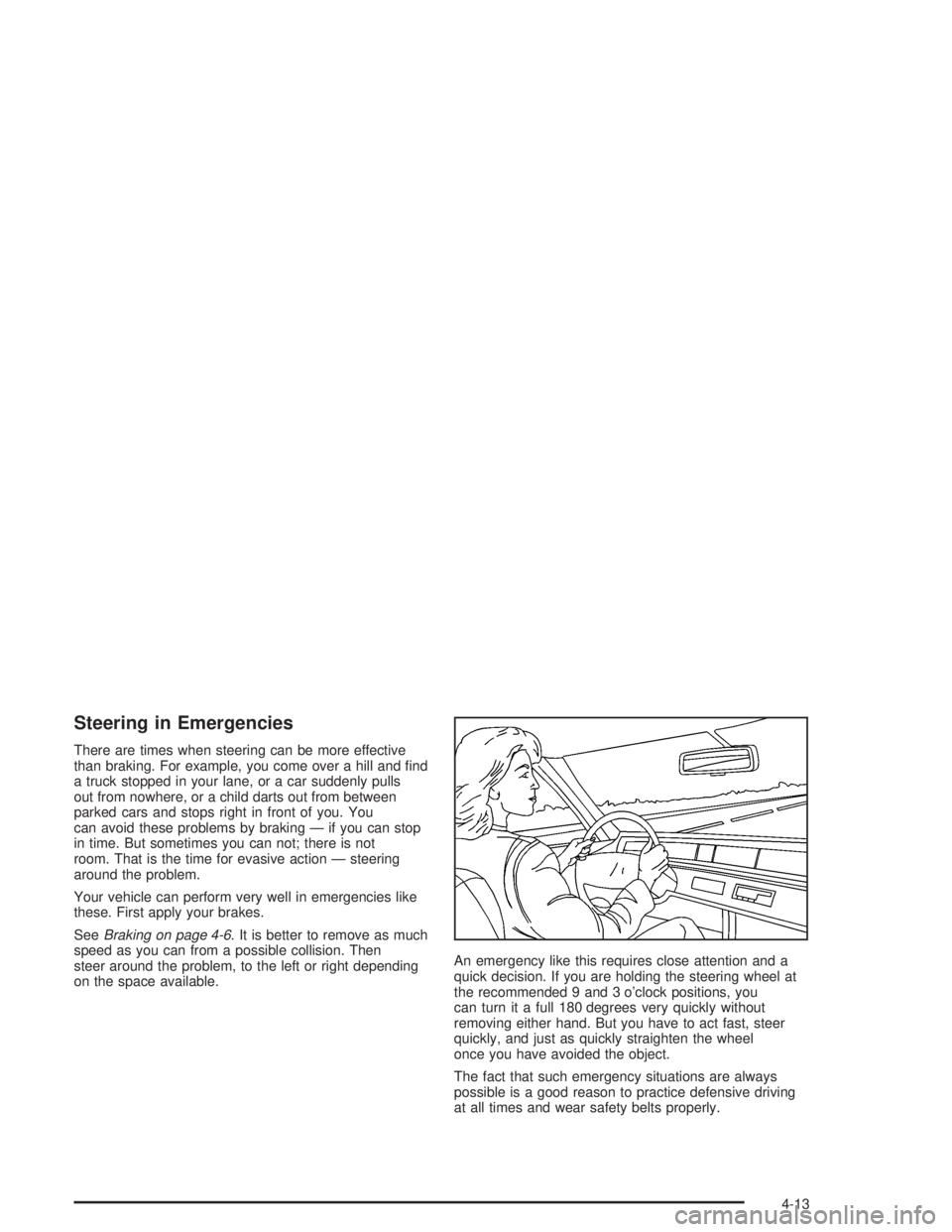
on the space available.An emergency like this requires close attention and a
quick decision. If you are holding the steering wheel at
the recommended 9 and 3 o’clock positions, you
can turn it a full 180 degrees very quickly without
removing either hand. But you have to act fast, steer
quickly, and just as quickly straighten the wheel
once you have avoided the object.
The fact that such emergency situations are always
possible is a good reason to practice defensive driving
at all times and wear safety belts properly.
4-13
Page 208 of 366
Automatic Ether Injection System....................5-66
Front Wheel Bearings with Oil-Filled Hubs........5-67
Air Conditioning System.................................5-67
Tires..............................................................5-68
Inflation - Tire Pressure.................................5-68
Rims and Wheels.........................................5-69
Dual Tire Operation.......................................5-69
When It Is Time for New Tires.......................5-70
Wheel Alignment and Tire Balance..................5-70
Tightening the Wheel Nuts.............................5-71
Wheel Replacement......................................5-74
If a Tire Goes Flat........................................5-75
Changing a Flat Tire.....................................5-76
Appearance Care............................................5-76
Cleaning the Inside of Your Vehicle.................5-77
Care of Safety Belts......................................5-79
Weatherstrips...............................................5-79
Cleaning the Outside of Your Vehicle..............5-80
Sheet Metal Damage.....................................5-82Finish Damage.............................................5-83
Underbody Maintenance................................5-83
Chemical Paint Spotting.................................5-83
Vehicle Care/Appearance Materials..................5-84
Vehicle Identication......................................5-85
Vehicle Identification Number (VIN).................5-85
Service Statement.........................................5-85
Service Parts Identification Label.....................5-86
Electrical System............................................5-86
Add-On Electrical Equipment..........................5-86
Headlamp Wiring..........................................5-86
Windshield Wiper Fuses................................5-87
Fusible Links................................................5-87
Power Windows and Other Power Options.......5-87
Fuses and Circuit Breakers............................5-87
Capacities and Specications..........................5-93
Normal Maintenance Replacement Parts.........5-100
Engine Drive Belt Routing............................5-103
Section 5 Service and Appearance Care
5-2
Page 276 of 366
SeeTightening the Wheel Nuts on page 5-71for wheel
nut tightening information and proper torque values.
{CAUTION:
If you operate your vehicle with a tire that is
badly underinated, the tire can overheat. An
overheated tire can lose air suddenly or catch
re. You or others could be injured. Be sure all
tires (including the spare, if any) are properly
inated.
SeeTires on page 5-68andInation - Tire Pressure on
page 5-68for more information on proper tire inflation.
When It Is Time for New Tires
Replace your tires when the tread depth is down to
1/8 of an inch (3.2 mm) for the front tires, or 1/16 of an
inch (1.6 mm) for a rear tire. Also, you need a new
tire if:
•You can see cord or fabric showing through the
tire’s rubber.
•The tread or sidewall is cracked, cut or snagged
deep enough to show cord or fabric.
•The tire has a bump, bulge or split.
•The tire has a puncture, cut or other damage that
can’t be repaired well because of the size or
location of the damage.
{CAUTION:
Mixing tires could cause you to lose control
while driving. If you mix tires of different
types — like radial and bias-belted tires — the
vehicle may not handle properly, and you
could have a crash. Be sure to use the same
type of tires all around.
When you replace tires, make sure they are the same
size, load range, speed rating and construction type
(bias, bias-belted or radial) as your original tires.
Wheel Alignment and Tire Balance
The wheels on your vehicle were aligned at the
factory to give you the longest tire life and best overall
performance.
5-70
Page 285 of 366
Cleaning the Top of the
Instrument Panel
Use only mild soap and water to clean the top surfaces
of the instrument panel. Sprays containing silicones
or waxes may cause annoying reflections in the
windshield and even make it difficult to see through the
windshield under certain conditions.
Cleaning Interior Plastic Components
Use only a mild soap and water solution on a soft cloth
or sponge. Commercial cleaners may affect the
surface finish.
Cleaning Glass Surfaces
Glass should be cleaned often. GM Glass Cleaner or a
liquid household glass cleaner will remove normal
tobacco smoke and dust films on interior glass. See
Vehicle Care/Appearance Materials on page 5-84.
Notice:If you use abrasive cleaners when cleaning
glass surfaces on your vehicle, you could scratch
the glass and/or cause damage to the rear window
defogger and the integrated radio antenna. When
cleaning the glass on your vehicle, use only a soft
cloth and glass cleaner.
Care of Safety Belts
Keep belts clean and dry.
{CAUTION:
Do not bleach or dye safety belts. If you do, it
may severely weaken them. In a crash, they
might not be able to provide adequate
protection. Clean safety belts only with mild
soap and lukewarm water.
Weatherstrips
Silicone grease on weatherstrips will make them last
longer, seal better, and not stick or squeak. Apply
silicone grease with a clean cloth at least every six
months. During very cold, damp weather more frequent
application may be required. SeePart C: Recommended
Fluids and Lubricants on page 6-29.
5-79
Page 309 of 366
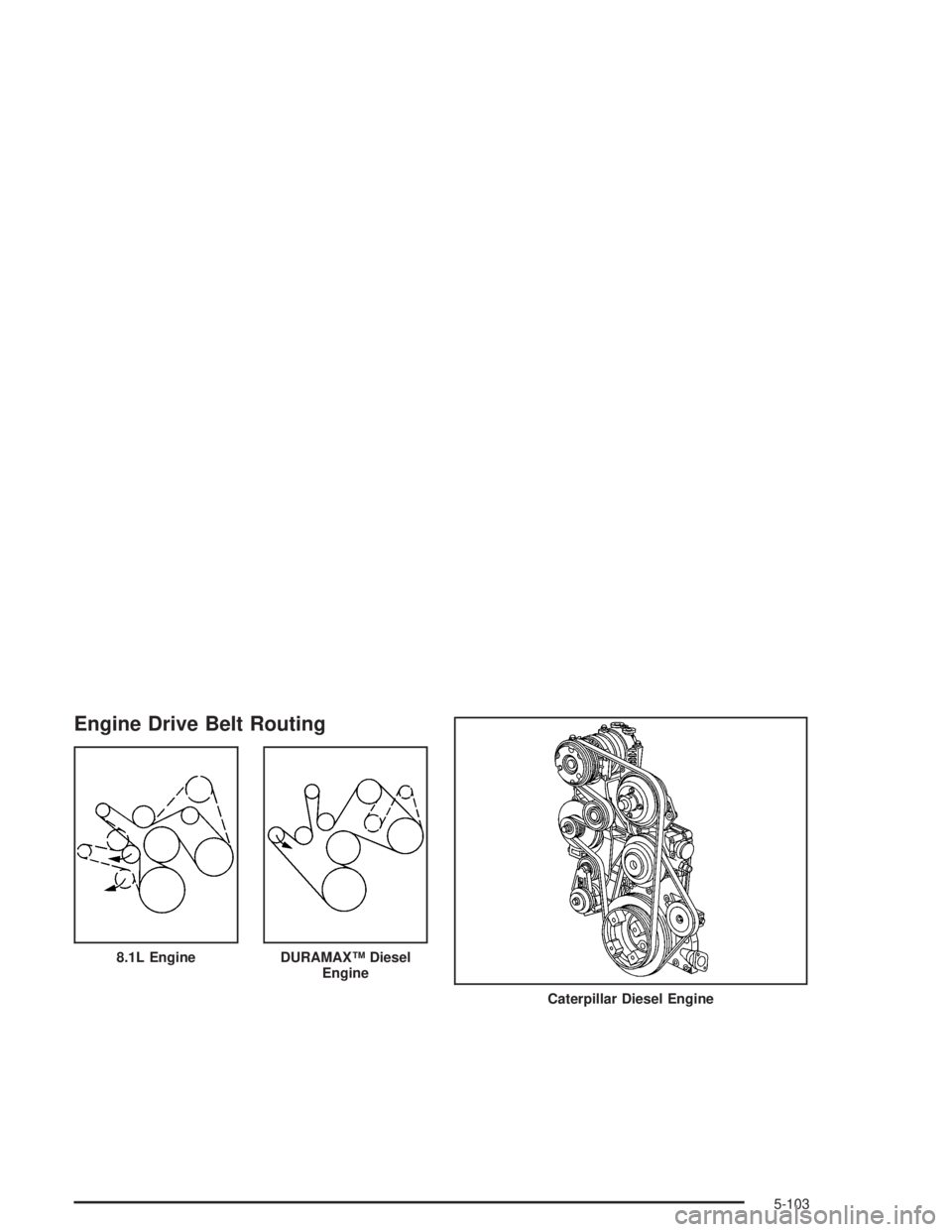
Engine Drive Belt Routing
8.1L EngineDURAMAX™ Diesel
Engine
Caterpillar Diesel Engine
5-103
Page 318 of 366
30,000 Miles (48 000 km)
❑Gasoline Engine Only: Check Oil Life System. If
engine oil and filter are changed, reset system. See
“Engine Oil (Gasoline Engine)” in the Index.(3) (9)
❑DURAMAX™ Diesel Only: Change engine oil and filter
(or every 12 months, whichever occurs first).(2) (3)
❑Check fluid levels (or every 3 months, whichever
occurs first).(1) (6)
❑Gasoline Engine: Replace engine air cleaner filter.
Diesel Engine: Inspect engine air cleaner filter change
indicator. If necessary, replace the filter. If vehicle is
driven in dusty/dirty conditions, inspect filter change
indicator at every engine oil change. SeeEngine Air
Cleaner/Filter on page 5-30for more information.† (3)
❑DURAMAX™ Diesel Only: Replace fuel filter.
❑Chassis lubrication service (or every 6 months,
whichever occurs first).(12)
❑Replace fuel filter(s) (or every 12 months, whichever
occurs first).(3)
❑Steering system service.(13)
❑Front and rear suspension service.(14)
❑Spring-to-axle U-bolts and shackle bolts service.(16)
❑Exhaust system service (or every 6 months, whichever
occurs first).(3) (4) (17)
❑Wheels and tires service.(15)❑Hydraulic brake service (or every 6 months, whichever
occurs first).(7) (46)
❑Parking brake service (or every 6 months, whichever
occurs first).(8)
❑Air brake service (or every 6 months, whichever
occurs first).(39)
❑Air brake automatic slack adjuster service (or every
500 hours, whichever occurs first).(40)
❑Check air brake relay valve operation and check for
leaks (or every month, or every 300 hours, whichever
occurs first).
❑Clean air brake application valve (or every 3 months,
or every 300 hours, whichever occurs first). Lubricate
linkage.
❑Air brake chamber service (or every 2 months,
whichever occurs first).(41)
❑Trailer brake hand control valve service (or every
3 months, or every 900 hours, whichever occurs
first).(42)
❑C600, C700 and C800 Gasoline Engines Only: Engine
drive belts service (or every 12 months, whichever
occurs first.)(18)
❑Thermostatically controlled engine cooling fan
service.(4) (20)
❑Shields and underhood insulation service.(4) (5) (21)
6-8
Page 323 of 366
❑C600, C700 and C800 Gasoline Engines Only:
Engine drive belts service (or every 12 months,
whichever occurs first).(18)
❑Thermostatically controlled engine cooling fan
service.(4) (20)
❑Shields and underhood insulation service.(4) (5) (21)
❑Air compressor dry element pleated paper air
strainer service (or every 2 months or every
800 hours, whichever occurs first).
67,500 Miles (108 000 km)
❑Gasoline Engine Only: Check Oil Life System. If
engine oil and filter are changed, reset system. See
“Engine Oil (Gasoline Engine)” in the Index.(3) (9)
❑Check fluid levels (or every 3 months, whichever
occurs first).(1) (6)
❑Chassis lubrication service (or every 6 months,
whichever occurs first).(12)
❑Cooling system service. Clean the cooling system filler
cap with clean water, clean the core, pressure test the
cap and the system for proper pressure capability and
inspect condition of cooling and heater hoses and
clamps. Replace hoses if cracked, swollen or
damaged.
❑Wheel bearing (grease type) service (or every 24
months, whichever occurs first, and whenever hubs
are removed).(23) (46)❑Wheels and tires service.(15)
❑Hydraulic brake service (or every 6 months, whichever
occurs first).(7) (46)
❑Parking brake service (or every 6 months, whichever
occurs first).(8)
❑Air brake service (or every 6 months, whichever
occurs first).(39)
❑Air brake automatic slack adjuster service (or every
500 hours, whichever occurs first).(40)
❑Check air brake relay valve operation and check for
leaks (or every month, or every 300 hours, whichever
occurs first).
❑Clean air brake application valve (or every 3 months,
or every 300 hours, whichever occurs first). Lubricate
linkage.
❑Air brake chamber service (or every 2 months,
whichever occurs first).(41)
❑Trailer brake hand control valve service (or every
3 months, or every 900 hours, whichever occurs
first).(42)
❑Rear axle air shift motor service.(11)
❑Air intake system service (or every 24 months,
whichever occurs first).(4) (5) (24)
❑Evaporative Control System service (if equipped) (or
every 24 months, whichever occurs first).(3) (26) †
6-13
Page 326 of 366
❑Gasoline Engine: Replace engine air cleaner filter.
Diesel Engine: Inspect engine air cleaner filter
change indicator. If necessary, replace the filter. If
vehicle is driven in dusty/dirty conditions, inspect filter
change indicator at every engine oil change. See
Engine Air Cleaner/Filter on page 5-30for more
information.† (3)
❑DURAMAX™ Diesel Only: Replace fuel filter.
❑Chassis lubrication service (or every 6 months,
whichever occurs first).(12)
❑Cooling system service. Clean the cooling system
filler cap with clean water, clean the core, pressure
test the cap and the system for proper pressure
capability and inspect condition of cooling and heater
hoses and clamps. Replace hoses if cracked,
swollen or damaged.
❑Wheel bearing (grease type) service (or every
24 months, whichever occurs first, and whenever
hubs are removed).(23) (46)
❑Replace fuel filter(s) (or every 12 months, whichever
occurs first).(3)
❑Steering system service.(13)
❑Front and rear suspension service.(14)
❑Spring-to-axle U-bolts and shackle bolts service.(16)
❑Exhaust system service (or every 6 months,
whichever occurs first).(3) (4) (17)❑Inspect door hinge pins and bushings and replace as
necessary.
❑Wheels and tires service.(15)
❑Hydraulic brake service (or every 6 months,
whichever occurs first).(7) (46)
❑Parking brake service (or every 6 months, whichever
occurs first).(8)
❑Air brake service (or every 6 months, whichever
occurs first).(39)
❑Air brake automatic slack adjuster service (or every
500 hours, whichever occurs first).(40)
❑Check air brake relay valve operation and check for
leaks (or every month, or every 300 hours, whichever
occurs first).
❑Clean air brake application valve (or every 3 months,
or every 300 hours, whichever occurs first). Lubricate
linkage.
❑Air brake chamber service (or every 2 months,
whichever occurs first).(41)
❑Trailer brake hand control valve service (or every
3 months, or every 900 hours, whichever occurs
first).(42)
❑C600, C700 and C800 Gasoline Engines Only:
Engine drive belts service (or every 12 months,
whichever occurs first).(18)
6-16
Page 327 of 366
❑Thermostatically controlled engine cooling fan
service.(4) (20)
❑Shields and underhood insulation service.(4) (5) (21)
❑Rear axle air shift motor service.(11)
❑Air intake system service (or every 24 months,
whichever occurs first).(4) (5) (24)
❑Evaporative Control System service (if equipped) (or
every 24 months, whichever occurs first).(3) (26) †
97,500 Miles (156 000 km)
❑Gasoline Engine Only: Check Oil Life System. If
engine oil and filter are changed, reset system.
See “Engine Oil (Gasoline Engine)” in the
Index.(3) (9)
❑Check fluid levels (or every 3 months, whichever
occurs first).(1) (6)
❑Chassis lubrication service (or every 6 months,
whichever occurs first).(12)
❑Wheels and tires service.(15)
❑Hydraulic brake service (or every 6 months,
whichever occurs first).(7) (46)
❑Parking brake service (or every 6 months, whichever
occurs first).(8)
❑Air brake service (or every 6 months, whichever
occurs first).(39)❑Air brake automatic slack adjuster service (or every
500 hours, whichever occurs first).(40)
❑Check air brake relay valve operation and check for
leaks (or every month, or every 300 hours, whichever
occurs first).
❑Clean air brake application valve (or every 3 months,
or every 300 hours, whichever occurs first). Lubricate
linkage.
❑Air brake chamber service (or every 2 months,
whichever occurs first).(41)
❑Trailer brake hand control valve service (or every 3
months, or every 900 hours, whichever occurs
first).(42)
100,000 Miles (160 000 km)
❑DURAMAX™ Diesel Only: Change engine oil
and filter (or every 12 months, whichever occurs
first).(2) (3)
❑Diesel Only: Inspect engine drive belt; replace as
necessary.
❑Gasoline Engine Only (Vehicles with GVW of
16,000 lbs. or less): Spark plug service.(3) (28)
❑Change power steering fluid (or every 36 months,
whichever occurs first).(13)
6-17