check oil CHEVROLET KODIAK 2004 Owners Manual
[x] Cancel search | Manufacturer: CHEVROLET, Model Year: 2004, Model line: KODIAK, Model: CHEVROLET KODIAK 2004Pages: 366, PDF Size: 6.87 MB
Page 84 of 366
Diesel Engine Warm-Up
Several factors affect how quickly your diesel engine
warms up. These can include outside temperature,
engine load, idle time and your vehicle’s option content.
Your vehicle may be equipped with some features
that can help the engine reach operating temperature
sooner. Some of these features are discussed below.
Also, remember that an automatic transmission
adds heat to the cooling system through the heat
exchanger in the radiator. Because of this, vehicles
equipped with automatic transmissions are often able to
retain engine coolant heat better than manual
transmission vehicles.
See your Caterpillar
®Operation & Maintenance manual
for additional diesel engine warm-up information.
Engine Alarm and Automatic Shutdown
Your check gages light will come on if the system
senses high engine temperature or low engine oil
pressure. If high engine temperature or low engine oil
pressure is detected, you will also hear a tone alarm at
two beats per second. The alarm and the light will
remain on until the condition is fixed. If the engine
temperature or oil pressure condition worsens, the tone
alarm will go to five beats per second.If the system senses low engine coolant, the five beat
per second alarm and the low coolant warning light
will come on.
The five beats per second tone alarm means that your
engine will shut down in about 25–30 seconds.
There is also an engine shutdown light to indicate that
the engine will shut down. SeeEngine Shutdown
Warning Light on page 3-39.
Pull off the road and shut off the engine. Don’t start it
until the reason for the problem is known, and the
problem is fixed. If the engine shuts down when you are
still in traffic, you can restart the engine and get
another 25–30 seconds of operation. Do this only if you
have to, since there is a problem that can harm the
engine if it isn’t fixed. Engine automatic shutdown, for
gasoline engines, requires activation by your dealer.
High Idle System (Caterpillar®
Diesel and Gasoline Engines)
Your vehicle has both automatic and manual high idle
capabilities.
2-16
Page 88 of 366
If you’re trying to start your engine after you’ve run out
of fuel, seeRunning Out of Fuel on page 5-15.
When your engine is cold, let it run for a few minutes
before you move your vehicle. This lets oil pressure
build up. Your engine will sound louder when it’s cold.
Notice:If you are not in an idling vehicle and
the engine overheats, you would not be there to see
the overheated engine indication. This could
damage your vehicle. Do not let your engine run
when you are not in your vehicle.
Cold Weather Starting (Diesel Engine)
The following tips will help you get good starting in
cold weather.
Use the recommended engine oil when the outside
temperature drops below freezing. SeeEngine Oil
(Caterpillar
®Diesel Engine) on page 5-20orEngine Oil
(Gasoline Engine) on page 5-20orEngine Oil
(DURAMAX™ Diesel) on page 5-25. When the outside
temperature drops below 0°F (−18°C), use of the
engine coolant heater is recommended.If you experience longer cranking times, notice an
unusual amount of exhaust smoke or are at higher
altitudes (over 7,000 ft. or 2 135 m), you may use your
engine coolant heater. SeeEngine Coolant Heater
on page 2-23.
SeeWhat Fuel to Use on page 5-8for information on
what fuel to use in cold weather.
If Your Diesel Engine Won’t Start
If you’ve run out of fuel, seeRunning Out of Fuel on
page 5-15.
If you’re not out of fuel, and your engine won’t start,
do this:
Turn your ignition key to RUN. IMMEDIATELY after
the wait to start light goes off, turn the ignition key
to START.
If the light doesn’t go off, wait a few seconds, then try
starting your engine again. And, see your dealer as soon
as you can for a starting system check.
If the light comes on and then goes off and you know
your batteries are charged, but your engine still
won’t start, your vehicle needs service.
If the light does not come on when the engine is cold,
your vehicle needs service.
2-20
Page 90 of 366
When the engine is started, it will slowly ramp up to the
high idle speed after a delay of a few seconds up to
about two minutes. For this method to work properly
there must be no throttle or brake pedal faults, and the
throttle pedal must not fall below 75 percent of wide
open throttle while pressing the brake pedal.
The engine idle speed will return to normal once the
following conditions are met:
•Once engine coolant temperature reaches
150°F (65°C).
•Air intake temperature reaches 41°F (5°C).
The high idle speed will be temporarily interrupted and
the engine speed will return to normal if any of the
following conditions occur:
•The brake pedal is applied.
•The accelerator pedal is pressed.
•The automatic transmission is shifted out of
PARK (P) or NEUTRAL (N).
•The clutch pedal on the manual transmission is
pressed.
•Vehicle speed is detected.
Once these inputs are removed, the engine idle speed
will slowly ramp back up to high idle after the normal
delay, if the conditions for engine coolant temperature
and air intake temperature are still met.
Engine Checks Before Operating
When you’ve started your engine, let it run for
20 to 30 seconds before you put a load on the engine.
Butdon’tleave the vehicle while the engine is running.
Avoid unnecessary idling of diesel engine equipped
vehicles.
If the engine idles too long, the temperature of the
engine coolant will fall below the normal operating
range. Low engine operating temperature causes
several conditions which affect engine operation and
reduce engine life.
The engine should be permitted to go through a
warm-up period. Operate the vehicle at a minimum of
600 rpm during the warm-up period. During this
period and during operation, the following observations
should be made.
During this warm-up period, check your warning lights
and gages:
•If oil pressure doesn’t begin to rise within
15 seconds of starting, stop the engine and find the
cause.
•If the engine coolant temperature gage needle goes
into the hot area on the gage, stop the engine and
find the cause of the overheating.
2-22
Page 147 of 366
Malfunction Indicator Lamp
Service Engine Soon Light
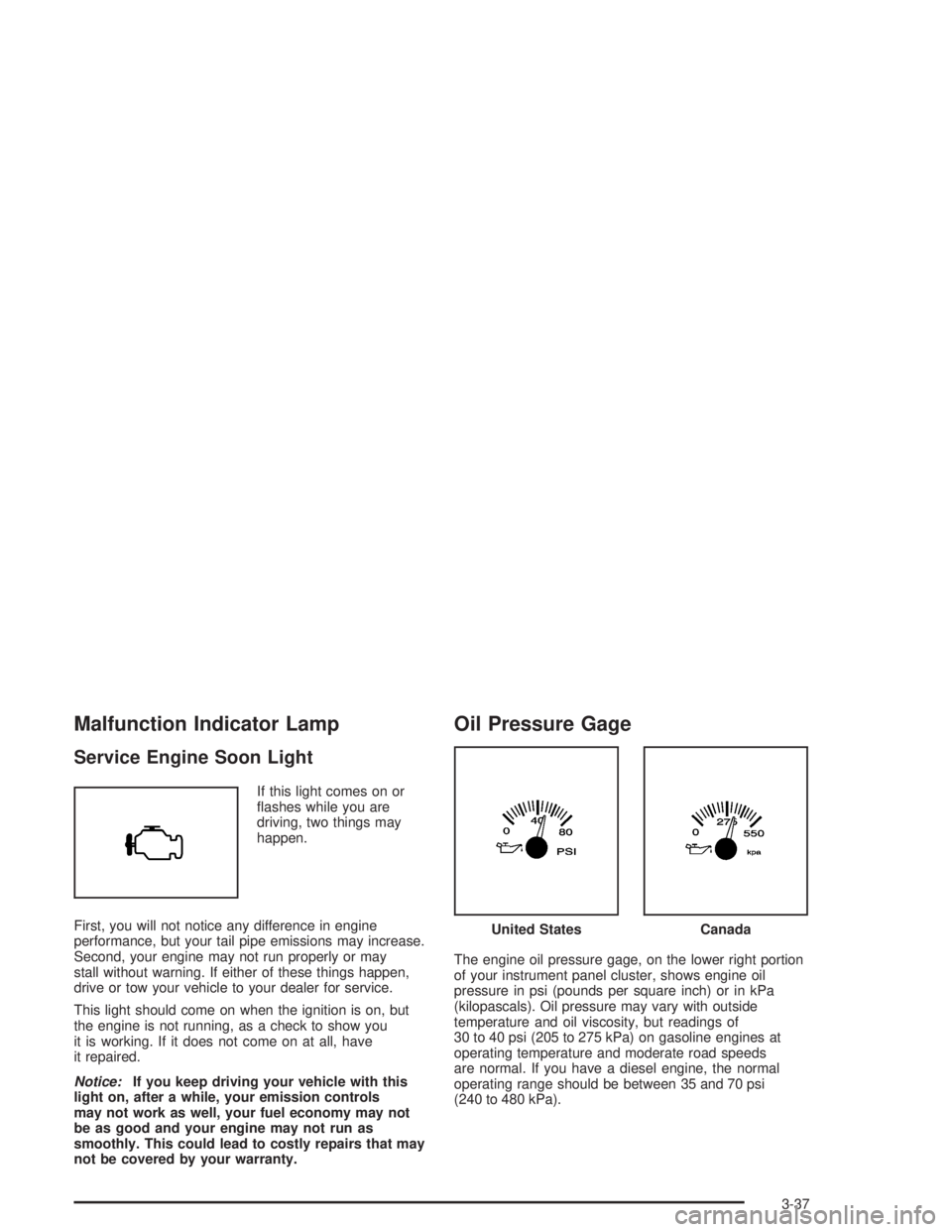
If this light comes on or
flashes while you are
driving, two things may
happen.
First, you will not notice any difference in engine
performance, but your tail pipe emissions may increase.
Second, your engine may not run properly or may
stall without warning. If either of these things happen,
drive or tow your vehicle to your dealer for service.
This light should come on when the ignition is on, but
the engine is not running, as a check to show you
it is working. If it does not come on at all, have
it repaired.
Notice:If you keep driving your vehicle with this
light on, after a while, your emission controls
may not work as well, your fuel economy may not
be as good and your engine may not run as
smoothly. This could lead to costly repairs that may
not be covered by your warranty.
Oil Pressure Gage
The engine oil pressure gage, on the lower right portion
of your instrument panel cluster, shows engine oil
pressure in psi (pounds per square inch) or in kPa
(kilopascals). Oil pressure may vary with outside
temperature and oil viscosity, but readings of
30 to 40 psi (205 to 275 kPa) on gasoline engines at
operating temperature and moderate road speeds
are normal. If you have a diesel engine, the normal
operating range should be between 35 and 70 psi
(240 to 480 kPa).
United StatesCanada
3-37
Page 148 of 366
A reading in the low pressure zone may be caused by a
dangerously low oil level or other problem.
If you have a Caterpillar
®diesel engine, also see your
Caterpillar®Operation & Maintenance Manual.
{CAUTION:
Do not keep driving if the oil pressure is low. If
you do, your engine can become so hot that it
catches re. You or others could be burned.
Check your oil as soon as possible and have
your vehicle serviced.
Notice:Lack of proper engine oil maintenance may
damage the engine. The repairs would not be
covered by your warranty. Always follow the
maintenance schedule in this manual for changing
engine oil.
Low Oil Level Light
This light should come on
as a check, when you start
your engine. If the light
fails to come on, have it
repaired as soon as possible
so you will be aware when
the oil level is low.
If this light comes on and stays on, it means your
engine is low on oil. You need to check the oil level
right away. SeeEngine Oil (Caterpillar
®Diesel Engine)
on page 5-20orEngine Oil (Gasoline Engine) on
page 5-20orEngine Oil (DURAMAX™ Diesel) on
page 5-25for further information.
3-38
Page 149 of 366
Change Engine Oil Light
The change engine oil light
should come on briefly as
a bulb check when you
start the engine. If the light
doesn’t come on, have it
serviced.
If the change engine oil light comes on and stays on
after you start the engine, have the oil changed.
For additional information on when to change engine oil
for gasoline engines or DURAMAX™ diesel engines,
seeEngine Oil (Caterpillar
®Diesel Engine) on page 5-20
orEngine Oil (Gasoline Engine) on page 5-20or
Engine Oil (DURAMAX™ Diesel) on page 5-25. To reset
the change engine oil light, seeEngine Oil
(Caterpillar
®Diesel Engine) on page 5-20orEngine Oil
(Gasoline Engine) on page 5-20orEngine Oil
(DURAMAX™ Diesel) on page 5-25.
Engine Overspeed Warning Light
If your vehicle has this
light, it will come on if your
engine is operating at
too many revolutions per
minute (rpm).
It will also come on for a moment as a check when you
start your engine.
If it comes on when you’re driving, reduce your engine
speed immediately.
Engine Shutdown Warning Light
If your vehicle has the
engine shutdown feature,
this light will come on
when engine shutdown
is active.
For more information, seeEngine Alarm and Automatic
ShutdownunderStarting Your Diesel Engine on
page 2-14.
3-39
Page 150 of 366
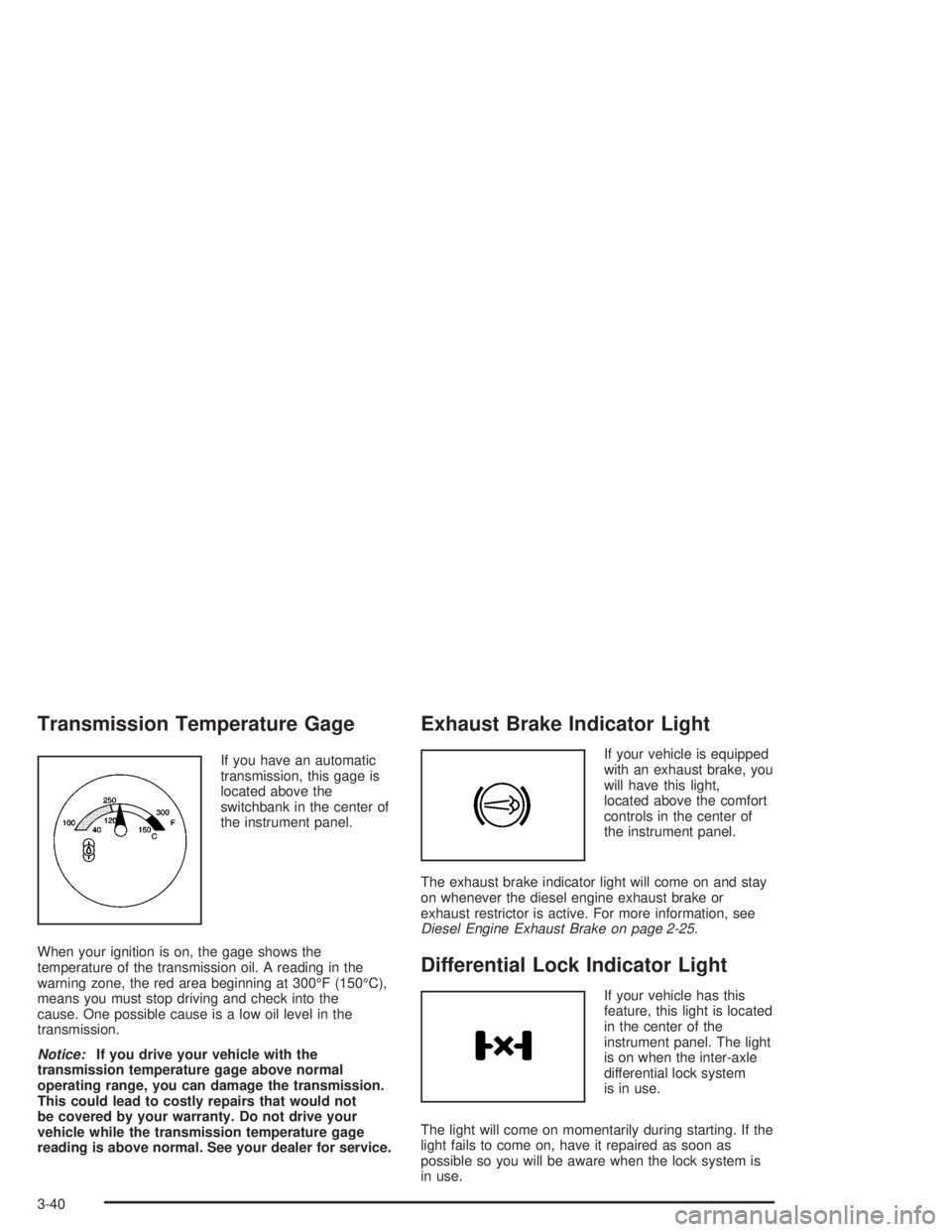
Transmission Temperature Gage
If you have an automatic
transmission, this gage is
located above the
switchbank in the center of
the instrument panel.
When your ignition is on, the gage shows the
temperature of the transmission oil. A reading in the
warning zone, the red area beginning at 300°F (150°C),
means you must stop driving and check into the
cause. One possible cause is a low oil level in the
transmission.
Notice:If you drive your vehicle with the
transmission temperature gage above normal
operating range, you can damage the transmission.
This could lead to costly repairs that would not
be covered by your warranty. Do not drive your
vehicle while the transmission temperature gage
reading is above normal. See your dealer for service.
Exhaust Brake Indicator Light
If your vehicle is equipped
with an exhaust brake, you
will have this light,
located above the comfort
controls in the center of
the instrument panel.
The exhaust brake indicator light will come on and stay
on whenever the diesel engine exhaust brake or
exhaust restrictor is active. For more information, see
Diesel Engine Exhaust Brake on page 2-25.
Differential Lock Indicator Light
If your vehicle has this
feature, this light is located
in the center of the
instrument panel. The light
is on when the inter-axle
differential lock system
is in use.
The light will come on momentarily during starting. If the
light fails to come on, have it repaired as soon as
possible so you will be aware when the lock system is
in use.
3-40
Page 152 of 366
Low Washer Fluid Warning Light
This light will come on
when your vehicle is low
on windshield washer fluid.
For more information, seeWindshield Washer Fluid on
page 5-44.
Check Gages Warning Light
This light will come on as
you’re starting the engine,
just as a check.
If this light comes on and stays on while you are driving.
it means that either your engine coolant temperature
gage or your engine oil pressure gage may be showing
a reading in the warning zone.When the check gages light comes on, you will also
hear a warning tone. The tone and the light will
stay activated until the problem is corrected.
This light may also come on if your vehicle is equipped
with the optional automatic engine shutdown system
and engine shutdown has begun. SeeEngine Alarm and
Automatic ShutdownunderStarting Your Diesel
Engine on page 2-14.
Fuel Gage
Your fuel gage is located
on the right side of your
instrument panel cluster.
When the ignition is on, your fuel gage lets you know
about how much fuel you have left. When the gage first
shows empty, you’ll still have a little fuel left, but you
should get more fuel soon.
3-42
Page 169 of 366
Care of Your CDs
Handle CDs carefully. Store them in their original cases
or other protective cases and away from direct
sunlight and dust. If the surface of a CD is soiled,
dampen a clean, soft cloth in a mild, neutral detergent
solution and clean it, wiping from the center to the edge.
Be sure never to touch the side without writing when
handling CDs. Pick up CDs by grasping the outer edges
or the edge of the hole and the outer edge.
Care of Your CD Player
The use of CD lens cleaners for CDs is not advised,
due to the risk of contaminating the lens of the CD optics
with lubricants internal to the CD mechanism.
Fixed Mast Antenna
The fixed mast antenna can withstand most car washes
without being damaged. If the mast should ever
become slightly bent, you can straighten it out by hand.
If the mast is badly bent, you should replace it.
Check occasionally to be sure the mast is still tightened
to the fender. If tightening is required, tighten by
hand, then with a wrench one quarter turn.
Chime Level Adjustment
The radio is the vehicle chime producer. The chime is
produced from the driver’s side front door speakers.
To change the volume level, press and hold
pushbutton 6 with the ignition on and the radio power
off. The chime volume level will change from the normal
level to loud, and HI will be displayed on the radio.
To change back to the default or normal setting, press
and hold pushbutton 6 again. The chime level will
change from the loud level to normal, and LO will be
displayed. Each time the chime volume is changed,
three chimes will sound as an example of the new
volume selected. Removing the radio and not replacing
it with a factory radio or chime module will disable
vehicle chimes.
3-59
Page 207 of 366
Service............................................................5-3
Doing Your Own Service Work.........................5-4
Two Safety Cautions about Engine Fan
Breakage...................................................5-5
Fuel................................................................5-6
Gasoline Octane............................................5-6
Gasoline Specifications....................................5-6
Additives.......................................................5-7
Diesel Engine Fuel.........................................5-8
What Fuel to Use...........................................5-8
Very Cold Weather Operation.........................5-10
Water in Fuel...............................................5-10
Running Out of Fuel.....................................5-15
Fuel Filter Replacement.................................5-15
Fuels in Foreign Countries.............................5-16
Filling Your Tank..........................................5-17
Filling a Portable Fuel Container.....................5-18
Checking Things Under the Hood....................5-18
Hood Latches...............................................5-19
Engine Oil (Caterpillar
®Diesel Engine).............5-20
Engine Oil (Gasoline Engine)..........................5-20
Engine Oil (DURAMAX™ Diesel).....................5-25
Engine Air Cleaner/Filter................................5-30
Automatic Transmission Fluid.........................5-31
Manual Transmission Fluid.............................5-32Engine Coolant (Gas and
DURAMAX™ engines)................................5-32
Engine Coolant (Caterpillar
®Diesel Engines).....5-35
Coolant Surge Tank Pressure Cap..................5-35
Engine Overheating.......................................5-36
Cooling System............................................5-38
Engine Fan Noise.........................................5-43
Power Steering Fluid.....................................5-43
Windshield Washer Fluid................................5-44
Brakes........................................................5-46
Battery........................................................5-55
Jump Starting...............................................5-56
Rear Axle.......................................................5-61
Rear Axle Shift Motor....................................5-61
Noise Control System.....................................5-62
Tampering with Noise Control System
Prohibited.................................................5-62
Bulb Replacement..........................................5-63
Replacement Bulbs.......................................5-63
Windshield Wiper Blade Replacement..............5-63
Other Service Items........................................5-64
Fuel Filter....................................................5-64
Primary Fuel Filter and Water Separator..........5-65
Secondary Fuel Filter and Water
Separator/Heater.......................................5-66
Section 5 Service and Appearance Care
5-1