tires CHEVROLET KODIAK 2005 Owner's Manual
[x] Cancel search | Manufacturer: CHEVROLET, Model Year: 2005, Model line: KODIAK, Model: CHEVROLET KODIAK 2005Pages: 374, PDF Size: 5.46 MB
Page 289 of 374
Wheel Replacement
Replace any wheel that is bent, cracked or badly rusted
or corroded. If wheel nuts keep coming loose, replace
the wheel. If the wheel leaks air, replace it.
Your dealer will know the kind of wheel you need.
Each new wheel should have the same load-carrying
capacity, diameter, width, offset and be mounted
the same way as the one it replaces.
If you need to replace any of your wheels, wheel bolts
or wheel nuts, replace them only with new GM
original equipment parts. This way, you will be sure to
have the right wheel, wheel bolts and wheel nuts
for your vehicle.
{CAUTION:
A leaking wheel could fail without warning. A
wheel designed for tubeless tires could be
leaking because it is damaged. Do not use an
inner tube or some other thing to try to stop the
leaking. Get a new wheel or the proper type.
{CAUTION:
Without the correct wheel, you may not be able
to stop properly, and you could have other
problems like a tire air-out. You could have a
collision. If you do not go to your dealer to get
a new wheel, be sure you get the correct one.
Each new wheel should match the original
wheel in load-carrying capacity, ination
pressure capacity, diameter, width, offset and
mounting conguration.
Using wheels and tires with higher load-carrying limits
than the original wheels and tires does not change
the Gross Axle Weight Rating (GAWR) or the Gross
Vehicle Weight Rating (GVWR) of your vehicle.
SeeLoading Your Vehicle on page 4-32for more
information.
Notice:The wrong wheel can cause trouble in
bearing life, brake cooling, speedometer/odometer
calibration, headlamp aim, bumper height, vehicle
ground clearance, stopping distance and tire
clearance to the body and chassis. You could also
have other problems like a tire air-out.
5-77
Page 290 of 374
Used Replacement Wheels
{CAUTION:
Putting a used wheel on your vehicle is
dangerous. You cannot know how it has been
used or how far it has been driven. It could fail
suddenly and cause a crash. If you have to
replace a wheel, use a new GM original
equipment wheel.
If a Tire Goes Flat
It’s unusual for a tire to “blow out” while you’re driving,
especially if you maintain your tires properly. If air
goes out of a tire, it’s much more likely to leak out
slowly. But if you should ever have a “blow out,” here
are a few tips about what to expect and what to do:
If a front tire fails, the flat tire will create a drag that pulls
the vehicle toward that side. Take your foot off the
accelerator pedal and grip the steering wheel firmly.
Steer to maintain lane position, and then gently brake to
a stop well out of the traffic lane.A rear blowout, particularly on a curve, acts much like a
skid and may require the same correction you’d use
in a skid. In any rear blowout, remove your foot from the
accelerator pedal. Get the vehicle under control by
steering the way you want the vehicle to go. It may be
very bumpy and noisy, but you can still steer. Gently
brake to a stop –– well off the road if possible.
If a tire goes flat, avoid further tire and wheel damage
by driving slowly to a level place and turn on your
hazard warning flashers.
{CAUTION:
Your vehicle, when new, did not include tire
changing equipment or a place to store a tire
in the vehicle. Special tools and procedures
are required if a tire needs to be serviced. If
these tools and procedures are not used, you
or others could be injured or killed while trying
to change or service a truck tire.
Your truck, when new, did not include tire changing
equipment or a place to store a tire in the vehicle. Few
drivers of these vehicles have the necessary equipment
aboard to be able to change a flat tire safely.
5-78
Page 297 of 374
Tires
To clean the tires, use a stiff brush with tire cleaner.
Notice:Using petroleum-based tire dressing
products on your vehicle may damage the paint
nish and/or tires. When applying a tire dressing,
always wipe off any overspray from all painted
surfaces on your vehicle.
Sheet Metal Damage
If the vehicle is damaged and requires sheet metal
repair or replacement, make sure the body repair shop
applies anti-corrosion material to parts repaired or
replaced to restore corrosion protection.
Original manufacturer replacement parts will provide the
corrosion protection while maintaining the warranty.
Finish Damage
Any stone chips, fractures or deep scratches in the
finish should be repaired right away. Bare metal
will corrode quickly and may develop into major repair
expense.
Minor chips and scratches can be repaired with
touch-up materials available from your GM dealer.
Larger areas of finish damage can be corrected in your
GM dealer’s body and paint shop.
Underbody Maintenance
Chemicals used for ice and snow removal and dust
control can collect on the underbody. If these are not
removed, corrosion and rust can develop on the
underbody parts such as fuel lines, frame, floor pan,
and exhaust system even though they have corrosion
protection.
At least every spring, flush these materials from the
underbody with plain water. Clean any areas where mud
and debris can collect. Dirt packed in close areas of
the frame should be loosened before being flushed.
Your dealer or an underbody car washing system can
do this for you.
Chemical Paint Spotting
Some weather and atmospheric conditions can create a
chemical fallout. Airborne pollutants can fall upon and
attack painted surfaces on the vehicle. This damage can
take two forms: blotchy, ring-shaped discolorations,
and small, irregular dark spots etched into the
paint surface.
Although no defect in the paint job causes this, GM will
repair, at no charge to the owner, the surfaces of
new vehicles damaged by this fallout condition within
12 months or 12,000 miles (20 000 km) of purchase,
whichever occurs first.
5-85
Page 320 of 374
7,500 Miles (12 000 km)
❑Gasoline Engine Only: Check engine oil life system. If
engine oil and filter are changed, reset system. See
“Engine Oil (Gasoline Engine)” in the Index.(2) (8)
❑Check fluid levels (or every 3 months, whichever
occurs first).(1) (5)
❑Chassis lubrication service (or every 6 months,
whichever occurs first).(11)
❑Wheels and tires service.(14)
❑Hydraulic brake service (or every 6 months, whichever
occurs first).(6) (36)
❑Parking brake service (or every 6 months, whichever
occurs first).(21)
❑Air brake service (or every 6 months, whichever
occurs first).(32)
❑Air brake automatic slack adjuster service (or every
500 hours, whichever occurs first).(33)
❑Check air brake relay valve operation and check for
leaks (or every month, or every 300 hours, whichever
occurs first).
❑Clean air brake application valve (or every 3 months,
or every 300 hours, whichever occurs first). Lubricate
linkage.
❑Air brake chamber service (or every 2 months,
whichever occurs first).(34)
12,000 Miles (20 000 km)
❑7.8L DURAMAX®Diesel Without Engine Oil Life
System Only: Change engine oil and filter (or
every 12 months, or every 600 hours of engine
operation, whichever occurs first).(2)
❑7.8L DURAMAX
®Diesel With Engine Oil Life System
Only: Check oil life system (or every 600 hours of
engine operation, whichever occurs first). If engine oil
and filter are changed, reset system. See “Engine
Oil (DURAMAX
®Diesel)” in the Index.(2) (7)
15,000 Miles (24 000 km)
❑Gasoline Engine Only: Check engine oil life system. If
engine oil and filter are changed, reset system. See
“Engine Oil (Gasoline Engine)” in the Index.(2) (8)
❑6.6L DURAMAX
®Diesel Without Engine Oil Life
System Only: Change engine oil and filter (or every
12 months, or every 750 hours of engine operation,
whichever occurs first).(2)
❑6.6L DURAMAX
®Diesel With Engine Oil Life System
Only: Check oil life system. If engine oil and filter are
changed, reset system. See “Engine Oil (DURAMAX
®
Diesel)” in the Index.(2) (9)
❑Chassis lubrication service (or every 6 months,
whichever occurs first).(11)
6-6
Page 321 of 374
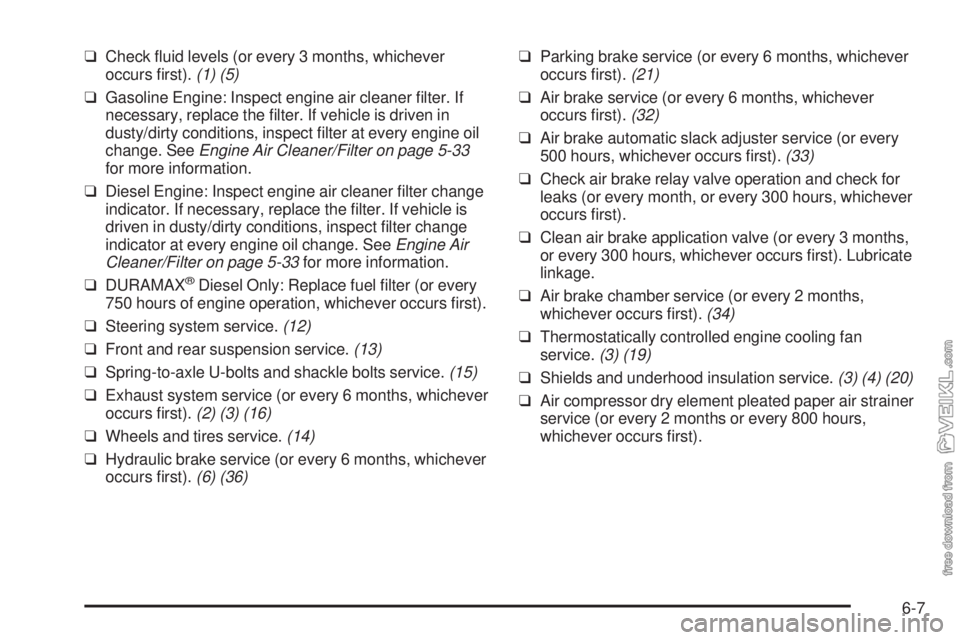
❑Check fluid levels (or every 3 months, whichever
occurs first).(1) (5)
❑Gasoline Engine: Inspect engine air cleaner filter. If
necessary, replace the filter. If vehicle is driven in
dusty/dirty conditions, inspect filter at every engine oil
change. SeeEngine Air Cleaner/Filter on page 5-33
for more information.
❑Diesel Engine: Inspect engine air cleaner filter change
indicator. If necessary, replace the filter. If vehicle is
driven in dusty/dirty conditions, inspect filter change
indicator at every engine oil change. SeeEngine Air
Cleaner/Filter on page 5-33for more information.
❑DURAMAX
®Diesel Only: Replace fuel filter (or every
750 hours of engine operation, whichever occurs first).
❑Steering system service.(12)
❑Front and rear suspension service.(13)
❑Spring-to-axle U-bolts and shackle bolts service.(15)
❑Exhaust system service (or every 6 months, whichever
occurs first).(2) (3) (16)
❑Wheels and tires service.(14)
❑Hydraulic brake service (or every 6 months, whichever
occurs first).(6) (36)❑Parking brake service (or every 6 months, whichever
occurs first).(21)
❑Air brake service (or every 6 months, whichever
occurs first).(32)
❑Air brake automatic slack adjuster service (or every
500 hours, whichever occurs first).(33)
❑Check air brake relay valve operation and check for
leaks (or every month, or every 300 hours, whichever
occurs first).
❑Clean air brake application valve (or every 3 months,
or every 300 hours, whichever occurs first). Lubricate
linkage.
❑Air brake chamber service (or every 2 months,
whichever occurs first).(34)
❑Thermostatically controlled engine cooling fan
service.(3) (19)
❑Shields and underhood insulation service.(3) (4) (20)
❑Air compressor dry element pleated paper air strainer
service (or every 2 months or every 800 hours,
whichever occurs first).
6-7
Page 322 of 374
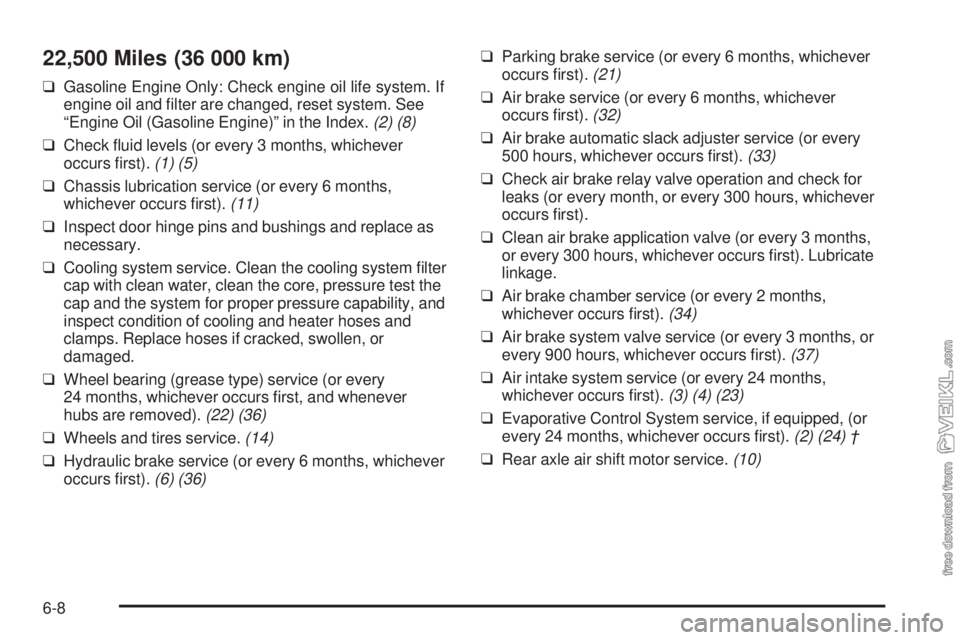
22,500 Miles (36 000 km)
❑Gasoline Engine Only: Check engine oil life system. If
engine oil and filter are changed, reset system. See
“Engine Oil (Gasoline Engine)” in the Index.(2) (8)
❑Check fluid levels (or every 3 months, whichever
occurs first).(1) (5)
❑Chassis lubrication service (or every 6 months,
whichever occurs first).(11)
❑Inspect door hinge pins and bushings and replace as
necessary.
❑Cooling system service. Clean the cooling system filter
cap with clean water, clean the core, pressure test the
cap and the system for proper pressure capability, and
inspect condition of cooling and heater hoses and
clamps. Replace hoses if cracked, swollen, or
damaged.
❑Wheel bearing (grease type) service (or every
24 months, whichever occurs first, and whenever
hubs are removed).(22) (36)
❑Wheels and tires service.(14)
❑Hydraulic brake service (or every 6 months, whichever
occurs first).(6) (36)❑Parking brake service (or every 6 months, whichever
occurs first).(21)
❑Air brake service (or every 6 months, whichever
occurs first).(32)
❑Air brake automatic slack adjuster service (or every
500 hours, whichever occurs first).(33)
❑Check air brake relay valve operation and check for
leaks (or every month, or every 300 hours, whichever
occurs first).
❑Clean air brake application valve (or every 3 months,
or every 300 hours, whichever occurs first). Lubricate
linkage.
❑Air brake chamber service (or every 2 months,
whichever occurs first).(34)
❑Air brake system valve service (or every 3 months, or
every 900 hours, whichever occurs first).(37)
❑Air intake system service (or every 24 months,
whichever occurs first).(3) (4) (23)
❑Evaporative Control System service, if equipped, (or
every 24 months, whichever occurs first).(2) (24) †
❑Rear axle air shift motor service.(10)
6-8
Page 323 of 374
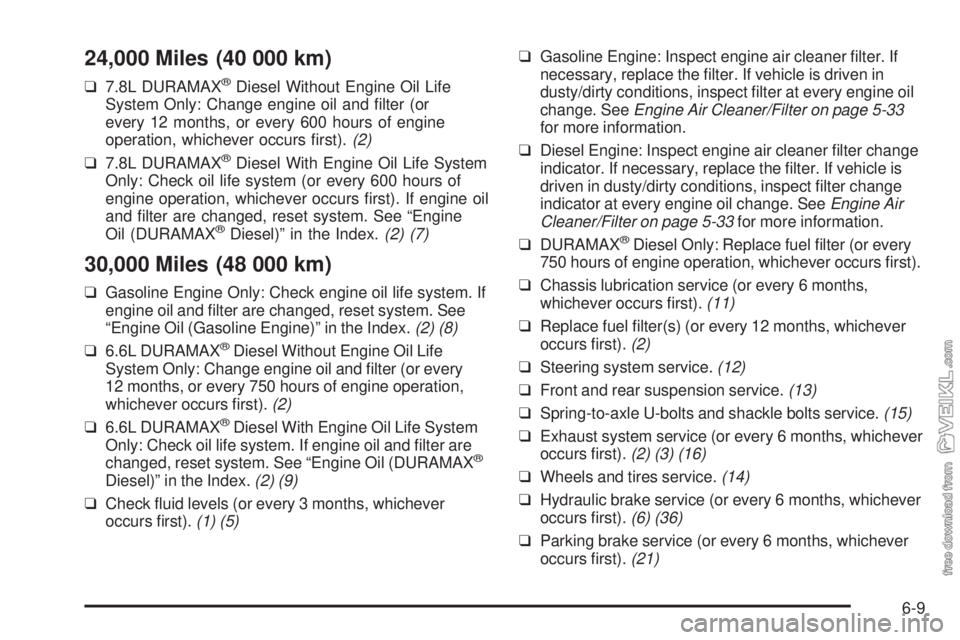
24,000 Miles (40 000 km)
❑7.8L DURAMAX®Diesel Without Engine Oil Life
System Only: Change engine oil and filter (or
every 12 months, or every 600 hours of engine
operation, whichever occurs first).(2)
❑7.8L DURAMAX
®Diesel With Engine Oil Life System
Only: Check oil life system (or every 600 hours of
engine operation, whichever occurs first). If engine oil
and filter are changed, reset system. See “Engine
Oil (DURAMAX
®Diesel)” in the Index.(2) (7)
30,000 Miles (48 000 km)
❑Gasoline Engine Only: Check engine oil life system. If
engine oil and filter are changed, reset system. See
“Engine Oil (Gasoline Engine)” in the Index.(2) (8)
❑6.6L DURAMAX
®Diesel Without Engine Oil Life
System Only: Change engine oil and filter (or every
12 months, or every 750 hours of engine operation,
whichever occurs first).(2)
❑6.6L DURAMAX
®Diesel With Engine Oil Life System
Only: Check oil life system. If engine oil and filter are
changed, reset system. See “Engine Oil (DURAMAX
®
Diesel)” in the Index.(2) (9)
❑Check fluid levels (or every 3 months, whichever
occurs first).(1) (5)❑Gasoline Engine: Inspect engine air cleaner filter. If
necessary, replace the filter. If vehicle is driven in
dusty/dirty conditions, inspect filter at every engine oil
change. SeeEngine Air Cleaner/Filter on page 5-33
for more information.
❑Diesel Engine: Inspect engine air cleaner filter change
indicator. If necessary, replace the filter. If vehicle is
driven in dusty/dirty conditions, inspect filter change
indicator at every engine oil change. SeeEngine Air
Cleaner/Filter on page 5-33for more information.
❑DURAMAX
®Diesel Only: Replace fuel filter (or every
750 hours of engine operation, whichever occurs first).
❑Chassis lubrication service (or every 6 months,
whichever occurs first).(11)
❑Replace fuel filter(s) (or every 12 months, whichever
occurs first).(2)
❑Steering system service.(12)
❑Front and rear suspension service.(13)
❑Spring-to-axle U-bolts and shackle bolts service.(15)
❑Exhaust system service (or every 6 months, whichever
occurs first).(2) (3) (16)
❑Wheels and tires service.(14)
❑Hydraulic brake service (or every 6 months, whichever
occurs first).(6) (36)
❑Parking brake service (or every 6 months, whichever
occurs first).(21)
6-9
Page 324 of 374
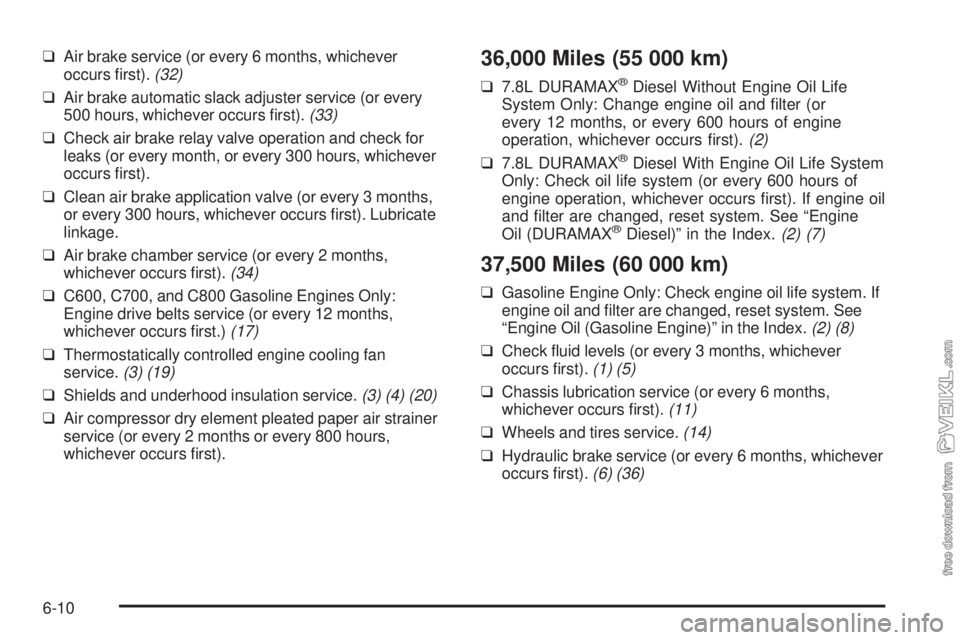
❑Air brake service (or every 6 months, whichever
occurs first).(32)
❑Air brake automatic slack adjuster service (or every
500 hours, whichever occurs first).(33)
❑Check air brake relay valve operation and check for
leaks (or every month, or every 300 hours, whichever
occurs first).
❑Clean air brake application valve (or every 3 months,
or every 300 hours, whichever occurs first). Lubricate
linkage.
❑Air brake chamber service (or every 2 months,
whichever occurs first).(34)
❑C600, C700, and C800 Gasoline Engines Only:
Engine drive belts service (or every 12 months,
whichever occurs first.)(17)
❑Thermostatically controlled engine cooling fan
service.(3) (19)
❑Shields and underhood insulation service.(3) (4) (20)
❑Air compressor dry element pleated paper air strainer
service (or every 2 months or every 800 hours,
whichever occurs first).36,000 Miles (55 000 km)
❑7.8L DURAMAX®Diesel Without Engine Oil Life
System Only: Change engine oil and filter (or
every 12 months, or every 600 hours of engine
operation, whichever occurs first).(2)
❑7.8L DURAMAX
®Diesel With Engine Oil Life System
Only: Check oil life system (or every 600 hours of
engine operation, whichever occurs first). If engine oil
and filter are changed, reset system. See “Engine
Oil (DURAMAX
®Diesel)” in the Index.(2) (7)
37,500 Miles (60 000 km)
❑Gasoline Engine Only: Check engine oil life system. If
engine oil and filter are changed, reset system. See
“Engine Oil (Gasoline Engine)” in the Index.(2) (8)
❑Check fluid levels (or every 3 months, whichever
occurs first).(1) (5)
❑Chassis lubrication service (or every 6 months,
whichever occurs first).(11)
❑Wheels and tires service.(14)
❑Hydraulic brake service (or every 6 months, whichever
occurs first).(6) (36)
6-10
Page 326 of 374
❑Front and rear suspension service.(13)
❑Spring-to-axle U-bolts and shackle bolts service.(15)
❑Exhaust system service (or every 6 months, whichever
occurs first).(2) (3) (16)
❑Wheels and tires service.(14)
❑Hydraulic brake service (or every 6 months, whichever
occurs first).(6) (36)
❑Parking brake service (or every 6 months, whichever
occurs first).(21)
❑Air brake service (or every 6 months, whichever
occurs first).(32)
❑Air brake automatic slack adjuster service (or every
500 hours, whichever occurs first).(33)
❑Check air brake relay valve operation and check for
leaks (or every month, or every 300 hours, whichever
occurs first).
❑Clean air brake application valve (or every 3 months,
or every 300 hours, whichever occurs first). Lubricate
linkage.
❑Air brake chamber service (or every 2 months,
whichever occurs first).(34)
❑Air brake system valve service (or every 3 months, or
every 900 hours, whichever occurs first).(37)
❑Thermostatically controlled engine cooling fan
service.(3) (19)❑Shields and underhood insulation service.(3) (4) (20)
❑Rear axle air shift motor service.(10)
❑Air intake system service (or every 24 months,
whichever occurs first).(3) (4) (23)
❑Evaporative Control System service, if equipped, (or
every 24 months, whichever occurs first).(2) (24) †
❑Air compressor dry element pleated paper air strainer
service (or every 2 months or every 800 hours,
whichever occurs first).
48,000 Miles (75 000 km)
❑7.8L DURAMAX®Diesel Without Engine Oil Life
System Only: Change engine oil and filter (or
every 12 months, or every 600 hours of engine
operation, whichever occurs first).(2)
❑7.8L DURAMAX
®Diesel With Engine Oil Life System
Only: Check oil life system (or every 600 hours of
engine operation, whichever occurs first). If engine oil
and filter are changed, reset system. See “Engine
Oil (DURAMAX
®Diesel)” in the Index.(2) (7)
50,000 Miles (80 000 km)
❑Inspect air compressor discharge port (or every
6 months or every 1,800 hours, whichever
occurs first.)
6-12
Page 327 of 374
52,500 Miles (84 000 km)
❑Gasoline Engine Only: Check engine oil life system. If
engine oil and filter are changed, reset system. See
“Engine Oil (Gasoline Engine)” in the Index.(2) (8)
❑Check fluid levels (or every 3 months, whichever
occurs first).(1) (5)
❑Chassis lubrication service (or every 6 months,
whichever occurs first).(11)
❑Wheels and tires service.(14)
❑DURAMAX
®Diesel Engine Only: Adjust valve lash (or
every 12 months, or every 2,625 hours of engine
operation, whichever occurs first).(18)
❑Hydraulic brake service (or every 6 months, whichever
occurs first).(6) (36)
❑Parking brake service (or every 6 months, whichever
occurs first).(21)
❑Air brake service (or every 6 months, whichever
occurs first).(32)
❑Air brake automatic slack adjuster service (or every
500 hours, whichever occurs first).(33)
❑Check air brake relay valve operation and check for
leaks (or every month, or every 300 hours, whichever
occurs first).
❑Clean air brake application valve (or every 3 months,
or every 300 hours, whichever occurs first). Lubricate
linkage.
❑Air brake chamber service (or every 2 months,
whichever occurs first).(34)
60,000 Miles (96 000 km)
❑Gasoline Engine Only: Check engine oil life system. If
engine oil and filter are changed, reset system. See
“Engine Oil (Gasoline Engine)” in the Index.(2) (8)
❑6.6L DURAMAX
®Diesel Without Engine Oil Life
System Only: Change engine oil and filter (or every
12 months, or every 750 hours of engine operation,
whichever occurs first).(2)
❑6.6L DURAMAX
®Diesel With Engine Oil Life System
Only: Check oil life system. If engine oil and filter are
changed, reset system. See “Engine Oil (DURAMAX
®
Diesel)” in the Index.(2) (9)
❑7.8L DURAMAX®Diesel Without Engine Oil Life
System Only: Change engine oil and filter (or every
12 months, or every 600 hours of engine operation,
whichever occurs first).(2)
❑7.8L DURAMAX
®Diesel With Engine Oil Life System
Only: Check oil life system (or every 600 hours of
engine operation, whichever occurs first). If engine oil
and filter are changed, reset system. See “Engine Oil
(DURAMAX
®Diesel)” in the Index.(2) (7)
❑Gasoline Engine Only (Vehicles with GVW greater
than 16,000 lbs): Spark plug service.(2) (25)
❑Check fluid levels (or every 3 months, whichever
occurs first).(1) (5)
6-13