belt CHEVROLET KODIAK 2005 Workshop Manual
[x] Cancel search | Manufacturer: CHEVROLET, Model Year: 2005, Model line: KODIAK, Model: CHEVROLET KODIAK 2005Pages: 374, PDF Size: 5.46 MB
Page 285 of 374
When you replace tires, make sure they are the same
size, load range, speed rating and construction type
(bias, bias-belted or radial) as your original tires.
If your vehicle has four-wheel drive, the axle differentials,
propshafts and transfer case may be damaged if tires
of different sizes, brands or tread types are installed on
the front and rear axles. That damage would not be
covered under your warranty.
Wheel Alignment and Tire Balance
The wheels on your vehicle were aligned at the
factory to give you the longest tire life and best overall
performance.
Proper front wheel alignment must be maintained in
order to ensure efficient steering, good directional
stability, and prevent abnormal tire wear. If you notice
unusual tire wear or your vehicle is pulling one way
or the other, the alignment may need to be reset. If you
notice your vehicle vibrating when driving on a smooth
road, your wheels may need to be balanced.
Tightening the Wheel Nuts
{CAUTION:
Wheel nuts that are not tight can work loose. If
all the nuts on a wheel come off, the wheel can
come off the vehicle, causing a crash. All
wheel nuts must be properly tightened. Follow
the rules in this section to be sure they are.
This section lets you know how often to check the
tightness of the wheel nuts on your vehicle and how tight
they must be.
5-73
Page 294 of 374
If any of the soil remains, a commercial fabric cleaner or
spot lifter may be necessary. When a commercial
upholstery cleaner or spot lifter is to be used, test a
small hidden area for colorfastness first. If the locally
cleaned area gives any impression that a ring formation
may result, clean the entire surface.
After the cleaning process has been completed, a paper
towel can be used to blot excess moisture from the
fabric or carpet.
Instrument Panel, Vinyl, and Other
Plastic Surfaces
A soft cloth dampened with water may be used to
remove dust. If a more thorough cleaning is necessary,
a clean soft cloth dampened with a mild soap solution
can be used to gently remove dust and dirt. Never use
spot lifters or removers on plastic surfaces. Many
commercial cleaners and coatings that are sold to
preserve and protect soft plastic surfaces may
permanently change the appearance and feel of your
interior and are not recommended. Do not use silicone
or wax-based products, or those containing organic
solvents to clean your vehicle’s interior because
they can alter the appearance by increasing the gloss in
a non-uniform manner.Some commercial products may increase gloss on
your instrument panel. The increase in gloss may
cause annoying reflections in the windshield and even
make it difficult to see through the windshield under
certain conditions.
Care of Safety Belts
Keep belts clean and dry.
{CAUTION:
Do not bleach or dye safety belts. If you do, it
may severely weaken them. In a crash, they
might not be able to provide adequate
protection. Clean safety belts only with mild
soap and lukewarm water.
Weatherstrips
Silicone grease on weatherstrips will make them last
longer, seal better, and not stick or squeak. Apply silicone
grease with a clean cloth. During very cold, damp
weather frequent application may be required. See
Part C: Recommended Fluids and Lubricants on
page 6-32.
5-82
Page 324 of 374
❑Air brake service (or every 6 months, whichever
occurs first).(32)
❑Air brake automatic slack adjuster service (or every
500 hours, whichever occurs first).(33)
❑Check air brake relay valve operation and check for
leaks (or every month, or every 300 hours, whichever
occurs first).
❑Clean air brake application valve (or every 3 months,
or every 300 hours, whichever occurs first). Lubricate
linkage.
❑Air brake chamber service (or every 2 months,
whichever occurs first).(34)
❑C600, C700, and C800 Gasoline Engines Only:
Engine drive belts service (or every 12 months,
whichever occurs first.)(17)
❑Thermostatically controlled engine cooling fan
service.(3) (19)
❑Shields and underhood insulation service.(3) (4) (20)
❑Air compressor dry element pleated paper air strainer
service (or every 2 months or every 800 hours,
whichever occurs first).36,000 Miles (55 000 km)
❑7.8L DURAMAX®Diesel Without Engine Oil Life
System Only: Change engine oil and filter (or
every 12 months, or every 600 hours of engine
operation, whichever occurs first).(2)
❑7.8L DURAMAX
®Diesel With Engine Oil Life System
Only: Check oil life system (or every 600 hours of
engine operation, whichever occurs first). If engine oil
and filter are changed, reset system. See “Engine
Oil (DURAMAX
®Diesel)” in the Index.(2) (7)
37,500 Miles (60 000 km)
❑Gasoline Engine Only: Check engine oil life system. If
engine oil and filter are changed, reset system. See
“Engine Oil (Gasoline Engine)” in the Index.(2) (8)
❑Check fluid levels (or every 3 months, whichever
occurs first).(1) (5)
❑Chassis lubrication service (or every 6 months,
whichever occurs first).(11)
❑Wheels and tires service.(14)
❑Hydraulic brake service (or every 6 months, whichever
occurs first).(6) (36)
6-10
Page 328 of 374
❑Gasoline Engine: Inspect engine air cleaner filter. If
necessary, replace the filter. If vehicle is driven in
dusty/dirty conditions, inspect filter at every engine oil
change. SeeEngine Air Cleaner/Filter on page 5-33
for more information.
❑Diesel Engine: Inspect engine air cleaner filter change
indicator. If necessary, replace the filter. If vehicle is
driven in dusty/dirty conditions, inspect filter change
indicator at every engine oil change. SeeEngine Air
Cleaner/Filter on page 5-33for more information.
❑DURAMAX
®Diesel Only: Replace fuel filter (or every
750 hours of engine operation, whichever occurs first).
❑Chassis lubrication service (or every 6 months,
whichever occurs first).(11)
❑Replace fuel filter(s) (or every 12 months, whichever
occurs first).(2)
❑Inspect door hinge pins and bushings and replace as
necessary.
❑Steering system service.(12)
❑Front and rear suspension service.(13)
❑Spring-to-axle U-bolts and shackle bolts service.(15)
❑Exhaust system service (or every 6 months, whichever
occurs first).(2) (3) (16)
❑Wheels and tires service.(14)❑Hydraulic brake service (or every 6 months, whichever
occurs first).(6) (36)
❑Parking brake service (or every 6 months, whichever
occurs first).(21)
❑Air brake service (or every 6 months, whichever
occurs first).(32)
❑Air brake automatic slack adjuster service (or every
500 hours, whichever occurs first).(33)
❑Check air brake relay valve operation and check for
leaks (or every month, or every 300 hours, whichever
occurs first).
❑Clean air brake application valve (or every 3 months,
or every 300 hours, whichever occurs first). Lubricate
linkage.
❑Air brake chamber service (or every 2 months,
whichever occurs first).(34)
❑C600, C700, and C800 Gasoline Engines Only:
Engine drive belts service (or every 12 months,
whichever occurs first).(17)
❑Thermostatically controlled engine cooling fan
service.(3) (19)
❑Shields and underhood insulation service.(3) (4) (20)
❑Air compressor dry element pleated paper air strainer
service (or every 2 months or every 800 hours,
whichever occurs first).
6-14
Page 333 of 374
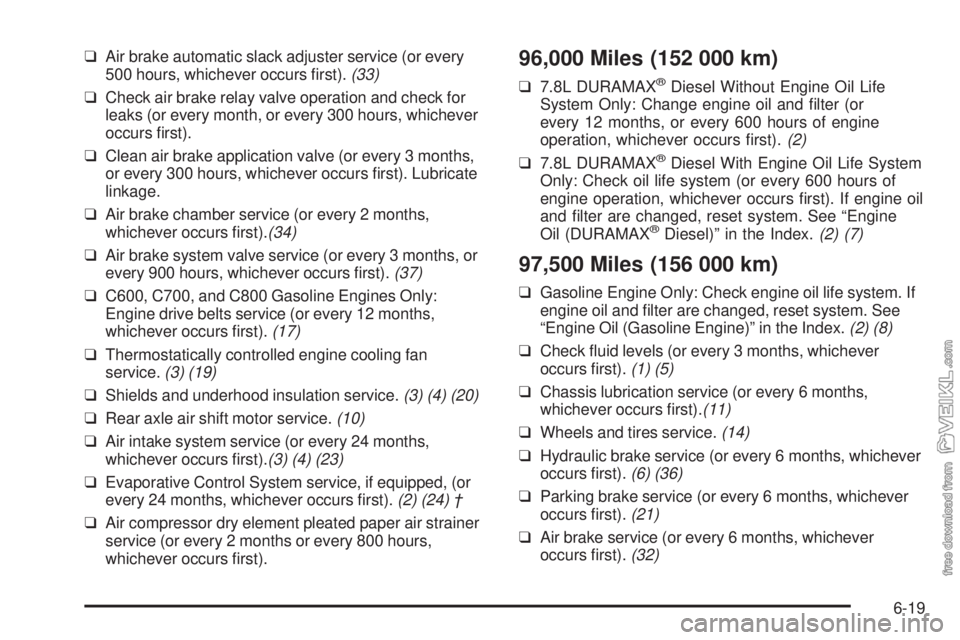
❑Air brake automatic slack adjuster service (or every
500 hours, whichever occurs first).(33)
❑Check air brake relay valve operation and check for
leaks (or every month, or every 300 hours, whichever
occurs first).
❑Clean air brake application valve (or every 3 months,
or every 300 hours, whichever occurs first). Lubricate
linkage.
❑Air brake chamber service (or every 2 months,
whichever occurs first).(34)
❑Air brake system valve service (or every 3 months, or
every 900 hours, whichever occurs first).(37)
❑C600, C700, and C800 Gasoline Engines Only:
Engine drive belts service (or every 12 months,
whichever occurs first).(17)
❑Thermostatically controlled engine cooling fan
service.(3) (19)
❑Shields and underhood insulation service.(3) (4) (20)
❑Rear axle air shift motor service.(10)
❑Air intake system service (or every 24 months,
whichever occurs first).(3) (4) (23)
❑Evaporative Control System service, if equipped, (or
every 24 months, whichever occurs first).(2) (24) †
❑Air compressor dry element pleated paper air strainer
service (or every 2 months or every 800 hours,
whichever occurs first).96,000 Miles (152 000 km)
❑7.8L DURAMAX®Diesel Without Engine Oil Life
System Only: Change engine oil and filter (or
every 12 months, or every 600 hours of engine
operation, whichever occurs first).(2)
❑7.8L DURAMAX
®Diesel With Engine Oil Life System
Only: Check oil life system (or every 600 hours of
engine operation, whichever occurs first). If engine oil
and filter are changed, reset system. See “Engine
Oil (DURAMAX
®Diesel)” in the Index.(2) (7)
97,500 Miles (156 000 km)
❑Gasoline Engine Only: Check engine oil life system. If
engine oil and filter are changed, reset system. See
“Engine Oil (Gasoline Engine)” in the Index.(2) (8)
❑Check fluid levels (or every 3 months, whichever
occurs first).(1) (5)
❑Chassis lubrication service (or every 6 months,
whichever occurs first).(11)
❑Wheels and tires service.(14)
❑Hydraulic brake service (or every 6 months, whichever
occurs first).(6) (36)
❑Parking brake service (or every 6 months, whichever
occurs first).(21)
❑Air brake service (or every 6 months, whichever
occurs first).(32)
6-19
Page 334 of 374
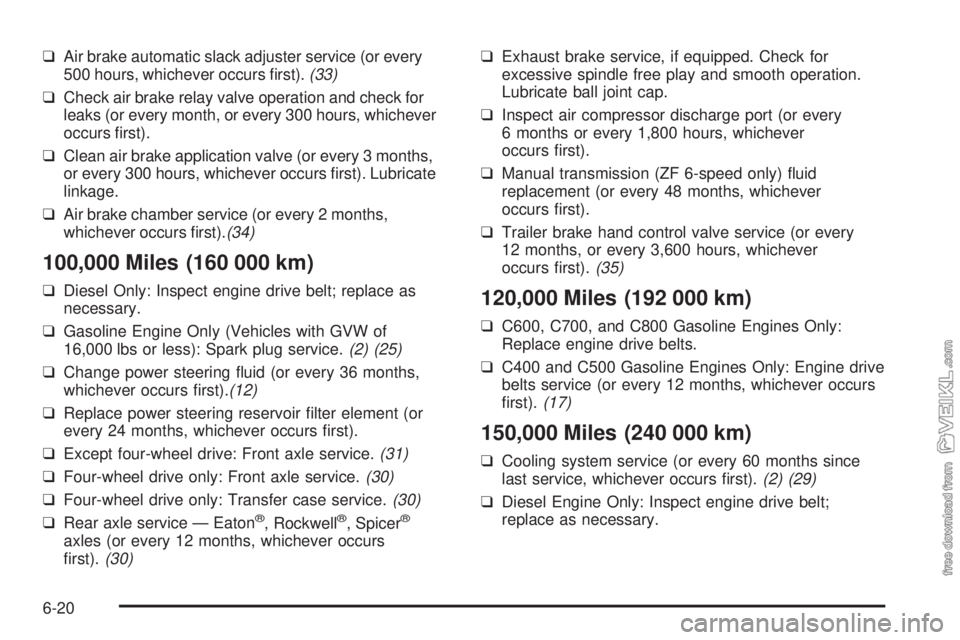
❑Air brake automatic slack adjuster service (or every
500 hours, whichever occurs first).(33)
❑Check air brake relay valve operation and check for
leaks (or every month, or every 300 hours, whichever
occurs first).
❑Clean air brake application valve (or every 3 months,
or every 300 hours, whichever occurs first). Lubricate
linkage.
❑Air brake chamber service (or every 2 months,
whichever occurs first).(34)
100,000 Miles (160 000 km)
❑Diesel Only: Inspect engine drive belt; replace as
necessary.
❑Gasoline Engine Only (Vehicles with GVW of
16,000 lbs or less): Spark plug service.(2) (25)
❑Change power steering fluid (or every 36 months,
whichever occurs first).(12)
❑Replace power steering reservoir filter element (or
every 24 months, whichever occurs first).
❑Except four-wheel drive: Front axle service.(31)
❑Four-wheel drive only: Front axle service.(30)
❑Four-wheel drive only: Transfer case service.(30)
❑Rear axle service — Eaton
®, Rockwell®, Spicer®
axles (or every 12 months, whichever occurs
first).(30)❑Exhaust brake service, if equipped. Check for
excessive spindle free play and smooth operation.
Lubricate ball joint cap.
❑Inspect air compressor discharge port (or every
6 months or every 1,800 hours, whichever
occurs first).
❑Manual transmission (ZF 6-speed only) fluid
replacement (or every 48 months, whichever
occurs first).
❑Trailer brake hand control valve service (or every
12 months, or every 3,600 hours, whichever
occurs first).(35)
120,000 Miles (192 000 km)
❑C600, C700, and C800 Gasoline Engines Only:
Replace engine drive belts.
❑C400 and C500 Gasoline Engines Only: Engine drive
belts service (or every 12 months, whichever occurs
first).(17)
150,000 Miles (240 000 km)
❑Cooling system service (or every 60 months since
last service, whichever occurs first).(2) (29)
❑Diesel Engine Only: Inspect engine drive belt;
replace as necessary.
6-20
Page 335 of 374
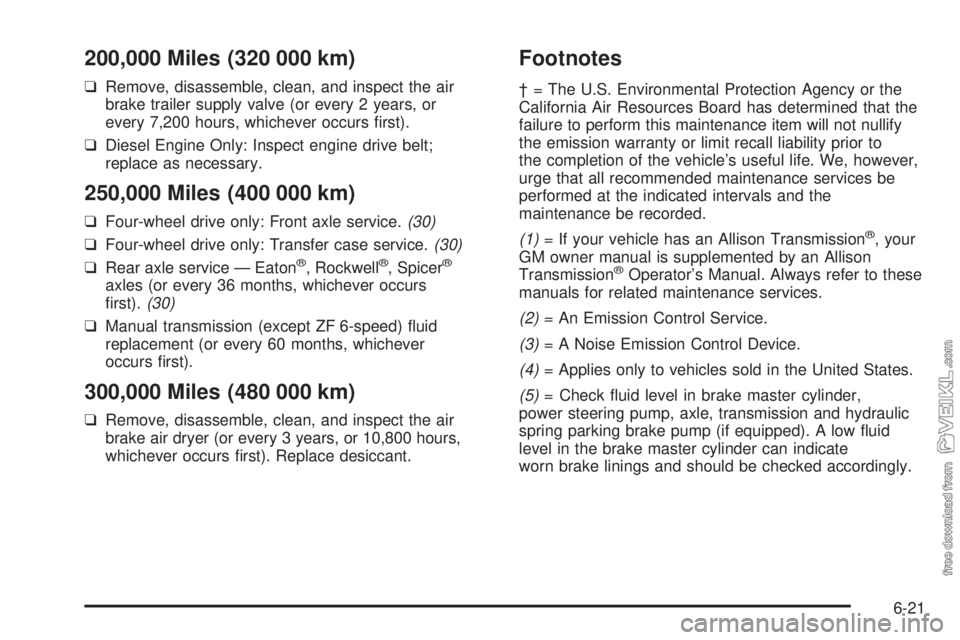
200,000 Miles (320 000 km)
❑Remove, disassemble, clean, and inspect the air
brake trailer supply valve (or every 2 years, or
every 7,200 hours, whichever occurs first).
❑Diesel Engine Only: Inspect engine drive belt;
replace as necessary.
250,000 Miles (400 000 km)
❑Four-wheel drive only: Front axle service.(30)
❑Four-wheel drive only: Transfer case service.(30)
❑Rear axle service — Eaton
®, Rockwell®, Spicer®
axles (or every 36 months, whichever occurs
first).(30)
❑Manual transmission (except ZF 6-speed) fluid
replacement (or every 60 months, whichever
occurs first).
300,000 Miles (480 000 km)
❑Remove, disassemble, clean, and inspect the air
brake air dryer (or every 3 years, or 10,800 hours,
whichever occurs first). Replace desiccant.
Footnotes
† = The U.S. Environmental Protection Agency or the
California Air Resources Board has determined that the
failure to perform this maintenance item will not nullify
the emission warranty or limit recall liability prior to
the completion of the vehicle’s useful life. We, however,
urge that all recommended maintenance services be
performed at the indicated intervals and the
maintenance be recorded.
(1)= If your vehicle has an Allison Transmission
®, your
GM owner manual is supplemented by an Allison
Transmission
®Operator’s Manual. Always refer to these
manuals for related maintenance services.
(2)= An Emission Control Service.
(3)= A Noise Emission Control Device.
(4)= Applies only to vehicles sold in the United States.
(5)= Check fluid level in brake master cylinder,
power steering pump, axle, transmission and hydraulic
spring parking brake pump (if equipped). A low fluid
level in the brake master cylinder can indicate
worn brake linings and should be checked accordingly.
6-21
Page 338 of 374
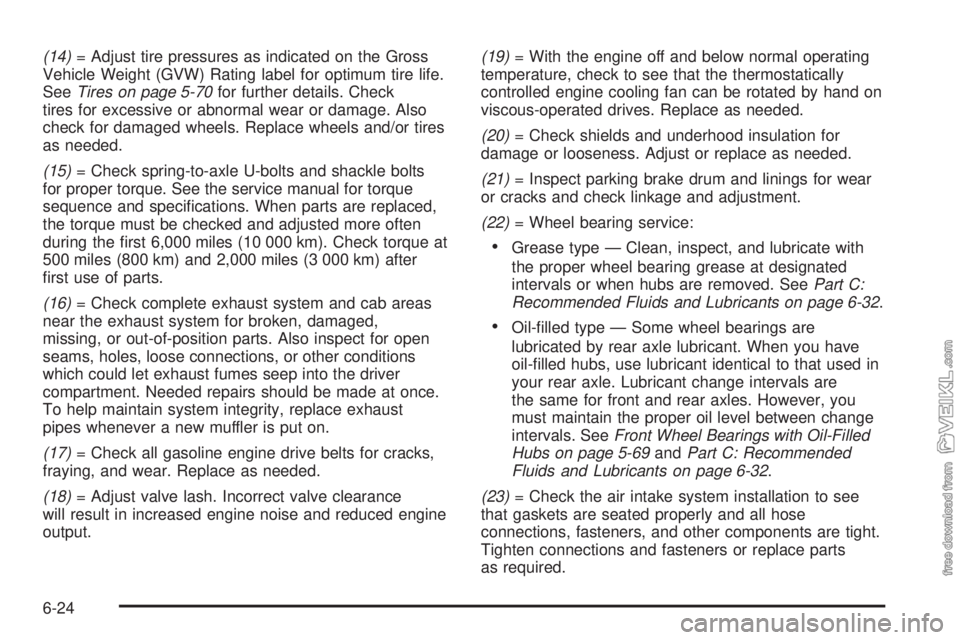
(14)= Adjust tire pressures as indicated on the Gross
Vehicle Weight (GVW) Rating label for optimum tire life.
SeeTires on page 5-70for further details. Check
tires for excessive or abnormal wear or damage. Also
check for damaged wheels. Replace wheels and/or tires
as needed.
(15)= Check spring-to-axle U-bolts and shackle bolts
for proper torque. See the service manual for torque
sequence and specifications. When parts are replaced,
the torque must be checked and adjusted more often
during the first 6,000 miles (10 000 km). Check torque at
500 miles (800 km) and 2,000 miles (3 000 km) after
first use of parts.
(16)= Check complete exhaust system and cab areas
near the exhaust system for broken, damaged,
missing, or out-of-position parts. Also inspect for open
seams, holes, loose connections, or other conditions
which could let exhaust fumes seep into the driver
compartment. Needed repairs should be made at once.
To help maintain system integrity, replace exhaust
pipes whenever a new muffler is put on.
(17)= Check all gasoline engine drive belts for cracks,
fraying, and wear. Replace as needed.
(18)= Adjust valve lash. Incorrect valve clearance
will result in increased engine noise and reduced engine
output.(19)= With the engine off and below normal operating
temperature, check to see that the thermostatically
controlled engine cooling fan can be rotated by hand on
viscous-operated drives. Replace as needed.
(20)= Check shields and underhood insulation for
damage or looseness. Adjust or replace as needed.
(21)= Inspect parking brake drum and linings for wear
or cracks and check linkage and adjustment.
(22)= Wheel bearing service:
•Grease type — Clean, inspect, and lubricate with
the proper wheel bearing grease at designated
intervals or when hubs are removed. SeePart C:
Recommended Fluids and Lubricants on page 6-32.
•Oil-filled type — Some wheel bearings are
lubricated by rear axle lubricant. When you have
oil-filled hubs, use lubricant identical to that used in
your rear axle. Lubricant change intervals are
the same for front and rear axles. However, you
must maintain the proper oil level between change
intervals. SeeFront Wheel Bearings with Oil-Filled
Hubs on page 5-69andPart C: Recommended
Fluids and Lubricants on page 6-32.
(23)= Check the air intake system installation to see
that gaskets are seated properly and all hose
connections, fasteners, and other components are tight.
Tighten connections and fasteners or replace parts
as required.
6-24
Page 342 of 374
Tire Ination Check
Check tire inflation cold. Make sure tires are inflated to
the pressures specified on the GVW Rating label.
SeeLoading Your Vehicle on page 4-32andTires on
page 5-70for further details.
At Least Twice a Year
Restraint System Check
Make sure the safety belt reminder light (if equipped)
and all your belts, buckles, latch plates, retractors, and
anchorages are working properly. Look for any other
loose or damaged safety belt system parts. If you
see anything that might keep a safety belt system from
doing its job, have it repaired. Have any torn or
frayed safety belts replaced.
Wiper Blade Check
Inspect wiper blades for wear or cracking. Replace
blade inserts that appear worn or damaged or that
streak or miss areas of the windshield. Also see
Windshield and Wiper Blades on page 5-84.
Weatherstrip Lubrication
Silicone grease on weatherstrips will make them last
longer, seal better, and not stick or squeak. Apply
silicone grease with a clean cloth. During very cold,
damp weather more frequent application may be
required. Part C tells you what to use.
Body Lubrication Service
Lubricate all exposed surfaces such as door checks,
door lock bolts, lock strike plates, door hinge bushings,
latches, and dovetail bumper wedges. Where oil
holes are provided, a dripless oil can be used. The seat
adjusters, seat track, door weatherstrips, and rubber
cap bumpers should also be lubricated. Part C tells you
what to use. More frequent lubrication may be required
when exposed to a corrosive environment.
Parking Brake Check
Park on a fairly steep hill and hold the vehicle with the
parking brake only. This checks holding ability.
6-28
Page 356 of 374
Canadian Roadside Assistance
In Canada, Medium Duty trucks are not eligible for
Roadside Assistance services. However,
owners/operators who contact Roadside Assistance by
calling 1-800-268-6800 may have a tow arranged
for them at the owner/operator expense.
If a Medium Duty truck is towed to a General Motors
dealership and the towing was necessary due to failure
of a warranted part, the dealer will accept the towing
charges and submit them as part of the warranty claim.
Vehicle Data Collection and Event
Data Recorders
Your vehicle, like other modern motor vehicles, has a
number of sophisticated computer systems that monitor
and control several aspects of the vehicle’s performance.
Your vehicle uses on-board vehicle computers to monitor
emission control components to optimize fuel economy,
to monitor conditions for airbag deployment and, if so
equipped, to provide anti-lock braking and to help the
driver control the vehicle in difficult driving situations.
Some information may be stored during regular
operations to facilitate repair of detected malfunctions;
other information is stored only in a crash event by
computer systems, such as those commonly called event
data recorders (EDR).In a crash event, computer systems, such as the Airbag
Sensing and Diagnostic Module (SDM) in your vehicle
may record information about the condition of the vehicle
and how it was operated, such as data related to
engine speed, brake application, throttle position, vehicle
speed, safety belt usage, airbag readiness, airbag
performance, and the severity of a collision. If your
vehicle is equipped with Quadrasteer, steering
performance, including yaw rate, steering wheel angle,
and lateral acceleration, is also recorded. This
information has been used to improve vehicle crash
performance and may be used to improve crash
performance of future vehicles and driving safety. Unlike
the data recorders on many airplanes, these on-board
systems do not record sounds, such as conversation of
vehicle occupants.
To read this information, special equipment is needed
and access to the vehicle or the device that stores
the data is required. GM will not access information
about a crash event or share it with others other than:
•with the consent of the vehicle owner or, if the
vehicle is leased, with the consent of the lessee,
•in response to an official request of police or similar
government office,
•as part of GM’s defense of litigation through the
discovery process, or
•as required by law.
7-6