battery CHEVROLET KODIAK 2005 Owners Manual
[x] Cancel search | Manufacturer: CHEVROLET, Model Year: 2005, Model line: KODIAK, Model: CHEVROLET KODIAK 2005Pages: 374, PDF Size: 5.46 MB
Page 65 of 374
Servicing Your Airbag-Equipped
Vehicle
Airbags affect how your vehicle should be serviced.
There are parts of the airbag system in several places
around your vehicle. You do not want the system to
inflate while someone is working on your vehicle.
Your dealer and the service manual have information
about servicing your vehicle and the airbag system.
To purchase a service manual, seeService Publications
Ordering Information on page 7-8.
{CAUTION:
For up to 10 seconds after the ignition key is
turned off and the battery is disconnected, an
airbag can still inate during improper service.
You can be injured if you are close to an
airbag when it inates. Avoid yellow wires,
wires wrapped with yellow tape or yellow
connectors. They are probably part of the
airbag system. Be sure to follow proper
service procedures, and make sure the person
performing work for you is qualied to do so.
The airbag system does not need regular maintenance.
Adding Equipment to Your
Airbag-Equipped Vehicle
Q:Is there anything I might add to the front of
the vehicle that could keep the airbags from
working properly?
A:Yes. If you add things that change your vehicle’s
frame, bumper system, front end sheet metal or
height, they may keep the airbag system from
working properly. Also, the airbag system may not
work properly if you relocate any of the airbag
sensors. If you have any questions about this,
you should contact Customer Assistance before
you modify your vehicle. The phone numbers
and addresses for Customer Assistance are in
Step Two of theCustomer Satisfaction Procedure
on page 7-2.
1-59
Page 70 of 374
At times you may notice a decrease in range. This is
normal for any remote keyless entry system. If the
transmitter does not work or if you have to stand closer
to your vehicle for the transmitter to work, try this:
•Check the distance. You may be too far from your
vehicle. You may need to stand closer during
rainy or snowy weather.
•Check the location. Other vehicles or objects may
be blocking the signal. Take a few steps to the
left or right, hold the transmitter higher, and
try again.
•Check to determine if battery replacement is
necessary. See “Battery Replacement” under
Remote Keyless Entry System Operation on
page 2-4.
•If you are still having trouble, see your dealer or a
qualified technician for service.
Remote Keyless Entry System
Operation
If your vehicle has this feature, you can lock and unlock
your doors from about 3 feet (1 m) up to 30 feet (9 m)
away using the remote keyless entry transmitter supplied
with your vehicle.
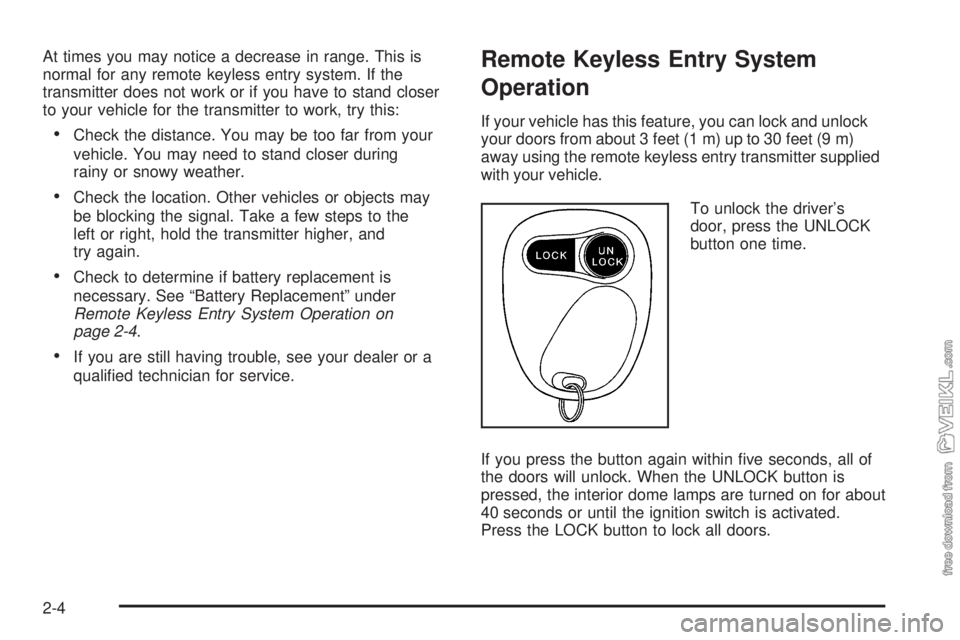
To unlock the driver’s
door, press the UNLOCK
button one time.
If you press the button again within five seconds, all of
the doors will unlock. When the UNLOCK button is
pressed, the interior dome lamps are turned on for about
40 seconds or until the ignition switch is activated.
Press the LOCK button to lock all doors.
2-4
Page 71 of 374
Matching Transmitter(s) to Your Vehicle
Each remote keyless entry transmitter is coded to
prevent another transmitter from unlocking your vehicle.
If a transmitter is lost or stolen, a replacement can
be purchased through your dealer. Remember to bring
any remaining transmitters with you when you go to
your dealer. When the dealer matches the replacement
transmitter to your vehicle, any remaining transmitters
must also be matched. Once your dealer has coded the
new transmitter, the lost transmitter will not unlock
your vehicle. Each vehicle can have a maximum of
four transmitters matched to it.
Battery Replacement
Under normal use, the battery in your remote keyless
entry transmitter should last about two years.
You can tell the battery is weak if the transmitter won’t
work at the normal range in any location. If you have
to get close to your vehicle before the transmitter works,
it’s probably time to change the battery.Notice:When replacing the battery, use care not to
touch any of the circuitry. Static from your body
transferred to these surfaces may damage the
transmitter.
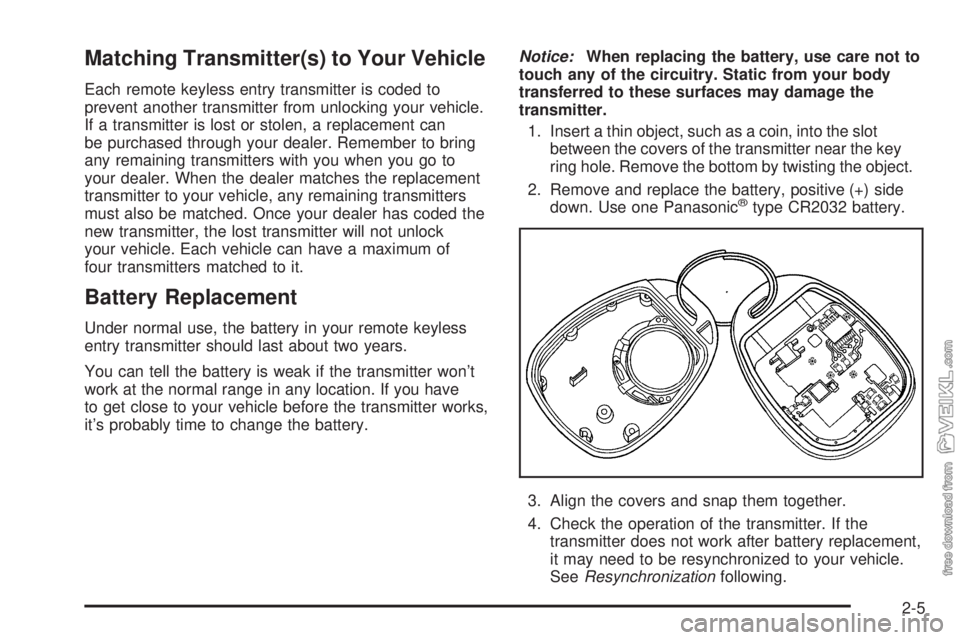
1. Insert a thin object, such as a coin, into the slot
between the covers of the transmitter near the key
ring hole. Remove the bottom by twisting the object.
2. Remove and replace the battery, positive (+) side
down. Use one Panasonic
®type CR2032 battery.
3. Align the covers and snap them together.
4. Check the operation of the transmitter. If the
transmitter does not work after battery replacement,
it may need to be resynchronized to your vehicle.
SeeResynchronizationfollowing.
2-5
Page 81 of 374
Automatic Transmission
Move your shift lever to PARK (P) or NEUTRAL (N).
Your engine will not start in any other position — that is
a safety feature. To restart when you are already
moving, use NEUTRAL (N) only.
Notice:Do not try to shift to PARK (P) if your
vehicle is moving. If you do, you could damage the
transmission. Shift to PARK (P) only when your
vehicle is stopped.
Manual Transmission
Move your shift lever to NEUTRAL and hold the
clutch pedal to the floor while starting the engine.
Your vehicle will not start if the clutch pedal is not
all the way down — that is a safety feature.
Starting Your Engine
1. Turn your ignition key to RUN.
Observe the wait to start light. SeeWait to
Start Indicator (Diesel Engine) on page 3-36.
This light may not come on if the engine is hot.
2. As soon as the wait to start light goes off,
immediately turn the ignition key to START.
When the engine starts, let go of the key.
If your vehicle is equipped with a DURAMAX
®6600
engine, it has a fast warm-up glow plug system.
The wait to start light will illuminate for a much
shorter time than most diesel engines, due to the
rapid heating of the glow plug system.
Notice:Holding your key in START for longer than
15 seconds at a time will cause your battery to
be drained much sooner. And the excessive heat
can damage your starter motor.
Notice:If the wait to start light stays on after
starting your vehicle, your vehicle may not run
properly. Have your vehicle serviced right away.
3. If the engine does not start after 15 seconds
of cranking, turn the ignition key to OFF. Wait
one minute for the starter to cool, then try the same
steps again.
2-15
Page 84 of 374
If Your Diesel Engine Will Not Start
If you have run out of fuel, seeRunning Out of Fuel on
page 5-15.
If you are not out of fuel, and your engine will not start,
do this:
Turn your ignition key to RUN. Immediately after the wait
to start light goes off, turn the ignition key to START.
If the light does not go off, wait a few seconds, then try
starting your engine again. And, see your dealer as
soon as you can for a starting system check.
If the light comes on and then goes off and you know
your batteries are charged, but your engine still will not
start, your vehicle needs service.
If the light does not come on when the engine is cold,
your vehicle needs service.
If your batteries do not have enough charge to start
your engine, seeBattery on page 5-55.
Be sure you have the right oil for your engine, and that
you have changed the oil at the proper times. If you
use the wrong oil, your engine may be harder to start.Be sure you are using the proper fuel for existing
weather conditions. SeeWhat Fuel to Use on page 5-8.
If the engine starts, runs a short time, then stops,
your vehicle needs service.
{CAUTION:
Do not use gasoline or starting aids, such as
ether, in the air intake. They could damage
your engine. There could also be a re, which
could cause serious personal injury.
Engine Alarm and Automatic
Shutdown
Your check gages warning light will come on if the
system senses high engine temperature or low engine
oil pressure. If high engine temperature or low engine oil
pressure is detected, you will also hear a tone alarm
at two beats per second. The alarm and the light
will remain on until the condition is fixed. If the engine
temperature or oil pressure condition worsens, the
tone alarm will go to five beats per second.
2-18
Page 89 of 374
During this warm-up period, check your warning lights
and gages:
•If oil pressure does not begin to rise within
15 seconds of starting, stop the engine and find the
cause. SeeOil Pressure Gage on page 3-37for
more information.
•If the engine coolant temperature gage needle goes
into the hot area on the gage, stop the engine and
find the cause of the overheating. SeeEngine
Coolant Temperature Gage on page 3-35for
more information.
•If you have air brakes, the dual-needle air pressure
gage should read at least 115 psi (790 kPa) for
both service systems before you try to move
the vehicle. When air pressure is below 60 psi
(420 kPa), the LOW AIR light will come on and you
will hear a tone alarm. SeeBrake System Warning
Light on page 3-31for more information. If the
pressure does not build up or drops during warm-up,
stop the engine and find the cause before you try
to move the vehicle. Recommended air pressure
before driving is 120 psi (830 kPa). SeeAir
Pressure Gage on page 3-44for more information.
•The charging system light should come on when
the ignition key is turned to RUN or START and
should go out when the engine is running above
idle. If the light does not go out or comes back on
during normal engine operation, have the charging
system checked right away. (This light tells you
if the generator is not charging; it does not reflect
the condition of the battery.) SeeCharging System
Light on page 3-30for more information.
•The voltmeter charge indicator gage tells you the
condition of your battery’s charge. The gage
should be in the center area during engine
operation. The red area on the left indicates an
undercharge condition; the red area on the
right indicates an overcharge. If the gage is in
either red area, have the battery and charging
system checked right away. SeeVoltmeter Gage
on page 3-30for more information.
Notice:Do not allow the engine to operate at low
idle for more than ve minutes. This can cause
low engine operating temperatures which can
affect engine operation and reduce engine life.
Engine idle speed should be increased to 1200 rpm
whenever extended idle is required. Once started,
the engine should be placed under load to allow the
engine coolant temperature to reach 150°F (66°C)
before shutting off the engine.
2-23
Page 131 of 374

The dome override button is located below the exterior
lamp control.
If the dome override button is pushed in, the dome
lamps will not come on. Use this feature when you want
to leave your door(s) open for an extended period of
time and do not want to run the battery down.
If the dome override button is in the out position, the
interior lamps will work as usual.
Entry Lighting
The delayed illumination feature will allow you to enter
or exit your vehicle with the lights on for about
20 seconds, after the door is closed or the ignition
is cycled.
Reading Lamps
If your vehicle has reading lamps, press the button next
to the lamp to turn the lamp on or off.
3-17
Page 133 of 374
q(Exhaust Brake Switch):SeeDiesel Engine
Exhaust Brake on page 2-25.
l(Differential Lock Control Switch):SeeRear
Axle Differential Lock Contol on page 4-9.
c(Airbag On/Off Switch):SeeAirbag Off Switch on
page 1-56.
If your vehicle does not have some of the features
controlled by these switches, there will be a blank switch
marker in its place.
Accessory Power Outlets
With accessory power outlets, you can plug in auxiliary
electrical equipment such as a cellular telephone or
CB radio.
The accessory power outlet is located on the
passenger’s side of the instrument panel.
To use an outlet, pull the cover down. When not using
it, always cover the outlet with the protective cap.
This circuit is protected by a fuse and has a maximum
current level.Notice:Leaving electrical equipment on for
extended periods will drain the battery. Always turn
off electrical equipment when not in use and do
not plug in equipment that exceeds the maximum
amperage rating.
Certain electrical accessories may not be compatible
with the accessory power outlet and could result
in blown vehicle or adapter fuses. If you experience a
problem, see your dealer for additional information
on accessory power outlets.
Notice:Adding any electrical equipment to your
vehicle may damage it or keep other components
from working as they should. The repairs would not
be covered by your warranty. Do not use equipment
exceeding maximum amperage rating. Check
with your dealer before adding electrical equipment.
When adding electrical equipment, be sure to follow
the proper installation instructions included with
the equipment.
Notice:Improper use of the power outlet can cause
damage not covered by your warranty. Do not
hang any type of accessory or accessory bracket
from the plug because the power outlets are
designed for accessory power plugs only.
3-19
Page 144 of 374
Charging System Light
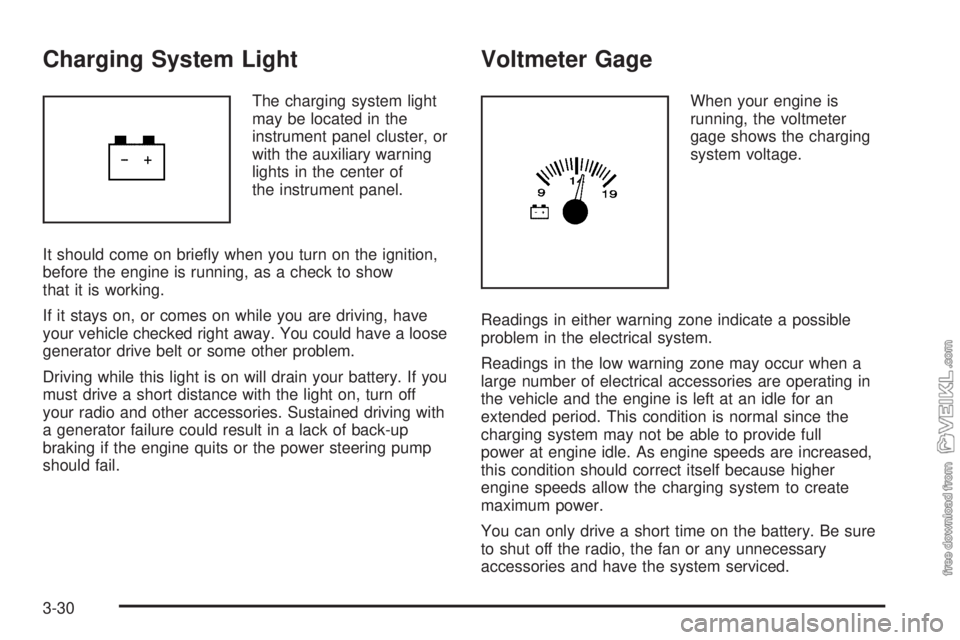
The charging system light
may be located in the
instrument panel cluster, or
with the auxiliary warning
lights in the center of
the instrument panel.
It should come on briefly when you turn on the ignition,
before the engine is running, as a check to show
that it is working.
If it stays on, or comes on while you are driving, have
your vehicle checked right away. You could have a loose
generator drive belt or some other problem.
Driving while this light is on will drain your battery. If you
must drive a short distance with the light on, turn off
your radio and other accessories. Sustained driving with
a generator failure could result in a lack of back-up
braking if the engine quits or the power steering pump
should fail.
Voltmeter Gage
When your engine is
running, the voltmeter
gage shows the charging
system voltage.
Readings in either warning zone indicate a possible
problem in the electrical system.
Readings in the low warning zone may occur when a
large number of electrical accessories are operating in
the vehicle and the engine is left at an idle for an
extended period. This condition is normal since the
charging system may not be able to provide full
power at engine idle. As engine speeds are increased,
this condition should correct itself because higher
engine speeds allow the charging system to create
maximum power.
You can only drive a short time on the battery. Be sure
to shut off the radio, the fan or any unnecessary
accessories and have the system serviced.
3-30
Page 158 of 374
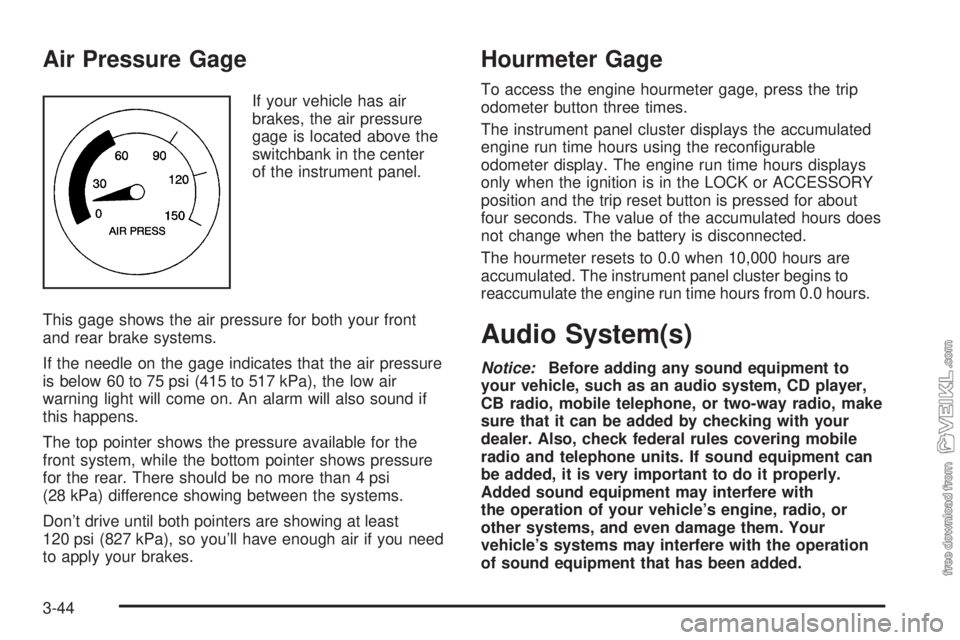
Air Pressure Gage
If your vehicle has air
brakes, the air pressure
gage is located above the
switchbank in the center
of the instrument panel.
This gage shows the air pressure for both your front
and rear brake systems.
If the needle on the gage indicates that the air pressure
is below 60 to 75 psi (415 to 517 kPa), the low air
warning light will come on. An alarm will also sound if
this happens.
The top pointer shows the pressure available for the
front system, while the bottom pointer shows pressure
for the rear. There should be no more than 4 psi
(28 kPa) difference showing between the systems.
Don’t drive until both pointers are showing at least
120 psi (827 kPa), so you’ll have enough air if you need
to apply your brakes.
Hourmeter Gage
To access the engine hourmeter gage, press the trip
odometer button three times.
The instrument panel cluster displays the accumulated
engine run time hours using the reconfigurable
odometer display. The engine run time hours displays
only when the ignition is in the LOCK or ACCESSORY
position and the trip reset button is pressed for about
four seconds. The value of the accumulated hours does
not change when the battery is disconnected.
The hourmeter resets to 0.0 when 10,000 hours are
accumulated. The instrument panel cluster begins to
reaccumulate the engine run time hours from 0.0 hours.
Audio System(s)
Notice:Before adding any sound equipment to
your vehicle, such as an audio system, CD player,
CB radio, mobile telephone, or two-way radio, make
sure that it can be added by checking with your
dealer. Also, check federal rules covering mobile
radio and telephone units. If sound equipment can
be added, it is very important to do it properly.
Added sound equipment may interfere with
the operation of your vehicle’s engine, radio, or
other systems, and even damage them. Your
vehicle’s systems may interfere with the operation
of sound equipment that has been added.
3-44