tow CHEVROLET KODIAK 2006 Owner's Guide
[x] Cancel search | Manufacturer: CHEVROLET, Model Year: 2006, Model line: KODIAK, Model: CHEVROLET KODIAK 2006Pages: 398, PDF Size: 5.72 MB
Page 225 of 398
Towing
Towing Your Vehicle
Consult your dealer or a professional towing service if
you need to have your disabled vehicle towed. See
Roadside Assistance Program on page 7-5.
Releasing Air-Operated Parking Brakes
If your vehicle has air brakes, you could have a
special towing problem. If your vehicle has to be towed
because of a complete loss of air pressure from
both systems, the parking brakes will have automatically
engaged. The tow operator can release the brakes
manually by using the following steps. Then your vehicle
can be towed with all wheels or only the rear wheels
on the ground.
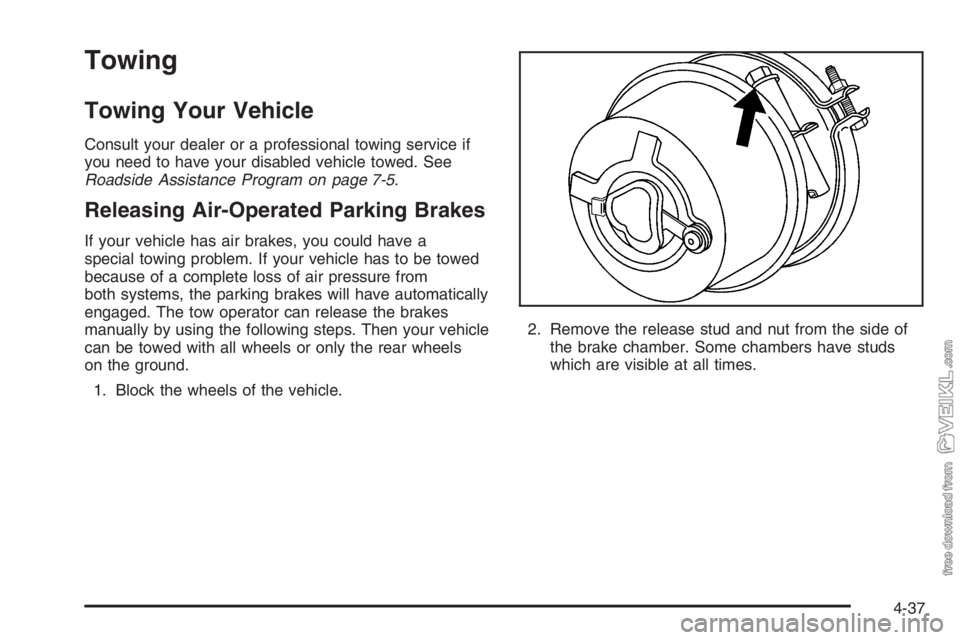
1. Block the wheels of the vehicle.2. Remove the release stud and nut from the side of
the brake chamber. Some chambers have studs
which are visible at all times.
4-37
Page 227 of 398
Trailer Connections
Heavy-Duty Trailer Wiring Package
Your vehicle may be equipped with an eight-wire trailer
towing harness. This harness, with a seven-pin
universal heavy-duty trailer connector, is attached to a
bracket on the platform hitch.
The Center High-Mounted Stoplamp (CHMSL) wire is
tied next to the trailer wiring harness for use with a
trailer.
The eight-wire harness contains the following trailer
circuits:
•Yellow: Left Stop/Turn Signal
•Dark Green: Right Stop/Turn Signal
•Brown: Taillamps
•White: Ground
•Light Green: Back-up Lamps
•Light Blue: CHMSL
•Red: Battery Feed
•Dark Blue: Trailer Brake
Trailer Connections
(C7/C8 Models Only)
If your vehicle has these trailer connections, they are
located at the rear of the cab for a tractor and at the rear
of the chassis when towing a trailer. There will be an
air connection and an electrical connection.
Be sure that the couplings to the trailer are made
correctly.
Air Connections
If you are not connecting the trailer air line connections
to another piece of equipment, be sure to replace
their protective caps.
Electrical Connections
This system is a seven-wire cable that will connect to
the trailer, supplying power to the trailer’s lighting
system. When not in use, it is stored in the trailer
air-hose storage bracket.
4-39
Page 252 of 398
Engine Oil
(Caterpillar
®Diesel Engine)
See your Caterpillar®Operation & Maintenance Manual
for information on oil quality and viscosities as well
as the temperature range chart.
Engine Oil (DURAMAX®Diesel)
Checking Engine Oil
It is a good idea to check your engine oil level every
time you get fuel.
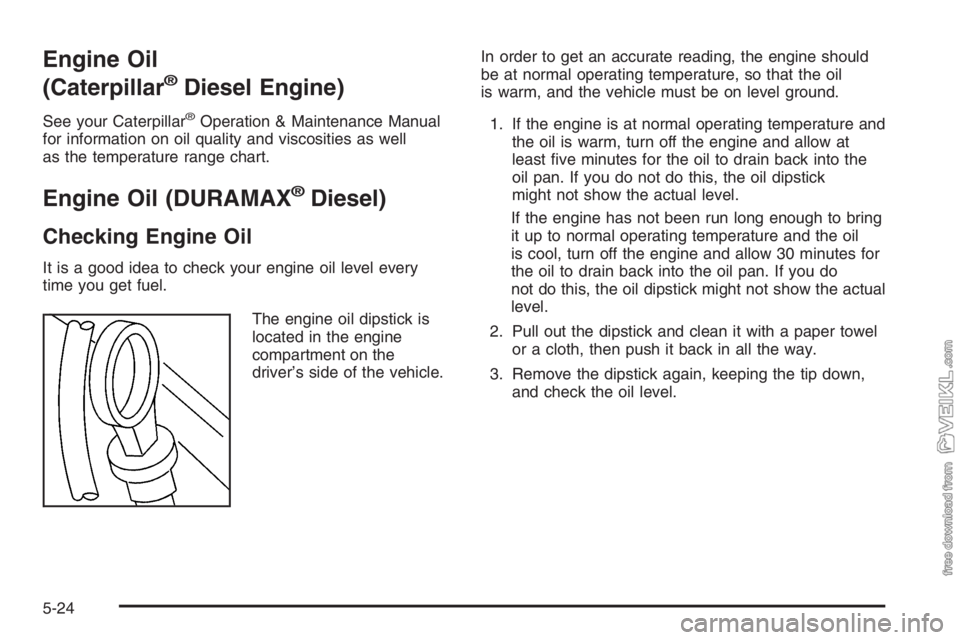
The engine oil dipstick is
located in the engine
compartment on the
driver’s side of the vehicle.In order to get an accurate reading, the engine should
be at normal operating temperature, so that the oil
is warm, and the vehicle must be on level ground.
1. If the engine is at normal operating temperature and
the oil is warm, turn off the engine and allow at
least five minutes for the oil to drain back into the
oil pan. If you do not do this, the oil dipstick
might not show the actual level.
If the engine has not been run long enough to bring
it up to normal operating temperature and the oil
is cool, turn off the engine and allow 30 minutes for
the oil to drain back into the oil pan. If you do
not do this, the oil dipstick might not show the actual
level.
2. Pull out the dipstick and clean it with a paper towel
or a cloth, then push it back in all the way.
3. Remove the dipstick again, keeping the tip down,
and check the oil level.
5-24
Page 256 of 398
Engine Oil (Gasoline Engine)
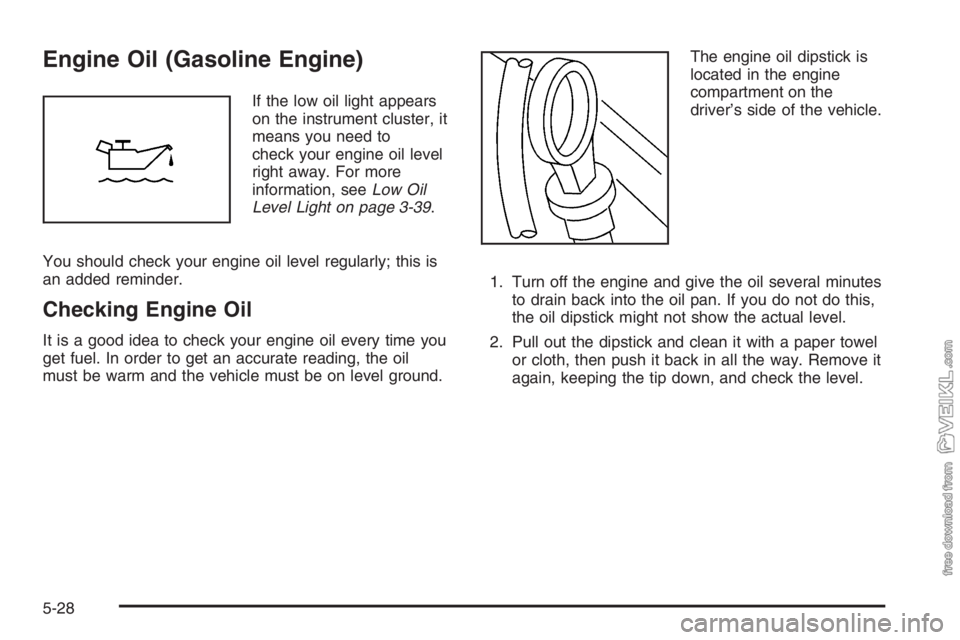
If the low oil light appears
on the instrument cluster, it
means you need to
check your engine oil level
right away. For more
information, seeLow Oil
Level Light on page 3-39.
You should check your engine oil level regularly; this is
an added reminder.
Checking Engine Oil
It is a good idea to check your engine oil every time you
get fuel. In order to get an accurate reading, the oil
must be warm and the vehicle must be on level ground.The engine oil dipstick is
located in the engine
compartment on the
driver’s side of the vehicle.
1. Turn off the engine and give the oil several minutes
to drain back into the oil pan. If you do not do this,
the oil dipstick might not show the actual level.
2. Pull out the dipstick and clean it with a paper towel
or cloth, then push it back in all the way. Remove it
again, keeping the tip down, and check the level.
5-28
Page 275 of 398
Engine Fan Noise
Your vehicle has a clutched engine cooling fan. When
the clutch is engaged, the fan spins faster to provide
more air to cool the engine. In most everyday driving
conditions, the clutch is not fully engaged. This improves
fuel economy and reduces fan noise. Under heavy
vehicle loading, trailer towing and/or high outside
temperatures, the fan speed increases when the clutch
engages. So you may hear an increase in fan noise.
This is normal and should not be mistaken as the
transmission slipping or making extra shifts. It is merely
the cooling system functioning properly. The fan will
slow down when additional cooling is not required and
the clutch disengages.
You may also hear this fan noise when you start the
engine. It will go away as the fan clutch disengages.
Power Steering Fluid
SeeScheduled Maintenance on page 6-5to determine
when to check your power steering fluid.
How To Check Power Steering Fluid
Check your power steering fluid only when the engine is
warm. If the engine is not warm, you probably will not
get an accurate reading.
If the fluid level is between the MIN (Minimum) and
MAX (Maximum) marks, you have enough. If you need
fluid, add only enough of the proper fluid to bring it
in between the MIN and MAX marks.
If your power steering fluid level is low, this can cause
the brake or service brakes soon warning lights to come
on. In addition, the steering effort and emergency
brake distance could increase.
If either light remains on after you have added power
steering fluid to the proper level, then shut off the engine
for 10 seconds. This should reset the brake warning
lights. If one or both lights stay on, see “Hydraulic Brake
System Warning Lights” underBrake System Warning
Light on page 3-33for more information.
What to Use
To determine what kind of fluid to use, seePart C:
Recommended Fluids and Lubricants on page 6-33.
Notice:When adding power steering uid or
making a complete uid change, always use the
proper uid. Failure to use the proper uid can
cause leaks and damage hoses and seals.
5-47
Page 297 of 398
Windshield Wiper Blade
Replacement
Windshield wiper blades should be inspected at least
twice a year for wear or cracking. See “Wiper Blade
Check” underAt Least Twice a Year on page 6-29for
more information.
Replacement blades come in different types and are
removed in different ways.
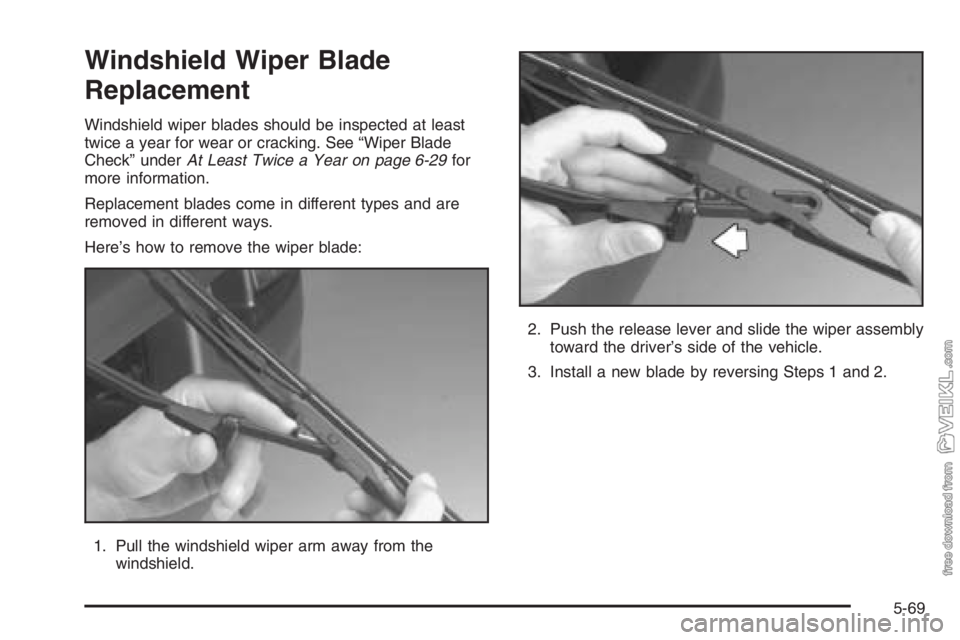
Here’s how to remove the wiper blade:
1. Pull the windshield wiper arm away from the
windshield.2. Push the release lever and slide the wiper assembly
toward the driver’s side of the vehicle.
3. Install a new blade by reversing Steps 1 and 2.
5-69
Page 308 of 398
{CAUTION:
If wheel studs are damaged, they can break. If
all the studs on a wheel broke, the wheel could
come off and cause a crash. If any stud is
damaged because of a loose-running wheel, it
could be that all of the studs are damaged. To
be sure, replace all studs on the wheel. If the
stud holes in a wheel have become larger, the
wheel could collapse in operation. Replace any
wheel if its stud holes have become larger or
distorted in any way. Inspect hubs and
hub-piloted wheels for damage. Because of
loose running wheels, piloting pad damage
may occur and require replacement of the
entire hub, for proper centering of the wheels.
When replacing studs, hubs, wheel nuts or
wheels, be sure to use GM original equipment
parts.
{CAUTION:
Rust or dirt on a wheel, or on the parts to
which it is fastened, can make wheel nuts
become loose after a time. The wheel could
come off and cause a crash. When you change
a wheel, remove any rust or dirt from places
where the wheel attaches to the vehicle. In an
emergency, you can use a cloth or a paper
towel to do this; but be sure to use a scraper
or wire brush later, if you need to, to get all the
rust or dirt off.
How Often to Check
Wheel tightness is so important you should have a
technician check nut tightness on all wheels with
a torque wrench after your first 100 miles (160 km), and
then 1,000 miles (1 600 km) after that. Be sure to
repeat this service whenever you have a tire removed
or serviced. SeeScheduled Maintenance on page 6-5
for further information.
5-80
Page 310 of 398
Used Replacement Wheels
{CAUTION:
Putting a used wheel on your vehicle is
dangerous. You cannot know how it has been
used or how far it has been driven. It could fail
suddenly and cause a crash. If you have to
replace a wheel, use a new GM original
equipment wheel.
If a Tire Goes Flat
It is unusual for a tire to blowout while you are driving,
especially if you maintain your tires properly. If air
goes out of a tire, it is much more likely to leak out
slowly. But if you should ever have a blowout, here are
a few tips about what to expect and what to do:
If a front tire fails, the flat tire will create a drag that
pulls the vehicle toward that side. Take your foot off the
accelerator pedal and grip the steering wheel firmly.
Steer to maintain lane position, and then gently brake to
a stop well out of the traffic lane.A rear blowout, particularly on a curve, acts much like a
skid and may require the same correction you would
use in a skid. In any rear blowout, remove your foot from
the accelerator pedal. Get the vehicle under control
by steering the way you want the vehicle to go. It may
be very bumpy and noisy, but you can still steer. Gently
brake to a stop –– well off the road if possible.
If a tire goes flat, avoid further tire and wheel damage
by driving slowly to a level place and turn on your
hazard warning flashers. SeeHazard Warning Flashers
on page 3-6.
{CAUTION:
Your vehicle, when new, did not include tire
changing equipment or a place to store a tire
in the vehicle. Special tools and procedures
are required if a tire needs to be serviced. If
these tools and procedures are not used, you
or others could be injured or killed while trying
to change or service a truck tire.
5-82
Page 313 of 398
Fabric/Carpet
Use a vacuum cleaner with a soft brush attachment
frequently to remove dust and loose dirt. A canister
vacuum with a beater bar in the nozzle may only
be used on floor carpet and carpeted floor mats. For
soils, always try to remove them first with plain water or
club soda. Before cleaning, gently remove as much
of the soil as possible using one of the following
techniques:
•For liquids: gently blot the remaining soil with a
paper towel. Allow the soil to absorb into the
paper towel until no more can be removed.
•For solid dry soils: remove as much as possible
and then vacuum.
To clean, use the following instructions:
1. Saturate a lint-free, clean white cloth with water or
club soda.
2. Wring the cloth to remove excess moisture.3. Start on the outside edge of the soil and gently rub
toward the center. Continue cleaning, using a clean
area of the cloth each time it becomes soiled.
4. Continue to gently rub the soiled area until the
cleaning cloth remains clean.
5. If the soil is not completely removed, use a mild
soap solution and repeat the cleaning process
that was used with plain water.
If any of the soil remains, a commercial fabric cleaner
or spot lifter may be necessary. When a commercial
upholstery cleaner or spot lifter is to be used, test
a small hidden area for colorfastness first. If the
locally cleaned area gives any impression that a ring
formation may result, clean the entire surface.
After the cleaning process has been completed, a paper
towel can be used to blot excess moisture from the
fabric or carpet.
5-85
Page 315 of 398
Washing Your Vehicle
The paint finish on the vehicle provides beauty, depth of
color, gloss retention, and durability.
The best way to preserve the vehicle’s finish is to keep
it clean by washing it often with lukewarm or cold
water.
Do not wash the vehicle in the direct rays of the sun.
Use a car washing soap. Do not use strong soaps
or chemical detergents. Be sure to rinse the vehicle well,
removing all soap residue completely. GM-approved
cleaning products can be obtained from your dealer. See
Vehicle Care/Appearance Materials on page 5-90.Do
not use cleaning agents that are petroleum based,
or that contain acid or abrasives. All cleaning agents
should be flushed promptly and not allowed to dry on the
surface, or they could stain. Dry the finish with a soft,
clean chamois or an all-cotton towel to avoid surface
scratches and water spotting.
High pressure car washes may cause water to enter the
vehicle.
Cleaning Exterior Lamps/Lenses
Use only lukewarm or cold water, a soft cloth and a car
washing soap to clean exterior lamps and lenses.
Follow instructions underWashing Your Vehicle on
page 5-87.
Finish Care
Occasional waxing or mild polishing of your vehicle by
hand may be necessary to remove residue from the
paint finish. You can get GM-approved cleaning products
from your dealer. SeeVehicle Care/Appearance
Materials on page 5-90.
If your vehicle has a “basecoat/clearcoat” paint finish,
the clearcoat gives more depth and gloss to the colored
basecoat. Always use waxes and polishes that are
non-abrasive and made for a basecoat/clearcoat paint
finish.
Notice:Machine compounding or aggressive
polishing on a basecoat/clearcoat paint nish may
damage it. Use only non-abrasive waxes and
polishes that are made for a basecoat/clearcoat
paint nish on your vehicle.
5-87