warning CHEVROLET KODIAK 2006 Service Manual
[x] Cancel search | Manufacturer: CHEVROLET, Model Year: 2006, Model line: KODIAK, Model: CHEVROLET KODIAK 2006Pages: 398, PDF Size: 5.72 MB
Page 267 of 398
If you have to add coolant more than four times a year,
have your dealer check your cooling system.
Notice:If you use extra inhibitors and/or additives
in your vehicle’s cooling system, you could
damage your vehicle. Use only the proper mixture
of the engine coolant listed in this manual for
the cooling system. SeePart C: Recommended
Fluids and Lubricants on page 6-33for more
information.
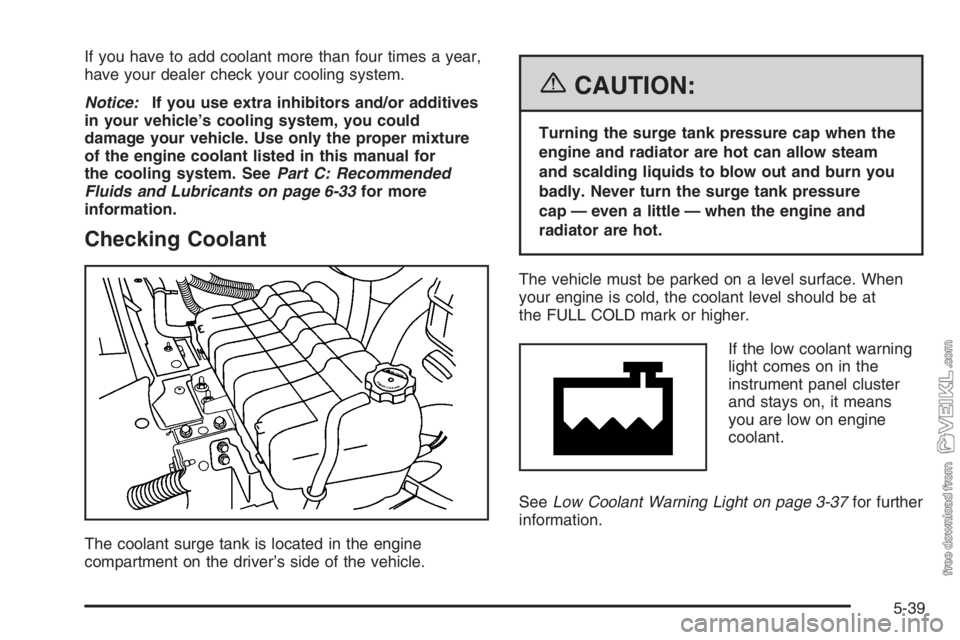
Checking Coolant
The coolant surge tank is located in the engine
compartment on the driver’s side of the vehicle.
{CAUTION:
Turning the surge tank pressure cap when the
engine and radiator are hot can allow steam
and scalding liquids to blow out and burn you
badly. Never turn the surge tank pressure
cap — even a little — when the engine and
radiator are hot.
The vehicle must be parked on a level surface. When
your engine is cold, the coolant level should be at
the FULL COLD mark or higher.
If the low coolant warning
light comes on in the
instrument panel cluster
and stays on, it means
you are low on engine
coolant.
SeeLow Coolant Warning Light on page 3-37for further
information.
5-39
Page 268 of 398
Adding Coolant
If you need more coolant, add the proper DEX-COOL®
coolant mixture at the surge tank, but only when the
engine is cool.
{CAUTION:
You can be burned if you spill coolant on hot
engine parts. Coolant contains ethylene glycol,
and it will burn if the engine parts are hot
enough. Do not spill coolant on a hot engine.
When replacing the pressure cap, make sure it is
hand-tight and fully seated.
Engine Coolant
(Caterpillar
®Diesel Engines)
If your vehicle has a Caterpillar®diesel engine, see the
Caterpillar®Diesel Engine Operation & Maintenance
Manual provided with your vehicle to find out what
to add, as well as when and how to service your cooling
system.
Coolant Surge Tank Pressure Cap
The coolant surge tank pressure cap is located in
the engine compartment, on the driver’s side of the
vehicle.
Notice:Your vehicle’s surge tank pressure cap is
designed for use with medium-duty cooling systems
only. If the surge tank pressure cap is not tightly
installed, coolant loss and possible engine damage
may occur. Be sure the cap is properly and tightly
secured.
Engine Overheating
You will find an engine coolant temperature gage, as
well as a low coolant warning light, on your vehicle’s
instrument panel. SeeEngine Coolant Temperature
Gage on page 3-36andLow Coolant Warning Light on
page 3-37for more information.
Your vehicle also has a check gages warning light on
the instrument panel. SeeCheck Gages Warning
Light on page 3-44for more information.
5-40
Page 269 of 398
If Steam Is Coming From Your Engine
{CAUTION:
Steam from an overheated engine can burn
you badly, even if you just open the hood. Stay
away from the engine if you see or hear steam
coming from it. Just turn it off and get
everyone away from the vehicle until it cools
down. Wait until there is no sign of steam or
coolant before you open the hood.
If you keep driving when your engine is
overheated, the liquids in it can catch re. You
or others could be badly burned. Stop your
engine if it overheats, and get out of the
vehicle until the engine is cool.
Notice:If your engine catches re because you
keep driving with no coolant, your vehicle can
be badly damaged. The costly repairs would not be
covered by your warranty.
If No Steam Is Coming From Your
Engine
An overheat warning, along with a low coolant light, can
indicate a serious problem. SeeLow Coolant Warning
Light on page 3-37for more information.
If you get an engine overheat warning with no low
coolant light, but see or hear no steam, the problem may
not be too serious. Sometimes the engine can get a
little too hot when you:
•Climb a long hill on a hot day.
•Stop after high-speed driving.
•Idle for long periods in traffic.
If you get the overheat warning with no sign of steam,
try this for a minute or so:
1. In heavy traffic, let the engine idle in NEUTRAL
while stopped. If it is safe to do so, pull off the
road, shift to PARK (P) or NEUTRAL and let the
engine idle.
2. Turn on your heater to full hot at the highest fan
speed and open the windows as necessary.
3. If climbing a hill, downshift to raise engine and fan
speeds.
5-41
Page 270 of 398
If you no longer have the overheat warning, you can
drive. Just to be safe, drive slower for about 10 minutes.
If the warning does not come back on, you can drive
normally.
If the warning continues and you have not stopped, pull
over, stop, and park your vehicle right away.
If there is still no sign of steam, you can push down the
accelerator until the engine speed is about twice as
fast as normal idle speed for at least three minutes while
you are parked. If you still have the warning, turn off
the engine and get everyone out of the vehicle until it
cools down.
You may decide not to lift the hood but to get service
help right away.Cooling System
(Gas and DURAMAX
®Engines)
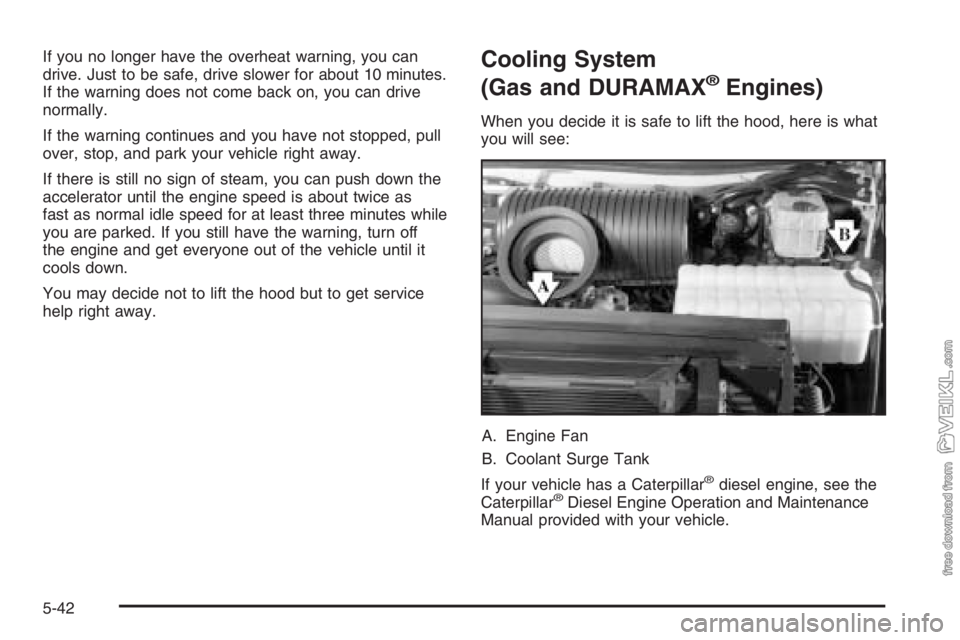
When you decide it is safe to lift the hood, here is what
you will see:
A. Engine Fan
B. Coolant Surge Tank
If your vehicle has a Caterpillar
®diesel engine, see the
Caterpillar®Diesel Engine Operation and Maintenance
Manual provided with your vehicle.
5-42
Page 273 of 398
{CAUTION:
Adding only plain water to your cooling
system can be dangerous. Plain water, or
some other liquid such as alcohol, can boil
before the proper coolant mixture will. Your
vehicle’s coolant warning system is set for the
proper coolant mixture. With plain water or the
wrong mixture, your engine could get too hot
but you would not get the overheat warning.
Your engine could catch re and you or others
could be burned. Use a 50/50 mixture of clean,
drinkable water and DEX-COOL
®coolant.
Notice:In cold weather, water can freeze and crack
the engine, radiator, heater core and other parts.
Use the recommended coolant and the proper
coolant mixture.
{CAUTION:
You can be burned if you spill coolant on hot
engine parts. Coolant contains ethylene glycol
and it will burn if the engine parts are hot
enough. Do not spill coolant on a hot engine.
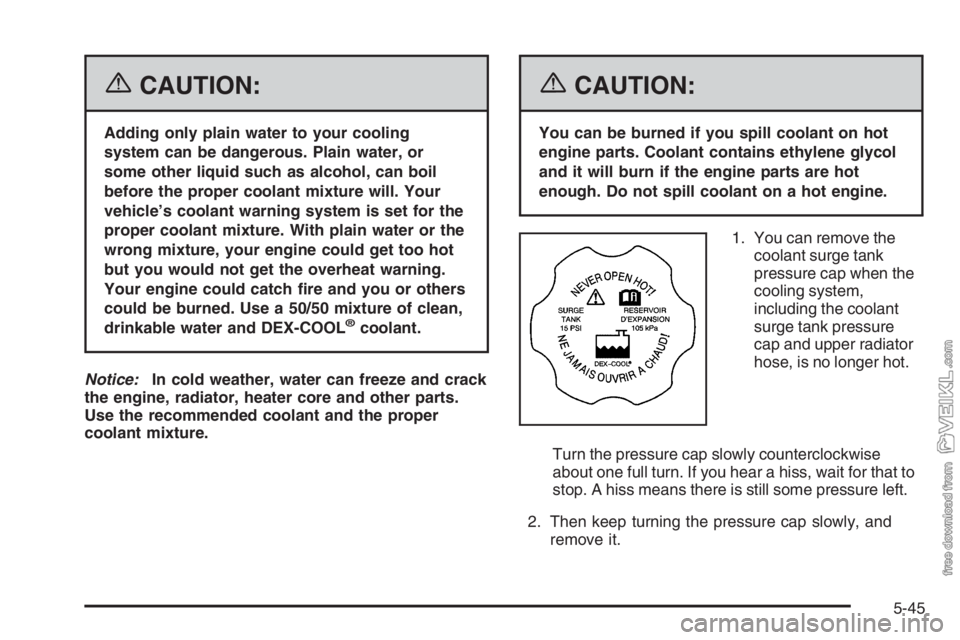
1. You can remove the
coolant surge tank
pressure cap when the
cooling system,
including the coolant
surge tank pressure
cap and upper radiator
hose, is no longer hot.
Turn the pressure cap slowly counterclockwise
about one full turn. If you hear a hiss, wait for that to
stop. A hiss means there is still some pressure left.
2. Then keep turning the pressure cap slowly, and
remove it.
5-45
Page 275 of 398
Engine Fan Noise
Your vehicle has a clutched engine cooling fan. When
the clutch is engaged, the fan spins faster to provide
more air to cool the engine. In most everyday driving
conditions, the clutch is not fully engaged. This improves
fuel economy and reduces fan noise. Under heavy
vehicle loading, trailer towing and/or high outside
temperatures, the fan speed increases when the clutch
engages. So you may hear an increase in fan noise.
This is normal and should not be mistaken as the
transmission slipping or making extra shifts. It is merely
the cooling system functioning properly. The fan will
slow down when additional cooling is not required and
the clutch disengages.
You may also hear this fan noise when you start the
engine. It will go away as the fan clutch disengages.
Power Steering Fluid
SeeScheduled Maintenance on page 6-5to determine
when to check your power steering fluid.
How To Check Power Steering Fluid
Check your power steering fluid only when the engine is
warm. If the engine is not warm, you probably will not
get an accurate reading.
If the fluid level is between the MIN (Minimum) and
MAX (Maximum) marks, you have enough. If you need
fluid, add only enough of the proper fluid to bring it
in between the MIN and MAX marks.
If your power steering fluid level is low, this can cause
the brake or service brakes soon warning lights to come
on. In addition, the steering effort and emergency
brake distance could increase.
If either light remains on after you have added power
steering fluid to the proper level, then shut off the engine
for 10 seconds. This should reset the brake warning
lights. If one or both lights stay on, see “Hydraulic Brake
System Warning Lights” underBrake System Warning
Light on page 3-33for more information.
What to Use
To determine what kind of fluid to use, seePart C:
Recommended Fluids and Lubricants on page 6-33.
Notice:When adding power steering uid or
making a complete uid change, always use the
proper uid. Failure to use the proper uid can
cause leaks and damage hoses and seals.
5-47
Page 286 of 398
Battery
Your vehicle has one or more maintenance free
batteries. When it is time for a new battery, be sure it
has the replacement number shown on the original
battery’s label. We recommend an ACDelco
®
replacement battery.
Warning:Battery posts, terminals, and related
accessories contain lead and lead compounds,
chemicals known to the State of California to cause
cancer and reproductive harm. Wash hands after
handling.
Vehicle Storage
If you are not going to drive your vehicle for 25 days or
more, remove the black, negative (−) cable from the
battery. This will help keep your battery from running
down. (If your vehicle has more than one battery,
be sure to remove the negative (−) battery cable from
each battery.)
{CAUTION:
Batteries have acid that can burn you and
gas that can explode. You can be badly hurt if
you are not careful. SeeJump Starting on
page 5-59for tips on working around a battery
without getting hurt.
When you are ready to use the vehicle again, refer to
the engine starting procedure in the Index.
5-58
Page 309 of 398
Wheel Replacement
Replace any wheel that is bent, cracked or badly rusted
or corroded. If wheel nuts keep coming loose, replace
the wheel. If the wheel leaks air, replace it.
Your dealer will know the kind of wheel you need.
Each new wheel should have the same load-carrying
capacity, diameter, width, offset and be mounted
the same way as the one it replaces.
If you need to replace any of your wheels, wheel bolts
or wheel nuts, replace them only with new GM original
equipment parts. This way, you will be sure to have the
right wheel, wheel bolts and wheel nuts for your vehicle.
{CAUTION:
A leaking wheel could fail without warning. A
wheel designed for tubeless tires could be
leaking because it is damaged. Do not use an
inner tube or some other thing to try to stop the
leaking. Get a new wheel or the proper type.
{CAUTION:
Without the correct wheel, you may not be able
to stop properly, and you could have other
problems like a tire air-out. You could have a
collision. If you do not go to your dealer to get
a new wheel, be sure you get the correct one.
Each new wheel should match the original
wheel in load-carrying capacity, ination
pressure capacity, diameter, width, offset and
mounting conguration.
Using wheels and tires with higher load-carrying limits
than the original wheels and tires does not change
the Gross Axle Weight Rating (GAWR) or the Gross
Vehicle Weight Rating (GVWR) of your vehicle.
SeeLoading Your Vehicle on page 4-34for more
information.
Notice:The wrong wheel can cause trouble in
bearing life, brake cooling, speedometer/odometer
calibration, headlamp aim, bumper height, vehicle
ground clearance, stopping distance and tire
clearance to the body and chassis. You could also
have other problems like a tire air-out.
5-81
Page 310 of 398
Used Replacement Wheels
{CAUTION:
Putting a used wheel on your vehicle is
dangerous. You cannot know how it has been
used or how far it has been driven. It could fail
suddenly and cause a crash. If you have to
replace a wheel, use a new GM original
equipment wheel.
If a Tire Goes Flat
It is unusual for a tire to blowout while you are driving,
especially if you maintain your tires properly. If air
goes out of a tire, it is much more likely to leak out
slowly. But if you should ever have a blowout, here are
a few tips about what to expect and what to do:
If a front tire fails, the flat tire will create a drag that
pulls the vehicle toward that side. Take your foot off the
accelerator pedal and grip the steering wheel firmly.
Steer to maintain lane position, and then gently brake to
a stop well out of the traffic lane.A rear blowout, particularly on a curve, acts much like a
skid and may require the same correction you would
use in a skid. In any rear blowout, remove your foot from
the accelerator pedal. Get the vehicle under control
by steering the way you want the vehicle to go. It may
be very bumpy and noisy, but you can still steer. Gently
brake to a stop –– well off the road if possible.
If a tire goes flat, avoid further tire and wheel damage
by driving slowly to a level place and turn on your
hazard warning flashers. SeeHazard Warning Flashers
on page 3-6.
{CAUTION:
Your vehicle, when new, did not include tire
changing equipment or a place to store a tire
in the vehicle. Special tools and procedures
are required if a tire needs to be serviced. If
these tools and procedures are not used, you
or others could be injured or killed while trying
to change or service a truck tire.
5-82
Page 322 of 398
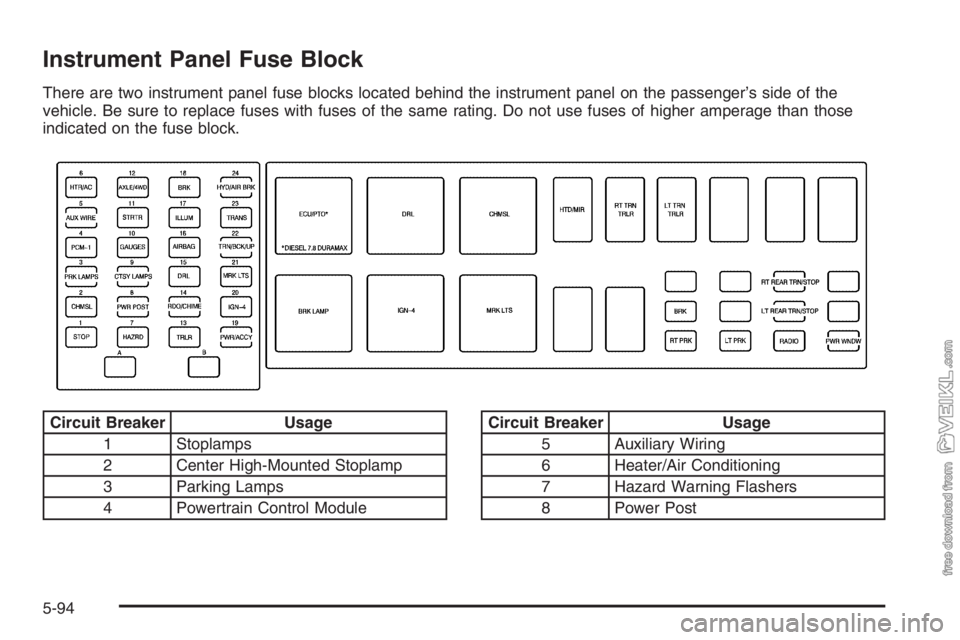
Instrument Panel Fuse Block
There are two instrument panel fuse blocks located behind the instrument panel on the passenger’s side of the
vehicle. Be sure to replace fuses with fuses of the same rating. Do not use fuses of higher amperage than those
indicated on the fuse block.
Circuit Breaker Usage
1 Stoplamps
2 Center High-Mounted Stoplamp
3 Parking Lamps
4 Powertrain Control ModuleCircuit Breaker Usage
5 Auxiliary Wiring
6 Heater/Air Conditioning
7 Hazard Warning Flashers
8 Power Post
5-94