warning CHEVROLET KODIAK 2006 User Guide
[x] Cancel search | Manufacturer: CHEVROLET, Model Year: 2006, Model line: KODIAK, Model: CHEVROLET KODIAK 2006Pages: 398, PDF Size: 5.72 MB
Page 122 of 398
Low Coolant Warning Light............................3-37
Wait to Start Indicator (Diesel Engine).............3-37
Malfunction Indicator Lamp.............................3-38
Oil Pressure Gage........................................3-38
Low Oil Level Light.......................................3-39
Change Engine Oil Light................................3-40
Engine Overspeed Warning Light....................3-40
Engine Shutdown Warning Light.....................3-40
Transmission Temperature Gage.....................3-41
Exhaust Brake Indicator Light.........................3-41
Differential Lock Indicator Light.......................3-42
Reduced Engine Power Light.........................3-42
Highbeam On Light.......................................3-43
Daytime Running Lamps (DRL)
Indicator Light...........................................3-43
Low Washer Fluid Warning Light.....................3-44
Check Gages Warning Light...........................3-44Fuel Gage...................................................3-45
Water in Fuel Warning Light...........................3-46
Air Filter Restriction Indicator..........................3-46
Air Pressure Gage........................................3-47
Hourmeter Gage...........................................3-47
Audio System(s).............................................3-48
Setting the Time...........................................3-49
AM-FM Radio...............................................3-50
Radio with Cassette......................................3-53
Radio with CD..............................................3-59
Theft-Deterrent Feature (Non-RDS Radios).......3-64
Radio Reception...........................................3-64
Care of the Cassette Tape Player...................3-65
Care of Your CDs.........................................3-66
Care of the CD Player...................................3-67
Fixed Mast Antenna......................................3-67
Chime Level Adjustment................................3-67
Section 3 Instrument Panel
3-2
Page 125 of 398
A. Air Outlets. SeeOutlet Adjustment on page 3-24.
B. Instrument Panel Cluster. SeeInstrument Panel
Cluster on page 3-26.
C. Shift Lever. SeeAutomatic Transmission Operation
on page 2-30orManual Transmission Operation
on page 2-31.
D. Air Brake Controls. SeeAir Brake on page 2-42.
E. Transfer Case Controls (If Equipped). See
Four-Wheel Drive on page 2-35. Air Filter Gage
(If Equipped). SeeAir Filter Restriction Indicator on
page 3-46.
F. Auxiliary Gages. SeeWarning Lights, Gages, and
Indicators on page 3-25.
G. Exterior Lamp Control. SeeExterior Lamps on
page 3-14.H. Turn Signal/Multifunction Lever. SeeTurn
Signal/Multifunction Lever on page 3-7.
I. Hazard Warning Flashers Button. SeeHazard
Warning Flashers on page 3-6.
J. Audio System(s). SeeAudio System(s) on
page 3-48.
K. Climate Controls. SeeClimate Control System on
page 3-20.
L. Instrument Panel Switchbank. SeeInstrument Panel
Switchbank on page 3-18.
M. Airbag Off Switch. SeeAirbag Off Switch on
page 1-58.
N. Accessory Power Outlets. SeeAccessory Power
Outlet(s) on page 3-19.
3-5
Page 126 of 398
Hazard Warning Flashers
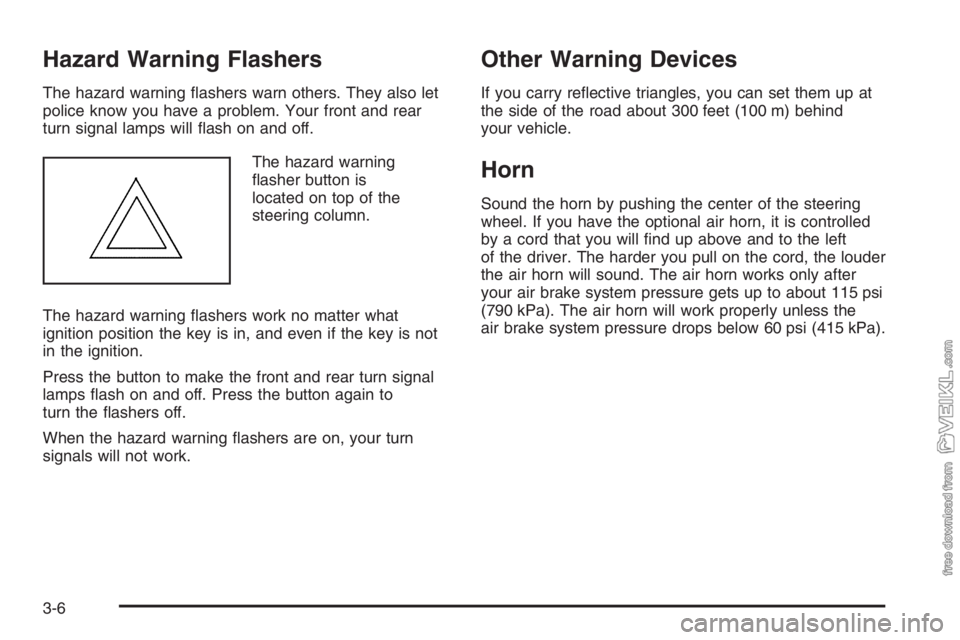
The hazard warning flashers warn others. They also let
police know you have a problem. Your front and rear
turn signal lamps will flash on and off.
The hazard warning
flasher button is
located on top of the
steering column.
The hazard warning flashers work no matter what
ignition position the key is in, and even if the key is not
in the ignition.
Press the button to make the front and rear turn signal
lamps flash on and off. Press the button again to
turn the flashers off.
When the hazard warning flashers are on, your turn
signals will not work.
Other Warning Devices
If you carry reflective triangles, you can set them up at
the side of the road about 300 feet (100 m) behind
your vehicle.
Horn
Sound the horn by pushing the center of the steering
wheel. If you have the optional air horn, it is controlled
by a cord that you will find up above and to the left
of the driver. The harder you pull on the cord, the louder
the air horn will sound. The air horn works only after
your air brake system pressure gets up to about 115 psi
(790 kPa). The air horn will work properly unless the
air brake system pressure drops below 60 psi (415 kPa).
3-6
Page 145 of 398
Warning Lights, Gages, and
Indicators
This part describes the warning lights and gages that
may be on your vehicle. The pictures will help you
locate them.
Warning lights and gages can signal that something is
wrong before it becomes serious enough to cause
an expensive repair or replacement. Paying attention to
your warning lights and gages could also save you
or others from injury.Warning lights come on when there may be or is a
problem with one of your vehicle’s functions. As you
will see in the details on the next few pages, some
warning lights come on briefly when you start the engine
just to let you know they’re working. If you are familiar
with this section, you should not be alarmed when
this happens.
Gages can indicate when there may be or is a problem
with one of your vehicle’s functions. Often gages
and warning lights work together to let you know when
there’s a problem with your vehicle.
When one of the warning lights comes on and stays on
when you are driving, or when one of the gages
shows there may be a problem, check the section that
tells you what to do about it. Waiting to do repairs
can be costly – and even dangerous.
3-25
Page 151 of 398
{CAUTION:
If the airbag readiness light ever comes on
when you have turned off the airbag, it means
that something may be wrong with the airbag
system. The right front passenger’s airbag
could inate even though the switch is off. If
this ever happens, do not let anyone whom the
national government has identied as a
member of a passenger airbag risk group sit in
the right front passenger’s position (for
example, do not secure a rear-facing child
restraint in the right front passenger’s seat)
until you have your vehicle serviced. See
Airbag Off Switch on page 1-58andAirbag
Readiness Light on page 3-29for more on this,
including important safety information.
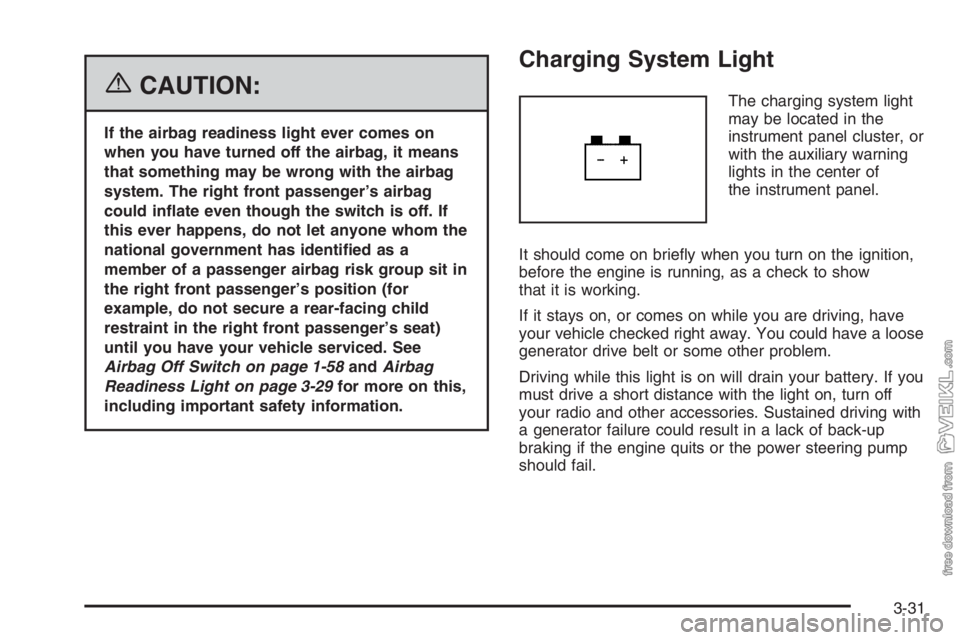
Charging System Light
The charging system light
may be located in the
instrument panel cluster, or
with the auxiliary warning
lights in the center of
the instrument panel.
It should come on briefly when you turn on the ignition,
before the engine is running, as a check to show
that it is working.
If it stays on, or comes on while you are driving, have
your vehicle checked right away. You could have a loose
generator drive belt or some other problem.
Driving while this light is on will drain your battery. If you
must drive a short distance with the light on, turn off
your radio and other accessories. Sustained driving with
a generator failure could result in a lack of back-up
braking if the engine quits or the power steering pump
should fail.
3-31
Page 152 of 398
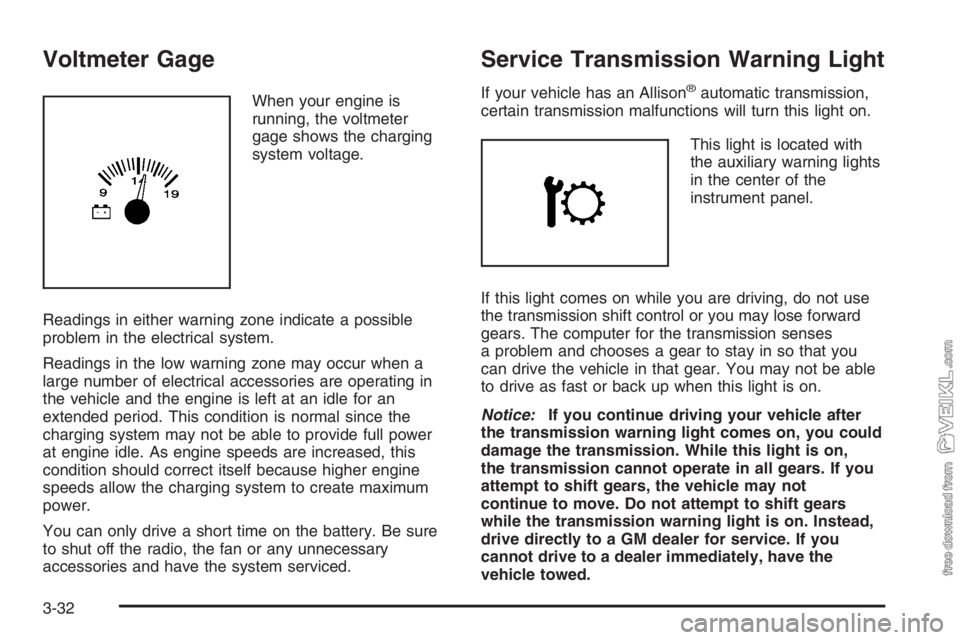
Voltmeter Gage
When your engine is
running, the voltmeter
gage shows the charging
system voltage.
Readings in either warning zone indicate a possible
problem in the electrical system.
Readings in the low warning zone may occur when a
large number of electrical accessories are operating in
the vehicle and the engine is left at an idle for an
extended period. This condition is normal since the
charging system may not be able to provide full power
at engine idle. As engine speeds are increased, this
condition should correct itself because higher engine
speeds allow the charging system to create maximum
power.
You can only drive a short time on the battery. Be sure
to shut off the radio, the fan or any unnecessary
accessories and have the system serviced.
Service Transmission Warning Light
If your vehicle has an Allison®automatic transmission,
certain transmission malfunctions will turn this light on.
This light is located with
the auxiliary warning lights
in the center of the
instrument panel.
If this light comes on while you are driving, do not use
the transmission shift control or you may lose forward
gears. The computer for the transmission senses
a problem and chooses a gear to stay in so that you
can drive the vehicle in that gear. You may not be able
to drive as fast or back up when this light is on.
Notice:If you continue driving your vehicle after
the transmission warning light comes on, you could
damage the transmission. While this light is on,
the transmission cannot operate in all gears. If you
attempt to shift gears, the vehicle may not
continue to move. Do not attempt to shift gears
while the transmission warning light is on. Instead,
drive directly to a GM dealer for service. If you
cannot drive to a dealer immediately, have the
vehicle towed.
3-32
Page 153 of 398
Range Inhibit Warning Indicator
If your vehicle has an Allison 1000/2200/2300/2500
series automatic transmission, a lighted bar under the
current gear selected will flash.
If your vehicle has an Allison 3000/3500 series
automatic transmission, the current gear selected on the
pushbutton display will flash.
The flashing bar or gear selection indicates that
transmission range shifts may not occur.
For detailed information on shift inhibit limitations, see
the Allison Automatic Transmission Operator’s Manual in
your vehicle for further information.
Brake System Warning Light
Your vehicle has either hydraulic or air brakes. Each
system has different warning lights.
Hydraulic Brake System Warning
Lights
Vehicles with hydraulic brake systems have two brake
system warning lights on the instrument panel.
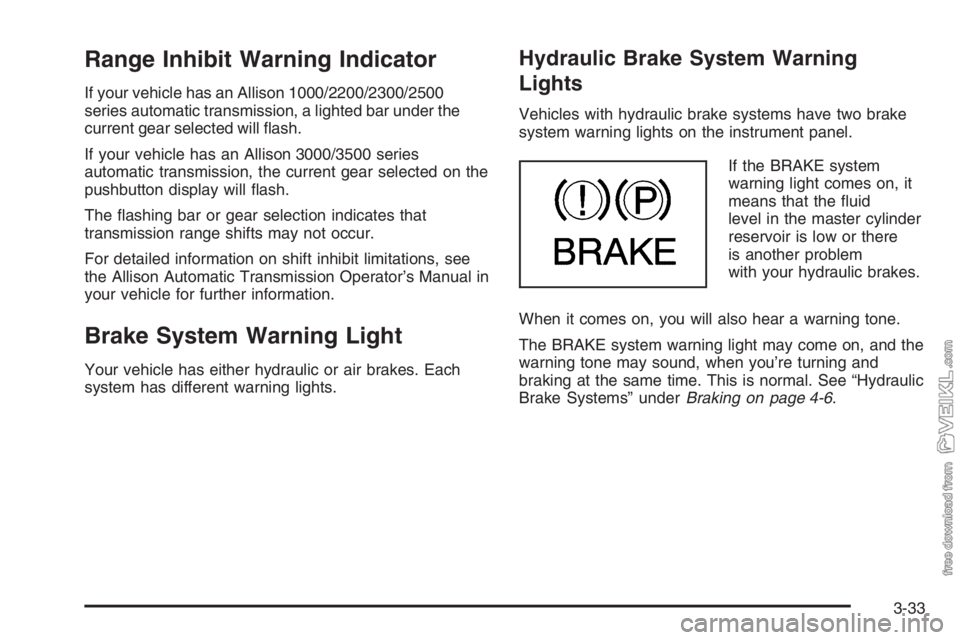
If the BRAKE system
warning light comes on, it
means that the fluid
level in the master cylinder
reservoir is low or there
is another problem
with your hydraulic brakes.
When it comes on, you will also hear a warning tone.
The BRAKE system warning light may come on, and the
warning tone may sound, when you’re turning and
braking at the same time. This is normal. See “Hydraulic
Brake Systems” underBraking on page 4-6.
3-33
Page 154 of 398
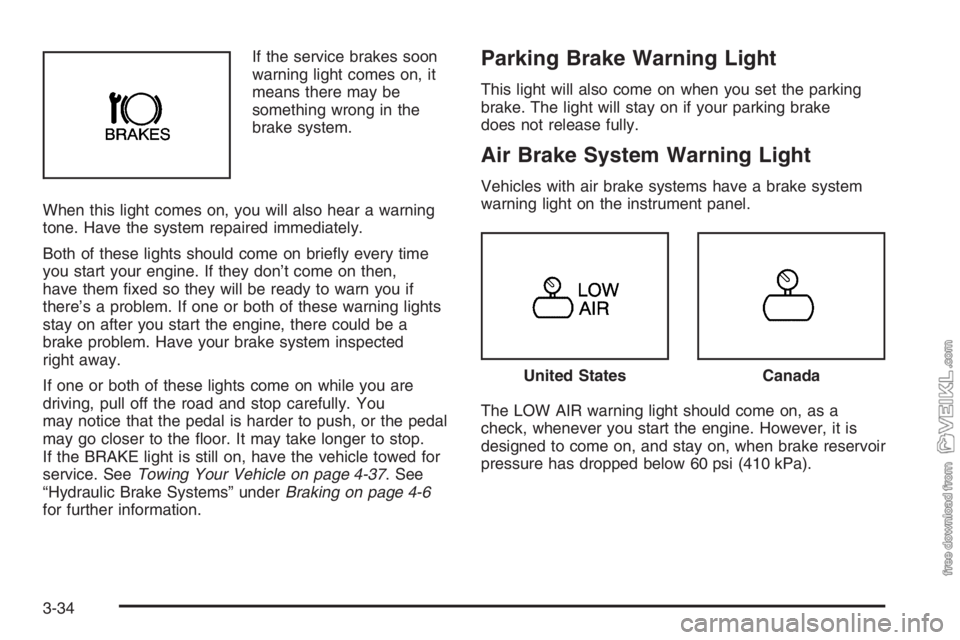
If the service brakes soon
warning light comes on, it
means there may be
something wrong in the
brake system.
When this light comes on, you will also hear a warning
tone. Have the system repaired immediately.
Both of these lights should come on briefly every time
you start your engine. If they don’t come on then,
have them fixed so they will be ready to warn you if
there’s a problem. If one or both of these warning lights
stay on after you start the engine, there could be a
brake problem. Have your brake system inspected
right away.
If one or both of these lights come on while you are
driving, pull off the road and stop carefully. You
may notice that the pedal is harder to push, or the pedal
may go closer to the floor. It may take longer to stop.
If the BRAKE light is still on, have the vehicle towed for
service. SeeTowing Your Vehicle on page 4-37. See
“Hydraulic Brake Systems” underBraking on page 4-6
for further information.Parking Brake Warning Light
This light will also come on when you set the parking
brake. The light will stay on if your parking brake
does not release fully.
Air Brake System Warning Light
Vehicles with air brake systems have a brake system
warning light on the instrument panel.
The LOW AIR warning light should come on, as a
check, whenever you start the engine. However, it is
designed to come on, and stay on, when brake reservoir
pressure has dropped below 60 psi (410 kPa).
United StatesCanada
3-34
Page 155 of 398
When the warning light comes on while you are driving,
you should drive only as far as the nearest point of
safety and then stop the vehicle. Here’s a very important
thing for you to know:
{CAUTION:
If the air brake system warning light comes on
and the warning tone sounds, the vehicle can
stop suddenly and without further warning.
This is because the parking brake will come on
if the pressure falls below 35 to 45 psi (240 to
310 kPa). You or others could be injured. If the
air brake system warning light comes on and
the warning tone sounds, stop as soon as you
can. You will not know how quickly the system
is losing pressure, so be aware that the
parking brake may come on suddenly.
Anti-Lock Brake System
Warning Light
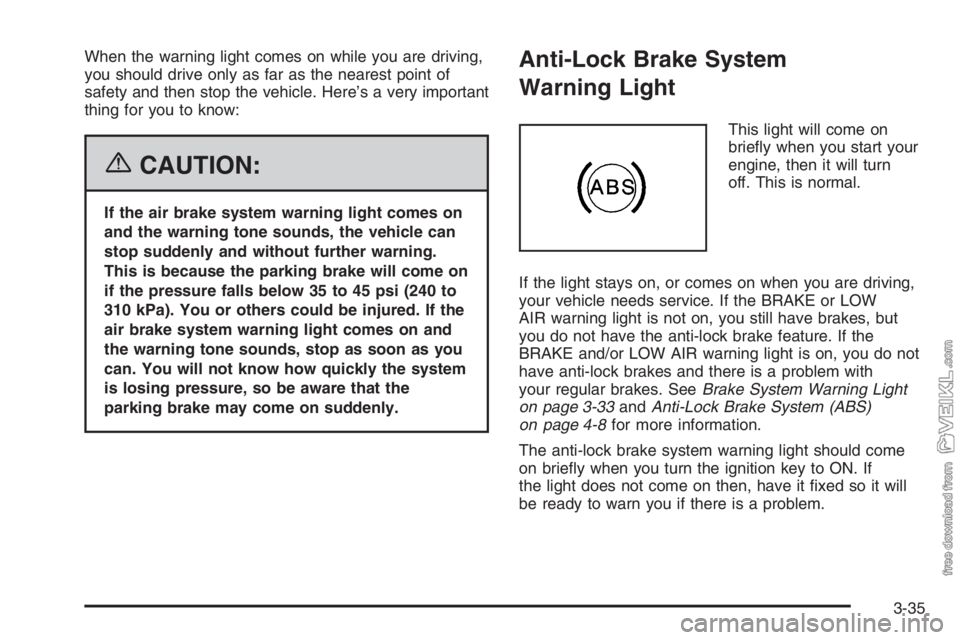
This light will come on
briefly when you start your
engine, then it will turn
off. This is normal.
If the light stays on, or comes on when you are driving,
your vehicle needs service. If the BRAKE or LOW
AIR warning light is not on, you still have brakes, but
you do not have the anti-lock brake feature. If the
BRAKE and/or LOW AIR warning light is on, you do not
have anti-lock brakes and there is a problem with
your regular brakes. SeeBrake System Warning Light
on page 3-33andAnti-Lock Brake System (ABS)
on page 4-8for more information.
The anti-lock brake system warning light should come
on briefly when you turn the ignition key to ON. If
the light does not come on then, have it fixed so it will
be ready to warn you if there is a problem.
3-35
Page 156 of 398
Trailer Anti-Lock Brake System
Warning Light
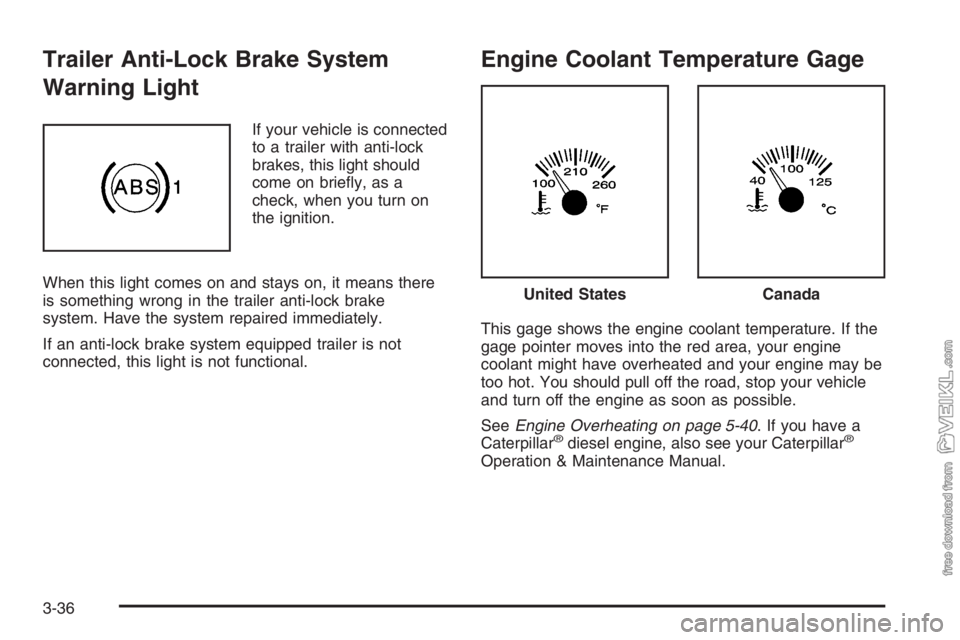
If your vehicle is connected
to a trailer with anti-lock
brakes, this light should
come on briefly, as a
check, when you turn on
the ignition.
When this light comes on and stays on, it means there
is something wrong in the trailer anti-lock brake
system. Have the system repaired immediately.
If an anti-lock brake system equipped trailer is not
connected, this light is not functional.
Engine Coolant Temperature Gage
This gage shows the engine coolant temperature. If the
gage pointer moves into the red area, your engine
coolant might have overheated and your engine may be
too hot. You should pull off the road, stop your vehicle
and turn off the engine as soon as possible.
SeeEngine Overheating on page 5-40. If you have a
Caterpillar
®diesel engine, also see your Caterpillar®
Operation & Maintenance Manual.
United StatesCanada
3-36