recommended oil CHEVROLET KODIAK 2007 User Guide
[x] Cancel search | Manufacturer: CHEVROLET, Model Year: 2007, Model line: KODIAK, Model: CHEVROLET KODIAK 2007Pages: 430, PDF Size: 6.06 MB
Page 283 of 430
Manual Transmission Fluid
When to Check
A good time to have it checked is when the
engine oil is checked. Refer to the Maintenance
Schedule to find out when to check and change
your manual transmission fluid. SeeScheduled
Maintenance on page 363.
How to Check and What to Use
Check the fluid level only when your engine is off,
the vehicle is parked on a level place, and the
transmission is cool enough for you to rest
your fingers on the transmission case.
To check the transmission fluid level, do the
following:
1. Remove the filler plug.
2. Check to be sure that the lubricant level is up
to the bottom of the fill opening. On heavy
duty transmissions, an inch of oil level equals
about one gallon of fluid.3. If the fluid level is good, reinstall the plug and
be sure it is fully seated. If the fluid level is
low, add more fluid as described in the
next steps. Refer to the Maintenance
Schedule to determine what kind of fluid to
use. SeePart C: Recommended Fluids
and Lubricants on page 397.
How to Add Fluid
To add transmission fluid, do the following:
1. Remove the filler plug.
2. Add fluid at the filler plug hole. Add only
enough fluid to bring the fluid level up to
the bottom of the fill opening. Refer to
the Maintenance Schedule to determine the
proper fluid to use. SeePart C:
Recommended Fluids and Lubricants on
page 397.
3. Reinstall the filler plug. Be sure the plug is
fully seated.
283
Page 285 of 430
What to Use
Use a mixture of one-half clean, drinkable water
and one-half DEX-COOL®coolant which will
not damage aluminum parts. If you use this coolant
mixture, you do not need to add anything else.
{CAUTION:
Adding only plain water to your cooling
system can be dangerous. Plain water, or
some other liquid such as alcohol, can
boil before the proper coolant mixture will.
Your vehicle’s coolant warning system is
set for the proper coolant mixture. With
plain water or the wrong mixture, your
engine could get too hot but you would
not get the overheat warning. Your engine
could catch re and you or others could
be burned. Use a 50/50 mixture of clean,
drinkable water and DEX-COOL
®coolant.Notice:If you use an improper coolant
mixture, your engine could overheat and be
badly damaged. The repair cost would not be
covered by your warranty. Too much water
in the mixture can freeze and crack the engine,
radiator, heater core, and other parts.
If you have to add coolant more than four times a
year, have your dealer check your cooling system.
Notice:If you use extra inhibitors and/or
additives in your vehicle’s cooling system, you
could damage your vehicle. Use only the
proper mixture of the engine coolant listed in
this manual for the cooling system. See
Part C: Recommended Fluids and Lubricants
on page 397for more information.
285
Page 292 of 430
If no coolant is visible in the surge tank, add
coolant as follows:
{CAUTION:
Steam and scalding liquids from a hot
cooling system can blow out and burn
you badly. They are under pressure, and if
you turn the coolant surge tank pressure
cap — even a little — they can come out at
high speed. Never turn the cap when the
cooling system, including the coolant
surge tank pressure cap, is hot. Wait for
the cooling system and coolant surge
tank pressure cap to cool if you ever have
to turn the pressure cap.
{CAUTION:
Adding only plain water to your cooling
system can be dangerous. Plain water, or
some other liquid such as alcohol, can
boil before the proper coolant mixture will.
Your vehicle’s coolant warning system is
set for the proper coolant mixture. With
plain water or the wrong mixture, your
engine could get too hot but you would
not get the overheat warning. Your engine
could catch re and you or others could
be burned. Use a 50/50 mixture of clean,
drinkable water and DEX-COOL
®coolant.
Notice:In cold weather, water can freeze and
crack the engine, radiator, heater core and
other parts. Use the recommended coolant and
the proper coolant mixture.
292
Page 317 of 430
Other Service Items
Fuel Filter
Fuel Filter/Pressure Regulator
(Gasoline Engines)
The steel fuel filter/pressure regulator is located
near the engine compartment on the driver’s
side frame rail. If your vehicle has a rear steel fuel
tank, the fuel filter/pressure regulator is located
near the rear fuel tank, on the driver’s side frame
rail. SeeScheduled Maintenance on page 363
for recommended service intervals.
If your vehicle is equipped with the optional Davco
spin-on type filter, it is located on the driver’s
side frame rail.
Fuel Filter (Diesel Engines)
If you have a diesel engine, your fuel filter is
located in the engine compartment on the driver’s
side of the vehicle, or along the driver’s side
frame rail. See “Fuel Filter Replacement” earlier in
this section for further information.
Also seeScheduled Maintenance on page 363for
recommended service intervals.
Primary Fuel Filter and Water
Separator
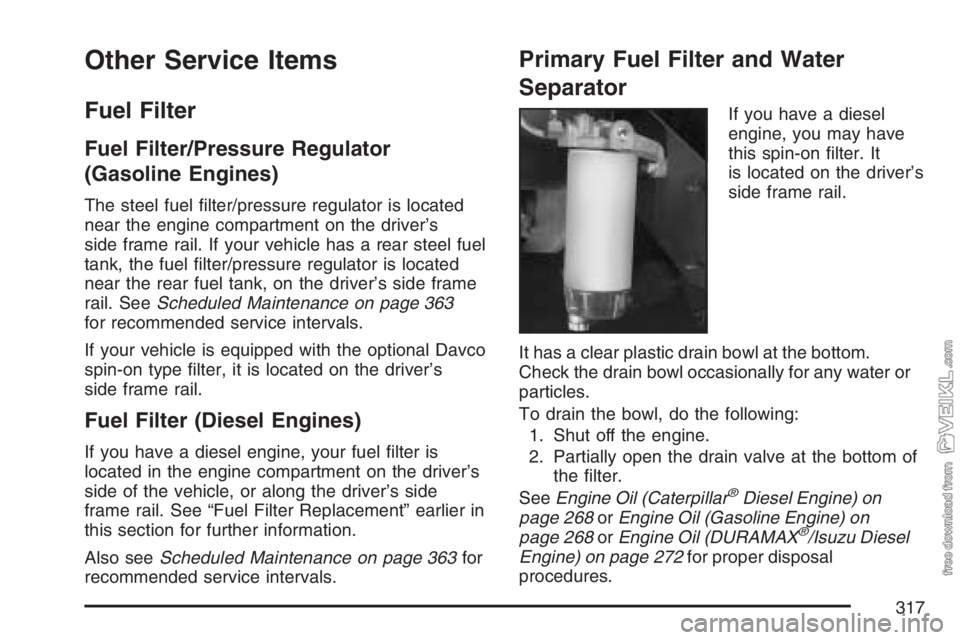
If you have a diesel
engine, you may have
this spin-on filter. It
is located on the driver’s
side frame rail.
It has a clear plastic drain bowl at the bottom.
Check the drain bowl occasionally for any water or
particles.
To drain the bowl, do the following:
1. Shut off the engine.
2. Partially open the drain valve at the bottom of
the filter.
SeeEngine Oil (Caterpillar
®Diesel Engine) on
page 268orEngine Oil (Gasoline Engine) on
page 268orEngine Oil (DURAMAX
®/Isuzu Diesel
Engine) on page 272for proper disposal
procedures.
317
Page 320 of 430
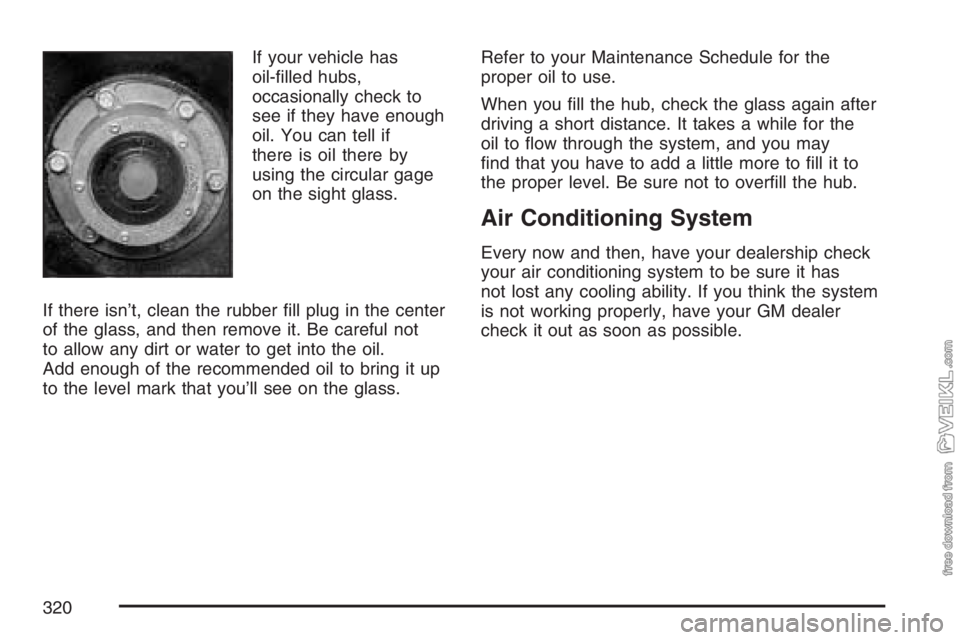
If your vehicle has
oil-filled hubs,
occasionally check to
see if they have enough
oil. You can tell if
there is oil there by
using the circular gage
on the sight glass.
If there isn’t, clean the rubber fill plug in the center
of the glass, and then remove it. Be careful not
to allow any dirt or water to get into the oil.
Add enough of the recommended oil to bring it up
to the level mark that you’ll see on the glass.Refer to your Maintenance Schedule for the
proper oil to use.
When you fill the hub, check the glass again after
driving a short distance. It takes a while for the
oil to flow through the system, and you may
find that you have to add a little more to fill it to
the proper level. Be sure not to overfill the hub.
Air Conditioning System
Every now and then, have your dealership check
your air conditioning system to be sure it has
not lost any cooling ability. If you think the system
is not working properly, have your GM dealer
check it out as soon as possible.
320
Page 331 of 430
Your truck, when new, did not include tire changing
equipment or a place to store a tire in the
vehicle. Few drivers of these vehicles have the
necessary equipment aboard to be able to change
a flat tire safely. For example, you would need
a truck jack that can lift several thousand pounds
and a torque wrench that can generate several
hundred foot-pounds (
Y) of twisting force.
{CAUTION:
If you try to put air back into a tire that
has run at, even a tire that was extremely
low on air, the tire can have a sudden
air-out. This could cause you to lose
control of the vehicle and have a serious
crash. Do not rell a at or very low tire
with air without rst having the tire taken
off the wheel and checked for damage.
So if you are stopped somewhere by a flat or
damaged tire or wheel, you should get expert help.
SeeRoadside Assistance Program on page 408.
Appearance Care
Cleaning the Inside of Your Vehicle
Your vehicle’s interior will continue to look its
best if it is cleaned often. Although not always
visible, dust and dirt can accumulate on your
upholstery. Dirt can damage carpet, fabric, leather,
and plastic surfaces. Regular vacuuming is
recommended to remove particles from your
upholstery. It is important to keep your upholstery
from becoming and remaining heavily soiled.
Soils should be removed as quickly as possible.
Your vehicle’s interior may experience extremes of
heat that could cause stains to set rapidly.
Lighter colored interiors may require more frequent
cleaning. Use care because newspapers and
garments that transfer color to your home
furnishings may also transfer color to your
vehicle’s interior.
331
Page 336 of 430
Foreign materials such as calcium chloride and
other salts, ice melting agents, road oil and tar, tree
sap, bird droppings, chemicals from industrial
chimneys, etc., can damage your vehicle’s finish if
they remain on painted surfaces. Wash the vehicle
as soon as possible. If necessary, use non-abrasive
cleaners that are marked safe for painted surfaces
to remove foreign matter.
Exterior painted surfaces are subject to aging,
weather and chemical fallout that can take their toll
over a period of years. You can help to keep
the paint finish looking new by keeping your
vehicle garaged or covered whenever possible.
Protecting Exterior Bright Metal Parts
Bright metal parts should be cleaned regularly to
keep their luster. Washing with water is all
that is usually needed. However, you may use
chrome polish on chrome or stainless steel trim,
if necessary.
Use special care with aluminum trim. To avoid
damaging protective trim, never use auto or
chrome polish, steam or caustic soap to clean
aluminum. A coating of wax, rubbed to high polish,
is recommended for all bright metal parts.
Windshield and Wiper Blades
If the windshield is not clear after using the
windshield washer, or if the wiper blade chatters
when running, wax, sap, or other material may
be on the blade or windshield.
Clean the outside of the windshield with a glass
cleaning liquid or powder and water solution.
The windshield is clean if beads do not form when
it is rinsed with water.
Grime from the windshield will stick to the wiper
blades and affect their performance. Clean
the blade by wiping vigorously with a cloth soaked
in full-strength windshield washer solvent. Then
rinse the blade with water.
Check the wiper blades and clean them as
necessary; replace blades that look worn.
336
Page 360 of 430
Maintenance Schedule
Introduction
Important: Keep engine oil at the proper level
and change as recommended.
Have you purchased the GM Protection Plan? The
Plan supplements your new vehicle warranties.
See your Warranty and Owner Assistance booklet
or your dealer for details.
Maintenance Requirements
Maintenance intervals, checks, inspections and
recommended fluids and lubricants as prescribed
in this manual are necessary to keep your
vehicle in good working condition. Any damage
caused by failure to follow scheduled maintenance
may not be covered by warranty.
Your Vehicle and the Environment
Proper vehicle maintenance not only helps to
keep your vehicle in good working condition, but
also helps the environment. Improper vehicle
maintenance can even affect the quality of the air
we breathe. Improper fluid levels or the wrong
tire inflation can increase the level of emissions
from your vehicle. To help protect our environment,
and to keep your vehicle in good condition, be
sure to maintain your vehicle properly.
How This Section is Organized
This maintenance schedule is divided into
four parts:
“Part A: Scheduled Maintenance Services”
explains what to have done and how often. Some
of these services can be complex, so unless
you are technically qualified and have the
necessary equipment, you should let your GM
dealer’s service department do these jobs.
Your GM dealer has GM-trained and supported
service people that will perform the work using
genuine GM parts.
360
Page 384 of 430
(2)= An Emission Control Service.
(3)= A Noise Emission Control Device.
(4)= Applies to vehicles sold in the United States
and is recommended for vehicles sold in Canada.
(5)= Check fluid level in brake master cylinder,
power steering pump, front and rear axles,
transmission, and hydraulic spring parking brake
pump (if equipped). A low fluid level in the
brake master cylinder can indicate worn brake
linings and should be checked accordingly.
(6)= Inspect brake lines and hoses for proper
hook-up, binding, leaks, cracks, chafing, etc.
Inspect disc brake pads for wear and rotors for
surface condition. Inspect caliper assemblies.
Check brake pedal for excessive free play or
travel (or every 6 months, whichever occurs first)
and have serviced if needed. Check brakes
more often if driving habits and conditions result
in frequent braking.(7)= This vehicle has the Engine Oil Life System.
This system will show you when to change the
engine oil and filter — usually between 3,000 miles
(5 000 km) and 12,000 miles (20 000 km) since
your last oil change. Under severe conditions,
the indicator may come on before 3,000 miles
(5 000 km). Never drive your 7.8L diesel engine
vehicle more than 12,000 miles (20 000 km),
or 12 months, or 600 engine hours, without an
oil and filter change.
Remember to reset the Engine Oil Life System
whenever the oil is changed. For more information,
seeEngine Oil Life System (Gasoline Engine)
on page 276orEngine Oil Life System
(DURAMAX
®Diesel) on page 278orEngine
Oil Life System (Caterpillar®Diesel Engine)
on page 279.
384
Page 388 of 430
(22)= Wheel bearing service:
•Grease type — Clean, inspect, and lubricate
with the proper wheel bearing grease at
designated intervals or when hubs are
removed. SeePart C: Recommended Fluids
and Lubricants on page 397.
•Oil-filled type — Some wheel bearings are
lubricated by axle lubricant. When you
have oil-filled hubs, use lubricant identical
to that used in the axle. Lubricant change
intervals are the same for front and rear
axles. However, you must maintain the proper
oil level between change intervals. See
Front Wheel Bearings with Oil-Filled Hubs
on page 319andPart C: Recommended
Fluids and Lubricants on page 397.
(23)= Check the air intake system installation
to see that gaskets are seated properly and
all hose connections, fasteners, and other
components are tight. Tighten connections
and fasteners or replace parts as required.(24)= Evaporative Control System Service,
if equipped: Check all fuel and vapor lines and
hoses for proper connections and correct routing
(or every 24 months, whichever occurs first).
Replace parts as needed.
(25)= Replace spark plugs. Inspect wires for
damage. Check the wire boot and boot heat
shield fit at spark plugs and coil. Replace parts
as needed.
(26)= Check the fuel tank, fuel cap and fuel lines
for damage which could cause leakage. Inspect
fuel cap for correct sealing ability and any
indications of damage. Check fuel cap gasket
for even filler neck imprint. Replace parts as
needed.
(27)= Check Exhaust Gas Recirculation (EGR)
system as described in the service manual.
SeeService Publications Ordering Information
on page 415.
388