fuel CHEVROLET KODIAK 2007 Owners Manual
[x] Cancel search | Manufacturer: CHEVROLET, Model Year: 2007, Model line: KODIAK, Model: CHEVROLET KODIAK 2007Pages: 430, PDF Size: 6.06 MB
Page 1 of 430
Seats and Restraint Systems
....................... 7
Front Seats
.............................................. 9
Rear Seats
............................................. 20
Safety Belts
............................................ 21
Child Restraints
...................................... 42
Airbag System
........................................ 68
Restraint System Check
......................... 82
Features and Controls
................................ 85
Keys
....................................................... 86
Doors and Locks
.................................... 91
Windows
................................................ 93
Starting and Operating Your Vehicle
....... 95
Mirrors
.................................................. 133
Storage Areas
...................................... 135Instrument Panel
....................................... 137
Instrument Panel Overview
................... 140
Climate Controls
................................... 157
Warning Lights, Gages, and
Indicators
.......................................... 161
Audio System(s)
................................... 184
Driving Your Vehicle
................................. 205
Your Driving, the Road, and
Your Vehicle
..................................... 206
Towing
................................................. 241
Service and Appearance Care
.................. 245
Service
................................................. 248
Fuel
...................................................... 251
Checking Things Under the Hood
......... 266
Rear Axle
............................................. 311
2007 Chevrolet Kodiak Owner ManualM
1
Page 99 of 430
Gasoline Engine Warm-Up
When you have started your engine, let it run for
20 or 30 seconds to warm up before you put a
load on the engine.
Drive at moderate speeds for the first 2 to 3 miles
(3.2 to 4.8 km), especially in cold weather. See
High Idle System on page 106.
Restarting the Gasoline Engine While
Moving (Automatic Transmission)
If you have to restart the engine while the
vehicle is moving, you will first have to shift to
NEUTRAL (N). This safety feature prevents
starting the engine when the transmission is in a
drive gear.
Stopping the Gasoline Engine
Let your engine idle for a few seconds before
turning it off after you have finished driving your
vehicle.
If you shift to NEUTRAL (N) or PARK (P), set the
parking brake.
If your vehicle has a two-speed axle, put the
range selector in low. To be sure the axle has
shifted into low, engage the clutch and
transmission; the vehicle may move slightly
when you do this.
While your engine is idling and before you turn it
off, you can make a list of any operational or
handling concerns to give to responsible
maintenance personnel so they can handle them
right away.
Moisture will condense in a fuel tank that is almost
empty if the engine has not run for a while,
even just overnight under some conditions. So, it
is always best to refuel your vehicle at the end
of each run.
99
Page 101 of 430
Notice:Holding your key in START for longer
than 15 seconds at a time will cause your
battery to be drained much sooner. And the
excessive heat can damage your starter motor.
Notice:If the wait to start light stays on
after starting your vehicle, your vehicle may
not run properly. Have your vehicle serviced
right away.
3. If the engine does not start after 15 seconds
of cranking, turn the ignition key to OFF. Wait
one minute for the starter to cool, then try
the same steps again.
If you are trying to start your engine after you
have run out of fuel, seeRunning Out of Fuel
on page 262.
When your engine is cold, let it run for a few
minutes before you move your vehicle. This lets
oil pressure build up. Your engine will sound louder
when it is cold.
Notice:If you are not in an idling vehicle and
the engine overheats, you would not be there to
see the overheated engine indication. This
could damage your vehicle. Do not let your
engine run when you are not in your vehicle.Cold Weather Starting
If your vehicle has the 6.6L DURAMAX®Diesel
Engine and the Isuzu 6H Diesel Engine, the
following notice applies:
Notice:Your diesel engine has an electric air
intake heater system which reduces white
smoke and helps start the engine in cold
weather. Do not spray starting uid into the air
intake where it can contact the heater elements.
If you do not have the GM Automatic Ether
Injection System, do not use starting uid or
you could damage your engine. If you have the
GM system, use only GM approved starting
uid that has been tested to establish
compatibility with the air inlet heater system.
101
Page 102 of 430
The following tips will help you get good starting in
cold weather.
•Use the recommended engine oil when the
outside temperature drops below freezing.
SeeEngine Oil (Caterpillar
®Diesel Engine) on
page 268orEngine Oil (Gasoline Engine)
on page 268orEngine Oil (DURAMAX
®/Isuzu
Diesel Engine) on page 272. When the
outside temperature drops below 0°F (−18°C),
use of the optional engine coolant block
heater is recommended.
•If you experience longer cranking times, notice
an unusual amount of exhaust smoke or are
at higher altitudes (over 7,000 ft. or 2 135 m),
you may use your optional engine coolant
block heater. SeeEngine Coolant Heater on
page 111.
•SeeWhat Fuel to Use on page 253for
information on what fuel to use in cold
weather.
Cold Weather Starting
(Caterpillar®Diesel)
Because the diesel engine uses compression
ignition, it is harder to start in cold weather than a
gasoline engine. The air intake heater and use
of the proper engine oil, optional engine coolant
heaters and optional ether injection systems
help cold weather starting. See the Caterpillar
®
Diesel Engine Operation & Maintenance Manual
for more information.
Restarting the Diesel Engine While
Moving (Automatic Transmission)
If you have to restart the engine while the vehicle
is moving, you will first have to shift to
NEUTRAL (N). This safety feature prevents
starting the engine when the transmission is in a
drive gear for more information.
102
Page 103 of 430
Stopping the Diesel Engine
1. Set the parking brake and shift to
NEUTRAL (N) or PARK (P).
2. Turn the ignition key to OFF.
If your vehicle has a two-speed axle, see
Two-Speed Rear Axle Electric Shift Control on
page 113.
If you have a Caterpillar
®diesel engine, see your
Caterpillar®Diesel Engine Operation &
Maintenance Manual for additional information.
Diesel Engine Warm-Up
Several factors affect how quickly your diesel
engine warms up. These can include outside
temperature, engine load, idle time and your
vehicle’s option content. Your vehicle may be
equipped with some features that can help
the engine reach operating temperature sooner.
Some of these features are discussed below.Also, remember that an automatic transmission
adds heat to the cooling system through the heat
exchanger in the radiator. Because of this,
vehicles equipped with automatic transmissions
are often able to retain engine coolant heat better
than manual transmission vehicles.
See your Caterpillar
®Operation & Maintenance
manual for additional diesel engine warm-up
information.
If Your Diesel Engine Will Not Start
If you have run out of fuel, seeRunning Out of
Fuel on page 262.
If you are not out of fuel, and your engine will not
start, do this:
Turn your ignition key to RUN. Immediately after
the wait to start light goes off, turn the ignition key
to START.
If the light does not go off, wait a few seconds, then
try starting your engine again. And, see your dealer
as soon as you can for a starting system check.
If the light comes on and then goes off and you
know your batteries are charged, but your engine
still will not start, your vehicle needs service.
103
Page 104 of 430
If the light does not come on when the engine is
cold, your vehicle needs service.
If your batteries do not have enough charge to
start your engine, seeBattery on page 304.
Be sure you have the right oil for your engine, and
that you have changed the oil at the proper
times. If you use the wrong oil, your engine may
be harder to start.
Be sure you are using the proper fuel for existing
weather conditions. SeeWhat Fuel to Use on
page 253.
If the engine starts, runs a short time, then stops,
your vehicle needs service.
{CAUTION:
Do not use gasoline or starting aids, such
as ether, in the air intake. They could
damage your engine. There could also be
a re, which could cause serious personal
injury.
Engine Alarm and Automatic
Shutdown
Your check gages warning light will come on if the
system senses high engine temperature or low
engine oil pressure. If high engine temperature or
low engine oil pressure is detected, you will
also hear a tone alarm at two beats per second.
The alarm and the light will remain on until
the condition is fixed. If the engine temperature or
oil pressure condition worsens, the tone alarm
will go to five beats per second.
If the system senses low engine coolant, the
five beat per second alarm and the low coolant
warning light will come on.
The five beats per second tone alarm means that
your engine will shut down in about 25 to
30 seconds. There is also an engine shutdown
light to indicate that the engine will shut down. See
Engine Shutdown Warning Light on page 177.
104
Page 111 of 430
Engine Coolant Heater
Your vehicle may be equipped with this feature.
In very cold weather, 0°F (–18°C) or colder,
the engine coolant heater can help. You will get
easier starting and better fuel economy during
engine warm-up. Usually, the coolant heater
should be plugged in a minimum of four hours
prior to starting your vehicle. At temperatures
above 32°F (0°C), use of the coolant heater is
not required.
To Use the Engine Coolant Heater
1. Turn off the engine.
2. Find the plug-in outlet located under the
driver’s door.
3. Plug it into a normal, grounded 110-volt AC
outlet.
{CAUTION:
Plugging the cord into an ungrounded
outlet could cause an electrical shock.
Also, the wrong kind of extension cord
could overheat and cause a re. You
could be seriously injured. Plug the cord
into a properly grounded three-prong
110-volt AC outlet. If the cord will not
reach, use a heavy-duty three-prong
extension cord rated for at least 15 amps.
4. Before starting the engine, be sure to unplug
and store the cord as it was before to keep it
away from moving engine parts. If you do
not, it could be damaged.
How long should you keep the coolant heater
plugged in? The answer depends on the outside
temperature, the kind of oil you have, and some
other things. Instead of trying to list everything here,
we ask that you contact your dealer in the area
where you will be parking your vehicle. The dealer
can give you the best advice for that particular area.
111
Page 120 of 430
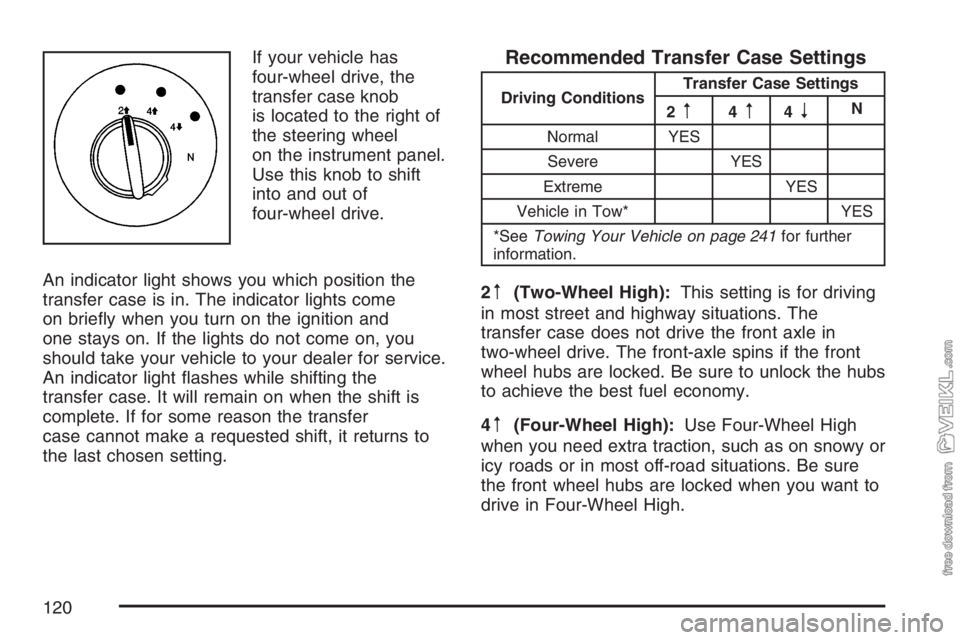
If your vehicle has
four-wheel drive, the
transfer case knob
is located to the right of
the steering wheel
on the instrument panel.
Use this knob to shift
into and out of
four-wheel drive.
An indicator light shows you which position the
transfer case is in. The indicator lights come
on briefly when you turn on the ignition and
one stays on. If the lights do not come on, you
should take your vehicle to your dealer for service.
An indicator light flashes while shifting the
transfer case. It will remain on when the shift is
complete. If for some reason the transfer
case cannot make a requested shift, it returns to
the last chosen setting.Recommended Transfer Case Settings
Driving ConditionsTransfer Case Settings
2m4m4nN
Normal YES
Severe YES
Extreme YES
Vehicle in Tow* YES
*SeeTowing Your Vehicle on page 241for further
information.
2m(Two-Wheel High):This setting is for driving
in most street and highway situations. The
transfer case does not drive the front axle in
two-wheel drive. The front-axle spins if the front
wheel hubs are locked. Be sure to unlock the hubs
to achieve the best fuel economy.
4
m(Four-Wheel High):Use Four-Wheel High
when you need extra traction, such as on snowy or
icy roads or in most off-road situations. Be sure
the front wheel hubs are locked when you want to
drive in Four-Wheel High.
120
Page 138 of 430
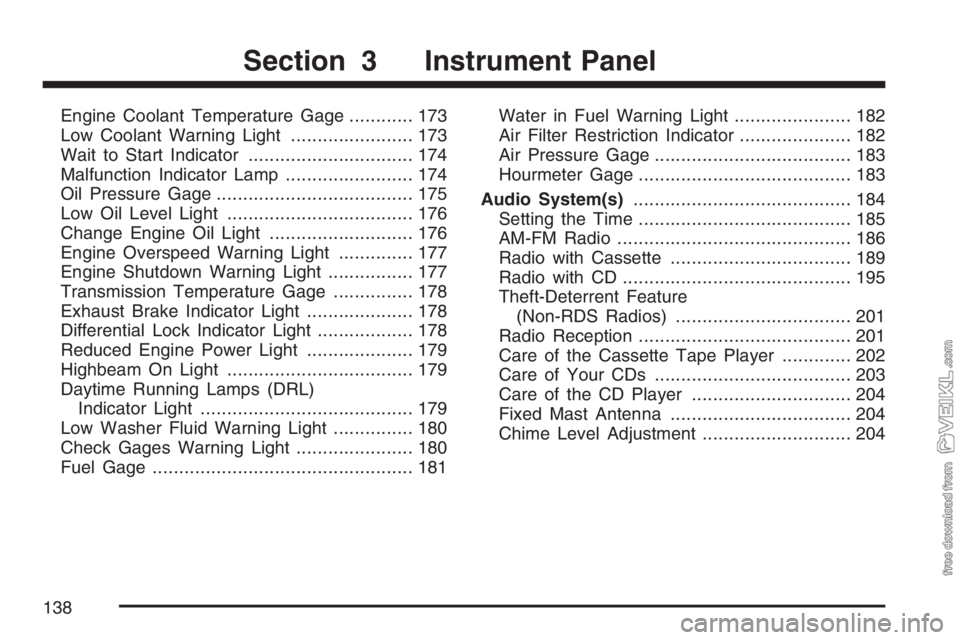
Engine Coolant Temperature Gage............ 173
Low Coolant Warning Light....................... 173
Wait to Start Indicator............................... 174
Malfunction Indicator Lamp........................ 174
Oil Pressure Gage..................................... 175
Low Oil Level Light................................... 176
Change Engine Oil Light........................... 176
Engine Overspeed Warning Light.............. 177
Engine Shutdown Warning Light................ 177
Transmission Temperature Gage............... 178
Exhaust Brake Indicator Light.................... 178
Differential Lock Indicator Light.................. 178
Reduced Engine Power Light.................... 179
Highbeam On Light................................... 179
Daytime Running Lamps (DRL)
Indicator Light........................................ 179
Low Washer Fluid Warning Light............... 180
Check Gages Warning Light...................... 180
Fuel Gage................................................. 181Water in Fuel Warning Light...................... 182
Air Filter Restriction Indicator..................... 182
Air Pressure Gage..................................... 183
Hourmeter Gage........................................ 183
Audio System(s)......................................... 184
Setting the Time........................................ 185
AM-FM Radio............................................ 186
Radio with Cassette.................................. 189
Radio with CD........................................... 195
Theft-Deterrent Feature
(Non-RDS Radios)................................. 201
Radio Reception........................................ 201
Care of the Cassette Tape Player............. 202
Care of Your CDs..................................... 203
Care of the CD Player.............................. 204
Fixed Mast Antenna.................................. 204
Chime Level Adjustment............................ 204
Section 3 Instrument Panel
138
Page 159 of 430
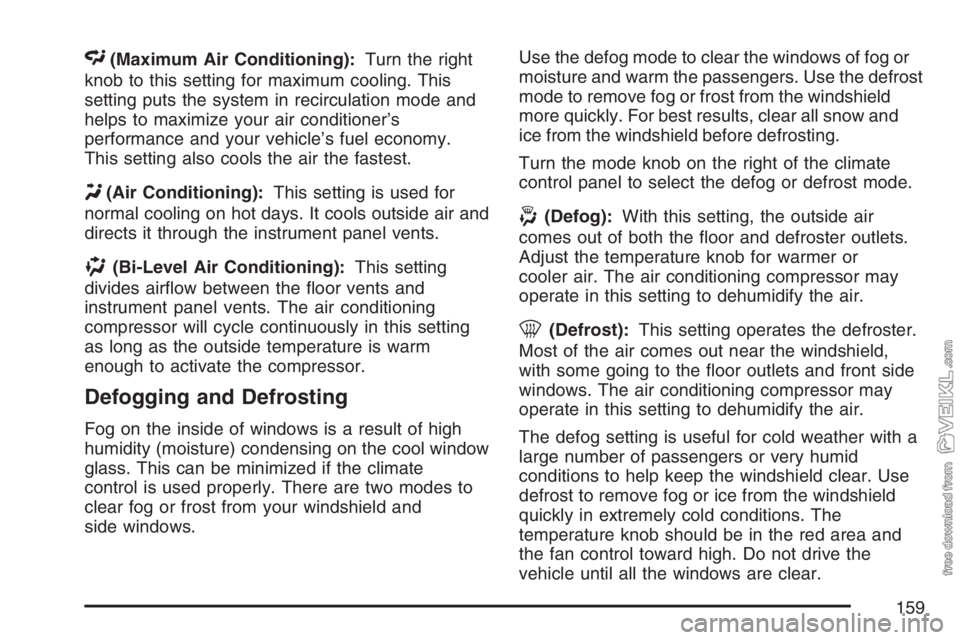
<(Maximum Air Conditioning):Turn the right
knob to this setting for maximum cooling. This
setting puts the system in recirculation mode and
helps to maximize your air conditioner’s
performance and your vehicle’s fuel economy.
This setting also cools the air the fastest.
Y(Air Conditioning):This setting is used for
normal cooling on hot days. It cools outside air and
directs it through the instrument panel vents.
)(Bi-Level Air Conditioning):This setting
divides airflow between the floor vents and
instrument panel vents. The air conditioning
compressor will cycle continuously in this setting
as long as the outside temperature is warm
enough to activate the compressor.
Defogging and Defrosting
Fog on the inside of windows is a result of high
humidity (moisture) condensing on the cool window
glass. This can be minimized if the climate
control is used properly. There are two modes to
clear fog or frost from your windshield and
side windows.Use the defog mode to clear the windows of fog or
moisture and warm the passengers. Use the defrost
mode to remove fog or frost from the windshield
more quickly. For best results, clear all snow and
ice from the windshield before defrosting.
Turn the mode knob on the right of the climate
control panel to select the defog or defrost mode.
-(Defog):With this setting, the outside air
comes out of both the floor and defroster outlets.
Adjust the temperature knob for warmer or
cooler air. The air conditioning compressor may
operate in this setting to dehumidify the air.
0(Defrost):This setting operates the defroster.
Most of the air comes out near the windshield,
with some going to the floor outlets and front side
windows. The air conditioning compressor may
operate in this setting to dehumidify the air.
The defog setting is useful for cold weather with a
large number of passengers or very humid
conditions to help keep the windshield clear. Use
defrost to remove fog or ice from the windshield
quickly in extremely cold conditions. The
temperature knob should be in the red area and
the fan control toward high. Do not drive the
vehicle until all the windows are clear.
159