engine CHEVROLET KODIAK 2007 Owner's Manual
[x] Cancel search | Manufacturer: CHEVROLET, Model Year: 2007, Model line: KODIAK, Model: CHEVROLET KODIAK 2007Pages: 430, PDF Size: 6.06 MB
Page 113 of 430
Two-Speed Rear Axle Electric
Shift Control
If your vehicle has this feature, you will find a label
on the headliner above the windshield or in
another place near the driver that shows how to
use it. Be sure to follow the directions carefully.
Use the following directions based on the type of
shift control the vehicle has.
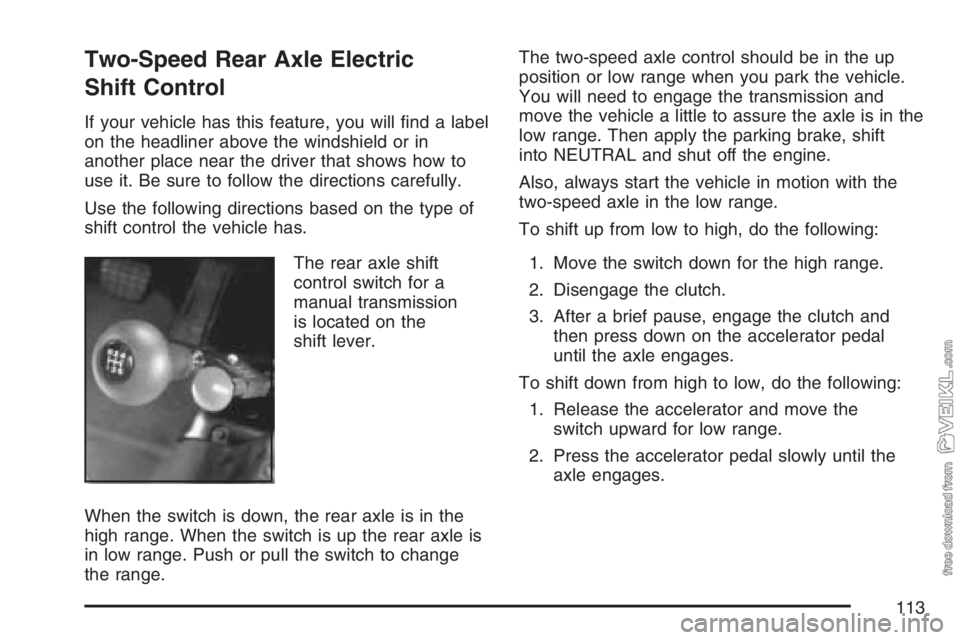
The rear axle shift
control switch for a
manual transmission
is located on the
shift lever.
When the switch is down, the rear axle is in the
high range. When the switch is up the rear axle is
in low range. Push or pull the switch to change
the range.The two-speed axle control should be in the up
position or low range when you park the vehicle.
You will need to engage the transmission and
move the vehicle a little to assure the axle is in the
low range. Then apply the parking brake, shift
into NEUTRAL and shut off the engine.
Also, always start the vehicle in motion with the
two-speed axle in the low range.
To shift up from low to high, do the following:
1. Move the switch down for the high range.
2. Disengage the clutch.
3. After a brief pause, engage the clutch and
then press down on the accelerator pedal
until the axle engages.
To shift down from high to low, do the following:
1. Release the accelerator and move the
switch upward for low range.
2. Press the accelerator pedal slowly until the
axle engages.
113
Page 114 of 430
Air Shift Control (Automatic
Transmission)
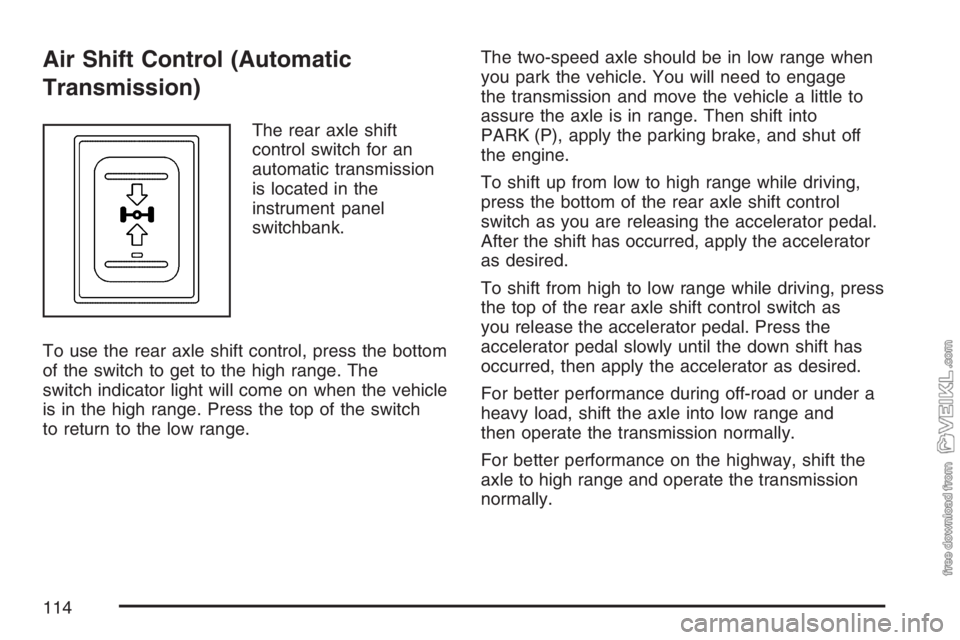
The rear axle shift
control switch for an
automatic transmission
is located in the
instrument panel
switchbank.
To use the rear axle shift control, press the bottom
of the switch to get to the high range. The
switch indicator light will come on when the vehicle
is in the high range. Press the top of the switch
to return to the low range.The two-speed axle should be in low range when
you park the vehicle. You will need to engage
the transmission and move the vehicle a little to
assure the axle is in range. Then shift into
PARK (P), apply the parking brake, and shut off
the engine.
To shift up from low to high range while driving,
press the bottom of the rear axle shift control
switch as you are releasing the accelerator pedal.
After the shift has occurred, apply the accelerator
as desired.
To shift from high to low range while driving, press
the top of the rear axle shift control switch as
you release the accelerator pedal. Press the
accelerator pedal slowly until the down shift has
occurred, then apply the accelerator as desired.
For better performance during off-road or under a
heavy load, shift the axle into low range and
then operate the transmission normally.
For better performance on the highway, shift the
axle to high range and operate the transmission
normally.
114
Page 115 of 430
Automatic Transmission Operation
We build vehicles with Allison®five and
six-speed automatic transmissions. This part of
the manual covers the basics of these. With these
transmissions, you will find another Allison
®
manual in your vehicle that goes into more detail.
On the headliner, in front of and above the
driver, or in some other place near the driver, you
will see a label that describes important operating
facts about the automatic transmission in your
vehicle. Make sure you follow the instructions on
this label.
Be sure to keep your parking brake set until you
are ready to shift into DRIVE (D), and press
the brake pedal while shifting from NEUTRAL (N)
or PARK (P) to a drive gear.
All vehicles equipped with automatic transmissions
can be started in PARK (P), if equipped, or in
NEUTRAL (N). See the Allison
®Transmission
Operator’s Manual in your vehicle for more
information about this.
{CAUTION:
It can be dangerous to get out of your
vehicle without the parking brake rmly
set. Your vehicle can roll. If you have left
the engine running, the vehicle can move
suddenly. You or others could be injured.
To be sure your vehicle will not move,
even when you are on fairly level ground,
always set the parking brake.
{CAUTION:
Shifting into a drive gear while your
engine is running at high speed is
dangerous. Unless your foot is rmly on
the brake pedal, your vehicle could move
very rapidly. You could lose control and
hit people or objects. Do not shift into a
drive gear while your engine is running at
high speed.
115
Page 116 of 430
Overdrive Defeat
If your vehicle has this feature, you can select not
to shift up to fifth gear. This is useful when
towing or under a heavy load.
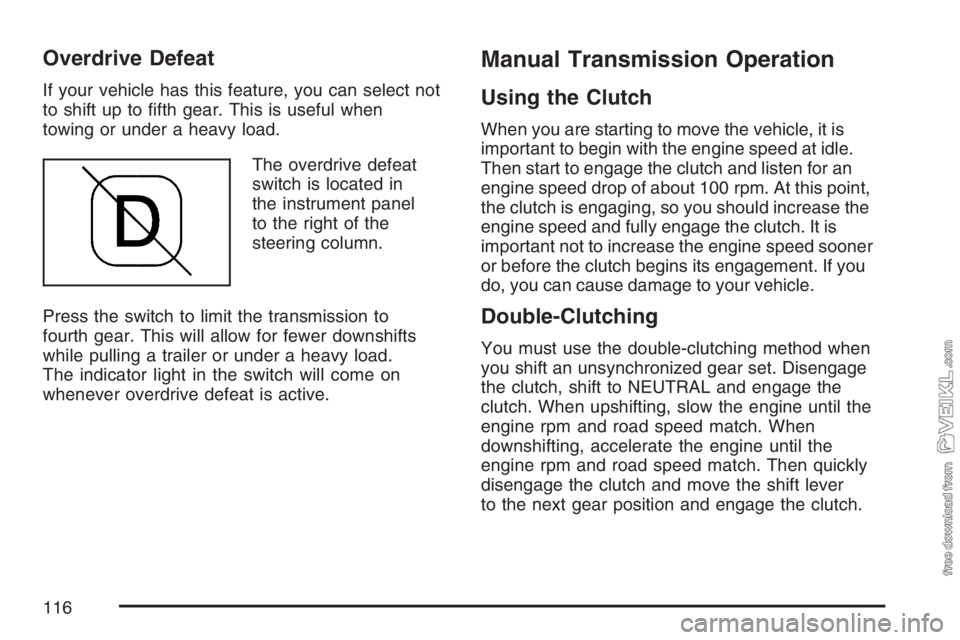
The overdrive defeat
switch is located in
the instrument panel
to the right of the
steering column.
Press the switch to limit the transmission to
fourth gear. This will allow for fewer downshifts
while pulling a trailer or under a heavy load.
The indicator light in the switch will come on
whenever overdrive defeat is active.
Manual Transmission Operation
Using the Clutch
When you are starting to move the vehicle, it is
important to begin with the engine speed at idle.
Then start to engage the clutch and listen for an
engine speed drop of about 100 rpm. At this point,
the clutch is engaging, so you should increase the
engine speed and fully engage the clutch. It is
important not to increase the engine speed sooner
or before the clutch begins its engagement. If you
do, you can cause damage to your vehicle.
Double-Clutching
You must use the double-clutching method when
you shift an unsynchronized gear set. Disengage
the clutch, shift to NEUTRAL and engage the
clutch. When upshifting, slow the engine until the
engine rpm and road speed match. When
downshifting, accelerate the engine until the
engine rpm and road speed match. Then quickly
disengage the clutch and move the shift lever
to the next gear position and engage the clutch.
116
Page 117 of 430
Eaton®Fuller®Five and Six-Speed
Transmissions and TTC Spicer
Seven-Speed Transmissions
These transmissions have gears that automatically
synchronize when you shift up or down (except
FIRST (1) gear on the five-speed and seven-speed
transmission which is unsynchronized). Choose
the gear that will maintain the road speed you want
while keeping the engine above two-thirds of the
governed speed. When the engine speed
drops below two-thirds of the governed speed,
shift into the next lower gear before your engine
begins to lug. When you shift down, be sure
to double-clutch if required.
Eaton®Fuller®Nine and Ten-Speed
Non-Synchronized Manual
Transmissions
If your vehicle has one of these transmissions the
engine rpm and road speed must match when
upshifting and downshifting. The label above the
windshield will tell you the operating basics
you need to know.
The following are driving tips.
•Always choose an initial starting gear suitable
for the load and terrain.
•Always use double-clutching procedures when
shifting.
•Never move the range shift lever to the
LO speed gear position after HI range
preselection, or anytime the transmission is in
the HI range.
•Never move the range knob or lever with the
shift lever in NEUTRAL while the vehicle is
moving.
•Never make a range shift while moving in
REVERSE (R).
117
Page 118 of 430
Clutch Brake (Vehicles with
Non-Synchronized Transmission)
A clutch brake is used to stop transmission input
shaft rotation so that FIRST (1) or REVERSE (R)
gear selection can be initiated when the vehicle is
at a standstill and the engine is idling.
Press the clutch pedal all the way down to the
floorboard to apply the clutch brake.
When using the clutch brake, disengage the clutch
pedal and shift the transmission into either the
initial starting gear or REVERSE (R). If the
tooth-butting occurs between the clutching teeth,
re-engage the clutch while applying light pressure
to the shift lever. This will provide for a smooth
shift into either FIRST (1) or REVERSE (R) gear.
Notice:Using the clutch brake for shifting
into any gear other than FIRST (1) or
REVERSE (R) may cause premature wear of
the clutch brake and make gear shift effort
more difficult. Do not use the clutch brake for
shifting after engaging FIRST (1) or
REVERSE (R).
Power Take-Off (PTO)
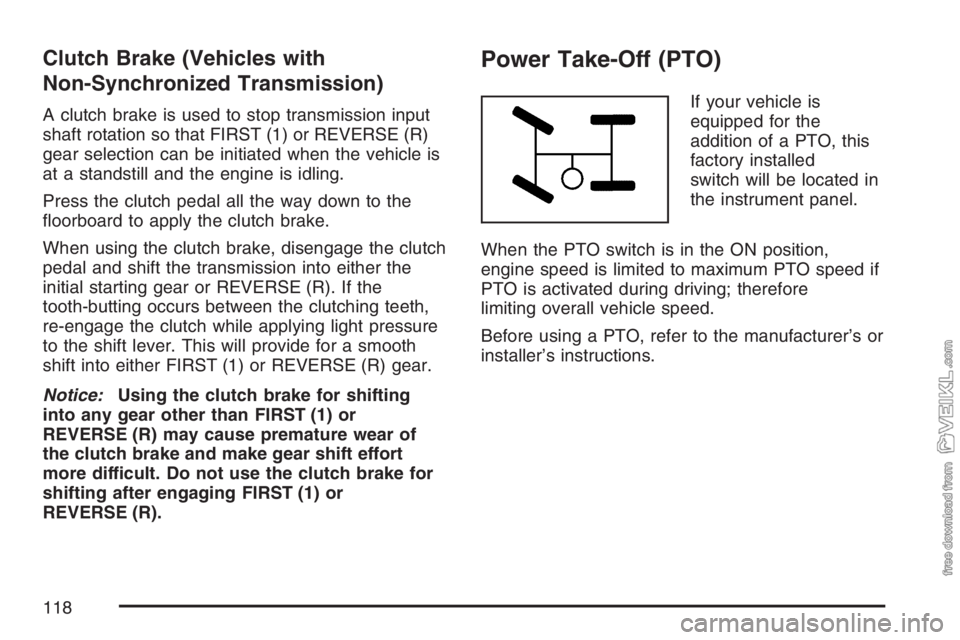
If your vehicle is
equipped for the
addition of a PTO, this
factory installed
switch will be located in
the instrument panel.
When the PTO switch is in the ON position,
engine speed is limited to maximum PTO speed if
PTO is activated during driving; therefore
limiting overall vehicle speed.
Before using a PTO, refer to the manufacturer’s or
installer’s instructions.
118
Page 119 of 430
Four-Wheel Drive
If your vehicle has four-wheel drive, you can send
the engine’s driving power to all four wheels for
extra traction. To get the most satisfaction
out of four-wheel drive, you must be familiar with
its operation. Read the part that follows before
using four-wheel drive. You should use two-wheel
drive high for most normal driving conditions.
Notice:Driving on clean, dry pavement
in four-wheel drive for an extended period of
time can cause premature wear on your
vehicle’s powertrain. Do not drive on clean,
dry pavement in four-wheel drive for extended
periods of time.
Locking Hubs
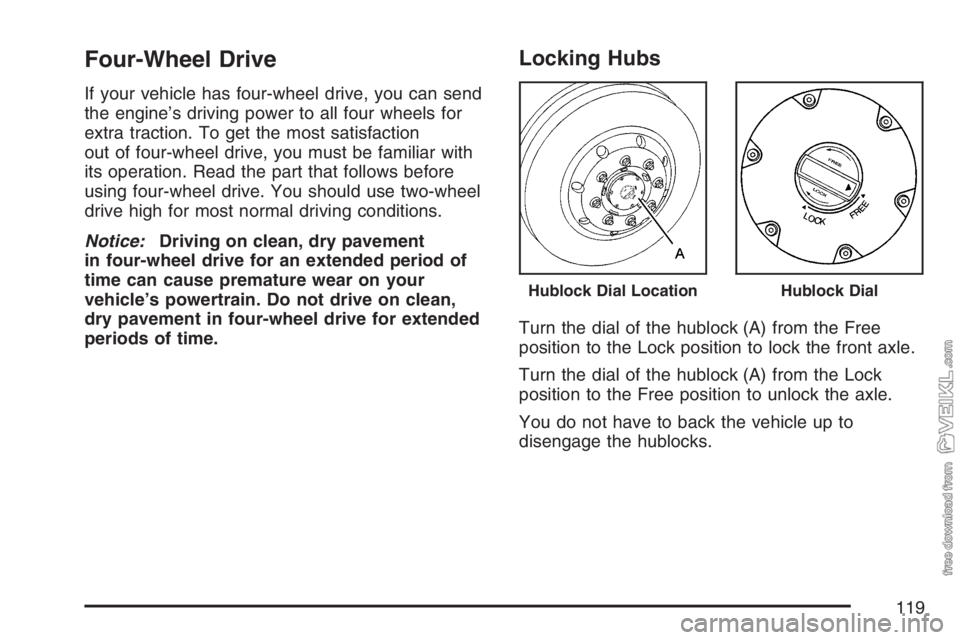
Turn the dial of the hublock (A) from the Free
position to the Lock position to lock the front axle.
Turn the dial of the hublock (A) from the Lock
position to the Free position to unlock the axle.
You do not have to back the vehicle up to
disengage the hublocks.
Hublock Dial LocationHublock Dial
119
Page 122 of 430
Shifting Into Two-Wheel High
Turn the knob to Two-Wheel High. This can be
done at 3 mph or less, while you are shifting out of
Four-Wheel Low.
Shifting Into Four-Wheel Low
To shift to Four-Wheel Low, the vehicle’s engine
must be running and the vehicle must be stopped
or moving less than 3 mph (5 km/h) with the
transmission in NEUTRAL (N). The preferred
method for shifting into Four-Wheel Low is to have
your vehicle moving 1 or 2 mph (1.6 to 3.2 km/h).
Turn the knob to Four-Wheel Low. You must
wait for the Four-Wheel Low indicator light to stop
flashing and remain on before shifting the
transmission into gear. Be sure to lock the
front hubs.Notice:Shifting the transmission into gear
before the Four-Wheel Drive Low indicator light
has stopped ashing could damage the
transfer case. To help avoid damaging your
vehicle, always wait for the Four-Wheel
Drive Low indicator light to stop ashing
before shifting the transmission into gear.
If you turn the knob to Four-Wheel Low while your
vehicle is in gear and/or moving, the Four-Wheel
Low indicator light flashes for 30 seconds and
does not complete the shift unless your vehicle is
moving less than 3 mph (4.8 km/h) and the
transmission is in NEUTRAL (N). After 30 seconds,
the transfer case returns to the setting last
chosen. If your vehicle is in gear and moving less
than 3 mph (4.8 km/h), the transfer case shifts
to Four-Wheel High.
122
Page 123 of 430
Shifting Out of Four-Wheel Low
To shift from Four-Wheel Low to Four-Wheel High
or Two-Wheel High, your vehicle must be
stopped or moving less than 3 mph (5 km/h) with
the transmission in NEUTRAL (N) and the
engine running. The preferred method for shifting
out of Four-Wheel Low is to have your vehicle
moving 1 or 2 mph (1.6 to 3.2 km/h). Turn the knob
to Four-Wheel High or Two-Wheel High. You
must wait for the Four-Wheel High or Two-Wheel
High indicator light to stop flashing and remain
on before shifting the transmission into gear.
Notice:Shifting the transmission into gear
before the Four-Wheel High or Two-Wheel High
indicator light has stopped ashing could
damage the transfer case. To help avoid
damaging your vehicle, always wait for the
Four-Wheel High or Two-Wheel High indicator
light to stop ashing before shifting the
transmission into gear.
If the knob is turned to Four-Wheel High or
Two-Wheel High while your vehicle is in gear and/or
moving, the Four-Wheel High or Two-Wheel high
indicator light flashes for 30 seconds. It will not
complete the shift unless your vehicle is moving
less than 3 mph (5 km/h) with the transmission in
NEUTRAL (N).
Shifting Into NEUTRAL
Before shifting the transfer case to NEUTRAL, first
make sure the vehicle is parked so that it will
not roll.
1. Set the parking brake.
2. Start the vehicle.
3. Put the transmission in NEUTRAL (N).
4. Shift the transfer case to Two-Wheel High.
5. Turn the transfer case knob all of the way past
Four-Wheel Low and hold it there for a
minimum of 10 seconds. The NEUTRAL
indicator light comes on.
6. Shift the transmission to REVERSE (R) for
one second, then shift the transmission to
DRIVE (D) for one second.
7. Turn the ignition to OFF.
8. Place the transmission shift lever in
PARK. (P).
9. Turn the ignition to LOCK.
123
Page 124 of 430
Shifting Out of NEUTRAL
To shift the transfer case out of NEUTRAL, do the
following:
1. Set the parking brake and apply the regular
brake pedal.
2. Turn the ignition to RUN with the engine off.
3. Put the transmission in NEUTRAL (N).
4. Turn the transfer case knob to the desired
shift position (Two-Wheel High, Four-Wheel
High, Four-Wheel Low).
5. After the transfer case has shifted out of
NEUTRAL, the indicator light goes out.Notice:Driving with the parking brake on can
overheat the brake system and cause
premature wear or damage to brake system
parts. Verify that the parking brake is fully
released and the brake warning light is
off before driving.
6. Release the parking brake.
7. Start the engine and shift the transmission
lever to the desired position.
Excessively shifting the transfer case into or out of
the different modes can cause the transfer case
to enter the shift protection mode. This protects the
transfer case from possible damage and only
allows the transfer case to respond to one shift per
10 seconds. The transfer case can stay in this
mode for up to three minutes.
124