transmission CHEVROLET KODIAK 2007 Service Manual
[x] Cancel search | Manufacturer: CHEVROLET, Model Year: 2007, Model line: KODIAK, Model: CHEVROLET KODIAK 2007Pages: 430, PDF Size: 6.06 MB
Page 245 of 430
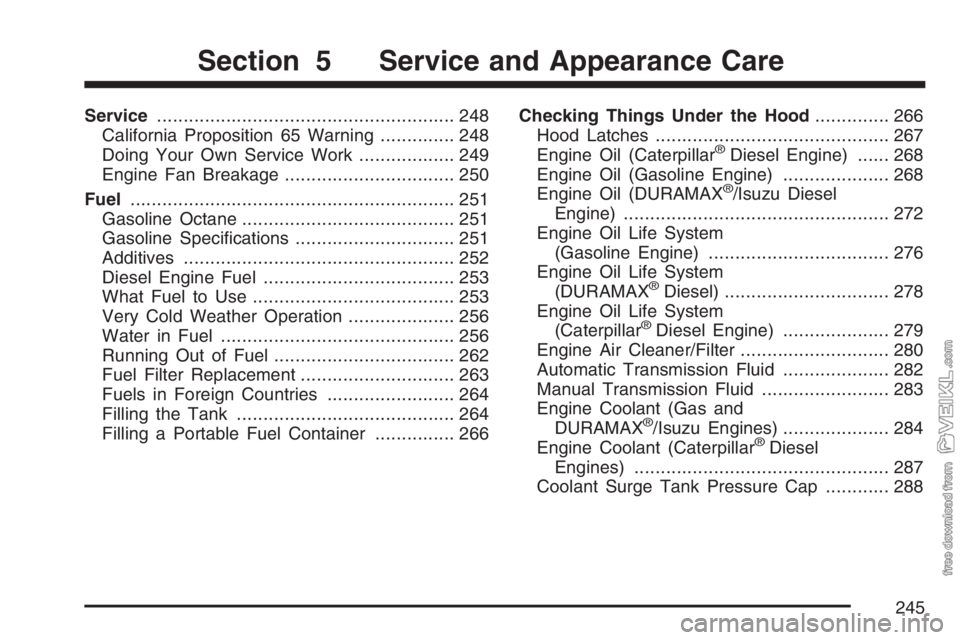
Service........................................................ 248
California Proposition 65 Warning.............. 248
Doing Your Own Service Work.................. 249
Engine Fan Breakage................................ 250
Fuel............................................................. 251
Gasoline Octane........................................ 251
Gasoline Specifications.............................. 251
Additives................................................... 252
Diesel Engine Fuel.................................... 253
What Fuel to Use...................................... 253
Very Cold Weather Operation.................... 256
Water in Fuel............................................ 256
Running Out of Fuel.................................. 262
Fuel Filter Replacement............................. 263
Fuels in Foreign Countries........................ 264
Filling the Tank......................................... 264
Filling a Portable Fuel Container............... 266Checking Things Under the Hood.............. 266
Hood Latches............................................ 267
Engine Oil (Caterpillar
®Diesel Engine)...... 268
Engine Oil (Gasoline Engine).................... 268
Engine Oil (DURAMAX
®/Isuzu Diesel
Engine).................................................. 272
Engine Oil Life System
(Gasoline Engine).................................. 276
Engine Oil Life System
(DURAMAX
®Diesel)............................... 278
Engine Oil Life System
(Caterpillar
®Diesel Engine).................... 279
Engine Air Cleaner/Filter............................ 280
Automatic Transmission Fluid.................... 282
Manual Transmission Fluid........................ 283
Engine Coolant (Gas and
DURAMAX
®/Isuzu Engines).................... 284
Engine Coolant (Caterpillar®Diesel
Engines)................................................ 287
Coolant Surge Tank Pressure Cap............ 288
Section 5 Service and Appearance Care
245
Page 253 of 430
Diesel Engine Fuel
For the Caterpillar®diesel, see the Caterpillar®
Operation & Maintenance Manual for information
concerning fuel usage.
Notice:Diesel fuel or fuel additives not
recommended in this manual could damage
your fuel system and engine. Your warranty
would not cover this damage. And:
Diesel fuel that has been mixed with engine
oil or automatic transmission uid could
damage your engine and emission controls.
Aftermarket diesel fuel additives are not
tested by General Motors. Some additives,
particularly those which contain alcohol or
water emulsiers, may damage your fuel
system. If you believe that unique
circumstances call for a fuel additive to be
used, consult your dealer for advice.
If you ever run out of diesel fuel, it can be
difficult to restart your engine. To avoid this,
never let your tank get empty.
If gasoline is ever accidentally added to the fuel
tank, to avoid severe engine damage, do not run
the engine until the fuel tank can be drained.
If you run out of fuel,Running Out of Fuel on
page 262tells you how to restart your engine.
What Fuel to Use
In the United States, for best results use
No. 2-D diesel fuel year-round (above and below
freezing conditions) as oil companies blend
No. 2-D fuel to address climate differences.
No. 1-D diesel fuel may be used in very cold
temperatures (when it stays below 0°F or−18°C);
however, it will produce a power and fuel
economy loss. Avoid the use of No. 1-D diesel
fuel in warm or hot climates. It may result in
stalling, poor starting when the engine is hot, and
may damage the fuel injection system.
It is important that diesel-powered trucks are
refueled only with ultra low-sulfur fuel. The
emission control system requires the use of diesel
fuel with ultra low-sulfur (0.0015% by weight, or
15 ppm, maximum) content. Both ultra low-sulfur
and higher sulfur diesel fuels are available in
the United States and ultra low-sulfur diesel fuel is
available in Canada. However, only higher
sulfur diesel fuel is available in Mexico. Use of
fuels with higher-sulfur content will affect the
function of the emission components and may
cause reduced performance, excessive smoke,
and unpleasant odor.
253
Page 282 of 430
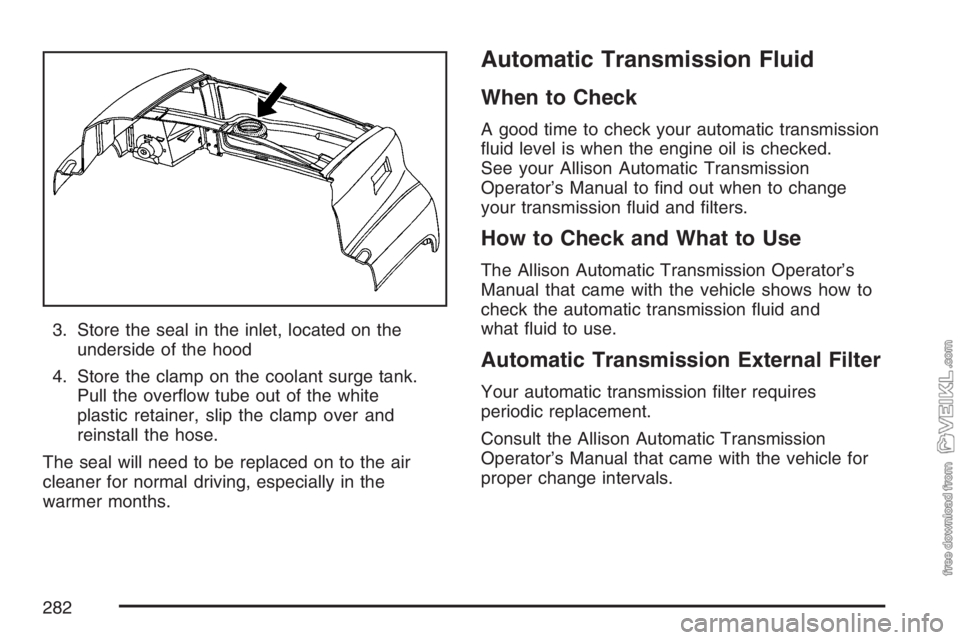
3. Store the seal in the inlet, located on the
underside of the hood
4. Store the clamp on the coolant surge tank.
Pull the overflow tube out of the white
plastic retainer, slip the clamp over and
reinstall the hose.
The seal will need to be replaced on to the air
cleaner for normal driving, especially in the
warmer months.
Automatic Transmission Fluid
When to Check
A good time to check your automatic transmission
fluid level is when the engine oil is checked.
See your Allison Automatic Transmission
Operator’s Manual to find out when to change
your transmission fluid and filters.
How to Check and What to Use
The Allison Automatic Transmission Operator’s
Manual that came with the vehicle shows how to
check the automatic transmission fluid and
what fluid to use.
Automatic Transmission External Filter
Your automatic transmission filter requires
periodic replacement.
Consult the Allison Automatic Transmission
Operator’s Manual that came with the vehicle for
proper change intervals.
282
Page 283 of 430
Manual Transmission Fluid
When to Check
A good time to have it checked is when the
engine oil is checked. Refer to the Maintenance
Schedule to find out when to check and change
your manual transmission fluid. SeeScheduled
Maintenance on page 363.
How to Check and What to Use
Check the fluid level only when your engine is off,
the vehicle is parked on a level place, and the
transmission is cool enough for you to rest
your fingers on the transmission case.
To check the transmission fluid level, do the
following:
1. Remove the filler plug.
2. Check to be sure that the lubricant level is up
to the bottom of the fill opening. On heavy
duty transmissions, an inch of oil level equals
about one gallon of fluid.3. If the fluid level is good, reinstall the plug and
be sure it is fully seated. If the fluid level is
low, add more fluid as described in the
next steps. Refer to the Maintenance
Schedule to determine what kind of fluid to
use. SeePart C: Recommended Fluids
and Lubricants on page 397.
How to Add Fluid
To add transmission fluid, do the following:
1. Remove the filler plug.
2. Add fluid at the filler plug hole. Add only
enough fluid to bring the fluid level up to
the bottom of the fill opening. Refer to
the Maintenance Schedule to determine the
proper fluid to use. SeePart C:
Recommended Fluids and Lubricants on
page 397.
3. Reinstall the filler plug. Be sure the plug is
fully seated.
283
Page 294 of 430
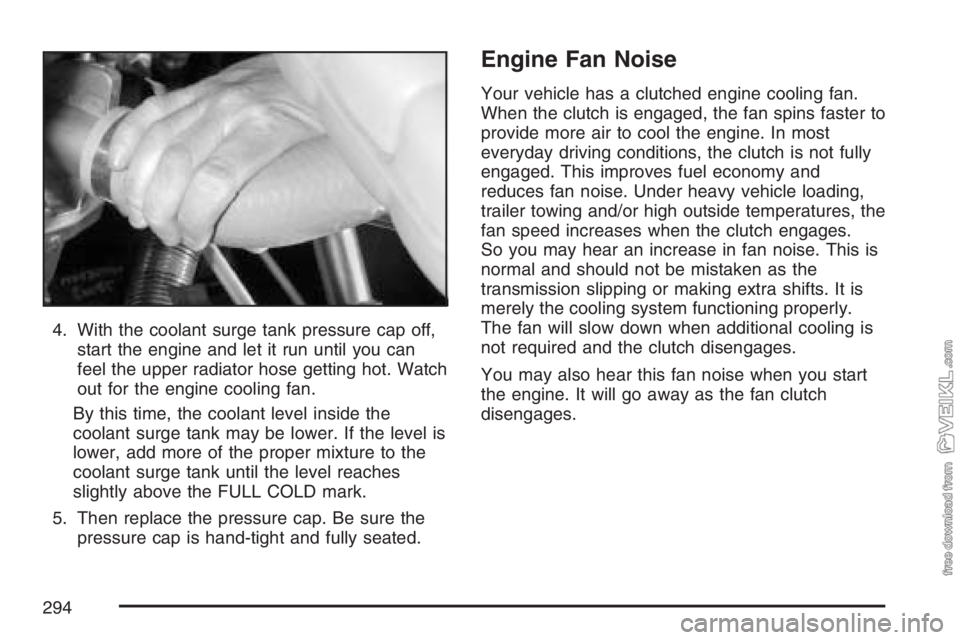
4. With the coolant surge tank pressure cap off,
start the engine and let it run until you can
feel the upper radiator hose getting hot. Watch
out for the engine cooling fan.
By this time, the coolant level inside the
coolant surge tank may be lower. If the level is
lower, add more of the proper mixture to the
coolant surge tank until the level reaches
slightly above the FULL COLD mark.
5. Then replace the pressure cap. Be sure the
pressure cap is hand-tight and fully seated.
Engine Fan Noise
Your vehicle has a clutched engine cooling fan.
When the clutch is engaged, the fan spins faster to
provide more air to cool the engine. In most
everyday driving conditions, the clutch is not fully
engaged. This improves fuel economy and
reduces fan noise. Under heavy vehicle loading,
trailer towing and/or high outside temperatures, the
fan speed increases when the clutch engages.
So you may hear an increase in fan noise. This is
normal and should not be mistaken as the
transmission slipping or making extra shifts. It is
merely the cooling system functioning properly.
The fan will slow down when additional cooling is
not required and the clutch disengages.
You may also hear this fan noise when you start
the engine. It will go away as the fan clutch
disengages.
294
Page 301 of 430
Electric Air Compressor
Your vehicle may have an electric air compressor.
This compressor is used to run options that
require pressurized air, such as an air horn, air
seat, 7.8L engine exhaust restrictor, or 7.8L engine
exhaust brake.
The air compressor is used when vehicles do not
have an air brake system.
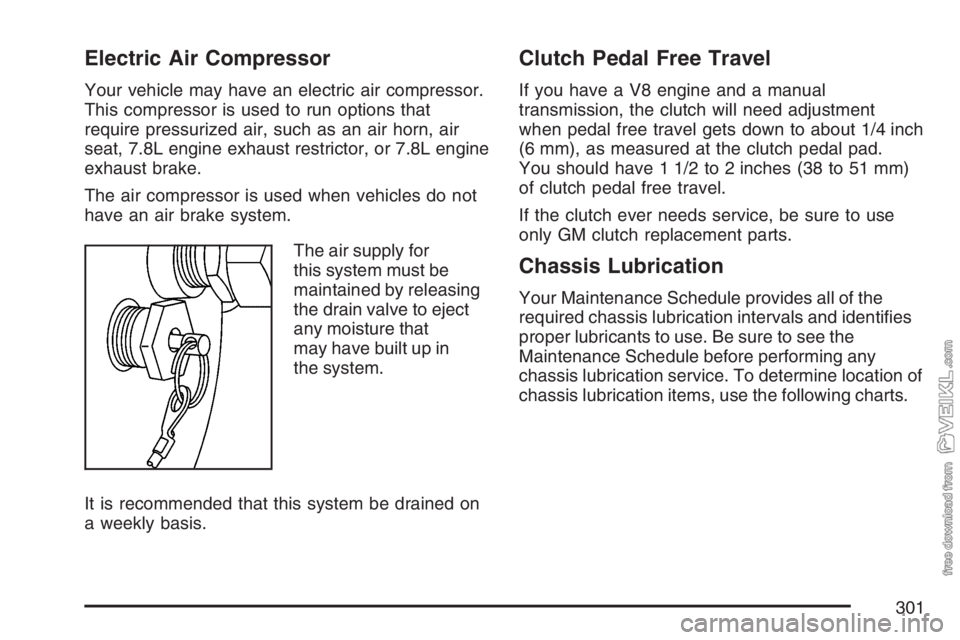
The air supply for
this system must be
maintained by releasing
the drain valve to eject
any moisture that
may have built up in
the system.
It is recommended that this system be drained on
a weekly basis.
Clutch Pedal Free Travel
If you have a V8 engine and a manual
transmission, the clutch will need adjustment
when pedal free travel gets down to about 1/4 inch
(6 mm), as measured at the clutch pedal pad.
You should have 1 1/2 to 2 inches (38 to 51 mm)
of clutch pedal free travel.
If the clutch ever needs service, be sure to use
only GM clutch replacement parts.
Chassis Lubrication
Your Maintenance Schedule provides all of the
required chassis lubrication intervals and identifies
proper lubricants to use. Be sure to see the
Maintenance Schedule before performing any
chassis lubrication service. To determine location of
chassis lubrication items, use the following charts.
301
Page 303 of 430
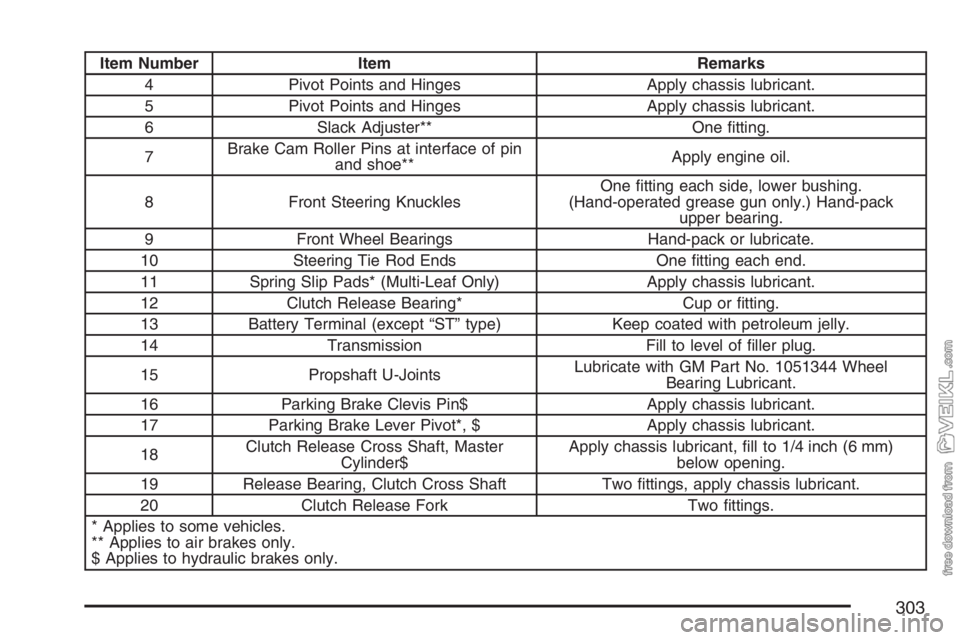
Item Number Item Remarks
4 Pivot Points and Hinges Apply chassis lubricant.
5 Pivot Points and Hinges Apply chassis lubricant.
6 Slack Adjuster** One fitting.
7Brake Cam Roller Pins at interface of pin
and shoe**Apply engine oil.
8 Front Steering KnucklesOne fitting each side, lower bushing.
(Hand-operated grease gun only.) Hand-pack
upper bearing.
9 Front Wheel Bearings Hand-pack or lubricate.
10 Steering Tie Rod Ends One fitting each end.
11 Spring Slip Pads* (Multi-Leaf Only) Apply chassis lubricant.
12 Clutch Release Bearing* Cup or fitting.
13 Battery Terminal (except “ST” type) Keep coated with petroleum jelly.
14 Transmission Fill to level of filler plug.
15 Propshaft U-JointsLubricate with GM Part No. 1051344 Wheel
Bearing Lubricant.
16 Parking Brake Clevis Pin$ Apply chassis lubricant.
17 Parking Brake Lever Pivot*, $ Apply chassis lubricant.
18Clutch Release Cross Shaft, Master
Cylinder$Apply chassis lubricant, fill to 1/4 inch (6 mm)
below opening.
19 Release Bearing, Clutch Cross Shaft Two fittings, apply chassis lubricant.
20 Clutch Release Fork Two fittings.
* Applies to some vehicles.
** Applies to air brakes only.
$ Applies to hydraulic brakes only.
303
Page 306 of 430
Notice:Ignoring these steps could result in
costly damage to your vehicle that would
not be covered by your warranty.
Trying to start your vehicle by pushing or
pulling it will not work, and it could damage
your vehicle.
1. Check the other vehicle. It must have a
12-volt battery (or batteries) with a negative
ground system.
Notice:If the other vehicle’s system is not a
12-volt system with a negative ground,
both vehicles can be damaged. Only use
vehicles with 12-volt systems with negative
grounds to jump start your vehicle.
If you have a diesel engine vehicle with
two batteries (or more), you should know
before you begin that, especially in cold
weather, you may not be able to get enough
power from a single battery in another
vehicle to start your diesel engine.
If your vehicle has more than one battery, use
the one closest to the starter — this will
reduce electrical resistance.2. Get the vehicles close enough so the jumper
cables can reach, but be sure the vehicles are
not touching each other. If they are, it could
cause a ground connection you do not
want. You would not be able to start your
vehicle, and the bad grounding could damage
the electrical systems.
To avoid the possibility of the vehicles rolling,
set the parking brake firmly on both vehicles
involved in the jump start procedure. Put
an automatic transmission in PARK (P) or a
manual transmission in NEUTRAL before
setting the parking brake. If you have a
four-wheel-drive vehicle, be sure the transfer
case is in a drive gear, not in NEUTRAL.
Notice:If you leave your radio or other
accessories on during the jump starting
procedure, they could be damaged. The repairs
would not be covered by your warranty.
Always turn off your radio and other
accessories when jump starting your vehicle.
3. Turn off the ignition on both vehicles. Unplug
unnecessary accessories plugged into the
cigarette lighter or accessory power outlets.
306
Page 343 of 430
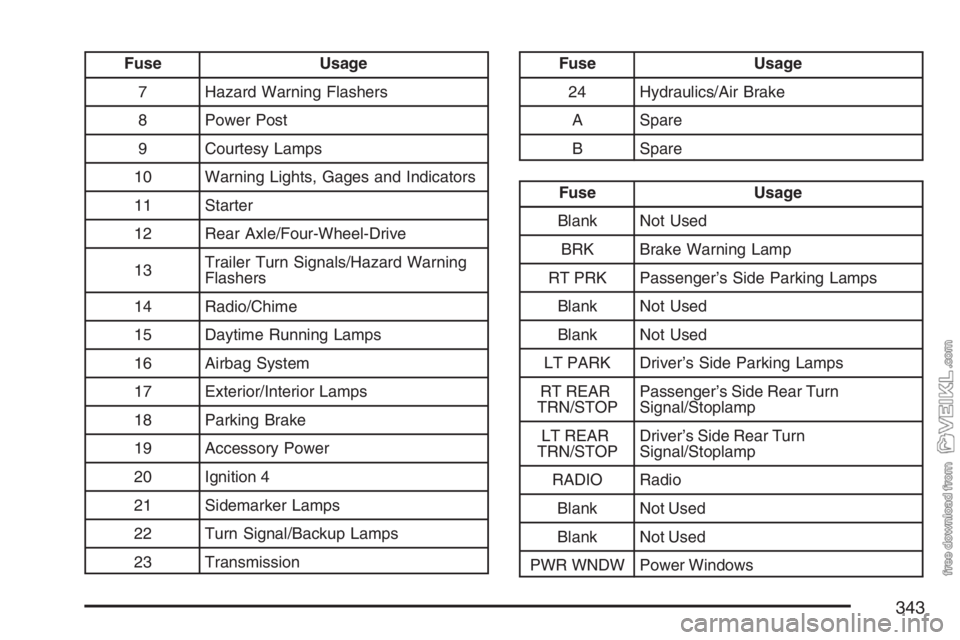
Fuse Usage
7 Hazard Warning Flashers
8 Power Post
9 Courtesy Lamps
10 Warning Lights, Gages and Indicators
11 Starter
12 Rear Axle/Four-Wheel-Drive
13Trailer Turn Signals/Hazard Warning
Flashers
14 Radio/Chime
15 Daytime Running Lamps
16 Airbag System
17 Exterior/Interior Lamps
18 Parking Brake
19 Accessory Power
20 Ignition 4
21 Sidemarker Lamps
22 Turn Signal/Backup Lamps
23 TransmissionFuse Usage
24 Hydraulics/Air Brake
A Spare
B Spare
Fuse Usage
Blank Not Used
BRK Brake Warning Lamp
RT PRK Passenger’s Side Parking Lamps
Blank Not Used
Blank Not Used
LT PARK Driver’s Side Parking Lamps
RT REAR
TRN/STOPPassenger’s Side Rear Turn
Signal/Stoplamp
LT REAR
TRN/STOPDriver’s Side Rear Turn
Signal/Stoplamp
RADIO Radio
Blank Not Used
Blank Not Used
PWR WNDW Power Windows
343
Page 346 of 430
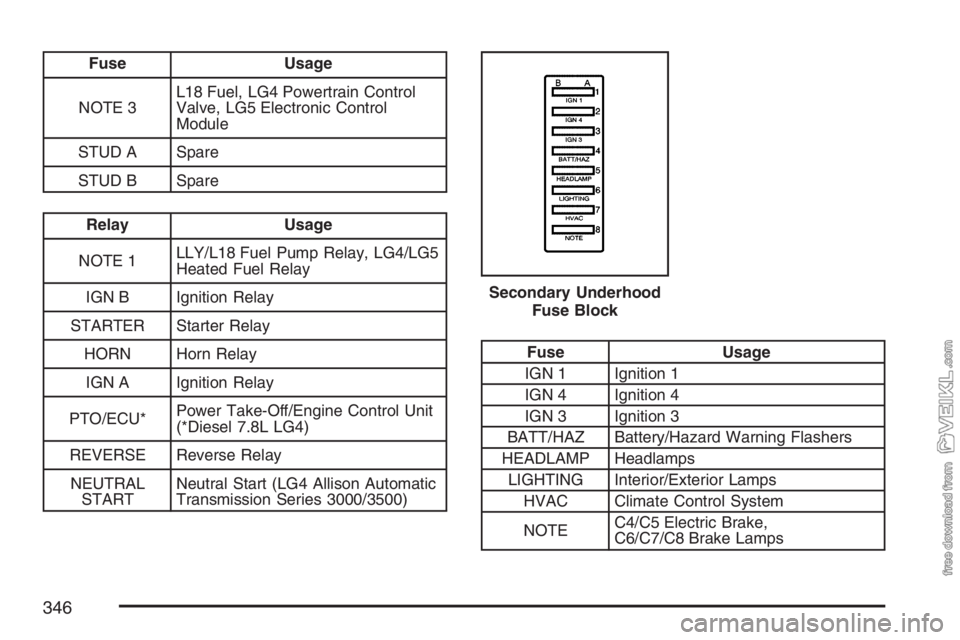
Fuse Usage
NOTE 3L18 Fuel, LG4 Powertrain Control
Valve, LG5 Electronic Control
Module
STUD A Spare
STUD B Spare
Relay Usage
NOTE 1LLY/L18 Fuel Pump Relay, LG4/LG5
Heated Fuel Relay
IGN B Ignition Relay
STARTER Starter Relay
HORN Horn Relay
IGN A Ignition Relay
PTO/ECU*Power Take-Off/Engine Control Unit
(*Diesel 7.8L LG4)
REVERSE Reverse Relay
NEUTRAL
STARTNeutral Start (LG4 Allison Automatic
Transmission Series 3000/3500)
Fuse Usage
IGN 1 Ignition 1
IGN 4 Ignition 4
IGN 3 Ignition 3
BATT/HAZ Battery/Hazard Warning Flashers
HEADLAMP Headlamps
LIGHTING Interior/Exterior Lamps
HVAC Climate Control System
NOTEC4/C5 Electric Brake,
C6/C7/C8 Brake Lamps Secondary Underhood
Fuse Block
346