air condition CHEVROLET KODIAK 2007 Owners Manual
[x] Cancel search | Manufacturer: CHEVROLET, Model Year: 2007, Model line: KODIAK, Model: CHEVROLET KODIAK 2007Pages: 430, PDF Size: 6.06 MB
Page 76 of 430
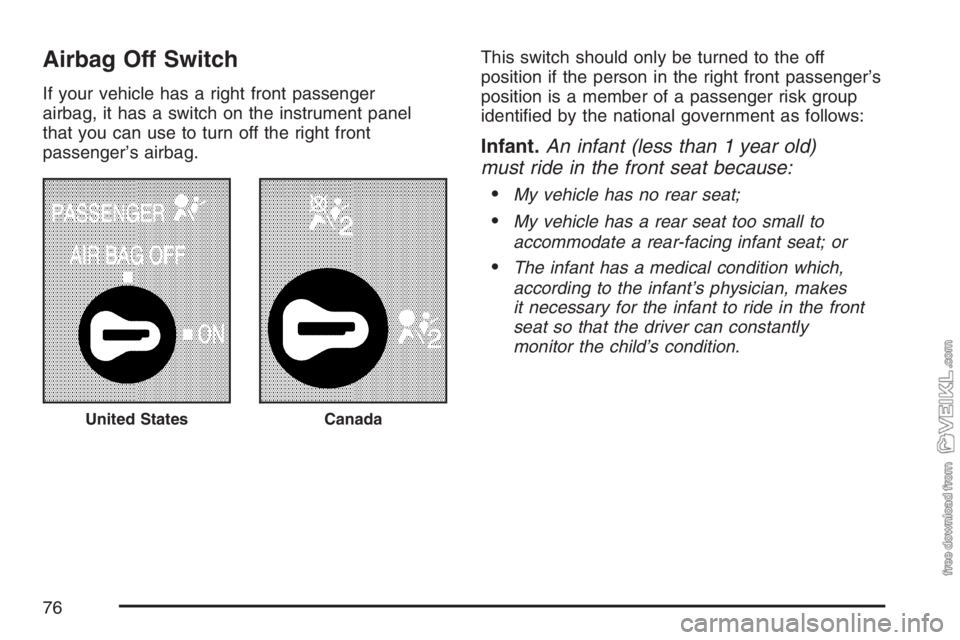
Airbag Off Switch
If your vehicle has a right front passenger
airbag, it has a switch on the instrument panel
that you can use to turn off the right front
passenger’s airbag.This switch should only be turned to the off
position if the person in the right front passenger’s
position is a member of a passenger risk group
identified by the national government as follows:
Infant.An infant (less than 1 year old)
must ride in the front seat because:
•
My vehicle has no rear seat;
•My vehicle has a rear seat too small to
accommodate a rear-facing infant seat; or
•The infant has a medical condition which,
according to the infant’s physician, makes
it necessary for the infant to ride in the front
seat so that the driver can constantly
monitor the child’s condition.
United StatesCanada
76
Page 77 of 430
Child Age 1 to 12.A child age 1 to 12 must
ride in the front seat because:
•
My vehicle has no rear seat;
•Although children ages 1 to 12 ride in the
rear seat(s) whenever possible, children
ages 1 to 12 sometimes must ride in the
front because no space is available in the
rear seat(s) of my vehicle; or
•The child has a medical condition which,
according to the child’s physician, makes
it necessary for the child to ride in the
front seat so that the driver can constantly
monitor the child’s condition.
Medical Condition.A passenger has a
medical condition which, according to his
or her physician:
•
Causes the passenger airbag to pose a
special risk for the passenger; and
•Makes the potential harm from the passenger
airbag in a crash greater than the potential
harm from turning off the airbag and allowing
the passenger, even if belted, to hit the
dashboard or windshield in a crash.
77
Page 104 of 430
If the light does not come on when the engine is
cold, your vehicle needs service.
If your batteries do not have enough charge to
start your engine, seeBattery on page 304.
Be sure you have the right oil for your engine, and
that you have changed the oil at the proper
times. If you use the wrong oil, your engine may
be harder to start.
Be sure you are using the proper fuel for existing
weather conditions. SeeWhat Fuel to Use on
page 253.
If the engine starts, runs a short time, then stops,
your vehicle needs service.
{CAUTION:
Do not use gasoline or starting aids, such
as ether, in the air intake. They could
damage your engine. There could also be
a re, which could cause serious personal
injury.
Engine Alarm and Automatic
Shutdown
Your check gages warning light will come on if the
system senses high engine temperature or low
engine oil pressure. If high engine temperature or
low engine oil pressure is detected, you will
also hear a tone alarm at two beats per second.
The alarm and the light will remain on until
the condition is fixed. If the engine temperature or
oil pressure condition worsens, the tone alarm
will go to five beats per second.
If the system senses low engine coolant, the
five beat per second alarm and the low coolant
warning light will come on.
The five beats per second tone alarm means that
your engine will shut down in about 25 to
30 seconds. There is also an engine shutdown
light to indicate that the engine will shut down. See
Engine Shutdown Warning Light on page 177.
104
Page 105 of 430
Pull off the road and shut off the engine. Do
not start it until the reason for the problem is
known, and the problem is fixed. If the engine
shuts down when you are still in traffic, you can
restart the engine and get another 25 to
30 seconds of operation. Do this only if you have
to, since there is a problem that can harm the
engine if it is not fixed. Engine automatic
shutdown, for gasoline engines, requires activation
by your dealer.
Notice:If you try to operate the vehicle after
the engine automatically shuts down, you
may damage the vehicle. Have your vehicle
repaired as soon as possible.Ambulance, Fire, and Rescue Packages
Your check gages warning light will come on if
the system senses high engine temperature or low
engine oil pressure. If high engine temperature
or low engine oil pressure is detected, you will also
hear a tone alarm at two beats per second. The
alarm and the light will remain on until the
condition is fixed. If the engine temperature or oil
pressure condition worsens, the tone alarm
will go to five beats per second.
If the system senses low engine coolant, the
five beat per second alarm and the low coolant
warning light will come on.
The engine will not shutdown, but you should
have the vehicle checked as soon as you can.
105
Page 109 of 430
The engine idle speed will return to normal once
the following conditions are met:
•Once engine coolant temperature reaches
about 150°F (65°C).
•The intake temperature reaches a
certain level.
The high idle speed will be temporarily interrupted
and the engine speed will return to normal if
any of the following conditions occur:
•The brake pedal is applied.
•The accelerator pedal is pressed.
•The automatic transmission is shifted out of
PARK (P) or NEUTRAL (N).
•The clutch pedal on the manual transmission
is pressed.
•Vehicle speed is detected.
Once these conditions no longer exist, the engine
idle speed will slowly increase to high idle after
the normal delay, if the conditions for engine
coolant temperature and air intake temperature
are still met.
Engine Checks Before Operating
When you have started your engine, let it run for
20 to 30 seconds before you put a load on the
engine. But do not leave the vehicle while
the engine is running.
Avoid unnecessary idling of diesel engine
equipped vehicles.
If the engine idles too long, the temperature of the
engine coolant will fall below the normal operating
range. Low engine operating temperature
causes several conditions which affect engine
operation and reduce engine life.
The engine should be permitted to go through a
warm-up period. Operate the vehicle at a minimum
of 600 rpm during the warm-up period. During
this period and during operation, the following
observations should be made.
During this warm-up period, check your warning
lights and gages:
•If oil pressure does not begin to rise within
15 seconds of starting, stop the engine
and find the cause. SeeOil Pressure Gage on
page 175for more information.
109
Page 110 of 430
•If the engine coolant temperature gage needle
goes into the hot area on the gage, stop the
engine and find the cause of the overheating.
SeeEngine Coolant Temperature Gage on
page 173for more information.
•If you have air brakes, the dual-needle air
pressure gage should read at least 115 psi
(790 kPa) for both service systems before you
try to move the vehicle. When air pressure
is below 60 psi (420 kPa), the LOW AIR light
will come on and you will hear a tone
alarm. SeeBrake System Warning Light on
page 169for more information. If the pressure
does not build up or drops during warm-up,
stop the engine and find the cause before you
try to move the vehicle. Recommended air
pressure before driving is 120 psi (830 kPa).
SeeAir Pressure Gage on page 183for
more information.
•The charging system light should come on
when the ignition key is turned to RUN or
START and should go out when the engine is
running above idle. If the light does not go
out or comes back on during normal engine
operation, have the charging system checked
right away. (This light tells you if thegenerator is not charging; it does not reflect
the condition of the battery.) SeeCharging
System Light on page 167for more
information.
•The voltmeter charge indicator gage tells you
the condition of your battery’s charge. The
gage should be in the center area during
engine operation. The red area on the
left indicates an undercharge condition; the
red area on the right indicates an overcharge.
If the gage is in either red area, have the
battery and charging system checked
right away. SeeVoltmeter Gage on page 168
for more information.
Notice:Do not allow the engine to operate at
low idle for more than ve minutes. This
can cause low engine operating temperatures
which can affect engine operation and
reduce engine life. Engine idle speed should
be increased to 1200 rpm whenever extended
idle is required. Once started, the engine
should be placed under load to allow the
engine coolant temperature to reach 150°F
(66°C) before shutting off the engine.
110
Page 157 of 430
Ashtray(s) and Cigarette Lighter
Your vehicle may have an ashtray and a cigarette
lighter located in the center floor console. To
open the removable ashtray, flip open the top.
Notice:If you put papers, pins, or other
ammable items in the ashtray, hot cigarettes
or other smoking materials could ignite
them and possibly damage your vehicle. Never
put ammable items in the ashtray.
To use the cigarette lighter, push it in all the way
and let it go. When it’s ready, it will pop back
out by itself.
Notice:Holding a cigarette lighter in while it
is heating will not allow the lighter to back
away from the heating element when it is hot.
Damage from overheating may occur to the
lighter or heating element, or a fuse could be
blown. Do not hold a cigarette lighter in
while it is heating.
Climate Controls
Climate Control System
With these systems, you can control the heating,
cooling and ventilation for your vehicle.
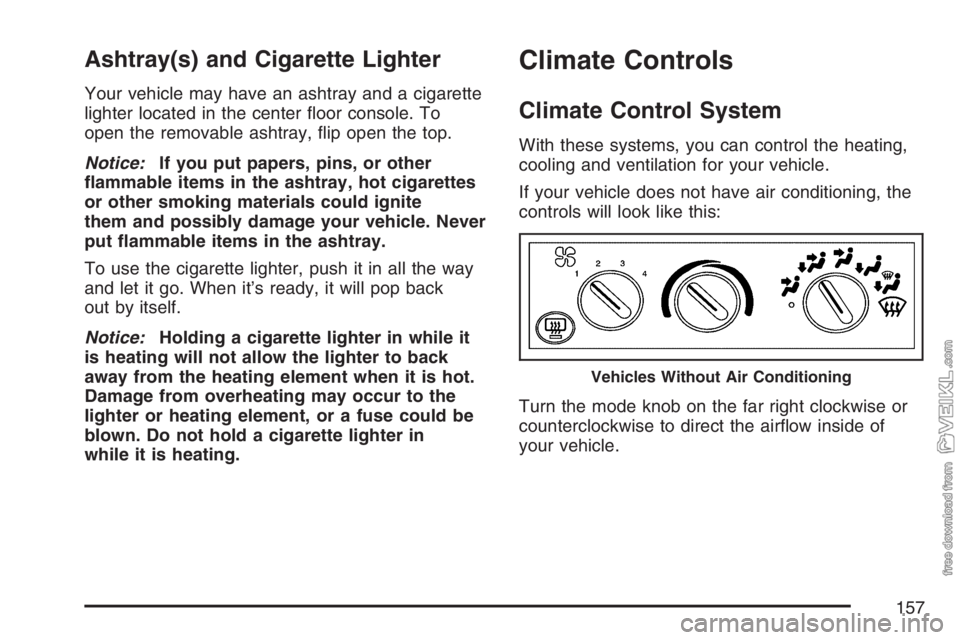
If your vehicle does not have air conditioning, the
controls will look like this:
Turn the mode knob on the far right clockwise or
counterclockwise to direct the airflow inside of
your vehicle.
Vehicles Without Air Conditioning
157
Page 158 of 430
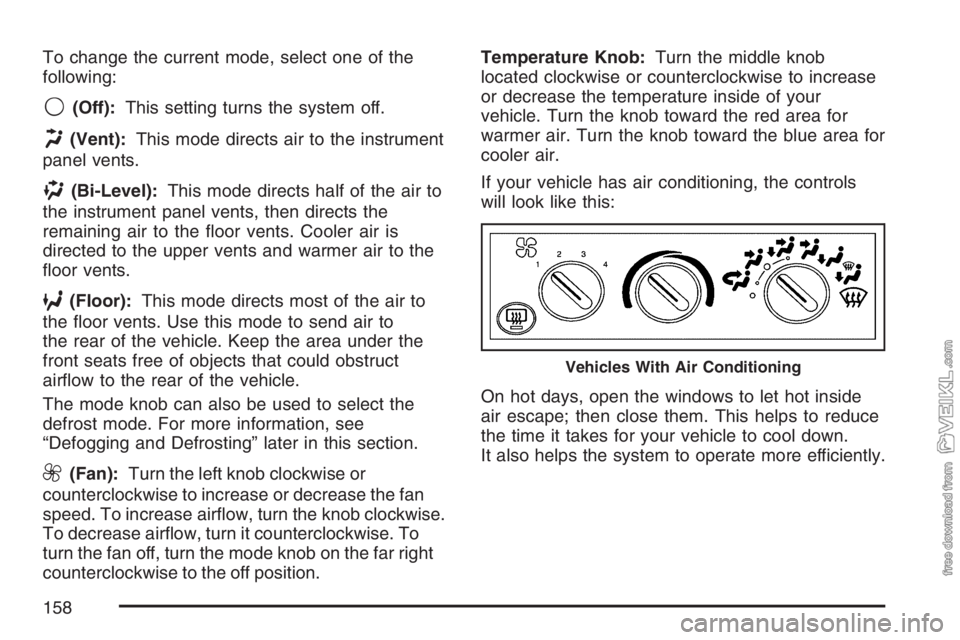
To change the current mode, select one of the
following:
9(Off):This setting turns the system off.
H(Vent):This mode directs air to the instrument
panel vents.
)(Bi-Level):This mode directs half of the air to
the instrument panel vents, then directs the
remaining air to the floor vents. Cooler air is
directed to the upper vents and warmer air to the
floor vents.
6(Floor):This mode directs most of the air to
the floor vents. Use this mode to send air to
the rear of the vehicle. Keep the area under the
front seats free of objects that could obstruct
airflow to the rear of the vehicle.
The mode knob can also be used to select the
defrost mode. For more information, see
“Defogging and Defrosting” later in this section.
9(Fan):Turn the left knob clockwise or
counterclockwise to increase or decrease the fan
speed. To increase airflow, turn the knob clockwise.
To decrease airflow, turn it counterclockwise. To
turn the fan off, turn the mode knob on the far right
counterclockwise to the off position.Temperature Knob:Turn the middle knob
located clockwise or counterclockwise to increase
or decrease the temperature inside of your
vehicle. Turn the knob toward the red area for
warmer air. Turn the knob toward the blue area for
cooler air.
If your vehicle has air conditioning, the controls
will look like this:
On hot days, open the windows to let hot inside
air escape; then close them. This helps to reduce
the time it takes for your vehicle to cool down.
It also helps the system to operate more efficiently.
Vehicles With Air Conditioning
158
Page 159 of 430
<(Maximum Air Conditioning):Turn the right
knob to this setting for maximum cooling. This
setting puts the system in recirculation mode and
helps to maximize your air conditioner’s
performance and your vehicle’s fuel economy.
This setting also cools the air the fastest.
Y(Air Conditioning):This setting is used for
normal cooling on hot days. It cools outside air and
directs it through the instrument panel vents.
)(Bi-Level Air Conditioning):This setting
divides airflow between the floor vents and
instrument panel vents. The air conditioning
compressor will cycle continuously in this setting
as long as the outside temperature is warm
enough to activate the compressor.
Defogging and Defrosting
Fog on the inside of windows is a result of high
humidity (moisture) condensing on the cool window
glass. This can be minimized if the climate
control is used properly. There are two modes to
clear fog or frost from your windshield and
side windows.Use the defog mode to clear the windows of fog or
moisture and warm the passengers. Use the defrost
mode to remove fog or frost from the windshield
more quickly. For best results, clear all snow and
ice from the windshield before defrosting.
Turn the mode knob on the right of the climate
control panel to select the defog or defrost mode.
-(Defog):With this setting, the outside air
comes out of both the floor and defroster outlets.
Adjust the temperature knob for warmer or
cooler air. The air conditioning compressor may
operate in this setting to dehumidify the air.
0(Defrost):This setting operates the defroster.
Most of the air comes out near the windshield,
with some going to the floor outlets and front side
windows. The air conditioning compressor may
operate in this setting to dehumidify the air.
The defog setting is useful for cold weather with a
large number of passengers or very humid
conditions to help keep the windshield clear. Use
defrost to remove fog or ice from the windshield
quickly in extremely cold conditions. The
temperature knob should be in the red area and
the fan control toward high. Do not drive the
vehicle until all the windows are clear.
159
Page 160 of 430
Rear Window Defogger
The rear window defogger uses a warming grid to
remove fog or frost from the rear window.
Be sure to clear as much snow from the rear
window as possible.
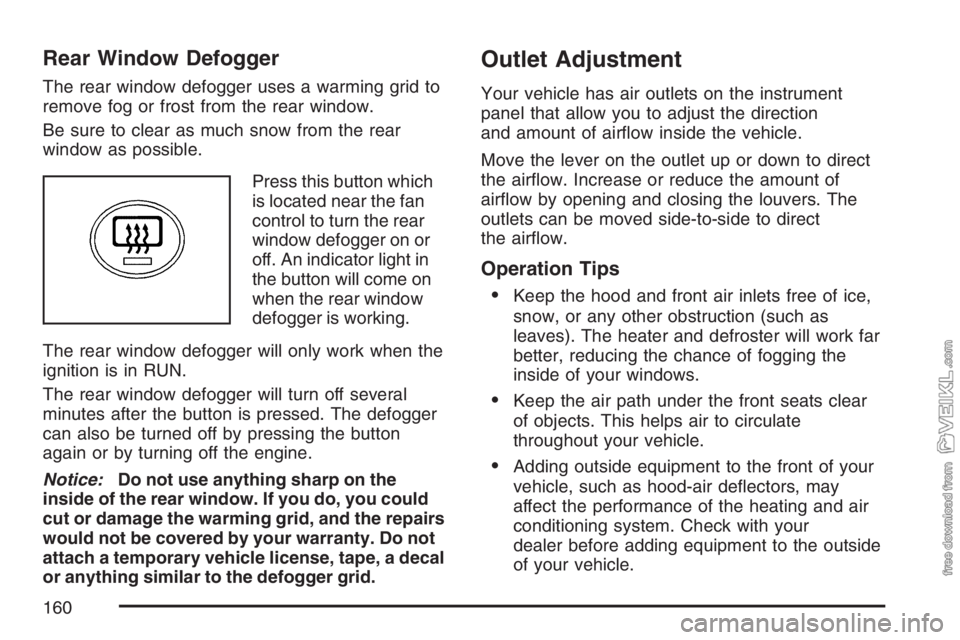
Press this button which
is located near the fan
control to turn the rear
window defogger on or
off. An indicator light in
the button will come on
when the rear window
defogger is working.
The rear window defogger will only work when the
ignition is in RUN.
The rear window defogger will turn off several
minutes after the button is pressed. The defogger
can also be turned off by pressing the button
again or by turning off the engine.
Notice:Do not use anything sharp on the
inside of the rear window. If you do, you could
cut or damage the warming grid, and the repairs
would not be covered by your warranty. Do not
attach a temporary vehicle license, tape, a decal
or anything similar to the defogger grid.
Outlet Adjustment
Your vehicle has air outlets on the instrument
panel that allow you to adjust the direction
and amount of airflow inside the vehicle.
Move the lever on the outlet up or down to direct
the airflow. Increase or reduce the amount of
airflow by opening and closing the louvers. The
outlets can be moved side-to-side to direct
the airflow.
Operation Tips
•
Keep the hood and front air inlets free of ice,
snow, or any other obstruction (such as
leaves). The heater and defroster will work far
better, reducing the chance of fogging the
inside of your windows.
•Keep the air path under the front seats clear
of objects. This helps air to circulate
throughout your vehicle.
•Adding outside equipment to the front of your
vehicle, such as hood-air deflectors, may
affect the performance of the heating and air
conditioning system. Check with your
dealer before adding equipment to the outside
of your vehicle.
160