automatic transmission CHEVROLET KODIAK 2008 User Guide
[x] Cancel search | Manufacturer: CHEVROLET, Model Year: 2008, Model line: KODIAK, Model: CHEVROLET KODIAK 2008Pages: 384, PDF Size: 5.4 MB
Page 93 of 384
Two-Speed Rear Axle
The Two-Speed rear axle lets the driver select Low
Range and High Range. Low Range provides good
starting torque and pulling power. When selecting High
Range the axle allows for higher road speed and
fuel economy.
For better performance during off-road or under a heavy
load, shift the axle into Low Range and then operate
the transmission normally.
For better performance on the highway, shift the axle to
High Range and operate the transmission normally.
High or Low Range can be used when additional shifts
between transmission gears is needed while driving
on grades and for better fuel economy.
Notice:Driving in Low Range above 50 mph
(80.5 kph) will damage driveline components. Drive
below 50 mph (80.5 kph) in Low Range.
If your vehicle has this feature, there is a label on the
headliner above the windshield or in another place near
the driver that shows how to use it. Be sure to follow
the directions carefully.
Two-Speed Rear Axle Shift Control
Operation
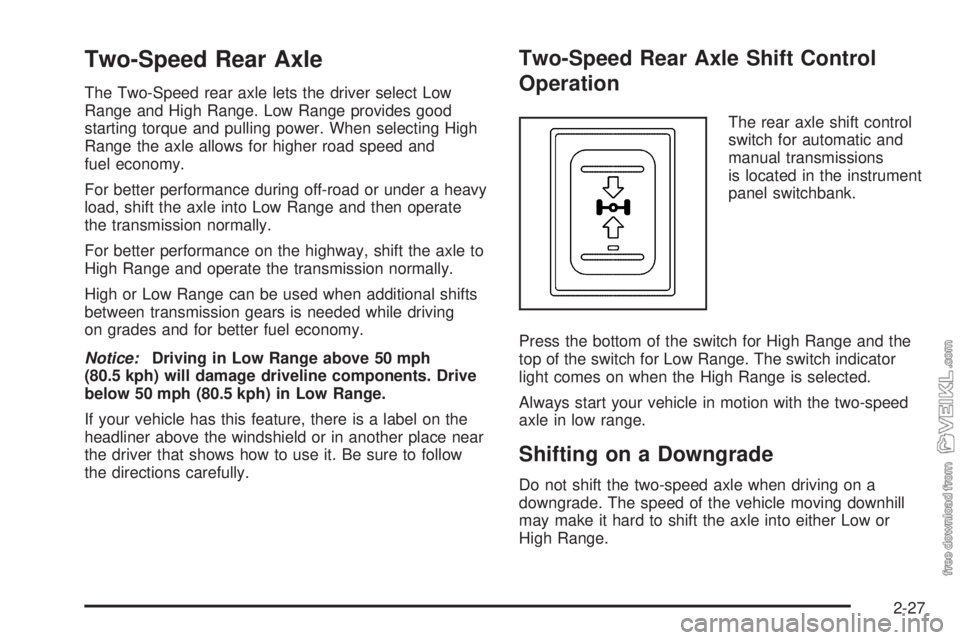
The rear axle shift control
switch for automatic and
manual transmissions
is located in the instrument
panel switchbank.
Press the bottom of the switch for High Range and the
top of the switch for Low Range. The switch indicator
light comes on when the High Range is selected.
Always start your vehicle in motion with the two-speed
axle in low range.
Shifting on a Downgrade
Do not shift the two-speed axle when driving on a
downgrade. The speed of the vehicle moving downhill
may make it hard to shift the axle into either Low or
High Range.
2-27
Page 95 of 384
Automatic Transmission Operation
Your vehicle has either an Allison®five-speed or
six-speed automatic transmission. This part of the
manual covers the basics of these. With these
transmissions, you will find another Allison
®manual in
your vehicle that goes into more detail. On the headliner,
in front of and above the driver, or in some other
place near the driver, you will see a label that describes
important operating facts about the automatic
transmission in your vehicle. Make sure you follow the
instructions on this label.
Be sure to keep your parking brake set until you are
ready to shift into DRIVE (D). SeeParking Brake (With
Hydraulic Brakes) on page 2-38orParking Brake
(With Air Brakes) on page 2-41for parking brake
procedure. Press the brake pedal while shifting from
NEUTRAL (N) or PARK (P) to a drive gear.
All vehicles that have an with automatic transmission
can be started in PARK (P), if equipped, or in
NEUTRAL (N). See the Allison
®Transmission
Operator’s Manual in your vehicle for more information
about this.
{CAUTION:
It can be dangerous to get out of your vehicle
without the parking brake rmly set. Your
vehicle can roll. If you have left the engine
running, the vehicle can move suddenly. You or
others could be injured. To be sure your vehicle
will not move, even when you are on fairly level
ground, always set the parking brake.
{CAUTION:
Shifting into a drive gear while the engine is
running at high speed is dangerous. Unless
your foot is rmly on the brake pedal, your
vehicle could move very rapidly. You could
lose control and hit people or objects. Do not
shift into a drive gear while your engine is
running at high speed.
2-29
Page 96 of 384
Overdrive Defeat
If your vehicle has this feature, you can select not to
shift up to fifth gear. This is useful when towing or under
a heavy load.
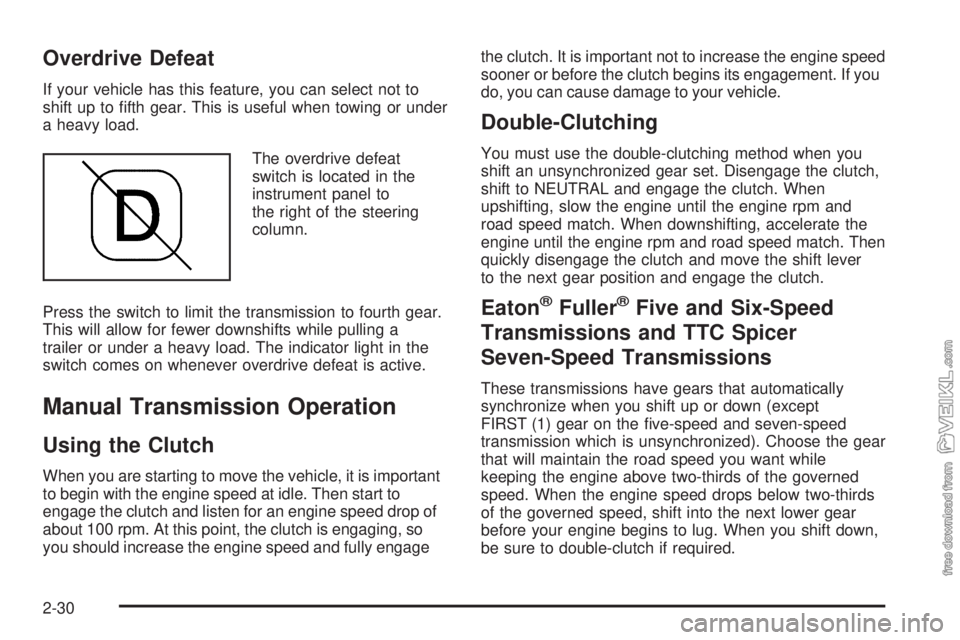
The overdrive defeat
switch is located in the
instrument panel to
the right of the steering
column.
Press the switch to limit the transmission to fourth gear.
This will allow for fewer downshifts while pulling a
trailer or under a heavy load. The indicator light in the
switch comes on whenever overdrive defeat is active.
Manual Transmission Operation
Using the Clutch
When you are starting to move the vehicle, it is important
to begin with the engine speed at idle. Then start to
engage the clutch and listen for an engine speed drop of
about 100 rpm. At this point, the clutch is engaging, so
you should increase the engine speed and fully engagethe clutch. It is important not to increase the engine speed
sooner or before the clutch begins its engagement. If you
do, you can cause damage to your vehicle.
Double-Clutching
You must use the double-clutching method when you
shift an unsynchronized gear set. Disengage the clutch,
shift to NEUTRAL and engage the clutch. When
upshifting, slow the engine until the engine rpm and
road speed match. When downshifting, accelerate the
engine until the engine rpm and road speed match. Then
quickly disengage the clutch and move the shift lever
to the next gear position and engage the clutch.
Eaton®Fuller®Five and Six-Speed
Transmissions and TTC Spicer
Seven-Speed Transmissions
These transmissions have gears that automatically
synchronize when you shift up or down (except
FIRST (1) gear on the five-speed and seven-speed
transmission which is unsynchronized). Choose the gear
that will maintain the road speed you want while
keeping the engine above two-thirds of the governed
speed. When the engine speed drops below two-thirds
of the governed speed, shift into the next lower gear
before your engine begins to lug. When you shift down,
be sure to double-clutch if required.
2-30
Page 104 of 384
Parking a Vehicle With the Two-Speed
Rear Axle
1. With the engine running, shift the two-speed
rear axle into low. To be sure it is in low,
you will need to move the vehicle in gear just
a little.
2. Hold the regular brake pedal down with your
right foot.
3. Apply the parking brake. SeeParking Brake (With
Hydraulic Brakes) on page 2-38orParking Brake
(With Air Brakes) on page 2-41for parking
brake apply procedure.
4. Shift the transmission to NEUTRAL for manual
transmission or PARK (P) for automatic
transmission.
Parking Brake (With Hydraulic
Brakes)
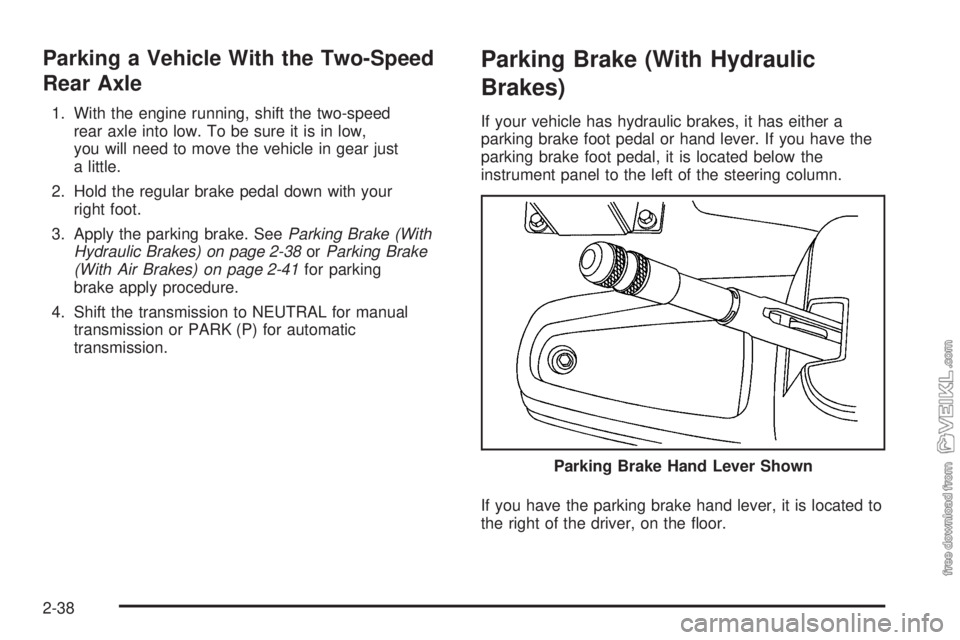
If your vehicle has hydraulic brakes, it has either a
parking brake foot pedal or hand lever. If you have the
parking brake foot pedal, it is located below the
instrument panel to the left of the steering column.
If you have the parking brake hand lever, it is located to
the right of the driver, on the floor.Parking Brake Hand Lever Shown
2-38
Page 109 of 384
{CAUTION:
If you apply any one of the air brake parking
controls while the vehicle is moving, your rig
will stop suddenly. If you are not ready for
this, you or others could be injured. Do not
apply any one of these controls while you are
driving, unless you have to make an
emergency stop.
If the air pressure drops below 60 to 70 psi
(413 to 482 kPa), the primary brake light and warning
buzzer will come on. If the air pressure drops to
35 to 45 psi (241 to 310 kPa), the red trailer air supply
knob will automatically pop out and apply the spring
brakes on the trailer.
If the air pressure drops to 35 to 45 psi (241 to 310 kPa),
the yellow park brake knob will automatically pop out
and apply the spring brakes on the truck or tractor.
If you ever have a complete loss of air so that your air
brakes automatically apply, there is a way that the
tow operator can release the parking brakes to tow the
vehicle. SeeTowing Your Vehicle on page 4-24.
Parking Brake Burnish Procedure
All vehicles which have hydraulic brakes have a parking
brake. It is recommended that the parking brake be
burnished as part of the new vehicle break-in. The
parking brake will work best after it has been burnished
following these instructions:
1. Make sure that there is no other traffic around,
bring the vehicle speed up to 20 mph (32 km/h)
and apply the parking brake. Let the vehicle come
to a complete stop. Apply the base brakes and
disengage the parking brake.
2. Repeat the burnishing procedure in Step 1 a total
of 10 times
3. Between stops, drive the vehicle about
2.5 miles (4 km)
Notice:Driving with the parking brake on can
damage the transmission and brake system parts.
Verify that the parking brake is fully released and the
brake warning light is off before driving.
2-43
Page 115 of 384
4. Fully set the parking brake.
5. Shift the transmission to PARK (P) or
NEUTRAL (N).
6. Idle the engine. If you used the idling control knob
to increase the engine speed, restore it all the way
to the left to reduce the engine speed.
7. If the vehicle has Power Take Off (PTO), turn the
PTO off. SeePower Take-Off (PTO) on page 2-32.
8. Press the DPF switch in the instrument panel
switchbank. SeeInstrument Panel Switchbank
on page 3-18. The green DPF indicator light comes
on, the exhaust gas control valve operates,
engine idle speed automatically increases, and DPF
regeneration begins. Do not leave the vehicle
unattended during manual regeneration.
9. When both the green and the yellow or red DPF
indicator lights go off, regeneration is completed.
Regeneration is normally completed in about
30 minutes.Under certain operating conditions, manual regeneration
might not be able to be performed, even if the soot
level in the DPF requires regeneration. This can occur
because of low coolant temperature, low battery voltage,
or high exhaust temperature or immediately after
starting the vehicle. When manual regeneration is
requested, by pressing the DPF switch, when coolant
temperature is low, engine warm-up is started, the green
indicator light will come on, the exhaust gas control
valve operates, and engine rpm increases to help raise
engine coolant temperature. When operating conditions
allow, regeneration will start.
2-49
Page 116 of 384
Running the Vehicle While Parked
It is better not to park with the engine running. But if you
ever have to, here are some things to know.
{CAUTION:
Idling the engine with the climate control
system off could allow dangerous exhaust into
your vehicle. See the earlier caution under
Engine Exhaust on page 2-45.
Also, idling in a closed-in place can let deadly
carbon monoxide (CO) into your vehicle even if
the climate control fan is at the highest setting.
One place this can happen is a garage.
Exhaust — with CO — can come in easily.
NEVER park in a garage with the engine
running.
Another closed-in place can be a blizzard. See
Winter Driving on page 4-16.
{CAUTION:
It can be dangerous to get out of your vehicle
if the automatic transmission shift lever is not
fully in PARK (P) with the parking brake rmly
set. Your vehicle can roll. Do not leave your
vehicle when the engine is running unless you
have to. If you have left the engine running,
the vehicle can move suddenly. You or others
could be injured. To be sure your vehicle will
not move, even when it is on fairly level
ground, always set the parking brake and
move the automatic transmission shift lever to
PARK (P), or the manual transmission shift
lever to NEUTRAL.
Follow the proper steps to be sure your vehicle will
not move.
2-50
Page 124 of 384
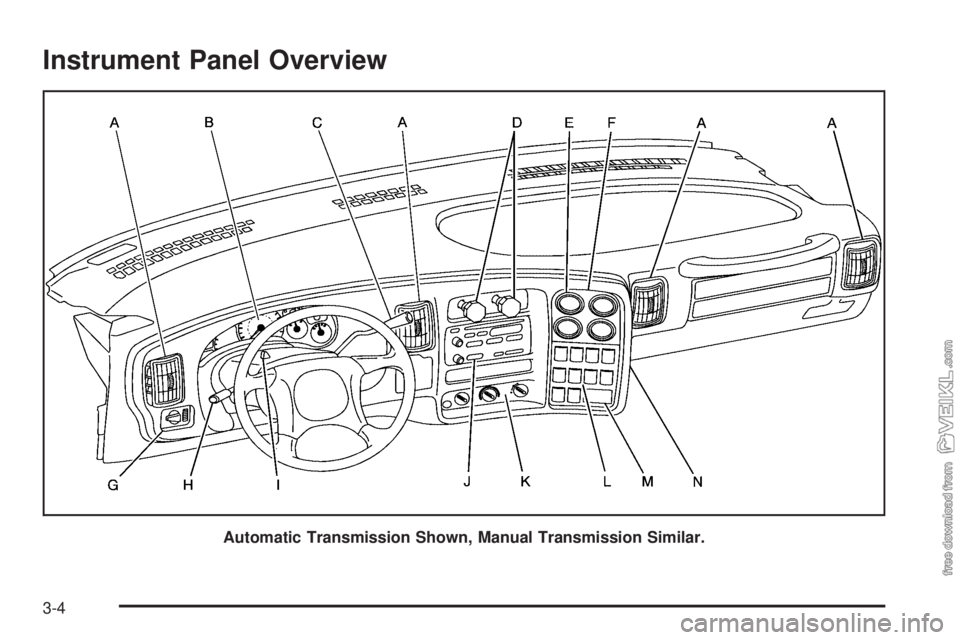
Instrument Panel Overview
Automatic Transmission Shown, Manual Transmission Similar.
3-4
Page 125 of 384
A. Air Outlets. SeeOutlet Adjustment on page 3-23.
B. Instrument Panel Cluster. SeeInstrument Panel
Cluster on page 3-25.
C. Shift Lever. SeeAutomatic Transmission Operation
on page 2-29orManual Transmission Operation
on page 2-30.
D. Air Brake Controls. SeeParking Brake
(With Hydraulic Brakes) on page 2-38or
Parking Brake (With Air Brakes) on page 2-41.
E. Transfer Case Controls (If Equipped). See
Four-Wheel Drive on page 2-32. Air Filter Gage
(If Equipped). SeeAir Filter Restriction Indicator on
page 3-45.
F. Auxiliary Gages. SeeWarning Lights, Gages,
and Indicators on page 3-24.
G. Exterior Lamp Control. SeeExterior Lamps on
page 3-14.H. Turn Signal/Multifunction Lever. SeeTurn
Signal/Multifunction Lever on page 3-7.
I. Hazard Warning Flashers Button. SeeHazard
Warning Flashers on page 3-6.
J. Audio System(s). SeeAudio System(s) on
page 3-47.
K. Climate Controls. SeeClimate Control System
on page 3-20.
L. Instrument Panel Switchbank. SeeInstrument
Panel Switchbank on page 3-18.
M. Airbag Off Switch. SeeAirbag Off Switch on
page 1-56.
N. Accessory Power Outlets. SeeAccessory Power
Outlet(s) on page 3-19.
3-5
Page 131 of 384
With cruise control, you can maintain a speed of about
25 mph (40 km/h) or more without keeping your foot
on the accelerator. Cruise control does not work
at speeds below about 25 mph (40 km/h).
If you have an automatic transmission and you apply
your brakes, the cruise control will shut off.
If you have a manual transmission and you apply your
brakes or push the clutch pedal, the cruise control
will shut off.
{CAUTION:
Cruise control can be dangerous where you
cannot drive safely at a steady speed. So, do
not use your cruise control on winding roads
or in heavy traffic.
Cruise control can be dangerous on slippery
roads. On such roads, fast changes in tire
traction can cause excessive wheel slip, and
you could lose control. Do not use cruise
control on slippery roads.
Setting Cruise Control
{CAUTION:
If you leave your cruise control on when you
are not using cruise, you might hit a button
and go into cruise when you do not want to.
You could be startled and even lose control.
Keep the cruise control switch off until you
want to use cruise control.
1. Move the cruise control switch to on.
2. Get up to the speed you want.
3. Press in the set button at the end of the lever
and release it.
4. Take your foot off the accelerator pedal.
The accelerator pedal will not go down.
3-11