change time CHEVROLET KODIAK 2008 User Guide
[x] Cancel search | Manufacturer: CHEVROLET, Model Year: 2008, Model line: KODIAK, Model: CHEVROLET KODIAK 2008Pages: 384, PDF Size: 5.4 MB
Page 141 of 384
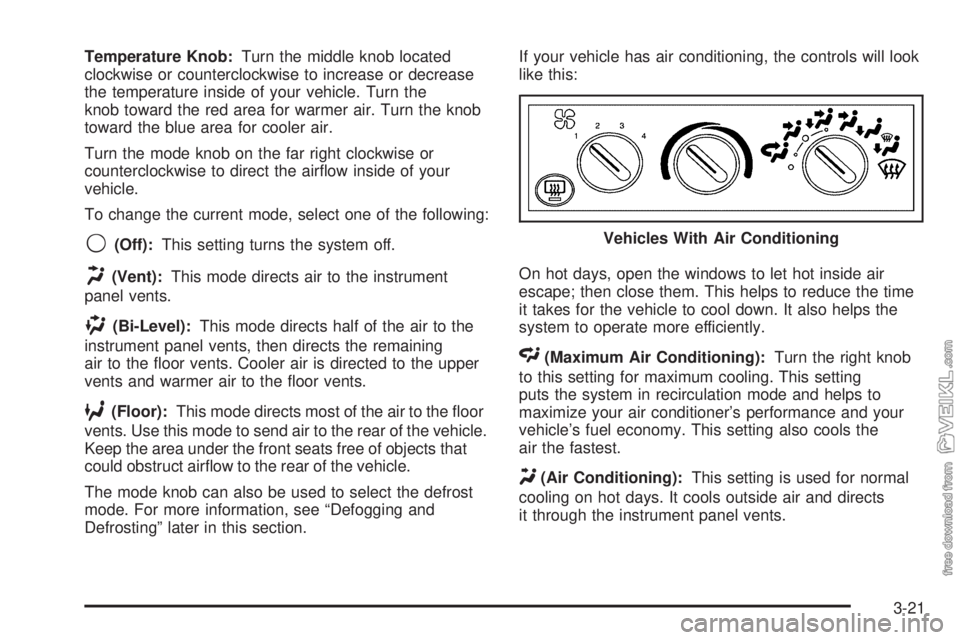
Temperature Knob:Turn the middle knob located
clockwise or counterclockwise to increase or decrease
the temperature inside of your vehicle. Turn the
knob toward the red area for warmer air. Turn the knob
toward the blue area for cooler air.
Turn the mode knob on the far right clockwise or
counterclockwise to direct the airflow inside of your
vehicle.
To change the current mode, select one of the following:
9(Off):This setting turns the system off.
H(Vent):This mode directs air to the instrument
panel vents.
)(Bi-Level):This mode directs half of the air to the
instrument panel vents, then directs the remaining
air to the floor vents. Cooler air is directed to the upper
vents and warmer air to the floor vents.
6(Floor):This mode directs most of the air to the floor
vents. Use this mode to send air to the rear of the vehicle.
Keep the area under the front seats free of objects that
could obstruct airflow to the rear of the vehicle.
The mode knob can also be used to select the defrost
mode. For more information, see “Defogging and
Defrosting” later in this section.If your vehicle has air conditioning, the controls will look
like this:
On hot days, open the windows to let hot inside air
escape; then close them. This helps to reduce the time
it takes for the vehicle to cool down. It also helps the
system to operate more efficiently.
<(Maximum Air Conditioning):Turn the right knob
to this setting for maximum cooling. This setting
puts the system in recirculation mode and helps to
maximize your air conditioner’s performance and your
vehicle’s fuel economy. This setting also cools the
air the fastest.
Y(Air Conditioning):This setting is used for normal
cooling on hot days. It cools outside air and directs
it through the instrument panel vents.Vehicles With Air Conditioning
3-21
Page 161 of 384
Reduced Engine Power Light
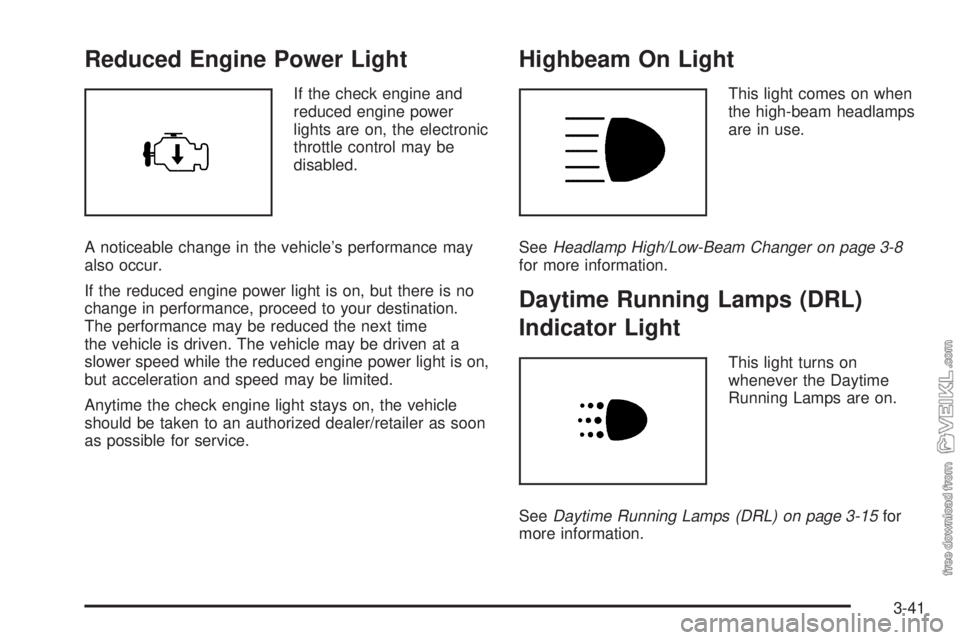
If the check engine and
reduced engine power
lights are on, the electronic
throttle control may be
disabled.
A noticeable change in the vehicle’s performance may
also occur.
If the reduced engine power light is on, but there is no
change in performance, proceed to your destination.
The performance may be reduced the next time
the vehicle is driven. The vehicle may be driven at a
slower speed while the reduced engine power light is on,
but acceleration and speed may be limited.
Anytime the check engine light stays on, the vehicle
should be taken to an authorized dealer/retailer as soon
as possible for service.
Highbeam On Light
This light comes on when
the high-beam headlamps
are in use.
SeeHeadlamp High/Low-Beam Changer on page 3-8
for more information.
Daytime Running Lamps (DRL)
Indicator Light
This light turns on
whenever the Daytime
Running Lamps are on.
SeeDaytime Running Lamps (DRL) on page 3-15for
more information.
3-41
Page 166 of 384
Air Pressure Gage
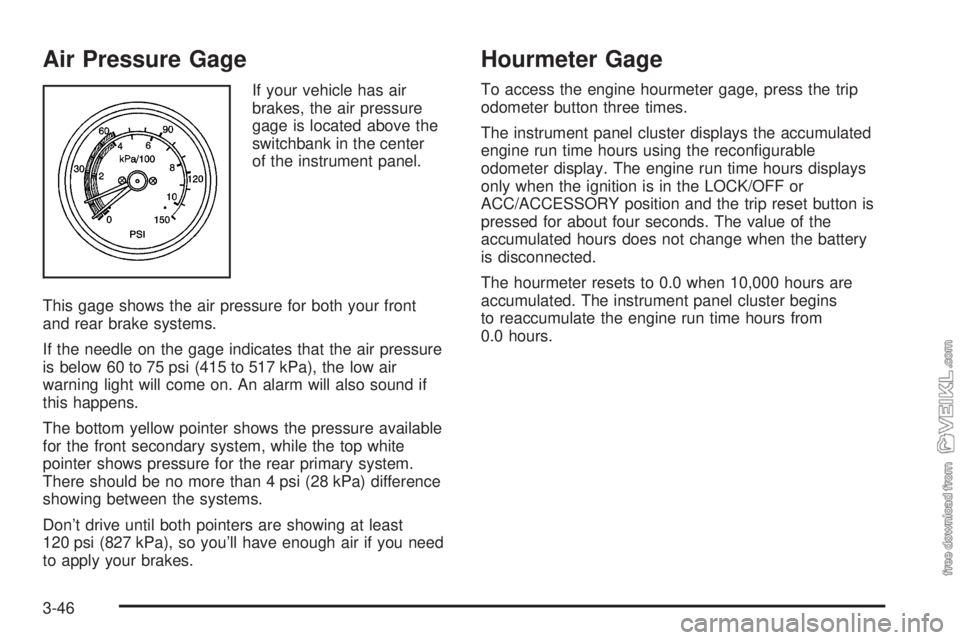
If your vehicle has air
brakes, the air pressure
gage is located above the
switchbank in the center
of the instrument panel.
This gage shows the air pressure for both your front
and rear brake systems.
If the needle on the gage indicates that the air pressure
is below 60 to 75 psi (415 to 517 kPa), the low air
warning light will come on. An alarm will also sound if
this happens.
The bottom yellow pointer shows the pressure available
for the front secondary system, while the top white
pointer shows pressure for the rear primary system.
There should be no more than 4 psi (28 kPa) difference
showing between the systems.
Don’t drive until both pointers are showing at least
120 psi (827 kPa), so you’ll have enough air if you need
to apply your brakes.
Hourmeter Gage
To access the engine hourmeter gage, press the trip
odometer button three times.
The instrument panel cluster displays the accumulated
engine run time hours using the reconfigurable
odometer display. The engine run time hours displays
only when the ignition is in the LOCK/OFF or
ACC/ACCESSORY position and the trip reset button is
pressed for about four seconds. The value of the
accumulated hours does not change when the battery
is disconnected.
The hourmeter resets to 0.0 when 10,000 hours are
accumulated. The instrument panel cluster begins
to reaccumulate the engine run time hours from
0.0 hours.
3-46
Page 178 of 384
Radio Reception
Frequency interference and static can occur during
normal radio reception if items such as cell phone
chargers, vehicle convenience accessories, and external
electronic devices are plugged into the accessory
power outlet. If there is interference or static, unplug the
item from the accessory power outlet.
AM
The range for most AM stations is greater than for
FM, especially at night. The longer range can cause
station frequencies to interfere with each other.
For better radio reception, most AM radio stations boost
the power levels during the day, and then reduce
these levels during the night. Static can also occur when
things like storms and power lines interfere with radio
reception. When this happens, try reducing the treble
on your radio.
FM Stereo
FM stereo gives the best sound, but FM signals reach
only about 10 to 40 miles (16 to 65 km). Tall buildings or
hills can interfere with FM signals, causing the sound
to fade in and out.
Fixed Mast Antenna
The fixed mast antenna can withstand most car washes
without being damaged. If the mast should ever
become slightly bent, straighten it out by hand. If the
mast is badly bent, replace it.
Check occasionally to make sure the mast is still
tightened to its base. If tightening is required, tighten by
hand, then with a wrench one quarter turn.
Chime Level Adjustment
The radio is used to adjust the vehicle’s chime level.
To change the volume level of the chime, press and hold
pushbutton 6 with the ignition on and the radio power
off. The volume level will change from the normal
level to loud, and HI will appear on the radio display.
To change back to the default or normal setting, press
and hold pushbutton 6 again. The volume level will
change from the loud level to normal, and LO will appear
on the radio display. Each time the chime volume is
changed, three chimes will sound as an example of the
new volume selected. Removing the radio and not
replacing it with a factory radio or chime module will
disable vehicle chimes.
3-58
Page 183 of 384
Antilock Brake System (ABS)
Your vehicle has the Antilock Brake System (ABS), an
advanced electronic braking system that will help
prevent a braking skid.
When you start the engine and begin to drive away,
ABS will check itself. You might hear a momentary
motor or clicking noise while this test is going on. This
is normal.
If there is a problem with
ABS, this warning light will
stay on. SeeAnti-lock
Brake System (ABS)
Warning Light on
page 3-34.
Let us say the road is wet and you are driving safely.
Suddenly, an animal jumps out in front of you. You slam
on the brakes and continue braking. Here is what
happens with ABS:
A computer senses that wheels are slowing down. If
one of the wheels is about to stop rolling, the computer
will separately work the brakes at each wheel.ABS can change the brake pressure faster than any
driver could. The computer is programmed to make the
most of available tire and road conditions. This can
help you steer around the obstacle while braking hard.
As you brake, the computer keeps receiving updates
on wheel speed and controls braking pressure
accordingly.
Remember: ABS does not change the time you need
to get your foot up to the brake pedal or always
decrease stopping distance. If you get too close to
the vehicle in front of you, you will not have time to
apply the brakes if that vehicle suddenly slows or
stops. Always leave enough room up ahead to stop,
even though you have ABS.
Using ABS
Do not pump the brakes. Just hold the brake pedal
down firmly and let antilock work for you. You might feel
the brakes pulsate, or you might hear air exhausting
if your vehicle has air brakes, but this is normal.
Braking in Emergencies
With ABS, you can steer and brake at the same time.
In many emergencies, steering can help you more than
even the very best braking.
4-5
Page 222 of 384
4. Turn the ignition key to START for 10 to 15 seconds
at a time until your engine starts. If the engine tries
to run, but does not run smoothly, increase the rpm
a little using the accelerator pedal. This will help
force air through the system.
Your service engine soon light may come on if the
vehicle has run out of fuel. This light may stay on for a
few drive cycles after the condition is corrected, but
will eventually clear itself.
Fuel Filter Replacement
If you want to change the diesel engine fuel filter
yourself, here is how to do it:
{CAUTION:
Diesel fuel is ammable. It could start a re if
something ignites it, and you could be burned.
Do not let it get on hot engine parts, and keep
matches or other ignition sources away.
First, drain any water from the filter by following the
water draining procedure earlier in this section.
Your vehicle’s engine should be off until the end of this
procedure.If your vehicle has the 6.6L engine, the fuel filter is
located in the engine compartment on the driver’s side
of the vehicle. If your vehicle has either the 7.2L or
7.8L engine, the fuel filters are located in the engine
compartment on the driver’s side of the vehicle, and on
the driver’s side frame rail in front of the fuel tank.
1. Apply the parking brake.
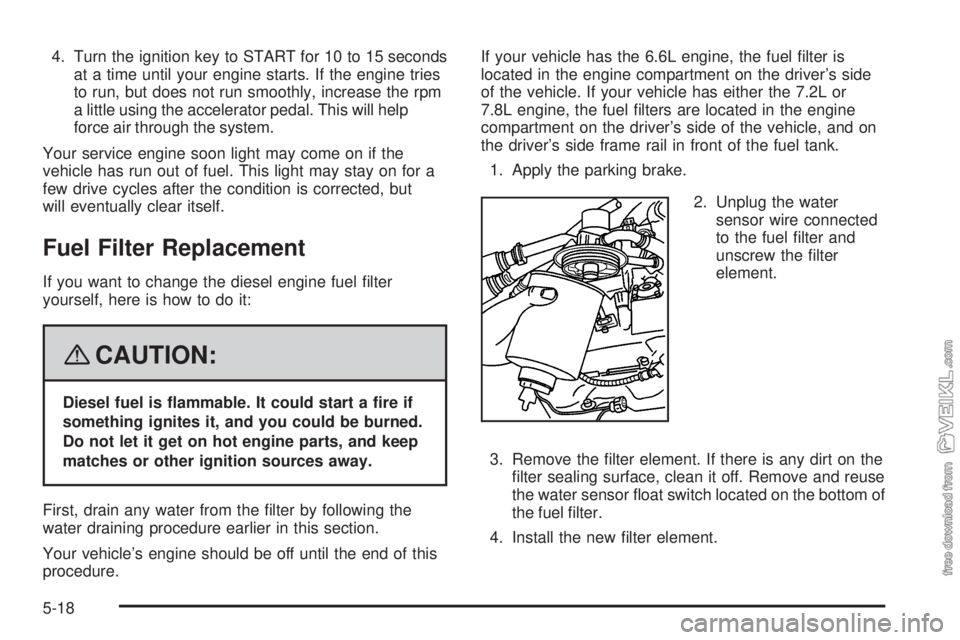
2. Unplug the water
sensor wire connected
to the fuel filter and
unscrew the filter
element.
3. Remove the filter element. If there is any dirt on the
filter sealing surface, clean it off. Remove and reuse
the water sensor float switch located on the bottom of
the fuel filter.
4. Install the new filter element.
5-18
Page 223 of 384
5. Reinstall and tighten the filter container and
reconnect the water sensor wire to the filter.
6. Use the fuel filter priming procedure earlier in this
section to prime the fuel filter.
7. Tighten the air bleed valve by turning it clockwise
until hand-tight.
8. Start your engine and let it idle for five minutes.
Check your fuel filter and air bleed valve for
leaks.
How to Reset Fuel Filter Change
Light - DURAMAX®6.6L (LMM) Engine
The engine controller calculates when to change
the fuel filter based on vehicle and fuel use. Anytime
your fuel filter is changed, reset the fuel filter light so the
engine controller can calculate when the next fuel filter
change is required. If a situation occurs where you
change your fuel filter prior to a change fuel filter light
being turned on, reset the fuel filter change light.To reset the Fuel Filter Change light:
1. Turn the ignition key to RUN with the engine off
2. Fully press the accelerator and brake pedals at the
same time for 10 seconds. If the Fuel Filter Change
light flashes for 5 seconds, the system is resetting.
3. Turn the key to OFF
If the Fuel Filter Change light comes back on when you
start your vehicle, the light has not been reset. Repeat
the procedure. SeeChange Fuel Filter Warning Light on
page 3-44for more information.Fuels in Foreign Countries
If you plan on driving in another country outside the
United States or Canada, the proper fuel might be hard
to find. Never use leaded gasoline or any other fuel
not recommended in the previous text on fuel. Costly
repairs caused by use of improper fuel would not be
covered by your warranty.
To check the fuel availability, ask an auto club, or
contact a major oil company that does business in the
country where you will be driving.
5-19
Page 236 of 384
Engine Oil (Isuzu Diesel Engine)
Checking Engine Oil
It is a good idea to check the engine oil level every time
you get fuel.
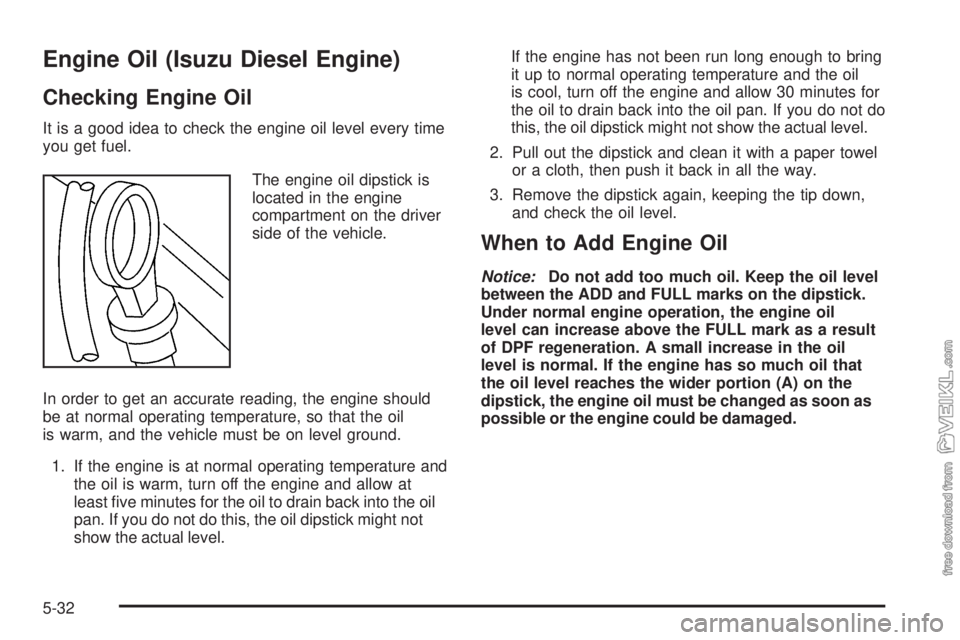
The engine oil dipstick is
located in the engine
compartment on the driver
side of the vehicle.
In order to get an accurate reading, the engine should
be at normal operating temperature, so that the oil
is warm, and the vehicle must be on level ground.
1. If the engine is at normal operating temperature and
the oil is warm, turn off the engine and allow at
least five minutes for the oil to drain back into the oil
pan. If you do not do this, the oil dipstick might not
show the actual level.If the engine has not been run long enough to bring
it up to normal operating temperature and the oil
is cool, turn off the engine and allow 30 minutes for
the oil to drain back into the oil pan. If you do not do
this, the oil dipstick might not show the actual level.
2. Pull out the dipstick and clean it with a paper towel
or a cloth, then push it back in all the way.
3. Remove the dipstick again, keeping the tip down,
and check the oil level.
When to Add Engine Oil
Notice:Do not add too much oil. Keep the oil level
between the ADD and FULL marks on the dipstick.
Under normal engine operation, the engine oil
level can increase above the FULL mark as a result
of DPF regeneration. A small increase in the oil
level is normal. If the engine has so much oil that
the oil level reaches the wider portion (A) on the
dipstick, the engine oil must be changed as soon as
possible or the engine could be damaged.
5-32
Page 240 of 384
Engine Oil Life System (Gasoline
Engine)
When to Change Engine Oil
Your vehicle has a computer system that lets you know
when to change the engine oil and filter. This is based
on engine revolutions and engine temperature, and not
on mileage. Based on driving conditions, the mileage at
which an oil change will be indicated can vary
considerably. For the oil life system to work properly, you
must reset the system every time the oil is changed.
When the system has calculated that oil life has been
diminished, it will indicate that an oil change is
necessary. A change engine oil light will come on. See
Change Engine Oil Light on page 3-38. Change the oil as
soon as possible within the next 600 miles (1 000 km).
It is possible that, if you are driving under the best
conditions, the oil life system might not indicate that an oil
change is necessary for over a year. However, the engine
oil and filter must be changed at least once a year and at
this time the system must be reset. Your dealer/retailer
has trained service people who will perform this work
using genuine parts and reset the system. It is also
important to check the oil regularly and keep it at the
proper level.If the system is ever reset accidentally, you must
change the oil at 3,000 miles (5 000 km) since your last
oil change. Remember to reset the oil life system
whenever the oil is changed.How to Reset the Engine Oil Life
System
The Engine Oil Life System calculates when to change
the engine oil and filter based on vehicle use. Whenever
the oil is changed, reset the system so it can calculate
when the next oil change is required. If a situation occurs
where you change the oil prior to a change engine oil light
being turned on, reset the system.
To reset the change engine oil light:
1. Turn the ignition key to ON/RUN with the
engine off.
2. Fully press and release the accelerator pedal slowly
three times within 10 seconds.
If the change engine oil light flashes for
five seconds, the system is resetting.
3. Turn the key to OFF.
If the change engine oil light comes back on when you
start your vehicle, the engine oil life system has not
reset. Repeat the procedure.
5-36
Page 241 of 384
What to Do with Used Oil
Used engine oil contains certain elements that can be
unhealthy for your skin and could even cause cancer.
Do not let used oil stay on your skin for very long. Clean
your skin and nails with soap and water, or a good
hand cleaner. Wash or properly dispose of clothing or
rags containing used engine oil. See the manufacturer’s
warnings about the use and disposal of oil products.
Used oil can be a threat to the environment. If you
change your own oil, be sure to drain all the oil from the
filter before disposal. Never dispose of oil by putting it
in the trash, pouring it on the ground, into sewers, or into
streams or bodies of water. Instead, recycle it by
taking it to a place that collects used oil. If you have a
problem properly disposing of used oil, ask your
dealer/retailer, a service station, or a local recycling
center for help.
Engine Oil Life System
(DURAMAX
®/Isuzu Diesel Engines)
When to Change Engine Oil
If your vehicle has the Engine Oil Life System, it has a
computer system that lets you know when to change
the engine oil and filter. This is based on injection timing,
engine load and engine temperature, and not on
mileage. Based on driving conditions, the mileage atwhich an oil change will be indicated can vary
considerably. For the oil life system to work properly, you
must reset the system every time the oil is changed.
When the system has calculated that oil life has been
diminished, it will indicate that an oil change is
necessary. A change engine oil light will come on. See
Change Engine Oil Light on page 3-38. Change the
oil as soon as possible within the next 600 miles
(1 000 km) or 30 hours of engine operation, whichever
occurs first. It is possible that, if you are driving under
the best conditions, the oil life system might not indicate
that an oil change is necessary for over a year. However,
the engine oil and filter must be changed at least once a
year and at this time the system must be reset. Your
dealer/retailer has trained service people who will
perform this work using genuine parts and reset the
system. It is also important to check the oil regularly and
keep it at the proper level.
If the system is ever reset accidentally, you must
change the oil at 15,000 miles (24 000 km), or 150 hours
of engine operation, whichever occurs first, since your
last oil change. Remember to reset the oil life system
whenever the oil is changed.
5-37