change time CHEVROLET KODIAK 2008 Owner's Manual
[x] Cancel search | Manufacturer: CHEVROLET, Model Year: 2008, Model line: KODIAK, Model: CHEVROLET KODIAK 2008Pages: 384, PDF Size: 5.4 MB
Page 242 of 384
How to Reset the Engine Oil Life
System
The Engine Oil Life System calculates when to change
the engine oil and filter based on vehicle use. Whenever
the oil is changed, reset the system so it can calculate
when the next oil change is required. If a situation occurs
where you change the oil prior to a change engine oil light
being turned on, reset the system.
To reset the Engine Oil Life System:
1. Turn the ignition key to ON/RUN with the
engine off.
2. Fully press and release the accelerator pedal slowly
three times within five seconds.
If the change engine oil light is turned off, the
system is resetting.
3. Turn the key to OFF.
If the change engine oil light comes back on when you
start your vehicle, the Engine Oil Life System has not
reset. Repeat the procedure.
What to Do with Used Oil
Used engine oil contains certain elements that can be
unhealthy for your skin and could even cause cancer.
Do not let used oil stay on your skin for very long. Clean
your skin and nails with soap and water, or a good hand
cleaner. Wash or properly dispose of clothing or rags
containing used engine oil. See the manufacturer’s
warnings about the use and disposal of oil products.
Used oil can be a threat to the environment. If you
change your own oil, be sure to drain all the oil from the
filter before disposal. Never dispose of oil by putting it
in the trash, pouring it on the ground, into sewers, or into
streams or bodies of water. Instead, recycle it by taking
it to a place that collects used oil. If you have a problem
properly disposing of used oil, ask your dealer/retailer, a
service station, or a local recycling center for help.
5-38
Page 243 of 384
Engine Oil Life System
(Caterpillar
®Diesel Engine)
How to Reset the Engine Oil Life
System
The Engine Oil Life System calculates when to change
the engine oil and filter based on vehicle use. Whenever
the oil is changed, reset the system so it can calculate
when the next oil change is required. If a situation occurs
where you change the oil prior to a change engine oil light
being turned on, reset the system.
To reset the Engine Oil Life System:
1. Turn the ignition key to ON/RUN with the
engine off.
2. Fully apply and hold the brake pedal while you fully
press and release the accelerator pedal, pausing
slightly at each press and each release, three times
within five seconds.
3. Turn the key to OFF.
If the change engine oil light comes back on when you
start your vehicle, the Engine Oil Life System has
not reset. Repeat the procedure.
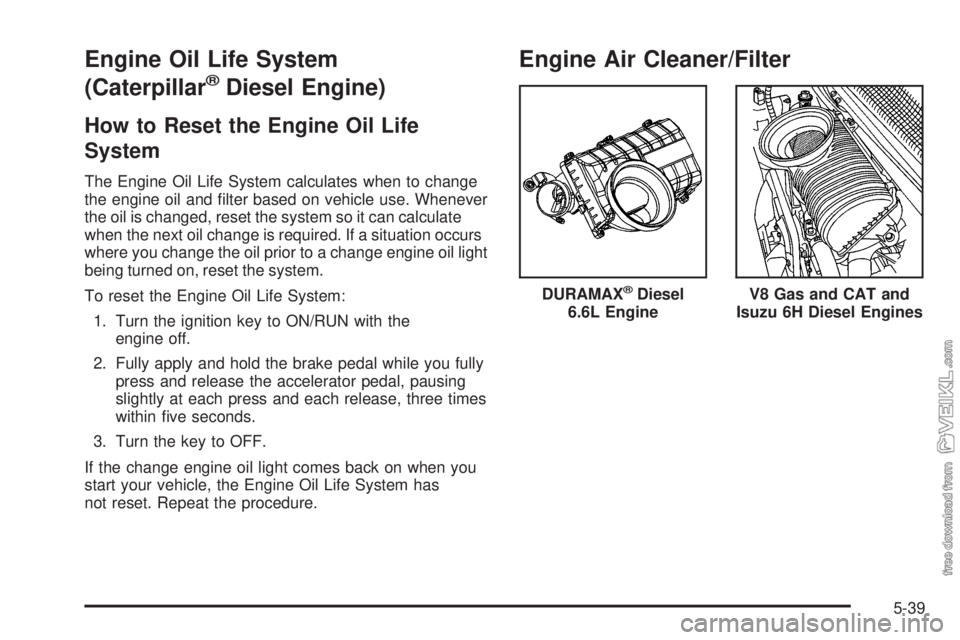
Engine Air Cleaner/Filter
DURAMAX®Diesel
6.6L EngineV8 Gas and CAT and
Isuzu 6H Diesel Engines
5-39
Page 247 of 384
Automatic Transmission Fluid
When to Check
A good time to check your automatic transmission fluid
level is when the engine oil is checked. See your
Allison Automatic Transmission Operator’s Manual to
find out when to change your transmission fluid
and filters.
How to Check and What to Use
The Allison Automatic Transmission Operator’s Manual
that came with the vehicle shows how to check the
automatic transmission fluid and what fluid to use.
Automatic Transmission External Filter
Your automatic transmission filter requires periodic
replacement.
Consult the Allison Automatic Transmission Operator’s
Manual that came with the vehicle for proper change
intervals.
Manual Transmission Fluid
When to Check
A good time to have it checked is when the engine oil is
checked. Refer to the Maintenance Schedule to find
out when to check and change your manual
transmission fluid. SeeScheduled Maintenance on
page 6-5.
How to Check and What to Use
Check the fluid level only when your engine is off, the
vehicle is parked on a level place, and the transmission
is cool enough for you to rest your fingers on the
transmission case.
To check the transmission fluid level, do the following:
1. Remove the filler plug.
2. Check to be sure that the lubricant level is up to the
bottom of the fill opening. On heavy duty
transmissions, an inch of oil level equals about one
gallon of fluid.
3. If the fluid level is good, reinstall the plug and be
sure it is fully seated. If the fluid level is low, add
more fluid as described in the next steps. Refer to
the Maintenance Schedule to determine what kind
of fluid to use. SeePart C: Recommended Fluids and
Lubricants on page 6-31.
5-43
Page 263 of 384
Four-Wheel and Six-Wheel Drum
Brakes (Air Only)
The brake drums should be removed and inspected
each time the tires are removed for rotation or changing.
When you have the front brakes replaced, have the rear
brakes inspected, too.
Brake linings should always be replaced as complete
axle sets.
Brake Pedal Travel
See your dealer/retailer if the brake pedal does not
return to normal height, or if there is a rapid increase in
pedal travel. This could be a sign that brake service
might be required.
Brake Adjustment
Every time you make a brake stop, the brakes adjust
for wear.
Brake Adjustment on Air Braked Vehicles
Your vehicle has automatic slack adjusters. Every
time you make a brake stop, the brakes automatically
adjust for wear. Slack adjusters should never be
manually adjusted to correct excessive brake chamber
pushrod stroke. Excessive brake chamber pushrod
stroke means that the brake system needs to be
serviced by a qualified service technician.Notice:Do not manually adjust automatic slack
adjusters. Manual adjustment of the automatic slack
adjusters can result in a degradation of the slack
adjuster performance over time. If the brake
chamber pushrod stroke is out of adjustment, the
brake system needs to be serviced by a qualied
service technician.
Replacing Brake System Parts
The braking system on a vehicle is complex. Its many
parts have to be of top quality and work well together if
the vehicle is to have really good braking. Your vehicle
was designed and tested with top-quality brake parts.
When you replace parts of the braking system — for
example, when the brake linings wear down and you
need new ones put in — be sure you get new approved
replacement parts. If you do not, the brakes might not
work properly. For example, if someone puts in brake
linings that are wrong for your vehicle, the balance
between the front and rear brakes can change — for the
worse. The braking performance you have come to
expect can change in many other ways if someone puts
in the wrong replacement brake parts.
5-59
Page 264 of 384
Hydraulic Brake Pads
Brake pad lining life will vary depending on vehicle
application, working environment, equipment
maintenance, and style of driving. The brake pad lining
wear rate has to be monitored for individual driving
habits — original equipment linings have mechanical
wear indicators to help with this. When you are down to
the last 10% of the brake lining, the brake lining wear
indicator will rub on the rotor, causing a scratching or
chirping sound. When you hear this sound, it is time to
service the brake pads. SeeScheduled Maintenance on
page 6-5.
Aftermarket brake linings might not meet the same
stringent requirements as the original equipment linings.
Using aftermarket brake linings can affect braking
performance, pedal feel, noise, and lining wear.
Air Brake Systems
If your vehicle has air brakes, it is important to get rid of
moisture in the system. Moisture will damage the
system if it is not removed daily.
There are two ways to do this. One is automatic through
the air brake vehicle’s air dryer with integral automatic
moisture ejector that purges air from the system through
a self-contained reservoir. The other way to drain
moisture from the air brake system is to manually activate
drain valves at each reservoir. Drain the air reservoirs
occasionally to be sure the air dryer is working properly.Drain the air brakes at full system pressure. To be sure
you are at full pressure, check the air pressure gage.
It should read at least 100 psi (692 kPa).
Air Dryer
If your vehicle has air brakes, it has an air dryer
mounted on the passenger side frame rail. This collects
and removes dirt, moisture, or other foreign matter
from the air prior to entering the brake system. The dryer
also acts as a moisture ejector. It automatically ejects
the moisture when the compressor cycles. The
purge tank has a manual drain valve that must be
drained every day. See “Air Brake Systems” for the
manual drain procedure.
The dryer has a filter that you need to change at
intervals. SeeScheduled Maintenance on page 6-5for
more about servicing this filter.
Electric Air Compressor
Your vehicle might have an electric air compressor. This
compressor is used to run options that require
pressurized air, such as an air horn or air seat.
The air compressor is used when vehicles do not have
an air brake system.
5-60
Page 277 of 384
Rear Axle Shift Motor
When to Check and Change Fluid
If you have an optional air-shift two-speed, controlled
traction, or locking differential type rear axle, a good time
to check the fluid level in the axle shift motor is when
the rear axle lubricant is checked.
How to Check Fluid
Remove the plug on the front plate of the axle shift
motor, add enough fluid to raise the level to the bottom
of the filler plug hole, then replace the plug.
What to Use
Refer to your Maintenance Schedule to determine what
kind of lubricant to use. SeePart C: Recommended
Fluids and Lubricants on page 6-31.
Four-Wheel Drive
Transfer Case
When to Check Lubricant
It is not necessary to regularly check transfer case fluid
unless you suspect there is a leak or you hear an
unusual noise. A fluid loss could indicate a problem.
Have it inspected and repaired.
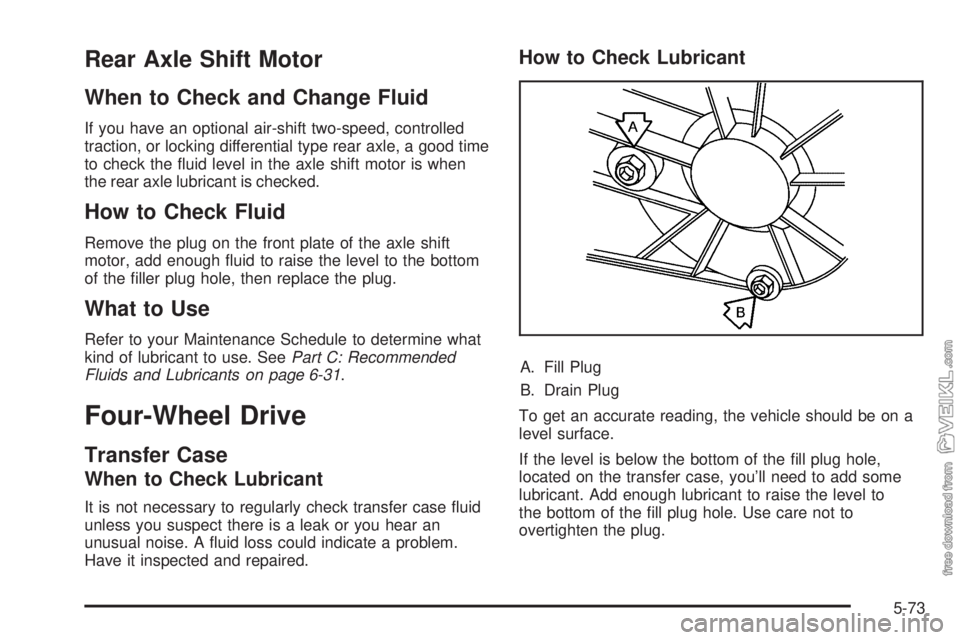
How to Check Lubricant
A. Fill Plug
B. Drain Plug
To get an accurate reading, the vehicle should be on a
level surface.
If the level is below the bottom of the fill plug hole,
located on the transfer case, you’ll need to add some
lubricant. Add enough lubricant to raise the level to
the bottom of the fill plug hole. Use care not to
overtighten the plug.
5-73
Page 293 of 384
{CAUTION:
If wheel studs are damaged, they can break.
If all the studs on a wheel broke, the wheel
could come off and cause a crash. If any stud
is damaged because of a loose-running wheel,
it could be that all of the studs are damaged.
To be sure, replace all studs on the wheel.
If the stud holes in a wheel have become
larger, the wheel could collapse in operation.
Replace any wheel if its stud holes have
become larger or distorted in any way. Inspect
hubs and hub-piloted wheels for damage.
Because of loose running wheels, piloting pad
damage may occur and require replacement of
the entire hub, for proper centering of the
wheels. When replacing studs, hubs, wheel
nuts or wheels, be sure to use GM original
equipment parts.
{CAUTION:
Rust or dirt on a wheel, or on the parts to
which it is fastened, can make wheel nuts
become loose after a time. The wheel
could come off and cause a crash. When
you change a wheel, remove any rust or
dirt from places where the wheel attaches
to the vehicle. In an emergency, you can
use a cloth or a paper towel to do this;
but be sure to use a scraper or wire brush
later, if you need to, to get all the rust or
dirt off.
How Often to Check
Wheel tightness is so important you should have a
technician check nut tightness on all wheels with
a torque wrench after your first 100 miles (160 km), and
then 1,000 miles (1 600 km) after that. Be sure to
repeat this service whenever you have a tire removed or
serviced. SeeScheduled Maintenance on page 6-5for
further information.
5-89
Page 349 of 384
(33)= Clean and lubricate air brake automatic slack
adjuster. Check pushrod travel and auto adjustment
operation. Have serviced if needed.
(34)= Air brake chamber service: Check operation,
mounting clamps, and air lines and check for leaks.
(35)= Trailer brake hand control valve service: Check
operation; lubricate cam and follower.
(36)= Tighten the wheel stud nuts to the specified
torque values at 100 miles (160 km). Thereafter, tighten
them 1,000 miles (1 600 km) after each time the wheel
is removed. SeeTightening the Wheel Nuts on
page 5-86.
(37)= Inspect and clean any accumulated dirt, gravel,
or other foreign objects from the valves and valve boots
as needed. Using light oil, lubricate brake pedal to
brake application valve linkage components. Check any
rubber boots for cracks, holes, or deterioration and
replace if necessary.(38)= Estimated minimum. Actual mileage depends on
fuel and oil consumed.
(39)= If the vehicle has the Isuzu diesel engine and is
used primarily for long trip, highway service, change
the engine oil and filter every 18,000 miles (28 800 km),
or every 12 months, or every 750 hours of engine
operation, whichever occurs first.
(40)= Make sure any safety belt reminder light and
safety belt assemblies are working properly. Look
for any other loose or damaged safety belt system parts.
If you see anything that might keep a safety belt
system from doing its job, have it repaired. Have any
torn or frayed safety belts replaced.
6-25
Page 370 of 384
Service Publications Ordering
Information
Service Manuals
Service Manuals have the diagnosis and repair
information on engines, transmission, axle suspension,
brakes, electrical, steering, body, etc.
Service Bulletins
Service Bulletins’ give additional technical service
information needed to knowledgeably service
General Motors cars and trucks. Each bulletin contains
instructions to assist in the diagnosis and service of
your vehicle.
Owner Information
Owner publications are written specifically for owners
and intended to provide basic operational information
about the vehicle. The owner manual includes the
Maintenance Schedule for all models.
In-Portfolio: Includes a Portfolio, Owner Manual, and
Warranty Booklet.
RETAIL SELL PRICE: $35.00 (U.S.) plus processing fee
Without Portfolio: Owner Manual only.
RETAIL SELL PRICE: $25.00 (U.S.) plus processing fee
Current and Past Model Order Forms
Technical Service Bulletins and Manuals are available
for current and past model GM vehicles. To request
an order form, specify year and model name of
the vehicle.
ORDER TOLL FREE: 1-800-551-4123
Monday-Friday 8:00 AM - 6:00 PM
Eastern Time
For Credit Card Orders Only
(VISA-MasterCard-Discover), visit Helm, Inc. on the
World Wide Web at: www.helminc.com
Or you can write to:
Helm, Incorporated
P.O. Box 07130
Detroit, MI 48207
Prices are subject to change without notice and without
incurring obligation. Allow ample time for delivery.
Note to Canadian Customers: All listed prices are
quoted in U.S. funds. Canadian residents are to make
checks payable in U.S. funds.
7-10
Page 378 of 384
Gage (cont.)
Speedometer..............................................3-26
Tachometer.................................................3-26
Transmission Temperature.............................3-39
Voltmeter Gage...........................................3-31
Gasoline
Octane........................................................ 5-7
Specifications............................................... 5-7
Gasoline Engine, Starting.................................2-12
GM Mobility Reimbursement Program.................. 7-5
H
Hazard Warning Flashers................................... 3-6
Headlamp Wiring...........................................5-102
Headlamps
Bulb Replacement.......................................5-76
Daytime Running Lamps...............................3-15
Exterior Lamps............................................3-14
High/Low Beam Changer................................ 3-8
On Reminder..............................................3-15
Heater...........................................................3-20
High Idle System............................................2-20
Highbeam On Light.........................................3-41
Highway Hypnosis...........................................4-15
Hill and Mountain Roads..................................4-15Hood
Checking Things Under................................5-22
Latches......................................................5-22
Horn............................................................... 3-6
Hourmeter Gage.............................................3-46
How to Wear Safety Belts Properly...................1-16
I
Ignition Positions.............................................2-11
Infants and Young Children, Restraints...............1-31
Inflation - Tire Pressure...................................5-82
Instrument Panel
Overview..................................................... 3-4
Switchbank.................................................3-18
Instrument Panel (I/P)
Brightness..................................................3-16
Cluster.......................................................3-25
J
Jump Starting.................................................5-67
K
Keyless Entry System....................................... 2-3
Keys............................................................... 2-2
6