instrument panel CHEVROLET KODIAK 2008 User Guide
[x] Cancel search | Manufacturer: CHEVROLET, Model Year: 2008, Model line: KODIAK, Model: CHEVROLET KODIAK 2008Pages: 384, PDF Size: 5.4 MB
Page 86 of 384
The engine will not go into idle shutdown mode if:
•The Power Take-Off (PTO) equipment is operating.
SeePower Take-Off (PTO) on page 2-32for more
information.
•The engine coolant temperature is below 60° F.
The engine idle shutdown will be activated once
the vehicle coolant reaches 60°F or above.
•The Diesel Particulate Filter (DPF) is in regeneration
mode and the green DPF lamp is illuminated to
notify the driver that DPF is regenerating. The
engine idle shutdown mode will be overridden for
the time necessary to complete the regeneration
process, up to a maximum of 30 minutes.
•Service or maintenance is being performed on the
engine. The engine idle shutdown mode may be
deactivated, by using a diagnostic scan tool,
for a period of up to a maximum of 60 minutes.
The ENGINE SHUTDOWN WARNING LIGHT will come
on and a continuous chime will alert the driver
30 seconds before the engine goes into idle shutdown
mode. The engine shutdown warning light and chime will
stay on for the entire duration of the idle shutdown
event to inform the driver that the engine is in idle
shutdown mode. SeeEngine Shutdown Warning Light
on page 3-39for more information.After the engine shutdown occurs, the engine is no
longer running, and the ignition is still in the ON/RUN
position, all accessories can be used. Turn the ignition
switch to START to restart the engine or turn it to
LOCK/OFF to prevent the battery from draining.
High Idle System
High Idle System with Switch
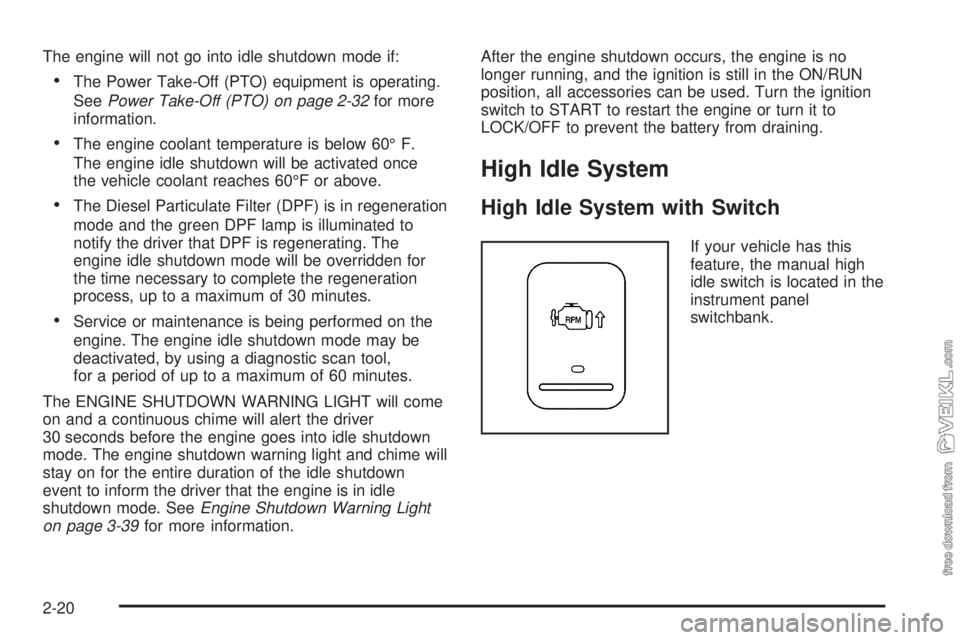
If your vehicle has this
feature, the manual high
idle switch is located in the
instrument panel
switchbank.
2-20
Page 87 of 384
This system can be used to increase your engine idle
speed whenever the following conditions are met:
•The brake pedal is not pressed.
•The vehicle is at a complete stop for vehicles with
diesel engines. The vehicle must not be moving
and the accelerator must not be pressed for vehicles
with gasoline engines.
•If the vehicle has manual transmission the clutch
pedal is not pressed or, if the vehicle has the
automatic transmission it is in NEUTRAL (N) or
PARK (P).
The manual high idle feature is activated by pressing
the switch on the instrument panel. When the switch is
pressed again, or any of the previous conditions are
not met, manual high idle will be deactivated.
The manual high idle has been preset at the factory.
Your dealer may change the setting to fit your needs.
For vehicles with Caterpillar
®diesel engines, the
high idle switch can be used to set any desired high
idle speed.To set a new temporary engine idle speed do the
following:
1. Make sure all of the previously described conditions
are met.
2. Press the accelerator pedal to the desired engine
speed.
3. Momentarily press the manual high idle switch.
The temporary high idle speed will be set. This new high
idle rpm level will be remembered by the system until
either the ignition is turned to OFF or a new high
idle speed is set.
Automatic High Idle System
The automatic high idle feature will engage whenever
you start your vehicle and the engine is below the preset
operating temperature. This will help decrease engine
warm-up time.
On vehicles that have the Caterpillar
®diesel engine you
may have an exhaust restrictor that will operate in
High Idle mode. The exhaust brake switch must be on
for this feature to operate. SeeDiesel Engine Exhaust
Brake on page 2-26for more information.
Idle speed will then return to normal when the engine
reaches the preset operating temperature or has
been operating for at least 10 minutes.
2-21
Page 92 of 384
Diesel Engine Exhaust Brake
If your vehicle has a Isuzu 6H Diesel Engine, it may
have an exhaust brake, which is located in the exhaust
system.
If your vehicle has a 6.6L DURAMAX
®6600 or
Caterpillar®Diesel Engine, it may have an exhaust
brake, which is controlled through the turbocharger.
The exhaust brake for both engines operates the same.
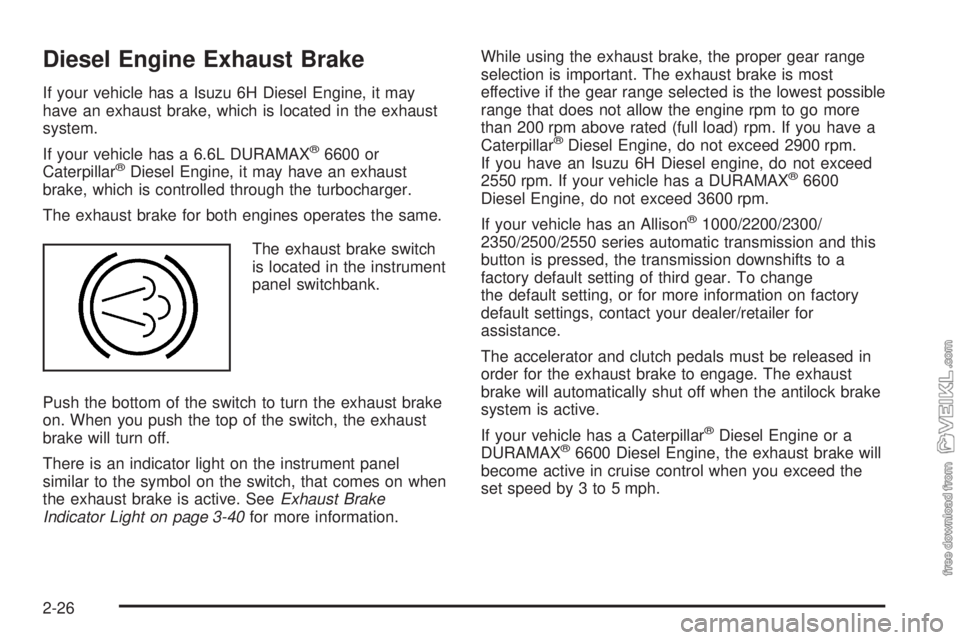
The exhaust brake switch
is located in the instrument
panel switchbank.
Push the bottom of the switch to turn the exhaust brake
on. When you push the top of the switch, the exhaust
brake will turn off.
There is an indicator light on the instrument panel
similar to the symbol on the switch, that comes on when
the exhaust brake is active. SeeExhaust Brake
Indicator Light on page 3-40for more information.While using the exhaust brake, the proper gear range
selection is important. The exhaust brake is most
effective if the gear range selected is the lowest possible
range that does not allow the engine rpm to go more
than 200 rpm above rated (full load) rpm. If you have a
Caterpillar
®Diesel Engine, do not exceed 2900 rpm.
If you have an Isuzu 6H Diesel engine, do not exceed
2550 rpm. If your vehicle has a DURAMAX
®6600
Diesel Engine, do not exceed 3600 rpm.
If your vehicle has an Allison
®1000/2200/2300/
2350/2500/2550 series automatic transmission and this
button is pressed, the transmission downshifts to a
factory default setting of third gear. To change
the default setting, or for more information on factory
default settings, contact your dealer/retailer for
assistance.
The accelerator and clutch pedals must be released in
order for the exhaust brake to engage. The exhaust
brake will automatically shut off when the antilock brake
system is active.
If your vehicle has a Caterpillar
®Diesel Engine or a
DURAMAX®6600 Diesel Engine, the exhaust brake will
become active in cruise control when you exceed the
set speed by 3 to 5 mph.
2-26
Page 93 of 384
Two-Speed Rear Axle
The Two-Speed rear axle lets the driver select Low
Range and High Range. Low Range provides good
starting torque and pulling power. When selecting High
Range the axle allows for higher road speed and
fuel economy.
For better performance during off-road or under a heavy
load, shift the axle into Low Range and then operate
the transmission normally.
For better performance on the highway, shift the axle to
High Range and operate the transmission normally.
High or Low Range can be used when additional shifts
between transmission gears is needed while driving
on grades and for better fuel economy.
Notice:Driving in Low Range above 50 mph
(80.5 kph) will damage driveline components. Drive
below 50 mph (80.5 kph) in Low Range.
If your vehicle has this feature, there is a label on the
headliner above the windshield or in another place near
the driver that shows how to use it. Be sure to follow
the directions carefully.
Two-Speed Rear Axle Shift Control
Operation
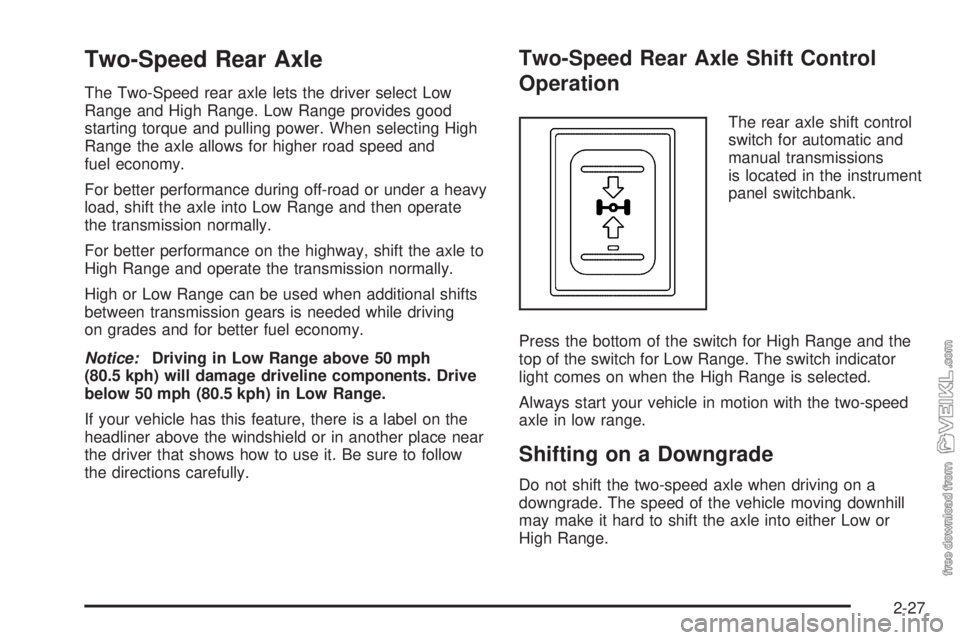
The rear axle shift control
switch for automatic and
manual transmissions
is located in the instrument
panel switchbank.
Press the bottom of the switch for High Range and the
top of the switch for Low Range. The switch indicator
light comes on when the High Range is selected.
Always start your vehicle in motion with the two-speed
axle in low range.
Shifting on a Downgrade
Do not shift the two-speed axle when driving on a
downgrade. The speed of the vehicle moving downhill
may make it hard to shift the axle into either Low or
High Range.
2-27
Page 96 of 384
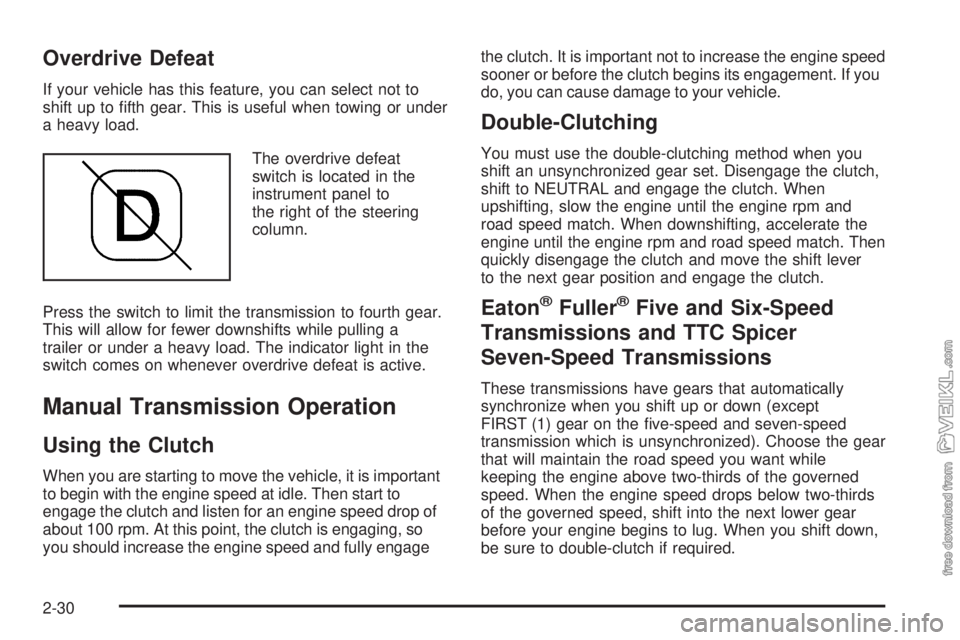
Overdrive Defeat
If your vehicle has this feature, you can select not to
shift up to fifth gear. This is useful when towing or under
a heavy load.
The overdrive defeat
switch is located in the
instrument panel to
the right of the steering
column.
Press the switch to limit the transmission to fourth gear.
This will allow for fewer downshifts while pulling a
trailer or under a heavy load. The indicator light in the
switch comes on whenever overdrive defeat is active.
Manual Transmission Operation
Using the Clutch
When you are starting to move the vehicle, it is important
to begin with the engine speed at idle. Then start to
engage the clutch and listen for an engine speed drop of
about 100 rpm. At this point, the clutch is engaging, so
you should increase the engine speed and fully engagethe clutch. It is important not to increase the engine speed
sooner or before the clutch begins its engagement. If you
do, you can cause damage to your vehicle.
Double-Clutching
You must use the double-clutching method when you
shift an unsynchronized gear set. Disengage the clutch,
shift to NEUTRAL and engage the clutch. When
upshifting, slow the engine until the engine rpm and
road speed match. When downshifting, accelerate the
engine until the engine rpm and road speed match. Then
quickly disengage the clutch and move the shift lever
to the next gear position and engage the clutch.
Eaton®Fuller®Five and Six-Speed
Transmissions and TTC Spicer
Seven-Speed Transmissions
These transmissions have gears that automatically
synchronize when you shift up or down (except
FIRST (1) gear on the five-speed and seven-speed
transmission which is unsynchronized). Choose the gear
that will maintain the road speed you want while
keeping the engine above two-thirds of the governed
speed. When the engine speed drops below two-thirds
of the governed speed, shift into the next lower gear
before your engine begins to lug. When you shift down,
be sure to double-clutch if required.
2-30
Page 98 of 384
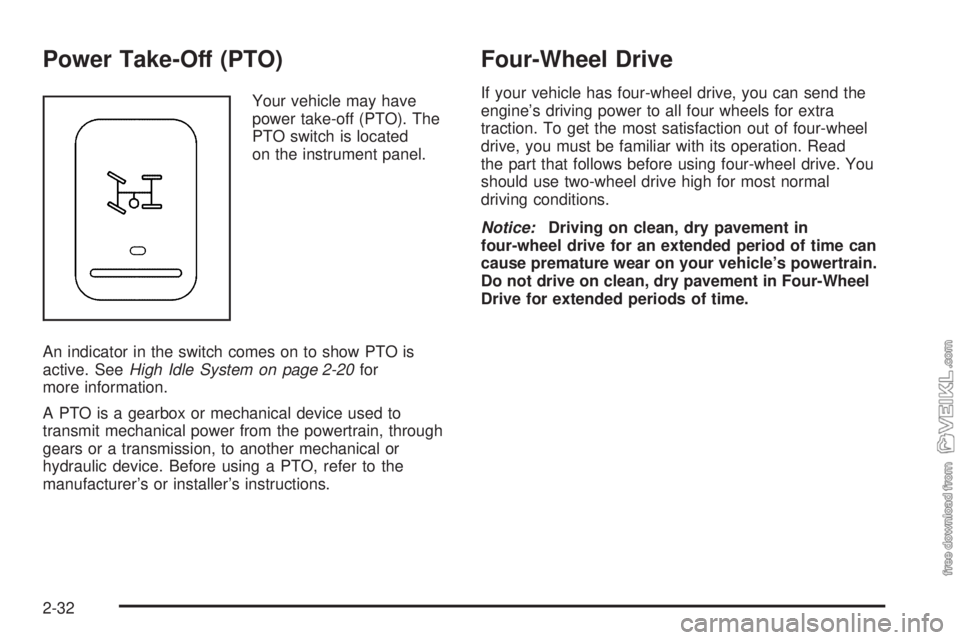
Power Take-Off (PTO)
Your vehicle may have
power take-off (PTO). The
PTO switch is located
on the instrument panel.
An indicator in the switch comes on to show PTO is
active. SeeHigh Idle System on page 2-20for
more information.
A PTO is a gearbox or mechanical device used to
transmit mechanical power from the powertrain, through
gears or a transmission, to another mechanical or
hydraulic device. Before using a PTO, refer to the
manufacturer’s or installer’s instructions.
Four-Wheel Drive
If your vehicle has four-wheel drive, you can send the
engine’s driving power to all four wheels for extra
traction. To get the most satisfaction out of four-wheel
drive, you must be familiar with its operation. Read
the part that follows before using four-wheel drive. You
should use two-wheel drive high for most normal
driving conditions.
Notice:Driving on clean, dry pavement in
four-wheel drive for an extended period of time can
cause premature wear on your vehicle’s powertrain.
Do not drive on clean, dry pavement in Four-Wheel
Drive for extended periods of time.
2-32
Page 99 of 384
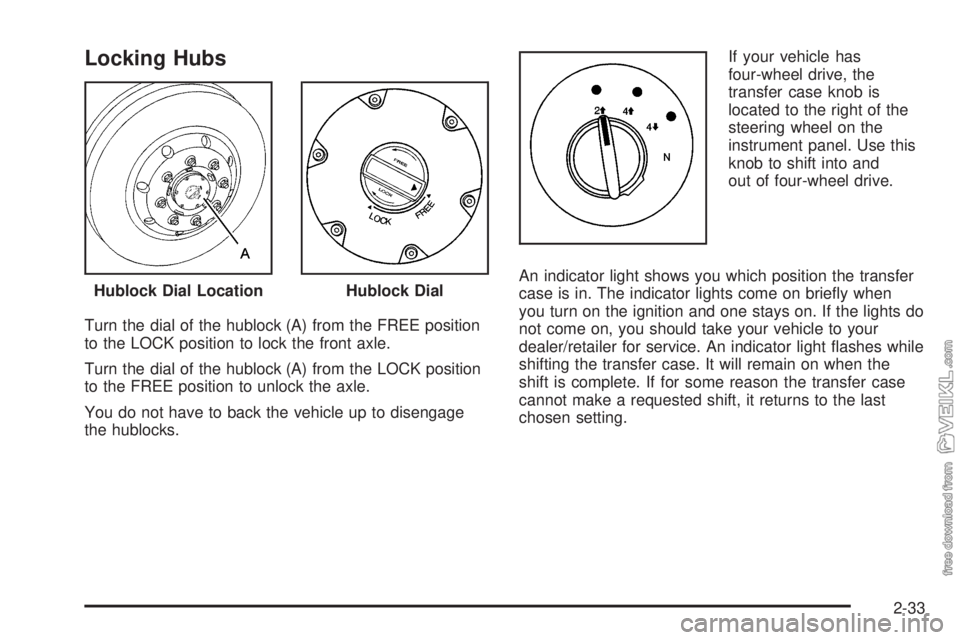
Locking Hubs
Turn the dial of the hublock (A) from the FREE position
to the LOCK position to lock the front axle.
Turn the dial of the hublock (A) from the LOCK position
to the FREE position to unlock the axle.
You do not have to back the vehicle up to disengage
the hublocks.If your vehicle has
four-wheel drive, the
transfer case knob is
located to the right of the
steering wheel on the
instrument panel. Use this
knob to shift into and
out of four-wheel drive.
An indicator light shows you which position the transfer
case is in. The indicator lights come on briefly when
you turn on the ignition and one stays on. If the lights do
not come on, you should take your vehicle to your
dealer/retailer for service. An indicator light flashes while
shifting the transfer case. It will remain on when the
shift is complete. If for some reason the transfer case
cannot make a requested shift, it returns to the last
chosen setting. Hublock Dial Location
Hublock Dial
2-33
Page 104 of 384
Parking a Vehicle With the Two-Speed
Rear Axle
1. With the engine running, shift the two-speed
rear axle into low. To be sure it is in low,
you will need to move the vehicle in gear just
a little.
2. Hold the regular brake pedal down with your
right foot.
3. Apply the parking brake. SeeParking Brake (With
Hydraulic Brakes) on page 2-38orParking Brake
(With Air Brakes) on page 2-41for parking
brake apply procedure.
4. Shift the transmission to NEUTRAL for manual
transmission or PARK (P) for automatic
transmission.
Parking Brake (With Hydraulic
Brakes)
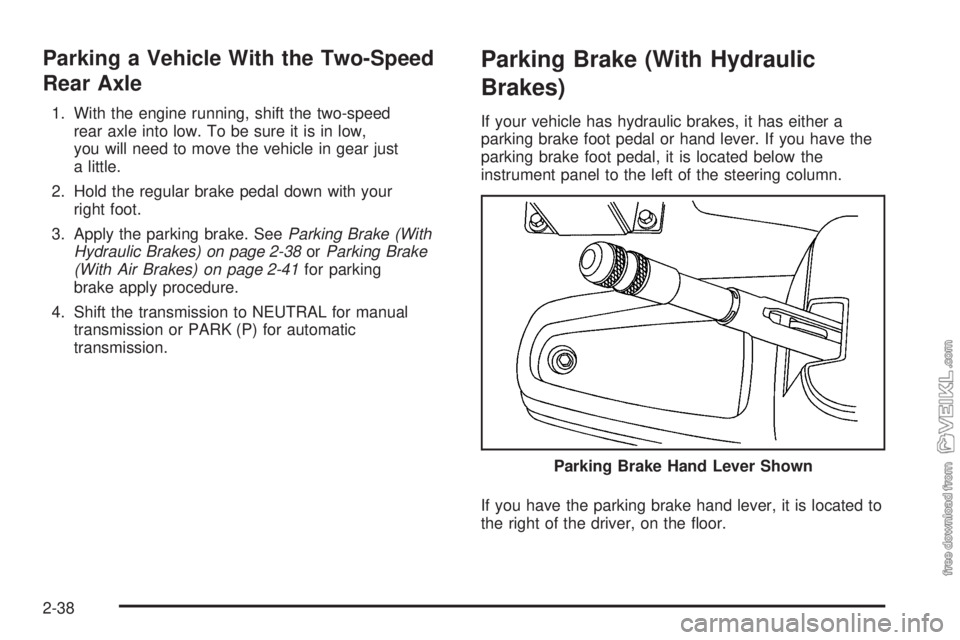
If your vehicle has hydraulic brakes, it has either a
parking brake foot pedal or hand lever. If you have the
parking brake foot pedal, it is located below the
instrument panel to the left of the steering column.
If you have the parking brake hand lever, it is located to
the right of the driver, on the floor.Parking Brake Hand Lever Shown
2-38
Page 107 of 384
4. Check to see if the vehicle moves by slowly
removing your foot from the regular brake pedal.
5. If the vehicle moves, press the regular brake and
repeat the adjustment procedure.
Notice:Over-tightening the park brake lever can
cause damage to the park brake system.
Over-tightening is possible by turning the knob
more than half a turn.
Over-tightening is similar to driving down the road with
your regular brakes applied. If your park brake system is
over-tightened your vehicle may seem sluggish to
accelerate, and/or your park brake hand lever maybe
very hard to pull up and apply the park brake.
If the park brake is over-tightened turn the knob to the
left until it stops and follow the parking brake adjustment
procedure.
Vehicles with a foot-pedal park brake system must be
serviced to make this adjustment. SeeScheduled
Maintenance on page 6-5for more information.Parking Brake (With Air Brakes)
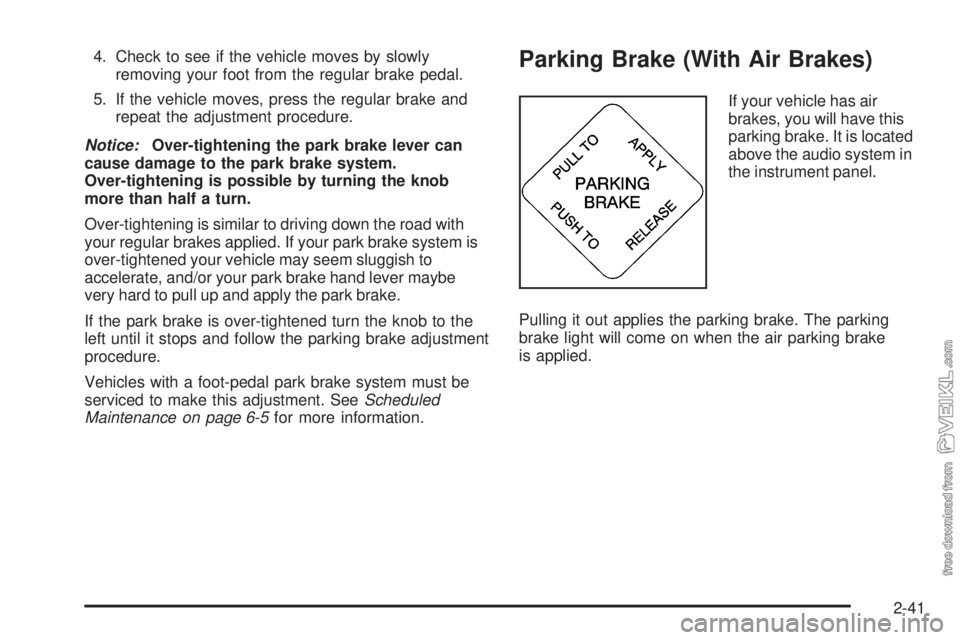
If your vehicle has air
brakes, you will have this
parking brake. It is located
above the audio system in
the instrument panel.
Pulling it out applies the parking brake. The parking
brake light will come on when the air parking brake
is applied.
2-41
Page 110 of 384
Air Suspension
Your vehicle may have the Hendrickson HAS Series
single-axle air suspension which is designed for a
single-axle on-highway use. This feature is available in
19,000 lb (8 613.3 kg), 21,000 lb (9 525.4 kg) and
23,000 lb (10 432.6 kg) capacities.
Rear Air Suspension Dump Control
If your vehicle is equipped with the Hendrickson
HAS Series single-axle air suspension, you may have
this control. The air suspension dump control allows the
operator to lower the deck height approximately
4.5 inches (11.5 cm) from the normal frame height.
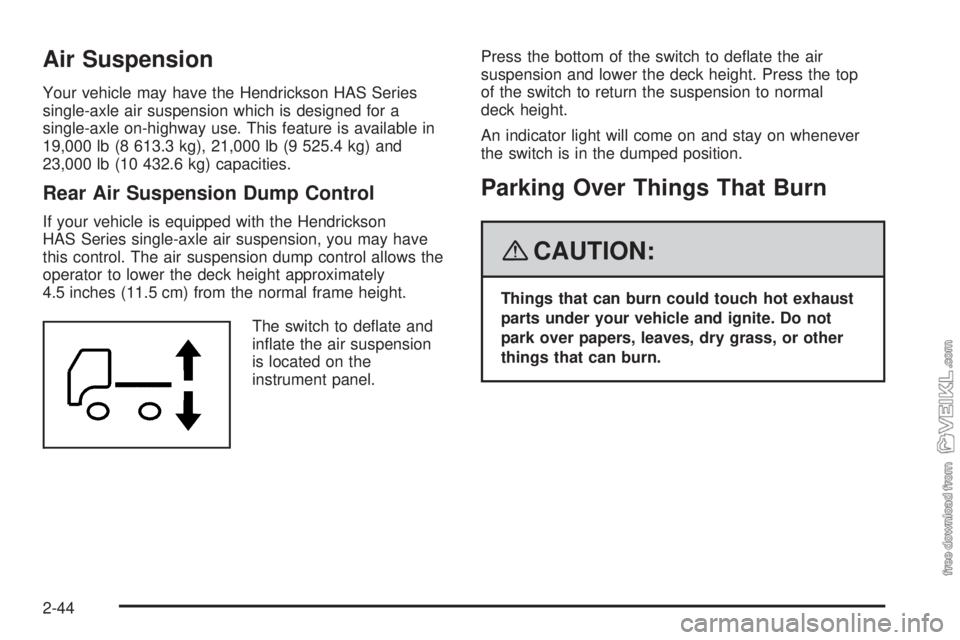
The switch to deflate and
inflate the air suspension
is located on the
instrument panel.Press the bottom of the switch to deflate the air
suspension and lower the deck height. Press the top
of the switch to return the suspension to normal
deck height.
An indicator light will come on and stay on whenever
the switch is in the dumped position.
Parking Over Things That Burn
{CAUTION:
Things that can burn could touch hot exhaust
parts under your vehicle and ignite. Do not
park over papers, leaves, dry grass, or other
things that can burn.
2-44