check engine CHEVROLET KODIAK 2008 Owner's Manual
[x] Cancel search | Manufacturer: CHEVROLET, Model Year: 2008, Model line: KODIAK, Model: CHEVROLET KODIAK 2008Pages: 384, PDF Size: 5.4 MB
Page 159 of 384
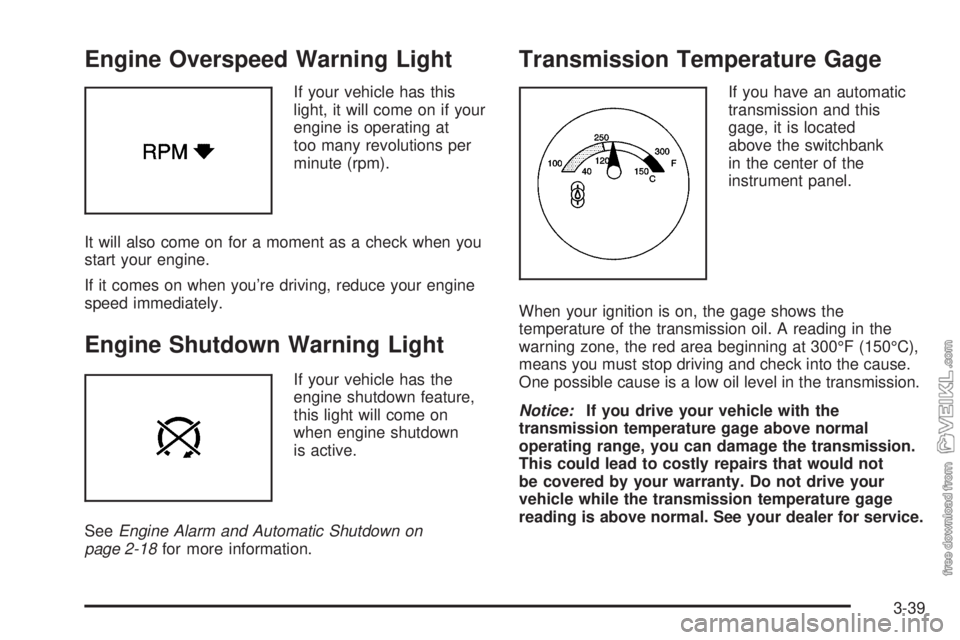
Engine Overspeed Warning Light
If your vehicle has this
light, it will come on if your
engine is operating at
too many revolutions per
minute (rpm).
It will also come on for a moment as a check when you
start your engine.
If it comes on when you’re driving, reduce your engine
speed immediately.
Engine Shutdown Warning Light
If your vehicle has the
engine shutdown feature,
this light will come on
when engine shutdown
is active.
SeeEngine Alarm and Automatic Shutdown on
page 2-18for more information.
Transmission Temperature Gage
If you have an automatic
transmission and this
gage, it is located
above the switchbank
in the center of the
instrument panel.
When your ignition is on, the gage shows the
temperature of the transmission oil. A reading in the
warning zone, the red area beginning at 300°F (150°C),
means you must stop driving and check into the cause.
One possible cause is a low oil level in the transmission.
Notice:If you drive your vehicle with the
transmission temperature gage above normal
operating range, you can damage the transmission.
This could lead to costly repairs that would not
be covered by your warranty. Do not drive your
vehicle while the transmission temperature gage
reading is above normal. See your dealer for service.
3-39
Page 161 of 384
Reduced Engine Power Light
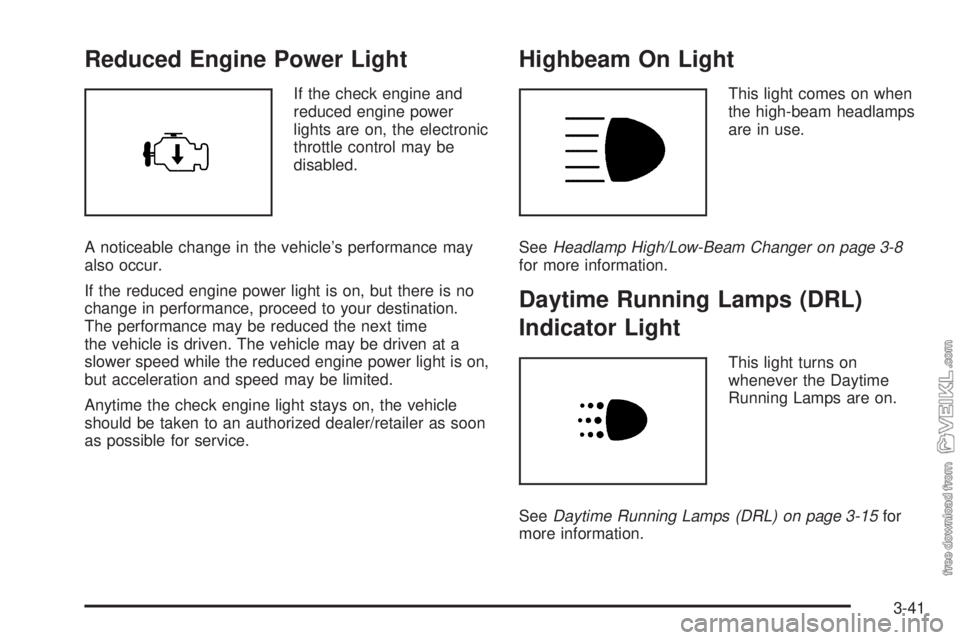
If the check engine and
reduced engine power
lights are on, the electronic
throttle control may be
disabled.
A noticeable change in the vehicle’s performance may
also occur.
If the reduced engine power light is on, but there is no
change in performance, proceed to your destination.
The performance may be reduced the next time
the vehicle is driven. The vehicle may be driven at a
slower speed while the reduced engine power light is on,
but acceleration and speed may be limited.
Anytime the check engine light stays on, the vehicle
should be taken to an authorized dealer/retailer as soon
as possible for service.
Highbeam On Light
This light comes on when
the high-beam headlamps
are in use.
SeeHeadlamp High/Low-Beam Changer on page 3-8
for more information.
Daytime Running Lamps (DRL)
Indicator Light
This light turns on
whenever the Daytime
Running Lamps are on.
SeeDaytime Running Lamps (DRL) on page 3-15for
more information.
3-41
Page 162 of 384
Low Washer Fluid Warning Light
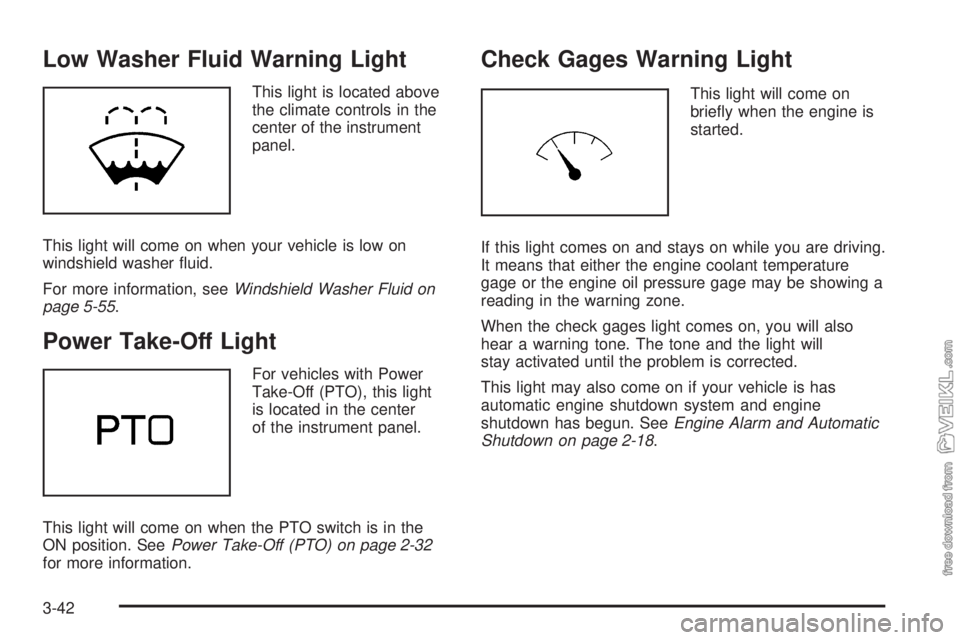
This light is located above
the climate controls in the
center of the instrument
panel.
This light will come on when your vehicle is low on
windshield washer fluid.
For more information, seeWindshield Washer Fluid on
page 5-55.
Power Take-Off Light
For vehicles with Power
Take-Off (PTO), this light
is located in the center
of the instrument panel.
This light will come on when the PTO switch is in the
ON position. SeePower Take-Off (PTO) on page 2-32
for more information.
Check Gages Warning Light
This light will come on
briefly when the engine is
started.
If this light comes on and stays on while you are driving.
It means that either the engine coolant temperature
gage or the engine oil pressure gage may be showing a
reading in the warning zone.
When the check gages light comes on, you will also
hear a warning tone. The tone and the light will
stay activated until the problem is corrected.
This light may also come on if your vehicle is has
automatic engine shutdown system and engine
shutdown has begun. SeeEngine Alarm and Automatic
Shutdown on page 2-18.
3-42
Page 167 of 384
Audio System(s)
If your vehicle came without a radio, the wiring
provisions for a radio and an antenna were installed at
the assembly plant, so that if you want, a radio can
be installed at the dealer/retailer.
Determine which radio your vehicle has and then read the
pages following to familiarize yourself with its features.
{CAUTION:
This system provides you with far greater
access to audio stations and song listings.
Giving extended attention to entertainment
tasks while driving can cause a crash and you
or others can be injured or killed. Always keep
your eyes on the road and your mind on the
drive — avoid engaging in extended searching
while driving.
Keeping your mind on the drive is important for safe
driving. SeeDefensive Driving on page 4-2. Here are
some ways in which you can help avoid distraction
while driving.While your vehicle is parked:
•Familiarize yourself with all of its controls.
•Familiarize yourself with its operation.
•Set up your audio system by presetting your
favorite radio stations, setting the tone, and
adjusting the speakers. Then, when driving
conditions permit, you can tune to your favorite
radio stations using the presets and steering wheel
controls if the vehicle has them.
Notice:Before adding any sound equipment to
your vehicle, such as an audio system, CD player,
CB radio, mobile telephone, or two-way radio, make
sure that it can be added by checking with your
dealer/retailer. Also, check federal rules covering
mobile radio and telephone units. If sound equipment
can be added, it is very important to do it properly.
Added sound equipment may interfere with the
operation of your vehicle’s engine, radio, or other
systems, and even damage them. Your vehicle’s
systems may interfere with the operation of sound
equipment that has been added.
Notice:The chime signals related to safety belts,
parking brake, and other functions of your vehicle
operate through the radio/entertainment system. If
that equipment is replaced or additional equipment is
added to your vehicle, the chimes may not work.
Make sure that replacement or additional equipment
is compatible with your vehicle before installing it.
3-47
Page 183 of 384
Antilock Brake System (ABS)
Your vehicle has the Antilock Brake System (ABS), an
advanced electronic braking system that will help
prevent a braking skid.
When you start the engine and begin to drive away,
ABS will check itself. You might hear a momentary
motor or clicking noise while this test is going on. This
is normal.
If there is a problem with
ABS, this warning light will
stay on. SeeAnti-lock
Brake System (ABS)
Warning Light on
page 3-34.
Let us say the road is wet and you are driving safely.
Suddenly, an animal jumps out in front of you. You slam
on the brakes and continue braking. Here is what
happens with ABS:
A computer senses that wheels are slowing down. If
one of the wheels is about to stop rolling, the computer
will separately work the brakes at each wheel.ABS can change the brake pressure faster than any
driver could. The computer is programmed to make the
most of available tire and road conditions. This can
help you steer around the obstacle while braking hard.
As you brake, the computer keeps receiving updates
on wheel speed and controls braking pressure
accordingly.
Remember: ABS does not change the time you need
to get your foot up to the brake pedal or always
decrease stopping distance. If you get too close to
the vehicle in front of you, you will not have time to
apply the brakes if that vehicle suddenly slows or
stops. Always leave enough room up ahead to stop,
even though you have ABS.
Using ABS
Do not pump the brakes. Just hold the brake pedal
down firmly and let antilock work for you. You might feel
the brakes pulsate, or you might hear air exhausting
if your vehicle has air brakes, but this is normal.
Braking in Emergencies
With ABS, you can steer and brake at the same time.
In many emergencies, steering can help you more than
even the very best braking.
4-5
Page 193 of 384
Highway Hypnosis
Always be alert and pay attention to your surroundings
while driving. If you become tired or sleepy, find a
safe place to park your vehicle and rest.
Other driving tips include:
•Keep the vehicle well ventilated.
•Keep interior temperature cool.
•Keep your eyes moving — scan the road ahead
and to the sides.
•Check the rearview mirror and vehicle instruments
often.
Hill and Mountain Roads
Driving on steep hills or through mountains is different
than driving on flat or rolling terrain. Tips for driving
in these conditions include:
•Keep your vehicle serviced and in good shape.
•Check all fluid levels and brakes, tires, cooling
system, and transmission.
•Going down steep or long hills, shift to a
lower gear.
{CAUTION:
If you do not shift down, the brakes could get
so hot that they would not work well. You
would then have poor braking or even none
going down a hill. You could crash. Shift down
to let the engine assist the brakes on a steep
downhill slope.
{CAUTION:
Coasting downhill in NEUTRAL (N) or with the
ignition off is dangerous. The brakes will have
to do all the work of slowing down and they
could get so hot that they would not work well.
You would then have poor braking or even
none going down a hill. You could crash.
Always have the engine running and your
vehicle in gear when you go downhill.
4-15
Page 196 of 384
If You Are Caught in a Blizzard
If you are stopped by heavy snow, you could be in a
serious situation. You should probably stay with
your vehicle unless you know for sure that you are near
help and you can hike through the snow. Here are
some things to do to summon help and keep yourself
and your passengers safe:
•Turn on the hazard warning flashers.
•Tie a red cloth to your mirror arm to alert police that
you have been stopped by the snow.
•Put on extra clothing or wrap a blanket around you.
If you do not have blankets or extra clothing, make
body insulators from newspapers, burlap bags,
rags, floor mats — anything you can wrap around
yourself or tuck under your clothing to keep warm.
You can run the engine to keep warm, but be careful.
{CAUTION:
Snow can trap exhaust gases under your
vehicle. This can cause deadly CO (carbon
monoxide) gas to get inside. CO could
overcome you and kill you. You cannot see it
or smell it, so you might not know it is in your
vehicle. Clear away snow from around the
base of your vehicle if any is blocking your
exhaust pipe. And check around again from
time to time to be sure snow does not collect
there.
Open a window just a little on the side of the
vehicle that is away from the wind. This will
help keep CO out.
4-18
Page 205 of 384
Service............................................................5-4
Accessories and Modifications..........................5-4
California Proposition 65 Warning.....................5-5
California Perchlorate Materials Requirements.....5-5
Doing Your Own Service Work.........................5-6
Engine Fan Breakage.....................................5-6
Fuel................................................................5-7
Gasoline Octane............................................5-7
Gasoline Specifications....................................5-7
Additives.......................................................5-8
Diesel Engine Fuel.........................................5-9
What Fuel to Use...........................................5-9
Very Cold Weather Operation.........................5-12
Water in Fuel...............................................5-12
Running Out of Fuel.....................................5-17
Fuel Filter Replacement.................................5-18
Fuels in Foreign Countries.............................5-19
Filling the Tank............................................5-20
Filling a Portable Fuel Container.....................5-21
Checking Things Under the Hood....................5-22
Hood Latches...............................................5-22
Engine Oil (Caterpillar
®Diesel Engine).............5-23
Engine Oil (Gasoline Engine)..........................5-24
Engine Oil (DURAMAX
®Diesel Engine)............5-28Engine Oil (Isuzu Diesel Engine).....................5-32
Engine Oil Life System (Gasoline Engine)........5-36
Engine Oil Life System (DURAMAX
®/Isuzu
Diesel Engines).........................................5-37
Engine Oil Life System (Caterpillar
®Diesel
Engine)....................................................5-39
Engine Air Cleaner/Filter................................5-39
Automatic Transmission Fluid.........................5-43
Manual Transmission Fluid.............................5-43
Engine Coolant (Caterpillar
®Diesel Engines).....5-44
Engine Coolant (Gas and DURAMAX®/
Isuzu 7.8L L6 Engines)..............................5-44
Coolant Surge Tank Pressure Cap..................5-47
Engine Overheating.......................................5-48
Cooling System............................................5-50
Engine Fan Noise.........................................5-54
Power Steering Fluid.....................................5-54
Windshield Washer Fluid................................5-55
Brakes........................................................5-57
Battery........................................................5-66
Jump Starting...............................................5-67
Rear Axle.......................................................5-72
Rear Axle Shift Motor....................................5-73
Section 5 Service and Appearance Care
5-1
Page 220 of 384
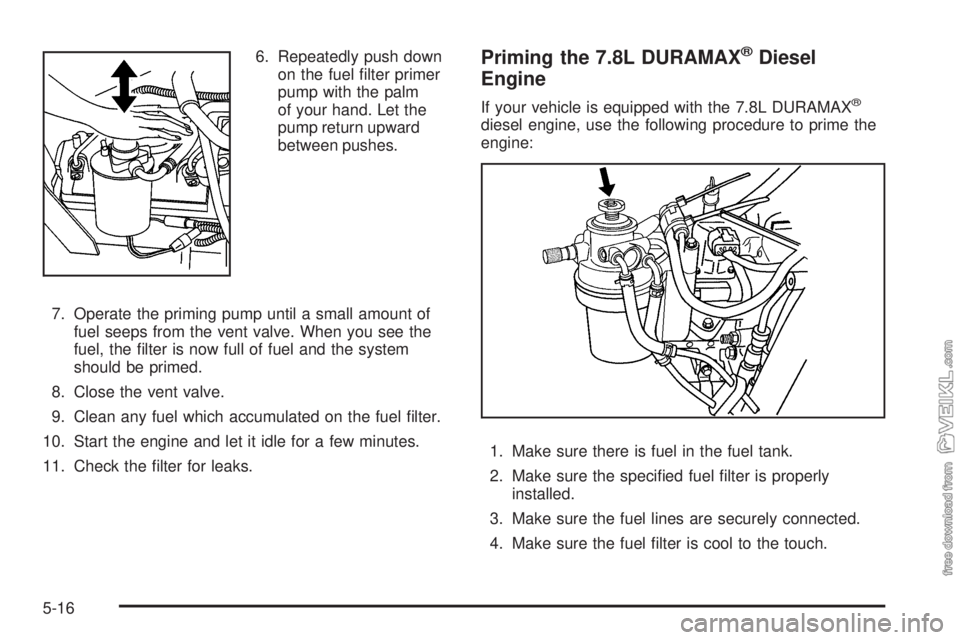
6. Repeatedly push down
on the fuel filter primer
pump with the palm
of your hand. Let the
pump return upward
between pushes.
7. Operate the priming pump until a small amount of
fuel seeps from the vent valve. When you see the
fuel, the filter is now full of fuel and the system
should be primed.
8. Close the vent valve.
9. Clean any fuel which accumulated on the fuel filter.
10. Start the engine and let it idle for a few minutes.
11. Check the filter for leaks.Priming the 7.8L DURAMAX®Diesel
Engine
If your vehicle is equipped with the 7.8L DURAMAX®
diesel engine, use the following procedure to prime the
engine:
1. Make sure there is fuel in the fuel tank.
2. Make sure the specified fuel filter is properly
installed.
3. Make sure the fuel lines are securely connected.
4. Make sure the fuel filter is cool to the touch.
5-16
Page 221 of 384
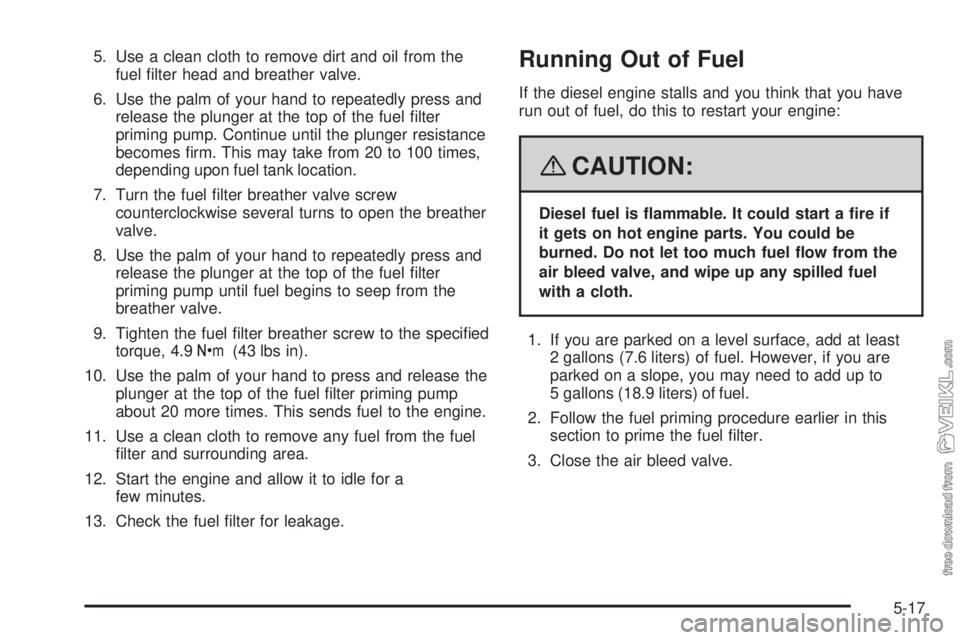
5. Use a clean cloth to remove dirt and oil from the
fuel filter head and breather valve.
6. Use the palm of your hand to repeatedly press and
release the plunger at the top of the fuel filter
priming pump. Continue until the plunger resistance
becomes firm. This may take from 20 to 100 times,
depending upon fuel tank location.
7. Turn the fuel filter breather valve screw
counterclockwise several turns to open the breather
valve.
8. Use the palm of your hand to repeatedly press and
release the plunger at the top of the fuel filter
priming pump until fuel begins to seep from the
breather valve.
9. Tighten the fuel filter breather screw to the specified
torque, 4.9Y(43 lbs in).
10. Use the palm of your hand to press and release the
plunger at the top of the fuel filter priming pump
about 20 more times. This sends fuel to the engine.
11. Use a clean cloth to remove any fuel from the fuel
filter and surrounding area.
12. Start the engine and allow it to idle for a
few minutes.
13. Check the fuel filter for leakage.Running Out of Fuel
If the diesel engine stalls and you think that you have
run out of fuel, do this to restart your engine:
{CAUTION:
Diesel fuel is ammable. It could start a re if
it gets on hot engine parts. You could be
burned. Do not let too much fuel ow from the
air bleed valve, and wipe up any spilled fuel
with a cloth.
1. If you are parked on a level surface, add at least
2 gallons (7.6 liters) of fuel. However, if you are
parked on a slope, you may need to add up to
5 gallons (18.9 liters) of fuel.
2. Follow the fuel priming procedure earlier in this
section to prime the fuel filter.
3. Close the air bleed valve.
5-17