air condition CHEVROLET KODIAK 2008 Service Manual
[x] Cancel search | Manufacturer: CHEVROLET, Model Year: 2008, Model line: KODIAK, Model: CHEVROLET KODIAK 2008Pages: 384, PDF Size: 5.4 MB
Page 346 of 384
(12)= Check steering system:
•Look for damaged, loose, or missing parts. Inspect
the steering linkage relay rod and tie rod ends for
looseness or lack of lubricant. Also look for parts
showing signs of wear or lack of lubrication. Replace
parts as needed. Also check steering gear mounting
bolts, pitman arm nut, gear housing upper cover and
side cover attaching bolts, steering column mounting
bolts and cardan joint clamp bolts; tighten if
necessary. See the service manual.
•Inspect power steering hoses, tubes, and fittings for
leaks. Hoses and lines must not be twisted, kinked,
or tightly bent. Make sure clips, clamps, supporting
tubes, and hoses are in place and properly secured.
•Check steering gear for leakage around pitman shaft
and housing. If leakage is evident (lubricant oozing
out, not just oily film), leak should be corrected
immediately.
(13)= Check front and rear suspension. Look for
damaged, loose, or missing parts or parts showing signs
of wear or lack of lubrication. Replace parts as needed.
(14)= Adjust tire pressures as indicated on the
Certification or Tire Information label for optimum tire
life. SeeTires on page 5-82for further details. Check
tires for excessive or abnormal wear or damage. Also
check for damaged wheels. Replace wheels and/or tires
as needed.(15)= Check spring-to-axle U-bolts and shackle bolts
for proper torque. See the service manual for torque
sequence and specifications. When parts are replaced,
the torque must be checked and adjusted more often
during the first 6,000 miles (10 000 km). Check torque at
500 miles (800 km) and 2,000 miles (3 000 km) after
first use of parts.
(16)= Check complete exhaust system, including DPF
pressure lines, and cab areas near the exhaust system
for broken, damaged, missing, or out-of-position parts.
Also inspect for open seams, holes, loose connections, or
other conditions which could let exhaust fumes seep into
the driver compartment. Needed repairs should be made
at once. To help maintain system integrity, replace
exhaust pipes whenever a new muffler is put on.
(17)= Check all gasoline engine drive belts for cracks,
fraying, and wear. Replace as needed.
(18)= Adjust valve lash. Incorrect valve clearance will
result in increased engine noise and reduced engine
output.
(19)= With the engine off and below normal operating
temperature, check to see that the thermostatically
controlled engine cooling fan can be rotated by hand on
viscous-operated drives. Replace as needed.
(20)= Check shields and underhood insulation for
damage or looseness. Adjust or replace as needed.
6-22
Page 348 of 384
(30)= Change the lubricant. SeePart C: Recommended
Fluids and Lubricants on page 6-31.
(31)= Front axle service: Re-pack upper kingpin roller
bearing.
(32)= Air brake service:
•Inspect brake lines and hoses for proper hook-up,
binding, leaks, cracks, chafing, etc. Inspect drum
brake linings for wear or cracks. Inspect other brake
parts at each wheel, including drums and wheel
speed sensor wiring. Check brake pedal for
excessive free play or travel (or every 6 months,
whichever occurs first) and have serviced if needed.
Check brakes more often if driving habits and
conditions result in frequent braking. Replace air
dryer cartridge only if excessive oil or moisture
is present. A small amount of oil in the system is
normal and should not be considered as a reason to
replace the cartridge.
•Test air lines for leaks; tighten as needed. Replace
compressor filter.
•Inspect air parking brake chamber for leaks and
damage. Inspect lines and hoses for leaks, cracks,
chafing, etc. Also check all attachments for tightness,
wear, or damage. Note: The spring brake section of
the rear brake diaphragms are non-serviceable.
•Replace the air compressor filter element, mounted
on the air compressor. For remote air compressor
intake service, refer to engine air cleaner filter
replacement.
•Remove, disassemble, clean, and inspect the safety
valve, service brake chambers, quick release valves,
quick release/double check valve combinations,
parking brake control valve, double check valves,
pressure protection valves, and ether injector
(if equipped).
•Remove, disassemble, and clean the application
valve; replace parts showing wear.
•Remove, disassemble, clean, and inspect the spring
brake control valve; replace rubber parts.
6-24
Page 352 of 384
Automatic Transmission Shift Indicator
Check
Check that the indicator points to the gear chosen.
Steering Check
Be alert for any changes in steering action, abnormal
front tire wear or steering wheel position. An inspection
or service is needed when the steering wheel is harder
to turn or has too much free play, or if there are strange
sounds when turning or parking.
Brake System Check
Be alert to the low air warning light or tone alarm, or
changes in braking action, such as repeated pulling to
one side, unusual sounds when braking or increased
brake pedal travel. Make sure air brake system
reservoirs are drained daily with full system air pressure,
and check system for leaks. Any of these conditions
could indicate the need for brake system inspection
and/or service.
Engine Cooling System Service
Inspect the hoses and have them replaced if they are
cracked, swollen, or deteriorated. Inspect all pipes,
fittings, and clamps; replace as needed. Clean the
outside of the radiator and air conditioning condenser.
To help ensure proper operation, a pressure test of the
cooling system and pressure cap is recommended at
least once a year.
Exhaust System Inspection
Be alert for any changes in the sound of the exhaust
system or any smell of fumes. These are signs the
system may be leaking. Have it checked and/or repaired
at once. SeeEngine Exhaust on page 2-45and
Running the Vehicle While Parked on page 2-50.
Check to be sure that mud or dirt is not caked on the
exhaust system, especially in the area of the diesel
particulate filter and tailpipe. Clean the area as needed.
SeeDiesel Particulate Filter (Diesel Engine) on
page 2-46.
At high mileages, the DPF becomes loaded with ash.
This is normal. When the amount of ash loading is high,
see your dealer/retailer for DPF cleaning or replacement.
6-28
Page 353 of 384
Windshield Wipers and Washers Check
Check operation and condition of the wiper blades.
Check the flow of the washer spray.
Defroster Check
Move the control to the defrost symbol and the fan to HI
or the high symbol. Then check the airflow from the
ducts at the inside base of the windshield.
Mirrors and Sun Visors Check
Check that friction joints hold mirrors and sun visors
in place.
Seat Adjuster Check
When adjusting a manual seat, be sure seat adjusters
latch by attempting to move the seat after latching.
Lamps Check
Check panel lighting, warning lights, indicator lights, and
interior lamps. On the outside, check: license plate
lamps, sidemarker lamps, reflectors or lights on outside
mirrors, headlamps, parking lamps, identification and
clearance lamps, taillamps, brake lamps, turn signals,
backup lamps, and hazard warning flashers. Have
headlamp aim checked at once if beams seem
improperly aimed.
Glass, Mirrors, Lamps, and/or
Reectors Condition Check
Look for broken, scratched, dirty, or damaged glass,
mirrors, lamps, or reflectors that could reduce the view
or visibility or cause injury. Replace, clean, or repair
promptly.
Door Latches Check
Check that doors close, latch, and lock tightly. Check for
broken, damaged, or missing parts that might prevent
tight latching.
Hood Latches Check
Check that the hood closes firmly. Check for broken,
damaged, loose, or missing parts that might prevent
tight latching. Make sure the secondary latch, if the
vehicle has one, keeps the hood from opening all the way
when the primary latch is released.
Fluid Leaks Check
Check for fuel, coolant, oil, or other fluid leaks by
looking at the surface beneath the vehicle after it has
been parked for awhile.
6-29
Page 367 of 384
Insuring Your Vehicle
Protect your investment in your GM vehicle with
comprehensive and collision insurance coverage. There
are significant differences in the quality of coverage
afforded by various insurance policy terms. Many
insurance policies provide reduced protection to your
GM vehicle by limiting compensation for damage repairs
by using aftermarket collision parts. Some insurance
companies will not specify aftermarket collision
parts. When purchasing insurance, we recommend that
you assure your vehicle will be repaired with GM
original equipment collision parts. If such insurance
coverage is not available from your current insurance
carrier, consider switching to another insurance carrier.
If your vehicle is leased, the leasing company may
require you to have insurance that assures repairs with
Genuine GM Original Equipment Manufacturer (OEM)
parts or Genuine Manufacturer replacement parts. Read
your lease carefully, as you may be charged at the
end of your lease for poor quality repairs.
If a Crash Occurs
Here is what to do if you are involved in a crash.
•Try to relax and then check to make sure you are all
right. If you are uninjured, make sure that no one else
in your vehicle, or the other vehicle, is injured.
•If there has been an injury, call emergency services
for help. Do not leave the scene of a crash until all
matters have been taken care of. Move your vehicle
only if its position puts you in danger or you are
instructed to move it by a police officer.
•Give only the necessary and requested information
to police and other parties involved in the crash. Do
not discuss your personal condition, mental frame of
mind, or anything unrelated to the crash. This will
help guard against post-crash legal action.
•If you need roadside assistance, call GM Roadside
Assistance. SeeRoadside Assistance Program on
page 7-5for more information.
•If your vehicle cannot be driven, know where the
towing service will be taking it. Get a card from the
tow truck operator or write down the driver’s name,
the service’s name, and the phone number.
•Remove any valuables from your vehicle before it is
towed away. Make sure this includes your insurance
information and registration if you keep these items
in your vehicle.
7-7
Page 371 of 384
Vehicle Data Recording and
Privacy
Vehicle Data Recording and Privacy
(Isuzu 7.8L L6 Engine)
Your GM vehicle has a number of sophisticated
computers that record information about the vehicle’s
performance and how it is driven. For example,
your vehicle uses computer modules to monitor and
control engine and transmission performance, to monitor
the conditions for airbag deployment and deploy
airbags in a crash and, if so equipped, to provide
antilock braking to help the driver control the vehicle.
These modules may store data to help your
dealer/retailer technician service your vehicle. Some
modules may also store data about how you operate the
vehicle, such as rate of fuel consumption or average
speed. These modules may also retain the owner’s
personal preferences, such as radio pre-sets, seat
positions, and temperature settings.
Event Data Recorders
(Isuzu 7.8L L6 Engine)
This vehicle has an Event Data Recorder (EDR). The
main purpose of an EDR is to record, in certain crash or
near crash-like situations, such as an airbag deployment
or hitting a road obstacle, data that will assist in
understanding how a vehicle’s systems performed. The
EDR is designed to record data related to vehicle
dynamics and safety systems for a short period of time,
typically 30 seconds or less. The EDR in this vehicle
is designed to record such data as:
•How various systems in your vehicle were operating
•Whether or not the driver and passenger safety
belts were buckled/fastened
•How far, if at all, the driver was pressing the
accelerator and/or brake pedal
•How fast the vehicle was traveling
This data can help provide a better understanding of the
circumstances in which crashes and injuries occur.
Important:EDR data is recorded by your vehicle only
if a non-trivial crash situation occurs; no data is
recorded by the EDR under normal driving conditions
and no personal data (e.g., name, gender, age,
and crash location) is recorded. However, other parties,
such as law enforcement, could combine the EDR
data with the type of personally identifying data routinely
acquired during a crash investigation.
7-11
Page 373 of 384
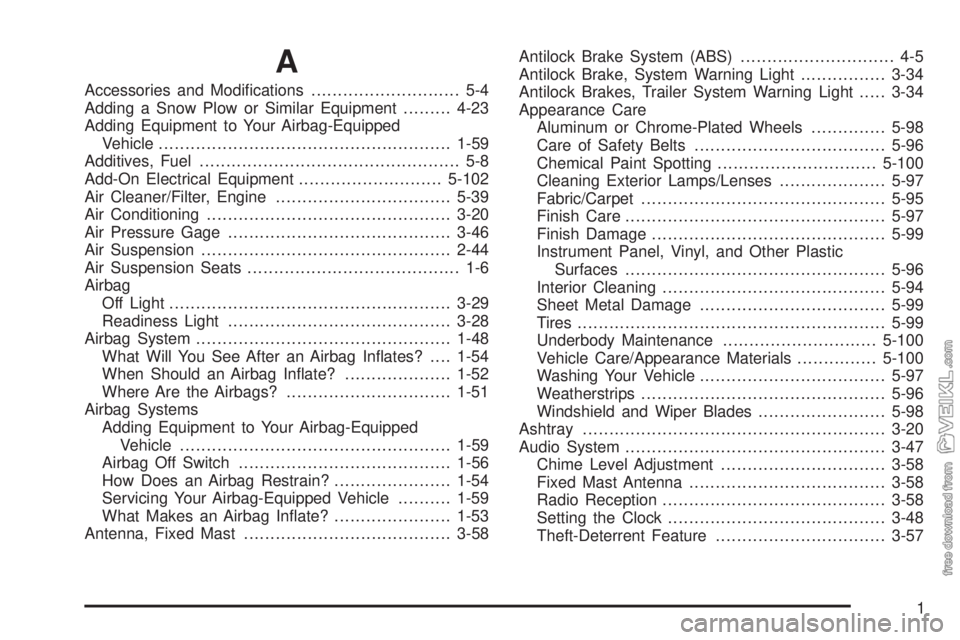
A
Accessories and Modifications............................ 5-4
Adding a Snow Plow or Similar Equipment.........4-23
Adding Equipment to Your Airbag-Equipped
Vehicle.......................................................1-59
Additives, Fuel................................................. 5-8
Add-On Electrical Equipment...........................5-102
Air Cleaner/Filter, Engine.................................5-39
Air Conditioning..............................................3-20
Air Pressure Gage..........................................3-46
Air Suspension...............................................2-44
Air Suspension Seats........................................ 1-6
Airbag
Off Light.....................................................3-29
Readiness Light..........................................3-28
Airbag System................................................1-48
What Will You See After an Airbag Inflates?....1-54
When Should an Airbag Inflate?....................1-52
Where Are the Airbags?...............................1-51
Airbag Systems
Adding Equipment to Your Airbag-Equipped
Vehicle...................................................1-59
Airbag Off Switch........................................1-56
How Does an Airbag Restrain?......................1-54
Servicing Your Airbag-Equipped Vehicle..........1-59
What Makes an Airbag Inflate?......................1-53
Antenna, Fixed Mast.......................................3-58Antilock Brake System (ABS)............................. 4-5
Antilock Brake, System Warning Light................3-34
Antilock Brakes, Trailer System Warning Light.....3-34
Appearance Care
Aluminum or Chrome-Plated Wheels..............5-98
Care of Safety Belts....................................5-96
Chemical Paint Spotting..............................5-100
Cleaning Exterior Lamps/Lenses....................5-97
Fabric/Carpet..............................................5-95
Finish Care.................................................5-97
Finish Damage............................................5-99
Instrument Panel, Vinyl, and Other Plastic
Surfaces.................................................5-96
Interior Cleaning..........................................5-94
Sheet Metal Damage...................................5-99
Tires..........................................................5-99
Underbody Maintenance.............................5-100
Vehicle Care/Appearance Materials...............5-100
Washing Your Vehicle...................................5-97
Weatherstrips..............................................5-96
Windshield and Wiper Blades........................5-98
Ashtray.........................................................3-20
Audio System.................................................3-47
Chime Level Adjustment...............................3-58
Fixed Mast Antenna.....................................3-58
Radio Reception..........................................3-58
Setting the Clock.........................................3-48
Theft-Deterrent Feature................................3-57
1