lock CHEVROLET KODIAK 2008 Workshop Manual
[x] Cancel search | Manufacturer: CHEVROLET, Model Year: 2008, Model line: KODIAK, Model: CHEVROLET KODIAK 2008Pages: 384, PDF Size: 5.4 MB
Page 191 of 384
If you have the Antilock Brake System (ABS),
remember: It helps avoid only the braking skid. If you do
not have ABS, then in a braking skid, where the
wheels are no longer rolling, release enough pressure
on the brakes to get the wheels rolling again. This
restores steering control. Push the brake pedal down
steadily when you have to stop suddenly. As long as the
wheels are rolling, you will have steering control.
Driving at Night
Night driving is more dangerous than day driving
because some drivers are likely to be impaired — by
alcohol or drugs, with night vision problems, or by
fatigue.
Night driving tips include:
•Drive defensively.
•Do not drink and drive.
•Reduce headlamp glare by adjusting the inside
rearview mirror.
•Slow down and keep more space between you and
other vehicles because your headlamps can only
light up so much road ahead.
•Watch for animals.
•When tired, pull off the road.
•Do not wear sunglasses.
•Avoid staring directly into approaching headlamps.
•Keep the windshield and all glass on your vehicle
clean — inside and out.
•Keep your eyes moving, especially during turns or
curves.
No one can see as well at night as in the daytime.
But, as we get older, these differences increase.
A 50-year-old driver might need at least twice as much
light to see the same thing at night as a 20-year-old.
4-13
Page 195 of 384
If your vehicle has the Traction Control System (TCS), it
improves your ability to accelerate when driving on a
slippery road. But you can turn the TCS off if you ever
need to. You should turn the system off if your
vehicle ever gets stuck in sand, mud, ice, or snow. See
If Your Vehicle is Stuck in Sand, Mud, Ice, or Snow
on page 4-19. Even though your vehicle has TCS, slow
down and adjust your driving to the road conditions.
Under certain conditions, you might want to turn the TCS
off, such as when driving through deep snow and
loose gravel, to help maintain vehicle motion at lower
speeds. SeeTraction Control System (TCS) on
page 4-8.
If your vehicle does not have TCS, accelerate gently.
Try not to break the fragile traction. If you accelerate too
fast, the drive wheels will spin and polish the surface
under the tires even more.
Unless your vehicle has the Antilock Brake System
(ABS), you will want to brake very gently, too. If you do
have ABS, seeAntilock Brake System (ABS) on
page 4-5. ABS improves your vehicle’s stability when
you make a hard stop on a slippery road. Whether your
vehicle has ABS or not, begin stopping sooner than
you would on dry pavement. Without ABS, if you
feel your vehicle begin to slide, let up on the brakes a
little. Push the brake pedal down steadily to get the most
traction you can.Remember, unless your vehicle has ABS, if you brake
so hard that the wheels stop rolling, you will just
slide. Brake so the wheels always keep rolling and you
can still steer.
•Whatever your vehicle’s braking system, allow
greater following distance on any slippery road.
•Watch for slippery spots. The road might be fine
until you hit a spot that is covered with ice. On
an otherwise clear road, ice patches can appear in
shaded areas where the sun cannot reach, such
as around clumps of trees, behind buildings,
or under bridges. Sometimes the surface of a curve
or an overpass can remain icy when the
surrounding roads are clear. If you see a patch of
ice ahead of you, brake before you are on it. Try not
to brake while you are actually on the ice, and
avoid sudden steering maneuvers.
4-17
Page 196 of 384
If You Are Caught in a Blizzard
If you are stopped by heavy snow, you could be in a
serious situation. You should probably stay with
your vehicle unless you know for sure that you are near
help and you can hike through the snow. Here are
some things to do to summon help and keep yourself
and your passengers safe:
•Turn on the hazard warning flashers.
•Tie a red cloth to your mirror arm to alert police that
you have been stopped by the snow.
•Put on extra clothing or wrap a blanket around you.
If you do not have blankets or extra clothing, make
body insulators from newspapers, burlap bags,
rags, floor mats — anything you can wrap around
yourself or tuck under your clothing to keep warm.
You can run the engine to keep warm, but be careful.
{CAUTION:
Snow can trap exhaust gases under your
vehicle. This can cause deadly CO (carbon
monoxide) gas to get inside. CO could
overcome you and kill you. You cannot see it
or smell it, so you might not know it is in your
vehicle. Clear away snow from around the
base of your vehicle if any is blocking your
exhaust pipe. And check around again from
time to time to be sure snow does not collect
there.
Open a window just a little on the side of the
vehicle that is away from the wind. This will
help keep CO out.
4-18
Page 202 of 384
Towing
Towing Your Vehicle
Consult your dealer/retailer or a professional towing
service if you need to have your disabled vehicle towed.
SeeRoadside Assistance Program on page 7-5.
Releasing Air-Operated Parking Brakes
If your vehicle has air brakes, you could have a
special towing problem. If your vehicle has to be towed
because of a complete loss of air pressure from
both systems, the parking brakes will have automatically
engaged. The tow operator can release the brakes
manually by using the following steps. Then your vehicle
can be towed with all wheels or only the rear wheels
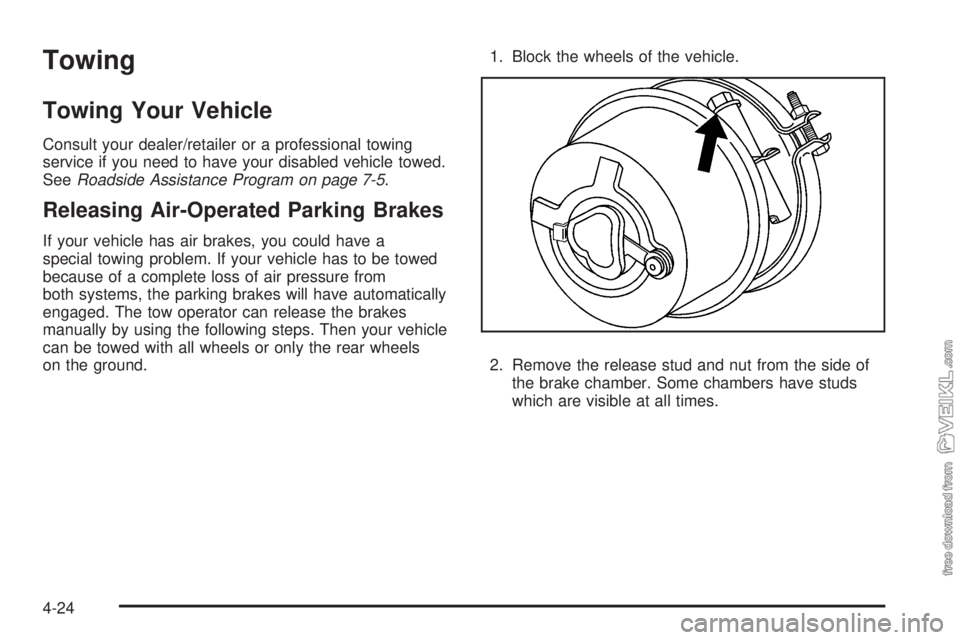
on the ground.1. Block the wheels of the vehicle.
2. Remove the release stud and nut from the side of
the brake chamber. Some chambers have studs
which are visible at all times.
4-24
Page 203 of 384
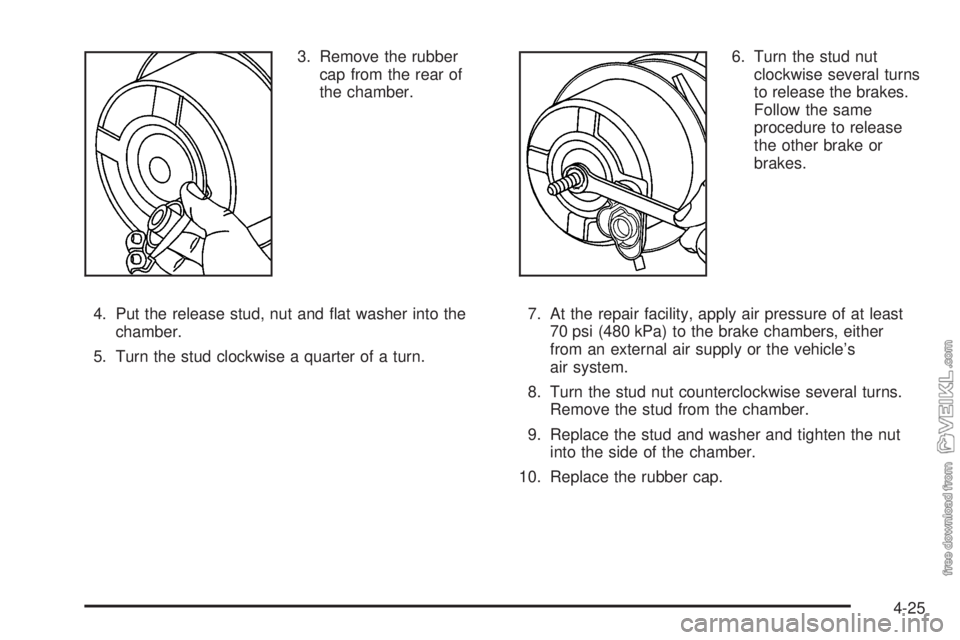
3. Remove the rubber
cap from the rear of
the chamber.
4. Put the release stud, nut and flat washer into the
chamber.
5. Turn the stud clockwise a quarter of a turn.6. Turn the stud nut
clockwise several turns
to release the brakes.
Follow the same
procedure to release
the other brake or
brakes.
7. At the repair facility, apply air pressure of at least
70 psi (480 kPa) to the brake chambers, either
from an external air supply or the vehicle’s
air system.
8. Turn the stud nut counterclockwise several turns.
Remove the stud from the chamber.
9. Replace the stud and washer and tighten the nut
into the side of the chamber.
10. Replace the rubber cap.
4-25
Page 207 of 384
Vehicle Identication.....................................5-101
Vehicle Identification Number (VIN)................5-101
Service Parts Identification Label...................5-102
Electrical System..........................................5-102
Add-On Electrical Equipment.........................5-102
Headlamp Wiring........................................5-102
Windshield Wiper Fuses...............................5-102
Fusible Links..............................................5-103Power Windows and Other Power Options......5-103
Fuses and Circuit Breakers..........................5-103
Instrument Panel Fuse Block........................5-103
Underhood Fuse Block................................5-106
Capacities and Specications........................5-109
Maintenance Replacement Parts....................5-115
Engine Drive Belt Routing............................5-117
Section 5 Service and Appearance Care
5-3
Page 208 of 384
Service
For service and parts needs, visit your dealer/retailer.
You will receive genuine GM parts and GM-trained and
supported service people.
Genuine GM parts have one of these marks:
Accessories and Modications
Adding non-dealer accessories to your vehicle can
affect its performance and safety. Such things as,
airbags, braking, stability, ride and handling, emissions
systems, aerodynamics, durability, and electronic
systems like anti-lock brakes, traction control, and
stability control could be affected. Some non-dealer
accessories could even cause malfunction or damage to
parts and systems and would not be covered by the
vehicle warranty.
GM Accessories are designed to complement and
function with other systems on your vehicle. Your GM
dealer can accessorize your vehicle using genuine
GM Accessories. When you go to your GM dealer and
ask for GM Accessories, you will know that GM-trained
and supported service technicians will perform the work
using genuine GM Accessories.
Also, seeAdding Equipment to Your Airbag-Equipped
Vehicle on page 1-59.
5-4
Page 219 of 384
If one or more of the above occurred, it is very likely
that air has entered your fuel system and that you will
need to prime the fuel system before operating the
vehicle.
Air in the fuel lines will not harm the engine or the
vehicle. However, the engine may not be able to start
until the fuel system is primed and the air is removed.
Priming the 6.6L DURAMAX®Diesel
Engine
If your vehicle is equipped with the 6.6L DURAMAX®
diesel engine, it has a priming pump which is part of the
engine mounted fuel filter. The vent valve and the fuel
filter primer pump are located on top of the fuel filter
housing. The priming pump is hand operated and is
designed to bring fuel to the engine to eliminate any air
that may be in the fuel lines.
To prime the 6.6L DURAMAX
®diesel engine, do the
following:
1. Make sure there is fuel in the tank.
2. Make sure the fuel filter had been installed and
properly tightened.3. Make sure the fuel lines are properly connected
and the fuel filter is cool enough to touch.
4. Remove any dirt from the fuel filter head and vent
valve by wiping with a cloth.
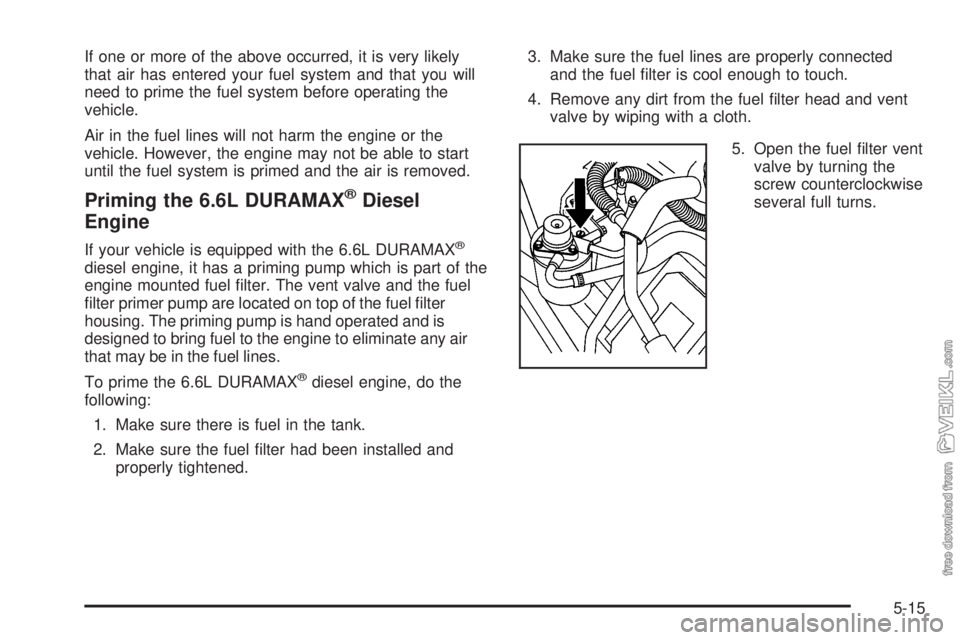
5. Open the fuel filter vent
valve by turning the
screw counterclockwise
several full turns.
5-15
Page 221 of 384
5. Use a clean cloth to remove dirt and oil from the
fuel filter head and breather valve.
6. Use the palm of your hand to repeatedly press and
release the plunger at the top of the fuel filter
priming pump. Continue until the plunger resistance
becomes firm. This may take from 20 to 100 times,
depending upon fuel tank location.
7. Turn the fuel filter breather valve screw
counterclockwise several turns to open the breather
valve.
8. Use the palm of your hand to repeatedly press and
release the plunger at the top of the fuel filter
priming pump until fuel begins to seep from the
breather valve.
9. Tighten the fuel filter breather screw to the specified
torque, 4.9Y(43 lbs in).
10. Use the palm of your hand to press and release the
plunger at the top of the fuel filter priming pump
about 20 more times. This sends fuel to the engine.
11. Use a clean cloth to remove any fuel from the fuel
filter and surrounding area.
12. Start the engine and allow it to idle for a
few minutes.
13. Check the fuel filter for leakage.Running Out of Fuel
If the diesel engine stalls and you think that you have
run out of fuel, do this to restart your engine:
{CAUTION:
Diesel fuel is ammable. It could start a re if
it gets on hot engine parts. You could be
burned. Do not let too much fuel ow from the
air bleed valve, and wipe up any spilled fuel
with a cloth.
1. If you are parked on a level surface, add at least
2 gallons (7.6 liters) of fuel. However, if you are
parked on a slope, you may need to add up to
5 gallons (18.9 liters) of fuel.
2. Follow the fuel priming procedure earlier in this
section to prime the fuel filter.
3. Close the air bleed valve.
5-17
Page 223 of 384
5. Reinstall and tighten the filter container and
reconnect the water sensor wire to the filter.
6. Use the fuel filter priming procedure earlier in this
section to prime the fuel filter.
7. Tighten the air bleed valve by turning it clockwise
until hand-tight.
8. Start your engine and let it idle for five minutes.
Check your fuel filter and air bleed valve for
leaks.
How to Reset Fuel Filter Change
Light - DURAMAX®6.6L (LMM) Engine
The engine controller calculates when to change
the fuel filter based on vehicle and fuel use. Anytime
your fuel filter is changed, reset the fuel filter light so the
engine controller can calculate when the next fuel filter
change is required. If a situation occurs where you
change your fuel filter prior to a change fuel filter light
being turned on, reset the fuel filter change light.To reset the Fuel Filter Change light:
1. Turn the ignition key to RUN with the engine off
2. Fully press the accelerator and brake pedals at the
same time for 10 seconds. If the Fuel Filter Change
light flashes for 5 seconds, the system is resetting.
3. Turn the key to OFF
If the Fuel Filter Change light comes back on when you
start your vehicle, the light has not been reset. Repeat
the procedure. SeeChange Fuel Filter Warning Light on
page 3-44for more information.Fuels in Foreign Countries
If you plan on driving in another country outside the
United States or Canada, the proper fuel might be hard
to find. Never use leaded gasoline or any other fuel
not recommended in the previous text on fuel. Costly
repairs caused by use of improper fuel would not be
covered by your warranty.
To check the fuel availability, ask an auto club, or
contact a major oil company that does business in the
country where you will be driving.
5-19