brake CHEVROLET KODIAK 2009 Owners Manual
[x] Cancel search | Manufacturer: CHEVROLET, Model Year: 2009, Model line: KODIAK, Model: CHEVROLET KODIAK 2009Pages: 376, PDF Size: 5.39 MB
Page 335 of 376
(4)= Applies to vehicles sold in the United States and is
recommended for vehicles sold in Canada.
(5)= Check fluidlevel in brake master cylinder, power
steering pump, front and rear axles, transmission, and
hydraulic spring parking brake pump (if equipped). A low
fluid level in the brake master cylinder can indicate worn
brake linings and should be checked accordingly.
(6)= Inspect brake lines and hoses for proper hook-up,
binding, leaks, cracks, chafing, etc. Inspect disc
brake pads for wear and rotors for surface condition.
Inspect caliper assemblies. Check brake pedal for
excessive free play or travel (or every 6 months,
whichever occurs first) and have serviced if needed.
Check brakes more often if driving habits and conditions
result in frequent braking.
(7)= Check for filter ash, sensor adjustment, and
sensor hose restriction. Clean as needed. This service
can be complex; you should have your dealer/retailer
perform this service.
(8)= This vehicle has the Engine Oil Life System. This
system will show you when to change the engine oil
and filter — usually between 3,000 miles (5 000 km) and
7,500 miles (12 000 km) since your last oil change.
Under severe conditions, the indicator may come
on before 3,000 miles (5 000 km). Never drive your
gasoline engine vehicle more than 7,500 miles
(12 000 km) or 12 months without an oil and filter
change.Remember to reset the Engine Oil Life System
whenever the oil is changed. For more information, see
Engine Oil Life System (Gasoline Engine) on page 5-35
orEngine Oil Life System (DURAMAX/Isuzu Diesel
Engines) on page 5-36orEngine Oil Life System
(Caterpillar Diesel Engine) on page 5-38.
(9)= This vehicle has the Engine Oil Life System. This
system will show you when to change the engine oil
and filter — usually between 3,000 miles (5 000 km) and
15,000 miles (24 000 km) since your last oil change.
Under severe conditions, the indicator may come
on before 3,000 miles (5 000 km). Never drive your
diesel engine vehicle more than 15,000 miles
(24 000 km), or 12 months, or 750 engine hours,
without an oil and filter change.
Remember to reset the Engine Oil Life System
whenever the oil is changed. For more information, see
Engine Oil Life System (Gasoline Engine) on page 5-35
orEngine Oil Life System (DURAMAX/Isuzu Diesel
Engines) on page 5-36orEngine Oil Life System
(Caterpillar Diesel Engine) on page 5-38.
(10)= Inspect rear axle air shift motor for fluid leaks.
Remove plug to check fluid level. Inspect air lines
and hoses for proper hook-up, binding, leaks, etc.
Inspect at 1,000 miles (1 600 km) and 22,500 miles
(36 000 km) and then every 22,500 miles (36 000 km)
thereafter.
6-21
Page 336 of 376
(11)= Chassis Lubrication Service: Lubricate all grease
fittings in front suspension, front axle, and steering
linkage. Do not lubricate kingpin bushings with air
pressure equipment; instead, use a hand grease gun to
ensure complete purge and eliminate sealer cap
distortion. Front axle tie rod ends, both upper and lower
kingpin fittings, and both steering linkage relay rod ends
should be greased with the vehicle loaded on the ground
and wheels turned straight ahead, not with the vehicle on
a hoist. Apply kingpin bushing lubricant to both upper and
lower kingpin grease fittings until new lubricant purges
from between the upper shim pack and thrust bearing.
Lubricate transmission and shift linkage, hood latches
and hood hinges, parking brake lever pivot, clevis pins
and linkage, disc brake caliper rails, clutch linkage and
release bearing (if equipped), bearing pads, propshaft
universal joints, brake camshaft bracket, slack adjusters,
pedal shaft, clutch cross shaft, clutch pedal springs, and
clutch cable bushing at transmission. Lubricate
suspension, axle, and steering linkage more often when
operating under dusty or muddy conditions and in
excessive off-road use. Frequently power-washed
vehicles will require more frequent lubrication.(12)= Check steering system:
•Look for damaged, loose, or missing parts. Inspect
the steering linkage relay rod and tie rod ends for
looseness or lack of lubricant. Also look for
parts showing signs of wear or lack of lubrication.
Replace parts as needed. Also check steering gear
mounting bolts, pitman arm nut, gear housing
upper cover and side cover attaching bolts, steering
column mounting bolts and cardan joint clamp
bolts; tighten if necessary. See the service manual.
•Inspect power steering hoses, tubes, and fittings for
leaks. Hoses and lines must not be twisted, kinked,
or tightly bent. Make sure clips, clamps, supporting
tubes, and hoses are in place and properly secured.
•Check steering gear for leakage around pitman shaft
and housing. If leakage is evident (lubricant oozing
out, not just oily film), leak should be corrected
immediately.
(13)= Check front and rear suspension. Look for
damaged, loose, or missing parts or parts showing signs
of wear or lack of lubrication. Replace parts as
needed.
6-22
Page 337 of 376
(14)= Adjust tire pressures as indicated on the
Certification or Tire Information label for optimum tire
life. SeeTires on page 5-76for further details.
Check tires for excessive or abnormal wear or damage.
Also check for damaged wheels. Replace wheels
and/or tires as needed.
(15)= Check spring-to-axle U-bolts and shackle bolts
for proper torque. See the service manual for torque
sequence and specifications. When parts are replaced,
the torque must be checked and adjusted more often
during the first 6,000 miles (10 000 km). Check torque at
500 miles (800 km) and 2,000 miles (3 000 km) after
first use of parts.
(16)= Check complete exhaust system, including DPF
pressure lines, and cab areas near the exhaust system
for broken, damaged, missing, or out-of-position parts.
Also inspect for open seams, holes, loose connections, or
other conditions which could let exhaust fumes seep into
the driver compartment. Needed repairs should be made
at once. To help maintain system integrity, replace
exhaust pipes whenever a new muffler is put on.
(17)= Check all gasoline engine drive belts for cracks,
fraying, and wear. Replace as needed.
(18)= Adjust valve lash. Incorrect valve clearance will
result in increased engine noise and reduced engine
output.(19)= With the engine off and below normal operating
temperature, check to see that the thermostatically
controlled engine cooling fan can be rotated by hand on
viscous-operated drives. Replace as needed.
(20)= Check shields and underhood insulation for
damage or looseness. Adjust or replace as needed.
(21)= Inspect parking brake drum and linings for wear
or cracks and check linkage and adjustment.
(22)= Wheel bearing service:
•Grease type — Clean, inspect, and lubricate with
the proper wheel bearing grease at designated
intervals or when hubs are removed. SeePart C:
Recommended Fluids and Lubricants on page 6-31.
•Oil-filled type — Some wheel bearings are
lubricated by axle lubricant. When you have oil-filled
hubs, use lubricant identical to that used in the
axle. Lubricant change intervals are the same for
front and rear axles. However, you must maintain
the proper oil level between change intervals.
SeeFront Wheel Bearings with Oil-Filled Hubs on
page 5-75andPart C: Recommended Fluids
and Lubricants on page 6-31.
(23)= Check the air intake system installation to
see that gaskets are seated properly and all hose
connections, fasteners, and other components are tight.
Tighten connections and fasteners or replace parts
as required.
6-23
Page 338 of 376

(24)= Evaporative Control System Service, if equipped:
Check all fuel and vapor lines and hoses for proper
connections and correct routing (or every 24 months,
whichever occurs first). Replace parts as needed.
(25)= Replace spark plugs. Inspect wires for damage.
Check the wire boot and boot heat shield fit at spark
plugs and coil. Replace parts as needed.
(26)= Check the fuel tank, fuel cap and fuel lines for
damage which could cause leakage. Inspect fuel cap for
correct sealing ability and any indications of damage.
Check fuel cap gasket for even filler neck imprint.
Replace parts as needed.
(27)= Check Exhaust Gas Recirculation (EGR) system
as described in the service manual. SeeService
Publications Ordering Information on page 7-10.
(28)= Inspect Electronic Vacuum Regulator Valve
(EVRV) filter for excessive contamination or plugging.
If needed, clean filter with solution of soap and water, let
dry and install.
(29)= Drain, flush, and refill cooling system. This service
can be complex; you should have your dealer/retailer
perform this service. SeePart C: Recommended Fluids
and Lubricants on page 6-31for what to use. Inspect
hoses. Clean radiator, condenser, pressure cap, and
neck. Pressure test cooling system and pressure cap.
For Caterpillar
®diesel engines, always refer to the
Caterpillar®Diesel Engine Operation & Maintenance
Manual for coolant recommendations and change
intervals.(30)= Change the lubricant. SeePart C: Recommended
Fluids and Lubricants on page 6-31.
(31)= Front axle service: Re-pack upper kingpin roller
bearing.
(32)= Air brake service:
•Inspect brake lines and hoses for proper hook-up,
binding, leaks, cracks, chafing, etc. Inspect drum
brake linings for wear or cracks. Inspect other brake
parts at each wheel, including drums and wheel
speed sensor wiring. Check brake pedal for
excessive free play or travel (or every 6 months,
whichever occurs first) and have serviced if needed.
Check brakes more often if driving habits and
conditions result in frequent braking. Replace air
dryer cartridge only if excessive oil or moisture is
present. A small amount of oil in the system is normal
and should not be considered as a reason to replace
the cartridge.
•Test air lines for leaks; tighten as needed. Replace
compressor filter.
•Inspect air parking brake chamber for leaks and
damage. Inspect lines and hoses for leaks, cracks,
chafing, etc. Also check all attachments for tightness,
wear, or damage. Note: The spring brake section of
the rear brake diaphragms are non-serviceable.
6-24
Page 339 of 376
•Replace the air compressor filter element, mounted
on the air compressor. For remote air compressor
intake service, refer to engine air cleaner filter
replacement.
•Remove, disassemble, clean, and inspect the safety
valve, service brake chambers, quick release valves,
quick release/double check valve combinations,
parking brake control valve, double check valves,
pressure protection valves, and ether injector
(if equipped).
•Remove, disassemble, and clean the application
valve; replace parts showing wear.
•Remove, disassemble, clean, and inspect the spring
brake control valve; replace rubber parts.
(33)= Clean and lubricate air brake automatic slack
adjuster. Check pushrod travel and auto adjustment
operation. Have serviced if needed.
(34)= Air brake chamber service: Check operation,
mounting clamps, and air lines and check for leaks.
(35)= Trailer brake hand control valve service: Check
operation; lubricate cam and follower.(36)= Tighten the wheel stud nuts to the specified torque
values at 100 miles (160 km). Thereafter, tighten them
1,000 miles (1 600 km) after each time the wheel is
removed. SeeTightening the Wheel Nuts on page 5-80.
(37)= Inspect and clean any accumulated dirt, gravel,
or other foreign objects from the valves and valve boots
as needed. Using light oil, lubricate brake pedal to
brake application valve linkage components. Check any
rubber boots for cracks, holes, or deterioration and
replace if necessary.
(38)= Estimated minimum. Actual mileage depends on
fuel and oil consumed.
(39)= If the vehicle has the Isuzu diesel engine and is
used primarily for long trip, highway service, change
the engine oil and filter every 18,000 miles (28 800 km),
or every 12 months, or every 750 hours of engine
operation, whichever occurs first.
(40)= Make sure any safety belt reminder light and
safety belt assemblies are working properly. Look
for any other loose or damaged safety belt system parts.
If you see anything that might keep a safety belt
system from doing its job, have it repaired. Have any
torn or frayed safety belts replaced.
6-25
Page 341 of 376
At Least Twice a Year
Wiper Blade Check
Inspect wiper blades for wear, cracking, or
contamination. Clean the windshield and wiper blades, if
contaminated. Replace wiper blades that are worn or
damaged. SeeWindshield Wiper Blade Replacement on
page 5-71andWindshield and Wiper Blades on
page 5-91for more information.
Weatherstrip Lubrication
Silicone grease on weatherstrips will make them last
longer, seal better, and not stick or squeak. Apply
silicone grease with a clean cloth. During very cold,
damp weather more frequent application may be
required. Part C tells you what to use.
Body Lubrication Service
Lubricate all exposed surfaces such as door checks,
door lock bolts, lock strike plates, door hinge bushings,
latches, and dovetail bumper wedges. Where oil
holes are provided, a dripless oil can be used. The seat
adjusters, seat track, door weatherstrips, and rubber
cap bumpers should also be lubricated. Part C tells you
what to use. More frequent lubrication may be required
when exposed to a corrosive environment.
Parking Brake Check
Park on a fairly steep hill and hold the vehicle with the
parking brake only. This checks holding ability. See
Parking Brake (With Hydraulic Brakes) on page 2-38or
Parking Brake (With Air Brakes) on page 2-41.
Starter Switch Check
{CAUTION:
When you are doing this inspection, the vehicle
could move suddenly. If the vehicle moves, you or
others could be injured.
1. Before you start, be sure you have enough room
around the vehicle.
2. Firmly apply both the parking brake and the regular
brakes.
Do not use the accelerator pedal, and be ready to
turn off the engine immediately if it starts.
3. On automatic transmission vehicles, try to start the
engine in each gear. The starter should work only in
P (Park) or N (Neutral). If the starter works in any
other position, your vehicle needs service. On
manual transmission vehicles, the starter should
work only when the clutch pedal is all the way down.
6-27
Page 342 of 376
Automatic Transmission Shift Indicator
Check
Check that the indicator points to the gear chosen.
Steering Check
Be alert for any changes in steering action, abnormal
front tire wear or steering wheel position. An inspection
or service is needed when the steering wheel is
harder to turn or has too much free play, or if there are
strange sounds when turning or parking.
Brake System Check
Be alert to the low air warning light or tone alarm, or
changes in braking action, such as repeated pulling to
one side, unusual sounds when braking or increased
brake pedal travel. Make sure air brake system reservoirs
are drained daily with full system air pressure, and check
system for leaks. Any of these conditions could indicate
the need for brake system inspection and/or service.
Engine Cooling System Service
Inspect the hoses and have them replaced if they are
cracked, swollen, or deteriorated. Inspect all pipes,
fittings, and clamps; replace as needed. Clean the
outside of the radiator and air conditioning condenser. To
help ensure proper operation, a pressure test of the
cooling system and pressure cap is recommended at
least once a year.
Exhaust System Inspection
Be alert for any changes in the sound of the exhaust
system or any smell of fumes. These are signs the
system may be leaking. Have it checked and/or repaired
at once. SeeEngine Exhaust on page 2-45and
Running the Vehicle While Parked on page 2-50.
Check to be sure that mud or dirt is not caked on the
exhaust system, especially in the area of the diesel
particulate filter and tailpipe. Clean the area as needed.
SeeDiesel Particulate Filter on page 2-46.
At high mileages, the DPF becomes loaded with ash.
This is normal. When the amount of ash loading is high,
see your dealer/retailer for DPF cleaning or replacement.
Windshield Wipers and Washers
Check
Check operation and condition of the wiper blades.
Check the flow of the washer spray.
Defroster Check
Move the control to the defrost symbol and the fan to HI
or the high symbol. Then check the airflow from the
ducts at the inside base of the windshield.
6-28
Page 343 of 376
Mirrors and Sun Visors Check
Check that friction joints hold mirrors and sun visors in
place.
Seat Adjuster Check
When adjusting a manual seat, be sure seat adjusters
latch by attempting to move the seat after latching.
Lamps Check
Check panel lighting, warning lights, indicator lights, and
interior lamps. On the outside, check: license plate lamps,
sidemarker lamps, reflectors or lights on outside mirrors,
headlamps, parking lamps, identification and clearance
lamps, taillamps, brake lamps, turn signals, backup
lamps, and hazard warning flashers. Have headlamp aim
checked at once if beams seem improperly aimed.
Glass, Mirrors, Lamps, and/or
Reflectors Condition Check
Look for broken, scratched, dirty, or damaged glass,
mirrors, lamps, or reflectors that could reduce the view
or visibility or cause injury. Replace, clean, or repair
promptly.
Door Latches Check
Check that doors close, latch, and lock tightly. Check for
broken, damaged, or missing parts that might prevent
tight latching.
Hood Latches Check
Check that the hood closes firmly. Check for broken,
damaged, loose, or missing parts that might prevent tight
latching. Make sure the secondary latch, if the vehicle
has one, keeps the hood from opening all the way when
the primary latch is released.
6-29
Page 344 of 376
Fluid Leaks Check
Check for fuel, coolant, oil, or other fluid leaks by
looking at the surface beneath the vehicle after it has
been parked for awhile.
Underbody Inspection
Corrosive materials used for ice, snow removal, and dust
control can collect on the underbody. If these materials
are not removed, accelerated corrosion (rust) can occur
on underbody parts such as fuel lines, frame, floor pan,
and exhaust system. At least every spring, flush these
materials from the underbody with plain water. Take care
to clean well any areas where mud and other debris can
collect. Sediment packed in closed areas of the frame
should be loosened before being flushed.
Engine Cover Check
Check that the cab’s engine cover and seal, if the
vehicle has one, are not torn or damaged. Be sure that
the cover is clamped down firmly to the floor.
At Least Once a Year
Key Lock Cylinders Service
Lubricate the key lock cylinders with the lubricant
specified in Part C.
Underbody Flushing Service
At least every spring, use plain water to flush any
corrosive materials from the underbody. Take care to
clean thoroughly any areas where mud and other debris
can collect.
Tractor Protection (Breakaway) Valve
Check
On air brake models, remove, disassemble, clean, and
inspect the tractor protection (breakaway) valve.
6-30
Page 345 of 376
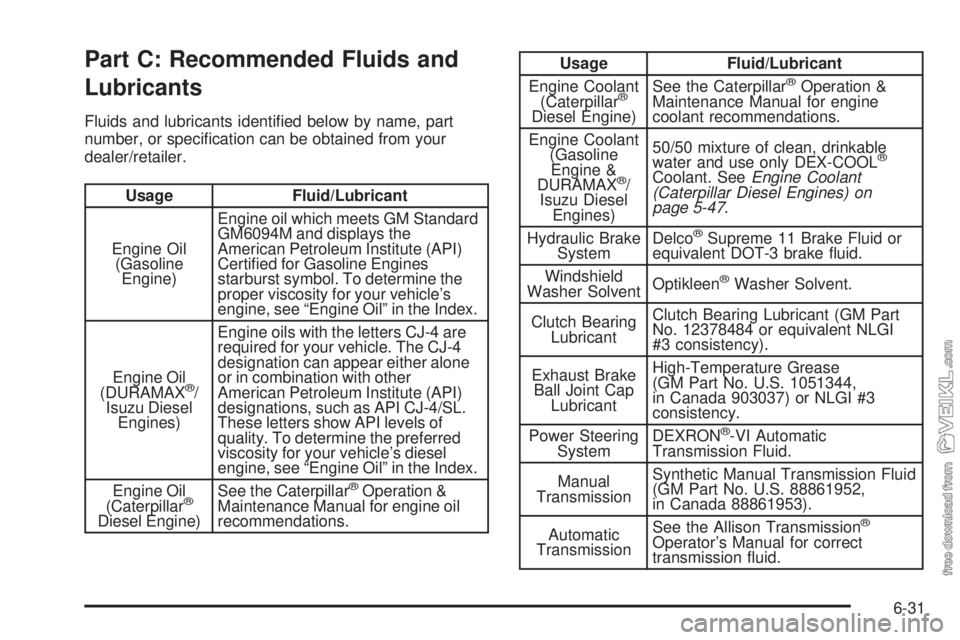
Part C: Recommended Fluids and
Lubricants
Fluids and lubricants identified below by name, part
number, or specification can be obtained from your
dealer/retailer.
Usage Fluid/Lubricant
Engine Oil
(Gasoline
Engine)Engine oil which meets GM Standard
GM6094M and displays the
American Petroleum Institute (API)
Certified for Gasoline Engines
starburst symbol. To determine the
proper viscosity for your vehicle’s
engine, see “Engine Oil” in the Index.
Engine Oil
(DURAMAX
®/
Isuzu Diesel
Engines)Engine oils with the letters CJ-4 are
required for your vehicle. The CJ-4
designation can appear either alone
or in combination with other
American Petroleum Institute (API)
designations, such as API CJ-4/SL.
These letters show API levels of
quality. To determine the preferred
viscosity for your vehicle’s diesel
engine, see “Engine Oil” in the Index.
Engine Oil
(Caterpillar
®
Diesel Engine)See the Caterpillar
®Operation &
Maintenance Manual for engine oil
recommendations.
Usage Fluid/Lubricant
Engine Coolant
(Caterpillar
®
Diesel Engine)See the Caterpillar
®Operation &
Maintenance Manual for engine
coolant recommendations.
Engine Coolant
(Gasoline
Engine &
DURAMAX
®/
Isuzu Diesel
Engines)50/50 mixture of clean, drinkable
water and use only DEX-COOL
®
Coolant. SeeEngine Coolant
(Caterpillar Diesel Engines) on
page 5-47.
Hydraulic Brake
SystemDelco
®Supreme 11 Brake Fluid or
equivalent DOT-3 brake fluid.
Windshield
Washer SolventOptikleen
®Washer Solvent.
Clutch Bearing
LubricantClutch Bearing Lubricant (GM Part
No. 12378484 or equivalent NLGI
#3 consistency).
Exhaust Brake
Ball Joint Cap
LubricantHigh-Temperature Grease
(GM Part No. U.S. 1051344,
in Canada 903037) or NLGI #3
consistency.
Power Steering
SystemDEXRON
®-VI Automatic
Transmission Fluid.
Manual
TransmissionSynthetic Manual Transmission Fluid
(GM Part No. U.S. 88861952,
in Canada 88861953).
Automatic
TransmissionSee the Allison Transmission
®
Operator’s Manual for correct
transmission fluid.
6-31