brake CHEVROLET KODIAK 2009 Manual PDF
[x] Cancel search | Manufacturer: CHEVROLET, Model Year: 2009, Model line: KODIAK, Model: CHEVROLET KODIAK 2009Pages: 376, PDF Size: 5.39 MB
Page 257 of 376
Replacing Brake System Parts
The braking system on a vehicle is complex. Its many
parts have to be of top quality and work well together if
the vehicle is to have really good braking. The vehicle
was designed and tested with top-quality brake parts.
When parts of the braking system are replaced — for
example, when the brake linings wear down and new
ones are installed — be sure to get new approved
replacement parts. If this is not done, the brakes might
not work properly. For example, if someone puts in brake
linings that are wrong for the vehicle, the balance
between the front and rear brakes can change — for the
worse. The braking performance expected can change in
many other ways if the wrong replacement brake parts
are installed.
Hydraulic Brake Pads
Brake pad lining life will vary depending on
vehicle application, working environment, equipment
maintenance, and style of driving. The brake pad lining
wear rate has to be monitored for individual driving
habits — original equipment linings have mechanical
wear indicators to help with this. When down to the last
10% of the brake lining, the brake lining wear indicator
rubs on the rotor, causing a scratching or chirping
sound. When this sound is heard, service to the brake
pads is needed. SeeScheduled Maintenance on
page 6-5.
Aftermarket brake linings might not meet the same
stringent requirements as the original equipment linings.
Using aftermarket brake linings can affect braking
performance, pedal feel, noise, and lining wear.
5-55
Page 258 of 376
Air Brake Systems
If the vehicle has air brakes, it is important to get rid of
moisture in the system. Moisture will damage the system
if it is not removed daily.
There are two ways to do this. One is automatic through
the air brake vehicle’s air dryer with integral automatic
moisture ejector that purges air from the system through
a self-contained reservoir. The other way to drain
moisture from the air brake system is to manually activate
drain valves at each reservoir. Drain the air reservoirs
occasionally to be sure the air dryer is working properly.
Drain the air brakes at full system pressure. To be sure of
full pressure, check the air pressure gage. It should read
at least 100 psi (692 kPa).
Air Dryer
If the vehicle has air brakes, it has an air dryer mounted
on the passenger side frame rail. This collects and
removes dirt, moisture, or other foreign matter from the
air prior to entering the brake system. The dryer also
acts as a moisture ejector. It automatically ejects
the moisture when the compressor cycles. The purge
tank has a manual drain valve that must be drained
every day. See “Air Brake Systems” for the manual drain
procedure.
The dryer has a filter that needs changing at intervals.
SeeScheduled Maintenance on page 6-5for more about
servicing this filter.
5-56
Page 259 of 376
Electric Air Compressor
The vehicle might have an electric air compressor.
This compressor is used to run options that require
pressurized air, such as an air horn or air seat.
The air compressor is used when vehicles do not have
an air brake system.
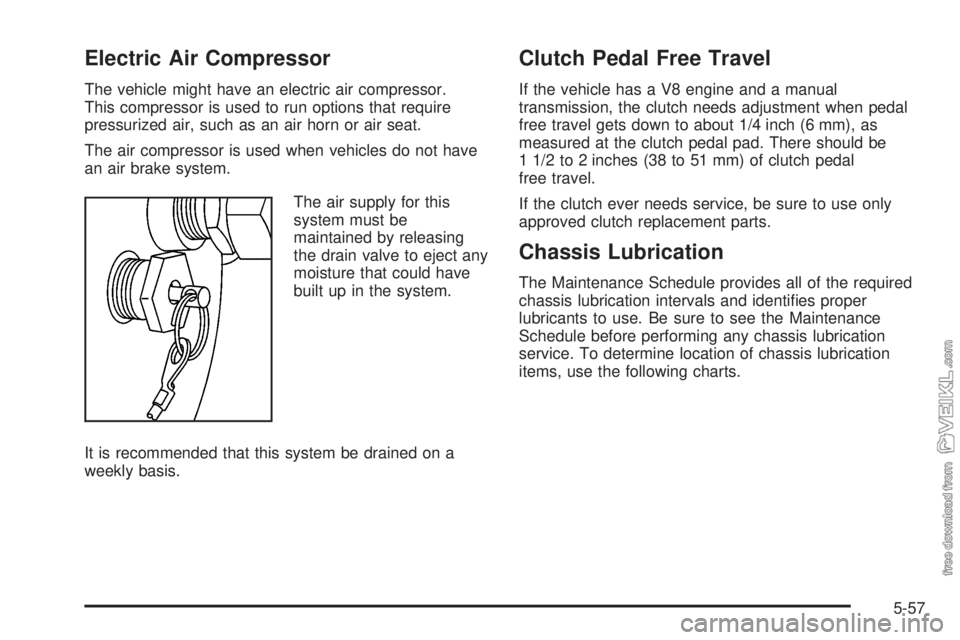
The air supply for this
system must be
maintained by releasing
the drain valve to eject any
moisture that could have
built up in the system.
It is recommended that this system be drained on a
weekly basis.
Clutch Pedal Free Travel
If the vehicle has a V8 engine and a manual
transmission, the clutch needs adjustment when pedal
free travel gets down to about 1/4 inch (6 mm), as
measured at the clutch pedal pad. There should be
1 1/2 to 2 inches (38 to 51 mm) of clutch pedal
free travel.
If the clutch ever needs service, be sure to use only
approved clutch replacement parts.
Chassis Lubrication
The Maintenance Schedule provides all of the required
chassis lubrication intervals and identifies proper
lubricants to use. Be sure to see the Maintenance
Schedule before performing any chassis lubrication
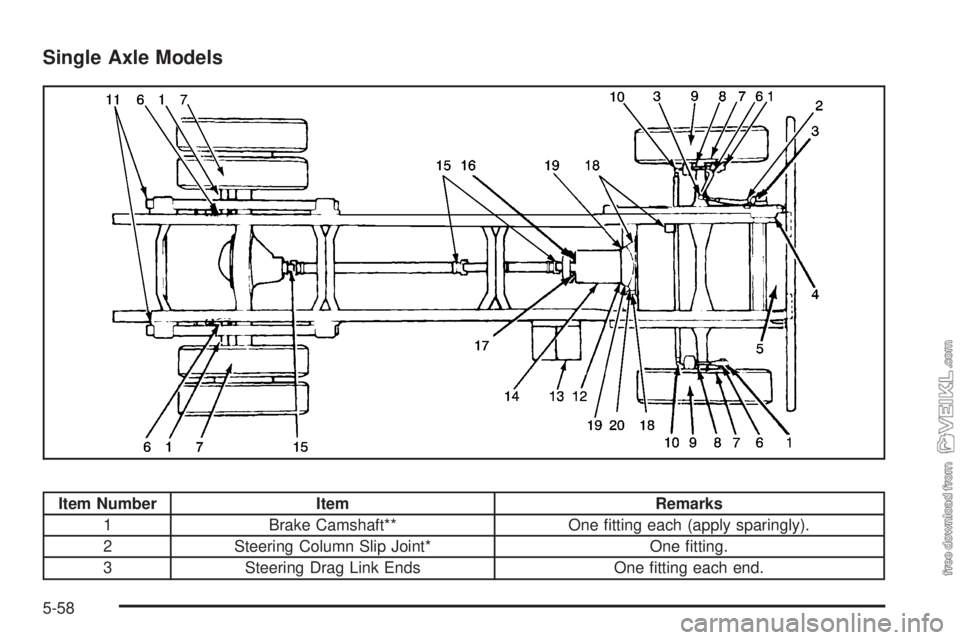
service. To determine location of chassis lubrication
items, use the following charts.
5-57
Page 260 of 376
Single Axle Models
Item Number Item Remarks
1 Brake Camshaft** One fitting each (apply sparingly).
2 Steering Column Slip Joint* One fitting.
3 Steering Drag Link Ends One fitting each end.
5-58
Page 261 of 376
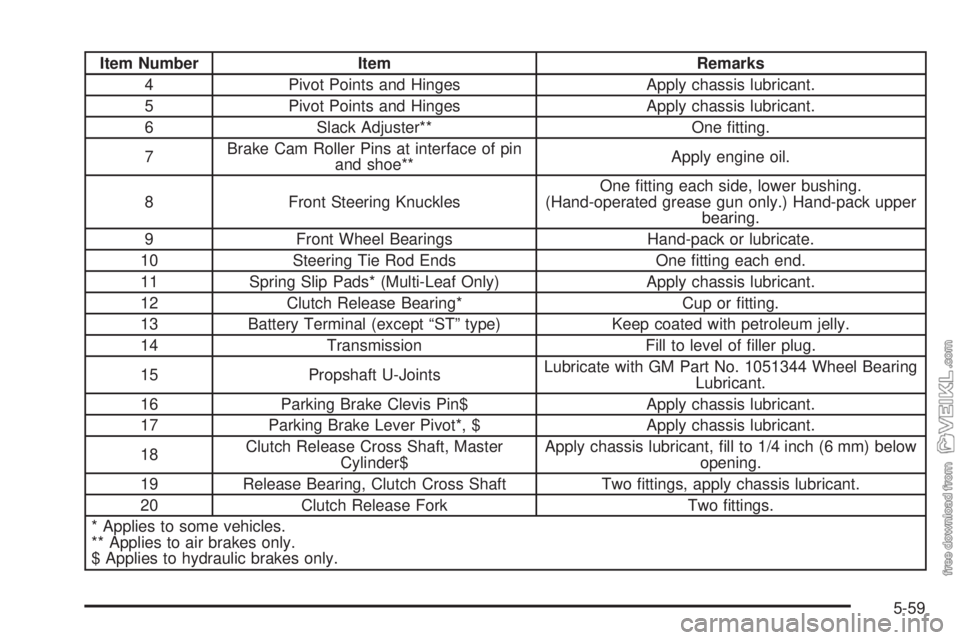
Item Number Item Remarks
4 Pivot Points and Hinges Apply chassis lubricant.
5 Pivot Points and Hinges Apply chassis lubricant.
6 Slack Adjuster** One fitting.
7Brake Cam Roller Pins at interface of pin
and shoe**Apply engine oil.
8 Front Steering KnucklesOne fitting each side, lower bushing.
(Hand-operated grease gun only.) Hand-pack upper
bearing.
9 Front Wheel Bearings Hand-pack or lubricate.
10 Steering Tie Rod Ends One fitting each end.
11 Spring Slip Pads* (Multi-Leaf Only) Apply chassis lubricant.
12 Clutch Release Bearing* Cup or fitting.
13 Battery Terminal (except “ST” type) Keep coated with petroleum jelly.
14 Transmission Fill to level of filler plug.
15 Propshaft U-JointsLubricate with GM Part No. 1051344 Wheel Bearing
Lubricant.
16 Parking Brake Clevis Pin$ Apply chassis lubricant.
17 Parking Brake Lever Pivot*, $ Apply chassis lubricant.
18Clutch Release Cross Shaft, Master
Cylinder$Apply chassis lubricant, fill to 1/4 inch (6 mm) below
opening.
19 Release Bearing, Clutch Cross Shaft Two fittings, apply chassis lubricant.
20 Clutch Release Fork Two fittings.
* Applies to some vehicles.
** Applies to air brakes only.
$ Applies to hydraulic brakes only.
5-59
Page 262 of 376
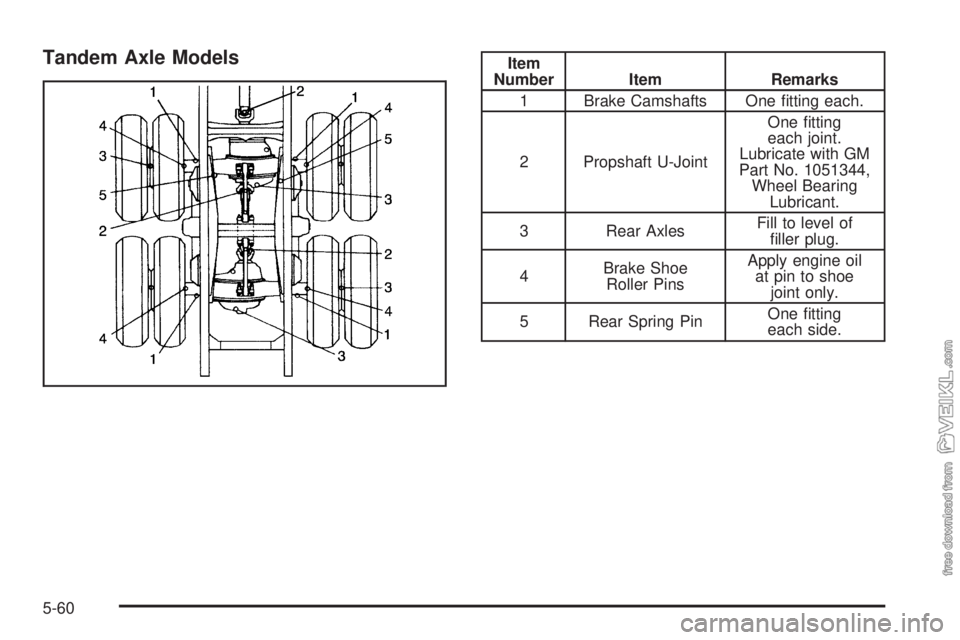
Tandem Axle ModelsItem
Number Item Remarks
1 Brake Camshafts One fitting each.
2 Propshaft U-JointOne fitting
each joint.
Lubricate with GM
Part No. 1051344,
Wheel Bearing
Lubricant.
3 Rear AxlesFill to level of
filler plug.
4Brake Shoe
Roller PinsApply engine oil
at pin to shoe
joint only.
5 Rear Spring PinOne fitting
each side.
5-60
Page 265 of 376
2. Get the vehicles close enough so the jumper cables
can reach, but be sure the vehicles are not touching
each other. If they are, it could cause a ground
connection you do not want. You would not be able
to start your vehicle, and the bad grounding could
damage the electrical systems.
To avoid the possibility of the vehicles rolling, set the
parking brake firmly on both vehicles involved in the
jump start procedure. Put an automatic transmission
in P (PARK) or a manual transmission in N (Neutral)
before setting the parking brake. If you have a
four-wheel-drive vehicle, be sure the transfer case
is in a drive gear, not in N (Neutral).
Notice:If you leave the radio or other accessories
on during the jump starting procedure, they could be
damaged. The repairs would not be covered by the
warranty. Always turn off the radio and other
accessories when jump starting the vehicle.
3. Turn off the ignition on both vehicles. Unplug
unnecessary accessories plugged into the cigarette
lighter or accessory power outlets. Turn off the
radio and all lamps that are not needed. This will
avoid sparks and help save both batteries, and
it could save the radio!4. Open the hood on the other vehicle and locate the
positive (+) and the negative (−) terminal locations
on that vehicle.
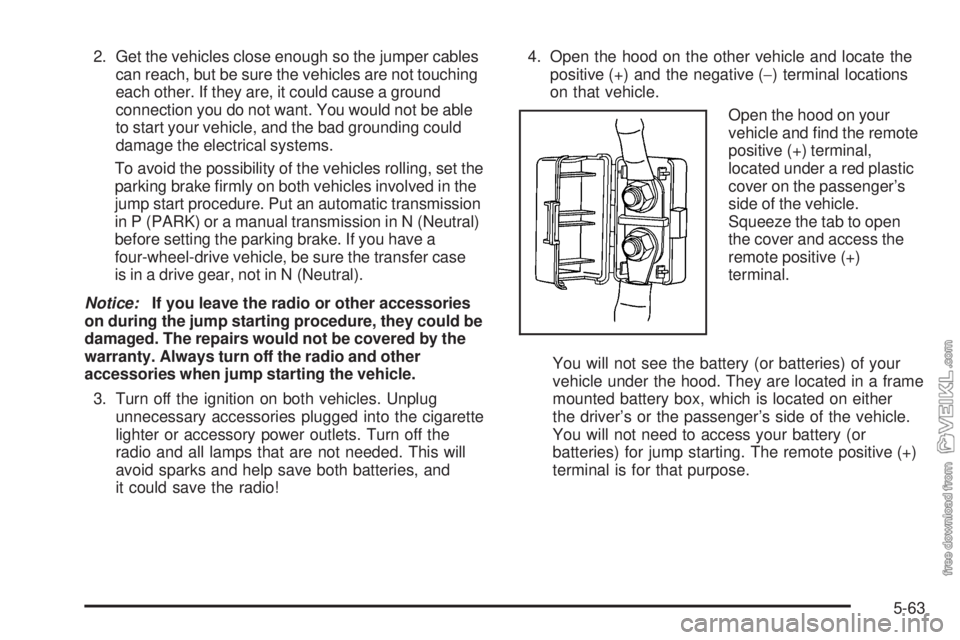
Open the hood on your
vehicle and find the remote
positive (+) terminal,
located under a red plastic
cover on the passenger’s
side of the vehicle.
Squeeze the tab to open
the cover and access the
remote positive (+)
terminal.
You will not see the battery (or batteries) of your
vehicle under the hood. They are located in a frame
mounted battery box, which is located on either
the driver’s or the passenger’s side of the vehicle.
You will not need to access your battery (or
batteries) for jump starting. The remote positive (+)
terminal is for that purpose.
5-63
Page 287 of 376
Using wheels and tires with higher load-carrying limits
than the original wheels and tires does not change
the Gross Axle Weight Rating (GAWR) or the Gross
Vehicle Weight Rating (GVWR) of your vehicle.
SeeLoading the Vehicle on page 4-20for more
information.
Notice:The wrong wheel can cause trouble in
bearing life, brake cooling, speedometer/odometer
calibration, headlamp aim, bumper height, vehicle
ground clearance, stopping distance and tire
clearance to the body and chassis. You could also
have other problems like a tire air-out.
Used Replacement Wheels
{CAUTION:
Putting a used wheel on the vehicle is dangerous.
You cannot know how it has been used or how far
it has been driven. It could fail suddenly and
cause a crash. If you have to replace a wheel, use
a new GM original equipment wheel.
If a Tire Goes Flat
It is unusual for a tire to blowout while you are driving,
especially if you maintain your tires properly. If air
goes out of a tire, it is much more likely to leak out
slowly. But if you should ever have a blowout, here are
a few tips about what to expect and what to do:
If a front tire fails, the flat tire will create a drag that
pulls the vehicle toward that side. Take your foot off the
accelerator pedal and grip the steering wheel firmly.
Steer to maintain lane position, and then gently brake to
a stop well out of the traffic lane.
A rear blowout, particularly on a curve, acts much like a
skid and may require the same correction you would
use in a skid. In any rear blowout, remove your foot from
the accelerator pedal. Get the vehicle under control
by steering the way you want the vehicle to go. It may
be very bumpy and noisy, but you can still steer. Gently
brake to a stop –– well off the road if possible.
5-85
Page 297 of 376
Electrical System
Add-On Electrical Equipment
Notice:Do not add anything electrical to the
vehicle unless you check with your dealer/retailer
first. Some electrical equipment can damage
the vehicle and the damage would not be covered
by the vehicle’s warranty. Some add-on electrical
equipment can keep other components from
working as they should.
Add-on equipment can drain the vehicle battery, even if
the vehicle is not operating.
The vehicle has an airbag system. Before attempting to
add anything electrical to the vehicle, seeServicing
Your Airbag-Equipped Vehicle on page 1-58.
Headlamp Wiring
The headlamp wiring is protected by a circuit breaker in
the light switch. An electrical overload will cause the lights
to go on and off, or in some cases to remain off. If this
happens, have your headlamp wiring checked right away.
Windshield Wiper Fuses
The windshield wiper motor is protected by a circuit
breaker inside the motor and a circuit breaker or fuse in
the fuse block. If the motor overheats, the wipers will
stop until the motor cools. If the overload is caused by
an electrical problem, be sure to get it fixed.
Fusible Links
A fusible link is a short piece of wire several gauge
sizes smaller than the circuit it protects. It will melt in an
overload situation, opening the circuit.
The starter and other circuits have fusible links. The size
is printed on the insulation. If the insulation is burned
beyond recognition, consult your dealer/retailer for the
proper size. Replace a fusible link with one of the same
size and insulation type. Fusible link insulation is a
special purpose high-temperature material.
Some examples of circuits with fusible links are the
hydraulic brake booster motor feed circuit, the generator
output circuit, and the intake heater feed circuit in
vehicles with a diesel engine.
5-95
Page 298 of 376
Power Windows and Other Power
Options
Circuit breakers in the fuse panel protect the power
windows and other power accessories. When the current
load is too heavy, the circuit breaker opens. This
protects the circuit until the current load returns to
normal or the problem is fixed.
Fuses and Circuit Breakers
The wiring circuits in the vehicle are protected from
short circuits by a combination of fuses, circuit breakers,
maxi-fuses and fusible links. This greatly reduces the
chance of a fire caused by an electrical problem. There
may be a fuse taped to the wiring harness near the
hydraulic brake booster.
Instrument Panel Fuse Block
There are two instrument panel fuse blocks located
behind the instrument panel on the passenger side of
the vehicle.
Be sure to replace fuses with fuses of the same rating.
Do not use fuses of higher amperage than those
indicated on the fuse block.
5-96