traction control CHEVROLET KODIAK 2009 User Guide
[x] Cancel search | Manufacturer: CHEVROLET, Model Year: 2009, Model line: KODIAK, Model: CHEVROLET KODIAK 2009Pages: 376, PDF Size: 5.39 MB
Page 193 of 376
Winter Driving
Driving on Snow or Ice
Drive carefully when there is snow or ice between the
tires and the road, creating less traction or grip. Wet ice
can occur at about 32°F (0°C) when freezing rain
begins to fall, resulting in even less traction. Avoid
driving on wet ice or in freezing rain until roads can be
treated with salt or sand.
Drive with caution, whatever the condition. Accelerate
gently so traction is not lost. Accelerating too quickly
causes the wheels to spin and makes the surface under
the tires slick, so there is even less traction.
Try not to break the fragile traction. If you accelerate too
fast, the drive wheels will spin and polish the surface
under the tires even more.
For four-wheel-drive vehicles, shift into 4HI. See
Four-Wheel Drive on page 2-30.If the vehicle has theTraction Control System (TCS) on
page 4-8, it improves the ability to accelerate on
slippery roads, but slow down and adjust your driving to
the road conditions. When driving through deep snow,
turn off the traction control system to help maintain
vehicle motion at lower speeds.
TheAntilock Brake System (ABS) on page 4-5improves
vehicle stability during hard stops on a slippery roads,
but apply the brakes sooner than when on dry
pavement.
Allow greater following distance on any slippery road
and watch for slippery spots. Icy patches can occur on
otherwise clear roads in shaded areas. The surface
of a curve or an overpass can remain icy when
the surrounding roads are clear. Avoid sudden steering
maneuvers and braking while on ice.
Turn off cruise control, if equipped, on slippery surfaces.
4-17
Page 205 of 376
Service
For service and parts needs, visit your dealer/retailer.
You will receive genuine GM parts and GM-trained and
supported service people.
Genuine GM parts have one of these marks:
Accessories and Modifications
Adding non-dealer accessories to the vehicle can affect
its performance and safety. Such things as airbags,
braking, stability, ride and handling, emissions systems,
aerodynamics, durability, and electronic systems like
anti-lock brakes, traction control, and stability control
could be affected. Some non-dealer accessories could
even cause malfunction or damage to parts and systems
and would not be covered by the vehicle warranty.
Damage to vehicle components resulting from the
installation or use of non-GM certified parts, including
control module modifications, are not covered under the
terms of the vehicle warranty and may affect remaining
warranty coverage for affected parts.
GM Accessories are designed to complement and
function with other systems on the vehicle. Your GM
dealer can accessorize the vehicle using genuine
GM Accessories. When you go to your GM dealer and
ask for GM Accessories, you will know that GM-trained
and supported service technicians will perform the
work using genuine GM Accessories.
Also, seeAdding Equipment to Your Airbag-Equipped
Vehicle on page 1-58.
5-3
Page 270 of 376
Rear Axle Shift Motor
When to Check and Change Fluid
If you have an optional air-shift two-speed, controlled
traction, or locking differential type rear axle, a good time
to check the fluid level in the axle shift motor is when
the rear axle lubricant is checked.
How to Check Fluid
Remove the plug on the front plate of the axle shift
motor, add enough fluid to raise the level to the bottom
of the filler plug hole, then replace the plug.
What to Use
Refer to your Maintenance Schedule to determine what
kind of lubricant to use. SeePart C: Recommended
Fluids and Lubricants on page 6-31.
Four-Wheel Drive
Transfer Case
When to Check Lubricant
It is not necessary to regularly check transfer case fluid
unless you suspect there is a leak or you hear an
unusual noise. A fluid loss could indicate a problem.
Have it inspected and repaired.
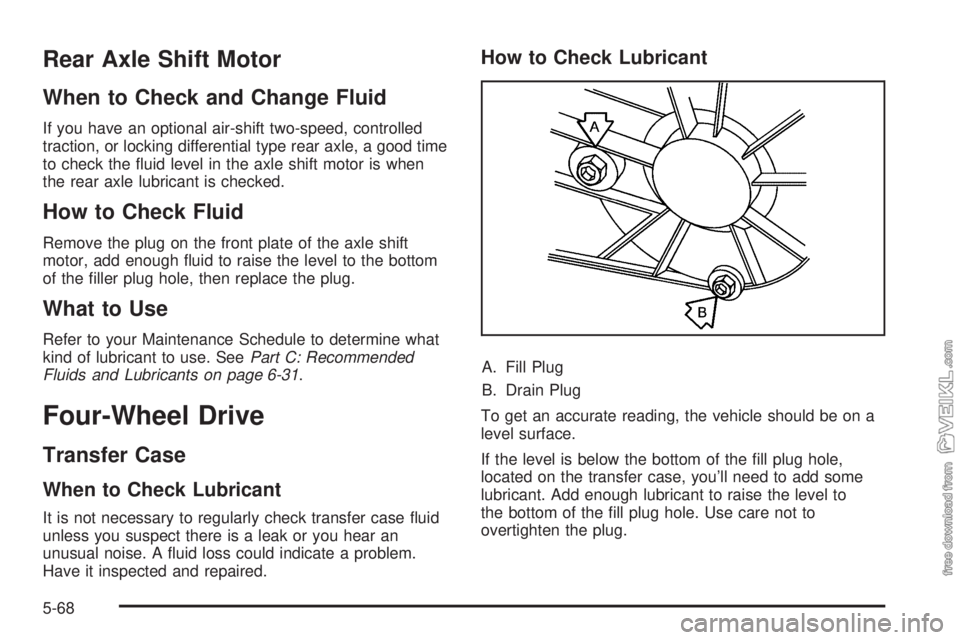
How to Check Lubricant
A. Fill Plug
B. Drain Plug
To get an accurate reading, the vehicle should be on a
level surface.
If the level is below the bottom of the fill plug hole,
located on the transfer case, you’ll need to add some
lubricant. Add enough lubricant to raise the level to
the bottom of the fill plug hole. Use care not to
overtighten the plug.
5-68
Page 375 of 376
Starting the Gasoline Engine............................2-12
Steering.......................................................... 4-9
Steering Wheel, Tilt Wheel................................. 3-6
Storage Areas................................................2-53
Center Console Storage Area........................2-53
Stuck in Sand, Mud, Ice, or Snow.....................4-19
Sun Visors...................................................... 2-9
Suspension, Air..............................................2-44
Switchbanks, Instrument Panel..........................3-18
T
Tachometer....................................................3-25
Theft-Deterrent, Radio.....................................3-57
Tilt Wheel........................................................ 3-6
Time, Setting..................................................3-48
Tires.............................................................5-76
Aluminum or Chrome-Plated Wheels,
Cleaning.................................................5-92
Buying New Tires........................................5-79
Cleaning....................................................5-92
Dual Tire Operation.....................................5-78
If a Tire Goes Flat.......................................5-85
Inflation - Tire Pressure................................5-77
Tightening the Wheel Nuts............................5-80Tires (cont.)
Wheel Alignment and Tire Balance.................5-80
Wheel Loading............................................5-78
Wheel Replacement.....................................5-84
When It Is Time for New Tires......................5-78
Tow Hooks.....................................................4-20
Towing
Your Vehicle...............................................4-23
Traction
Control System (TCS).................................... 4-8
Trailer
Connections................................................4-25
Trailer Brake Hand Control Valve........................ 4-6
Transmission
Fluid, Automatic...........................................5-42
Fluid, Manual..............................................5-42
Service Warning Light..................................3-30
Temperature Gage.......................................3-40
Transmission Operation, Automatic....................2-27
Transmission Operation, Manual........................2-28
Trip Odometer................................................3-25
Turn and Lane-Change Signals.......................... 3-7
Turn Signal/Multifunction Lever........................... 3-7
Two-Speed Rear Axle......................................2-36
11