ECU CHEVROLET KODIAK 2009 Owner's Manual
[x] Cancel search | Manufacturer: CHEVROLET, Model Year: 2009, Model line: KODIAK, Model: CHEVROLET KODIAK 2009Pages: 376, PDF Size: 5.39 MB
Page 197 of 376
The Certification label also tells you the maximum
weight for the front and rear axles, called the Gross Axle
Weight Rating (GAWR). To find out the actual loads
on your front and rear axles, go to a weigh station and
weigh your vehicle. Your dealer can help you with
this. Be sure to spread out your load equally on both
sides of the center line.
Never exceed the GVWR for your vehicle, or the GAWR
for either the front or rear axle.
And, if you do have a heavy load, spread it out.
{CAUTION:
Do not load the vehicle any heavier than the
Gross Vehicle Weight Rating (GVWR), or
either the maximum front or rear Gross Axle
Weight Rating (GAWR). If you do, parts on the
vehicle can break, and it can change the way
your vehicle handles. These could cause you
to lose control and crash. Also, overloading
can shorten the life of the vehicle.
Using heavier suspension components to get added
durability might not change the weight ratings. Ask your
dealer to help you load your vehicle the right way.
Notice:Overloading your vehicle may cause
damage. Repairs would not be covered by your
warranty. Do not overload your vehicle.
If you put things inside your vehicle — like suitcases,
tools, packages, or anything else — they go as fast
as the vehicle goes. If you have to stop or turn quickly,
or if there is a crash, they keep going.
{CAUTION:
Things you put inside your vehicle can strike
and injure people in a sudden stop or turn, or
in a crash.
•Put things in the cargo area of your
vehicle. Try to spread the weight evenly.
•Never stack heavier things, like
suitcases, inside the vehicle so that some
of them are above the tops of the seats.
•Do not leave an unsecured child restraint
in your vehicle.
•When you carry something inside the
vehicle, secure it whenever you can.
•Do not leave a seat folded down unless
you need to.
4-21
Page 218 of 376
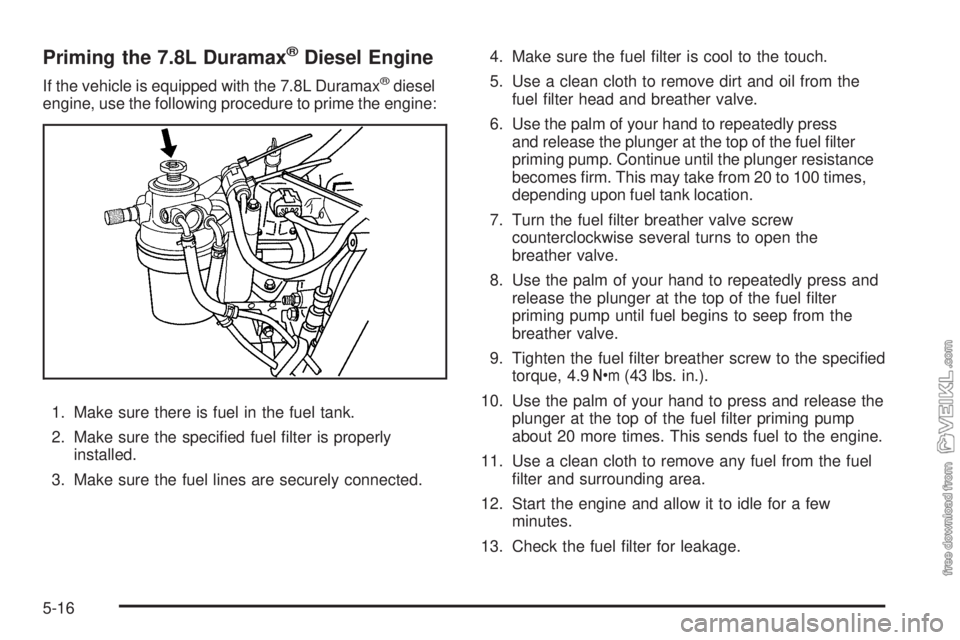
Priming the 7.8L Duramax®Diesel Engine
If the vehicle is equipped with the 7.8L Duramax®diesel
engine, use the following procedure to prime the engine:
1. Make sure there is fuel in the fuel tank.
2. Make sure the specified fuel filter is properly
installed.
3. Make sure the fuel lines are securely connected.4. Make sure the fuel filter is cool to the touch.
5. Use a clean cloth to remove dirt and oil from the
fuel filter head and breather valve.
6. Use the palm of your hand to repeatedly press
and release the plunger at the top of the fuel filter
priming pump. Continue until the plunger resistance
becomes firm. This may take from 20 to 100 times,
depending upon fuel tank location.
7. Turn the fuel filter breather valve screw
counterclockwise several turns to open the
breather valve.
8. Use the palm of your hand to repeatedly press and
release the plunger at the top of the fuel filter
priming pump until fuel begins to seep from the
breather valve.
9. Tighten the fuel filter breather screw to the specified
torque, 4.9Y(43 lbs. in.).
10. Use the palm of your hand to press and release the
plunger at the top of the fuel filter priming pump
about 20 more times. This sends fuel to the engine.
11. Use a clean cloth to remove any fuel from the fuel
filter and surrounding area.
12. Start the engine and allow it to idle for a few
minutes.
13. Check the fuel filter for leakage.
5-16
Page 225 of 376
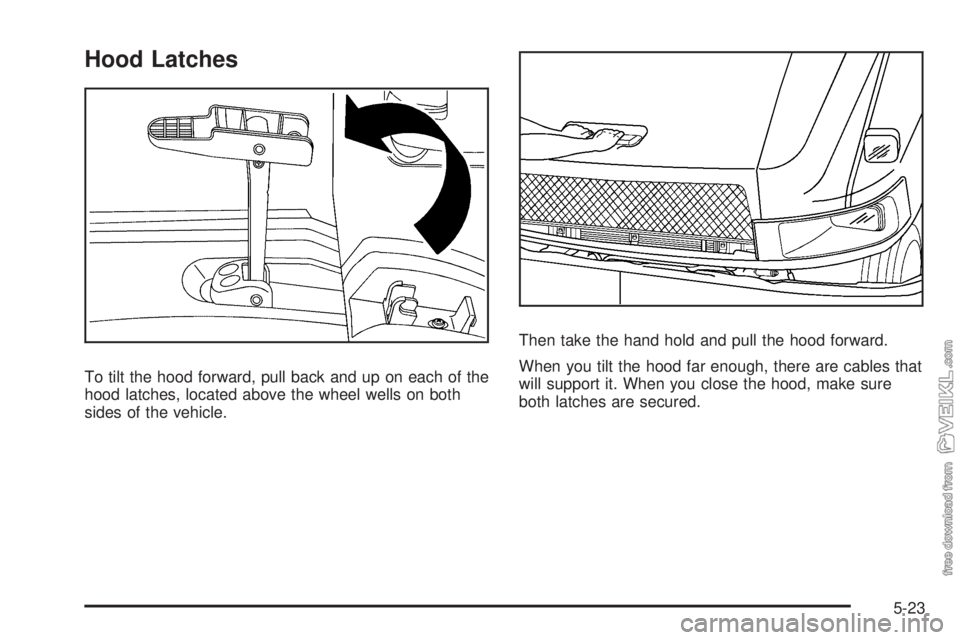
Hood Latches
To tilt the hood forward, pull back and up on each of the
hood latches, located above the wheel wells on both
sides of the vehicle.Then take the hand hold and pull the hood forward.
When you tilt the hood far enough, there are cables that
will support it. When you close the hood, make sure
both latches are secured.
5-23
Page 242 of 376
How to Inspect the Engine Air Cleaner/
Filters (Gas V8 8.1L, Caterpillar 7.2L and
Isuzu 7.8L Diesel Engines)
{CAUTION:
Operating the engine with the air cleaner/filter off
can cause you or others to be burned. The air
cleaner not only cleans the air; it helps to stop
flames if the engine backfires. If it is not there and
the engine backfires, you could be burned. Do not
drive with it off, and be careful working on the
engine with the air cleaner/filter off.
Notice:If the air cleaner/filter is off, a backfire can
cause a damaging engine fire. And, dirt can easily get
into the engine, which will damage it. Always have
the air cleaner/filter in place when you are driving.
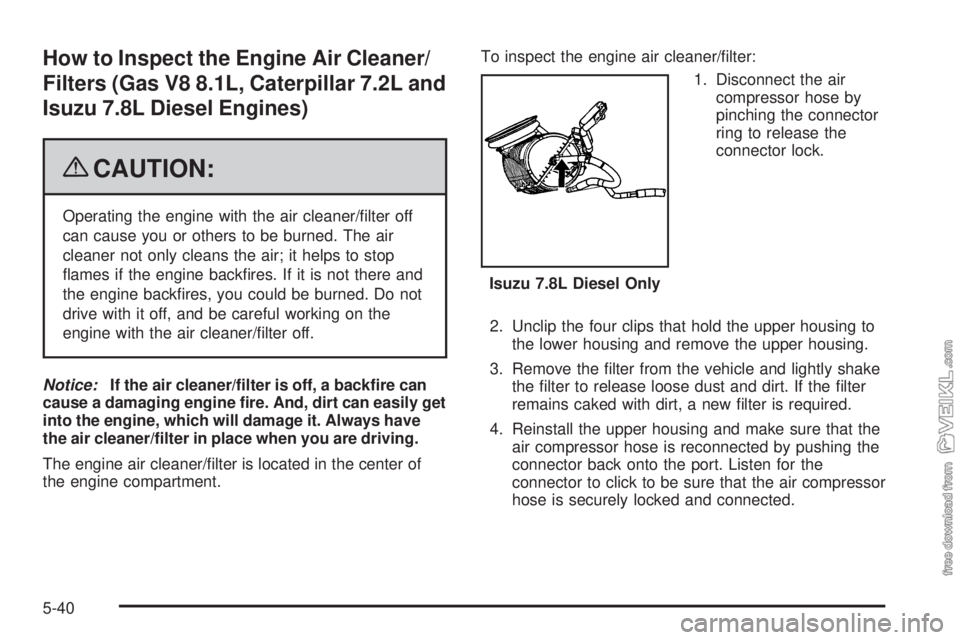
The engine air cleaner/filter is located in the center of
the engine compartment.To inspect the engine air cleaner/filter:
1. Disconnect the air
compressor hose by
pinching the connector
ring to release the
connector lock.
2. Unclip the four clips that hold the upper housing to
the lower housing and remove the upper housing.
3. Remove the filter from the vehicle and lightly shake
the filter to release loose dust and dirt. If the filter
remains caked with dirt, a new filter is required.
4. Reinstall the upper housing and make sure that the
air compressor hose is reconnected by pushing the
connector back onto the port. Listen for the
connector to click to be sure that the air compressor
hose is securely locked and connected. Isuzu 7.8L Diesel Only
5-40
Page 249 of 376
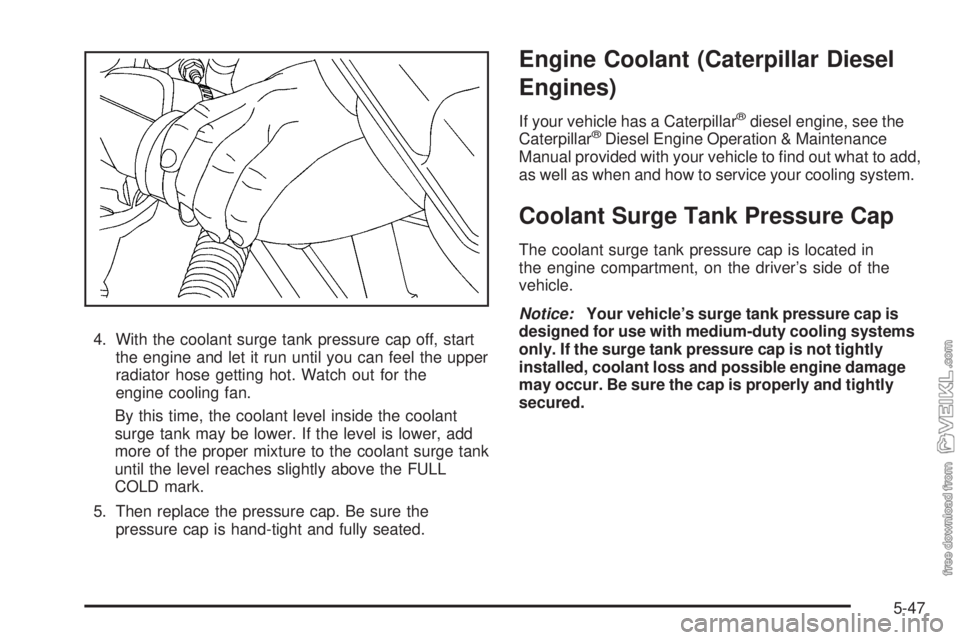
4. With the coolant surge tank pressure cap off, start
the engine and let it run until you can feel the upper
radiator hose getting hot. Watch out for the
engine cooling fan.
By this time, the coolant level inside the coolant
surge tank may be lower. If the level is lower, add
more of the proper mixture to the coolant surge tank
until the level reaches slightly above the FULL
COLD mark.
5. Then replace the pressure cap. Be sure the
pressure cap is hand-tight and fully seated.
Engine Coolant (Caterpillar Diesel
Engines)
If your vehicle has a Caterpillar®diesel engine, see the
Caterpillar®Diesel Engine Operation & Maintenance
Manual provided with your vehicle to find out what to add,
as well as when and how to service your cooling system.
Coolant Surge Tank Pressure Cap
The coolant surge tank pressure cap is located in
the engine compartment, on the driver’s side of the
vehicle.
Notice:Your vehicle’s surge tank pressure cap is
designed for use with medium-duty cooling systems
only. If the surge tank pressure cap is not tightly
installed, coolant loss and possible engine damage
may occur. Be sure the cap is properly and tightly
secured.
5-47
Page 300 of 376
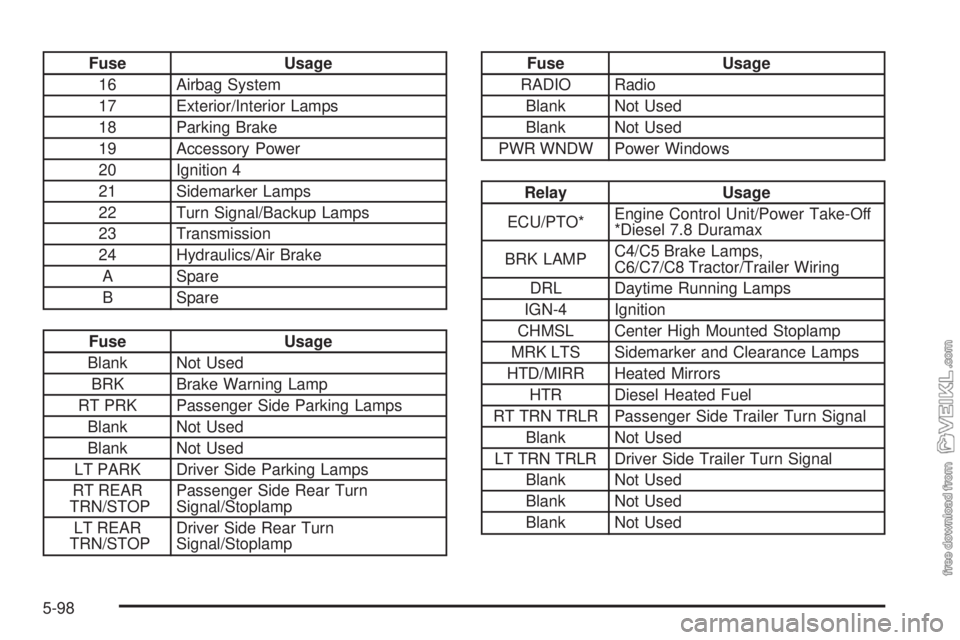
Fuse Usage
16 Airbag System
17 Exterior/Interior Lamps
18 Parking Brake
19 Accessory Power
20 Ignition 4
21 Sidemarker Lamps
22 Turn Signal/Backup Lamps
23 Transmission
24 Hydraulics/Air Brake
A Spare
B Spare
Fuse Usage
Blank Not Used
BRK Brake Warning Lamp
RT PRK Passenger Side Parking Lamps
Blank Not Used
Blank Not Used
LT PARK Driver Side Parking Lamps
RT REAR
TRN/STOPPassenger Side Rear Turn
Signal/Stoplamp
LT REAR
TRN/STOPDriver Side Rear Turn
Signal/Stoplamp
Fuse Usage
RADIO Radio
Blank Not Used
Blank Not Used
PWR WNDW Power Windows
Relay Usage
ECU/PTO*Engine Control Unit/Power Take-Off
*Diesel 7.8 Duramax
BRK LAMPC4/C5 Brake Lamps,
C6/C7/C8 Tractor/Trailer Wiring
DRL Daytime Running Lamps
IGN-4 Ignition
CHMSL Center High Mounted Stoplamp
MRK LTS Sidemarker and Clearance Lamps
HTD/MIRR Heated Mirrors
HTR Diesel Heated Fuel
RT TRN TRLR Passenger Side Trailer Turn Signal
Blank Not Used
LT TRN TRLR Driver Side Trailer Turn Signal
Blank Not Used
Blank Not Used
Blank Not Used
5-98
Page 302 of 376
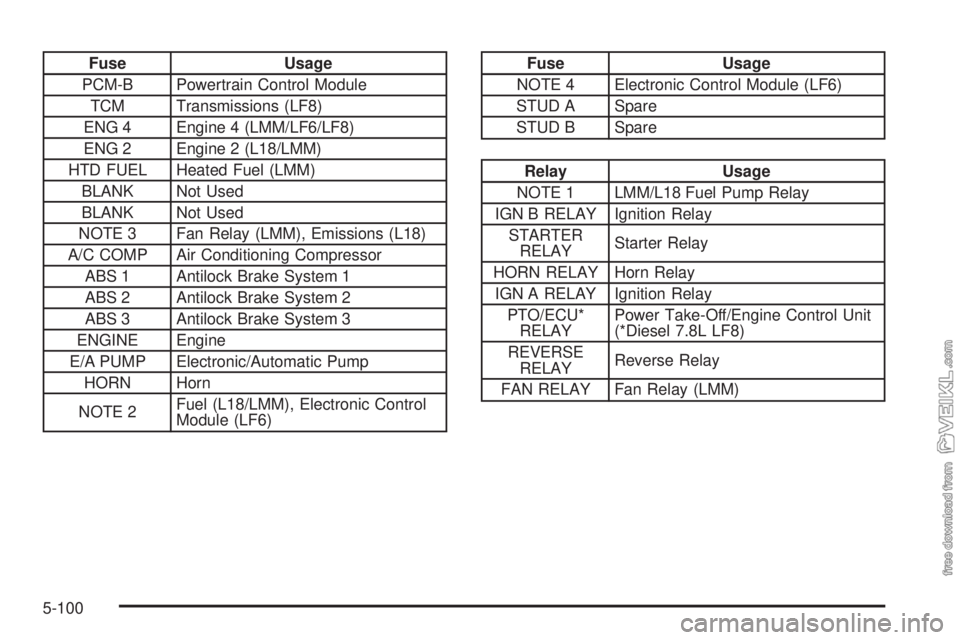
Fuse Usage
PCM-B Powertrain Control Module
TCM Transmissions (LF8)
ENG 4 Engine 4 (LMM/LF6/LF8)
ENG 2 Engine 2 (L18/LMM)
HTD FUEL Heated Fuel (LMM)
BLANK Not Used
BLANK Not Used
NOTE 3 Fan Relay (LMM), Emissions (L18)
A/C COMP Air Conditioning Compressor
ABS 1 Antilock Brake System 1
ABS 2 Antilock Brake System 2
ABS 3 Antilock Brake System 3
ENGINE Engine
E/A PUMP Electronic/Automatic Pump
HORN Horn
NOTE 2Fuel (L18/LMM), Electronic Control
Module (LF6)Fuse Usage
NOTE 4 Electronic Control Module (LF6)
STUD A Spare
STUD B Spare
Relay Usage
NOTE 1 LMM/L18 Fuel Pump Relay
IGN B RELAY Ignition Relay
STARTER
RELAYStarter Relay
HORN RELAY Horn Relay
IGN A RELAY Ignition Relay
PTO/ECU*
RELAYPower Take-Off/Engine Control Unit
(*Diesel 7.8L LF8)
REVERSE
RELAYReverse Relay
FAN RELAY Fan Relay (LMM)
5-100
Page 336 of 376
(11)= Chassis Lubrication Service: Lubricate all grease
fittings in front suspension, front axle, and steering
linkage. Do not lubricate kingpin bushings with air
pressure equipment; instead, use a hand grease gun to
ensure complete purge and eliminate sealer cap
distortion. Front axle tie rod ends, both upper and lower
kingpin fittings, and both steering linkage relay rod ends
should be greased with the vehicle loaded on the ground
and wheels turned straight ahead, not with the vehicle on
a hoist. Apply kingpin bushing lubricant to both upper and
lower kingpin grease fittings until new lubricant purges
from between the upper shim pack and thrust bearing.
Lubricate transmission and shift linkage, hood latches
and hood hinges, parking brake lever pivot, clevis pins
and linkage, disc brake caliper rails, clutch linkage and
release bearing (if equipped), bearing pads, propshaft
universal joints, brake camshaft bracket, slack adjusters,
pedal shaft, clutch cross shaft, clutch pedal springs, and
clutch cable bushing at transmission. Lubricate
suspension, axle, and steering linkage more often when
operating under dusty or muddy conditions and in
excessive off-road use. Frequently power-washed
vehicles will require more frequent lubrication.(12)= Check steering system:
•Look for damaged, loose, or missing parts. Inspect
the steering linkage relay rod and tie rod ends for
looseness or lack of lubricant. Also look for
parts showing signs of wear or lack of lubrication.
Replace parts as needed. Also check steering gear
mounting bolts, pitman arm nut, gear housing
upper cover and side cover attaching bolts, steering
column mounting bolts and cardan joint clamp
bolts; tighten if necessary. See the service manual.
•Inspect power steering hoses, tubes, and fittings for
leaks. Hoses and lines must not be twisted, kinked,
or tightly bent. Make sure clips, clamps, supporting
tubes, and hoses are in place and properly secured.
•Check steering gear for leakage around pitman shaft
and housing. If leakage is evident (lubricant oozing
out, not just oily film), leak should be corrected
immediately.
(13)= Check front and rear suspension. Look for
damaged, loose, or missing parts or parts showing signs
of wear or lack of lubrication. Replace parts as
needed.
6-22
Page 363 of 376
OnStar®(Isuzu 7.8L L6 Engine)
If your vehicle has OnStar and you subscribe to the
OnStar services, please refer to the OnStar Terms and
Conditions for information on data collection and use.
Navigation System (Isuzu
7.8L L6 Engine)
If your vehicle has a navigation system, use of the
system may result in the storage of destinations,
addresses, telephone numbers, and other trip
information. Refer to the navigation system operating
manual for information on stored data and for deletion
instructions.
Radio Frequency Identification
(RFID) (Isuzu 7.8L L6 Engine)
RFID technology is used in some vehicles for functions
such as tire pressure monitoring and ignition system
security, as well as in connection with conveniences
such as key fobs for remote door locking/unlocking and
starting, and in-vehicle transmitters for garage door
openers. RFID technology in GM vehicles does not use
or record personal information or link with any other
GM system containing personal information.
7-13
Page 366 of 376
Audio System(s).............................................3-49
Automatic Transmission
Fluid..........................................................5-42
Operation...................................................2-27
B
Battery..........................................................5-61
Bench Seat, Split............................................. 1-6
Brake
Diesel Engine Exhaust.................................2-26
Emergencies................................................ 4-5
Exhaust Indicator Light.................................3-41
Trailer Hand Control Valve.............................. 4-6
Brake Fluid....................................................5-52
Brakes..........................................................5-52
Hydraulic Systems......................................... 4-4
Parking Brake Burnish Procedure...................2-43
System Warning Light..................................3-31
Braking........................................................... 4-4
Braking in Emergencies..................................... 4-5
Break-In, New Vehicle.....................................2-10
Bucket Seats................................................... 1-2
Bulb Replacement...........................................5-71
Buying New Tires...........................................5-79
C
California Perchlorate Materials
Requirements............................................... 5-4
California Proposition 65 Warning....................... 5-4
Capacities and Specifications..........................5-102
Carbon Monoxide...................................2-45, 4-17
Care of
Safety Belts................................................5-89
Center Console Storage Area...........................2-53
Change Fuel Filter Warning Light......................3-45
Charging System Light....................................3-29
Check
Engine Lamp..............................................3-36
Gages Warning Light...................................3-43
Checking Things Under the Hood......................5-22
Chemical Paint Spotting...................................5-93
Child Restraints
Child Restraint Systems...............................1-36
Infants and Young Children...........................1-32
Lower Anchors and Tethers for Children..........1-40
Older Children.............................................1-28
Securing a Child Restraint in a Rear
Outside Seat Position...............................1-40
Securing a Child Restraint in the Center
Front Seat Position...................................1-44
2