ECU CHEVROLET KODIAK 2009 User Guide
[x] Cancel search | Manufacturer: CHEVROLET, Model Year: 2009, Model line: KODIAK, Model: CHEVROLET KODIAK 2009Pages: 376, PDF Size: 5.39 MB
Page 46 of 376
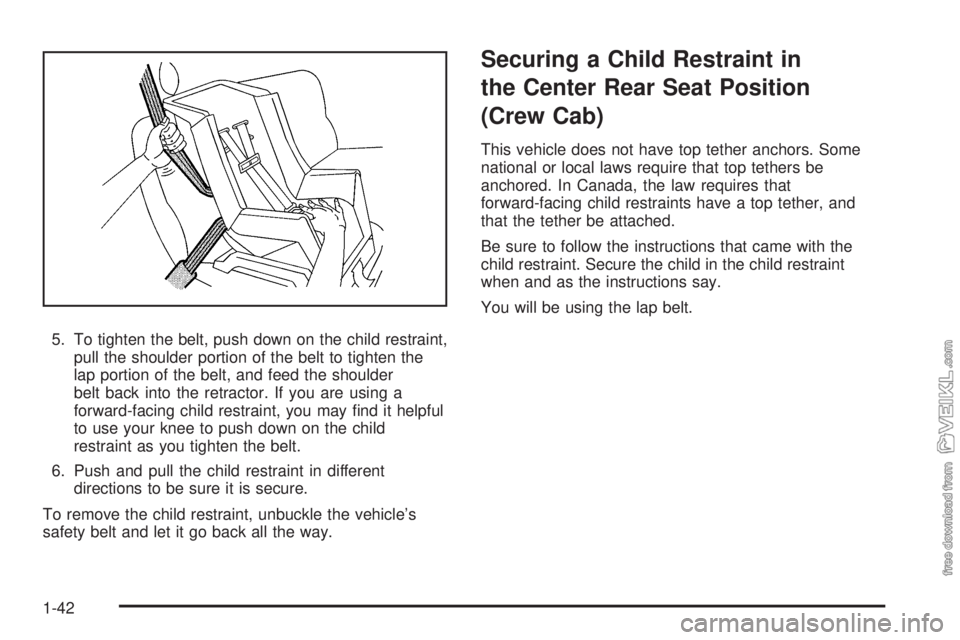
5. To tighten the belt, push down on the child restraint,
pull the shoulder portion of the belt to tighten the
lap portion of the belt, and feed the shoulder
belt back into the retractor. If you are using a
forward-facing child restraint, you may find it helpful
to use your knee to push down on the child
restraint as you tighten the belt.
6. Push and pull the child restraint in different
directions to be sure it is secure.
To remove the child restraint, unbuckle the vehicle’s
safety belt and let it go back all the way.
Securing a Child Restraint in
the Center Rear Seat Position
(Crew Cab)
This vehicle does not have top tether anchors. Some
national or local laws require that top tethers be
anchored. In Canada, the law requires that
forward-facing child restraints have a top tether, and
that the tether be attached.
Be sure to follow the instructions that came with the
child restraint. Secure the child in the child restraint
when and as the instructions say.
You will be using the lap belt.
1-42
Page 47 of 376
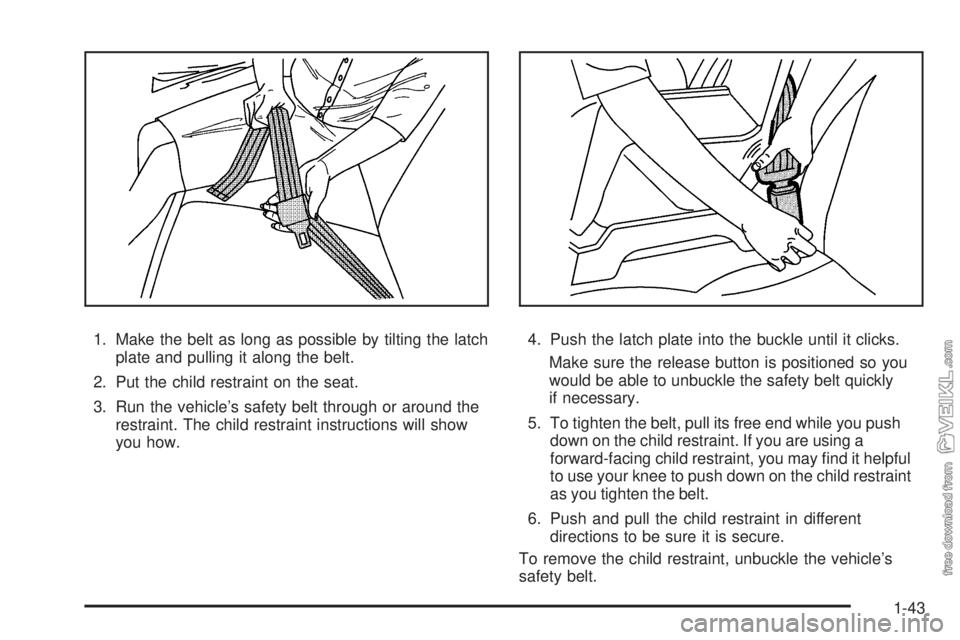
1. Make the belt as long as possible by tilting the latch
plate and pulling it along the belt.
2. Put the child restraint on the seat.
3. Run the vehicle’s safety belt through or around the
restraint. The child restraint instructions will show
you how.4. Push the latch plate into the buckle until it clicks.
Make sure the release button is positioned so you
would be able to unbuckle the safety belt quickly
if necessary.
5. To tighten the belt, pull its free end while you push
down on the child restraint. If you are using a
forward-facing child restraint, you may find it helpful
to use your knee to push down on the child restraint
as you tighten the belt.
6. Push and pull the child restraint in different
directions to be sure it is secure.
To remove the child restraint, unbuckle the vehicle’s
safety belt.
1-43
Page 48 of 376
Securing a Child Restraint in the
Center Front Seat Position
{CAUTION:
A child in a child restraint in the center front seat
can be badly injured or killed by the frontal airbags
if they inflate. Never secure a child restraint in the
center front seat if your vehicle has airbags or if it
interferes with shifting gears. It is always better to
secure a child restraint in a rear seat.
Do not use child restraints in the center front seat
position if your vehicle has airbags. If your vehicle does
not have airbags, use the instructions forSecuring a
Child Restraint in the Center Rear Seat Position (Crew
Cab) on page 1-42to install a child restraint in the
center front position.
Securing a Child Restraint in the
Right Front Seat Position
This vehicle may have airbags. A rear seat is a safer
place to secure a forward-facing child restraint. See
Where to Put the Restraint on page 1-38.
There may be a switch on the instrument panel that you
can use to turn off the right front passenger frontal
airbag. SeeAirbag Off Switch on page 1-55for more on
this, including important safety information.
A label on your sun visor says, “Never put a rear-facing
child seat in the front.” This is because the risk to the
rear-facing child is so great, if the airbag deploys.
1-44
Page 49 of 376
{CAUTION:
A child in a rear-facing child restraint can be
seriously injured or killed if the right front
passenger airbag inflates. This is because the
back of the rear-facing child restraint would be
very close to the inflating airbag. A child in a
forward-facing child restraint can be seriously
injured or killed if the right front passenger airbag
inflates and the passenger seat is in a forward
position.
Even if the airbag switch has turned off the right
front passenger frontal airbag, no system is
fail-safe. No one can guarantee that an airbag will
not deploy under some unusual circumstance,
even though it is turned off.
Secure rear-facing child restraints in a rear seat,
even if the airbag is off. If you secure a
forward-facing child restraint in the right front seat,
always move the front passenger seat as far back
as it will go. It is better to secure the child restraint
in a rear seat.
{CAUTION:
If the airbag readiness light ever comes on when
you have turned off the airbag, it means that
something may be wrong with the airbag system.
The right front passenger’s airbag could inflate
even though the switch is off. If this ever happens,
do not let anyone whom the national government
has identified as a member of a passenger airbag
risk group sit in the right front passenger’s position
(for example, do not secure a rear-facing child
restraint in the right front passenger’s seat) until
you have your vehicle serviced. SeeAirbag Off
Switch on page 1-55andAirbag Readiness Light
on page 3-27for more on this, including important
safety information.
If the vehicle does not have a rear seat that will
accommodate a rear-facing child restraint, a rear-facing
child restraint should not be installed in the vehicle,
even if the airbag is off.
1-45
Page 50 of 376
Do not secure a child restraint in a position without a
top tether anchor if a national or local law requires that
the top tether be anchored, or if the instructions that
come with the child restraint say that the top strap must
be anchored.
In Canada, the law requires that forward-facing child
restraints have a top tether, and that the tether be
attached.
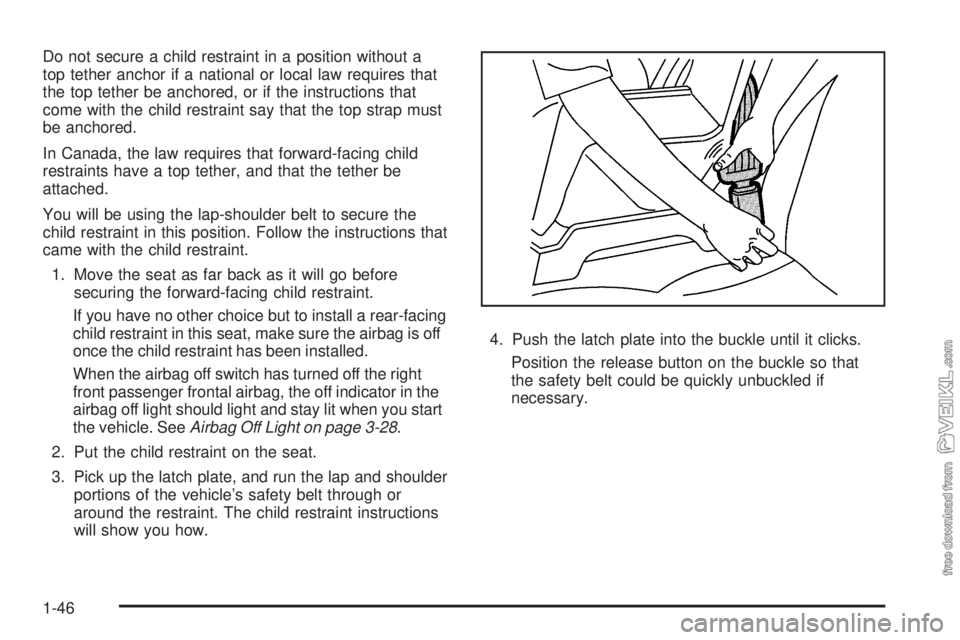
You will be using the lap-shoulder belt to secure the
child restraint in this position. Follow the instructions that
came with the child restraint.
1. Move the seat as far back as it will go before
securing the forward-facing child restraint.
If you have no other choice but to install a rear-facing
child restraint in this seat, make sure the airbag is off
once the child restraint has been installed.
When the airbag off switch has turned off the right
front passenger frontal airbag, the off indicator in the
airbag off light should light and stay lit when you start
the vehicle. SeeAirbag Off Light on page 3-28.
2. Put the child restraint on the seat.
3. Pick up the latch plate, and run the lap and shoulder
portions of the vehicle’s safety belt through or
around the restraint. The child restraint instructions
will show you how.4. Push the latch plate into the buckle until it clicks.
Position the release button on the buckle so that
the safety belt could be quickly unbuckled if
necessary.
1-46
Page 51 of 376
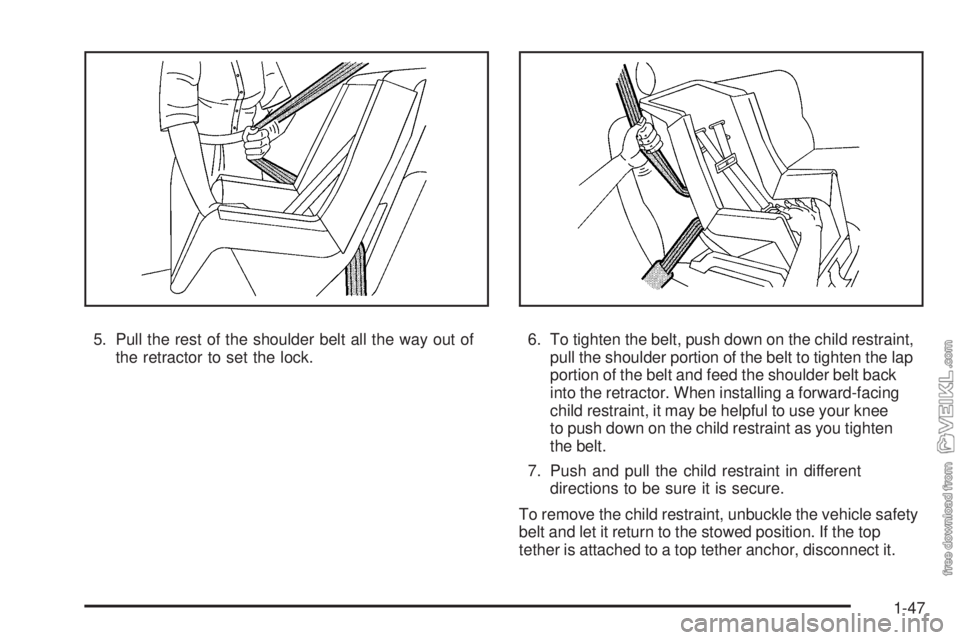
5. Pull the rest of the shoulder belt all the way out of
the retractor to set the lock.6. To tighten the belt, push down on the child restraint,
pull the shoulder portion of the belt to tighten the lap
portion of the belt and feed the shoulder belt back
into the retractor. When installing a forward-facing
child restraint, it may be helpful to use your knee
to push down on the child restraint as you tighten
the belt.
7. Push and pull the child restraint in different
directions to be sure it is secure.
To remove the child restraint, unbuckle the vehicle safety
belt and let it return to the stowed position. If the top
tether is attached to a top tether anchor, disconnect it.
1-47
Page 54 of 376
{CAUTION:
Children who are up against, or very close to, any
airbag when it inflates can be seriously injured or
killed. Airbags plus lap-shoulder belts offer
protection for adults and older children, but not for
young children and infants. Neither the vehicle’s
safety belt system nor its airbag system is
designed for them. Young children and infants
need the protection that a child restraint system
can provide. Always secure children properly in
your vehicle. To read how, seeOlder Children on
page 1-28orInfants and Young Children on
page 1-32.
There is an airbag
readiness light on the
instrument panel cluster,
which shows the airbag
symbol.The system checks the airbag electrical system for
malfunctions. The light tells you if there is an electrical
problem. SeeAirbag Readiness Light on page 3-27
for more information.
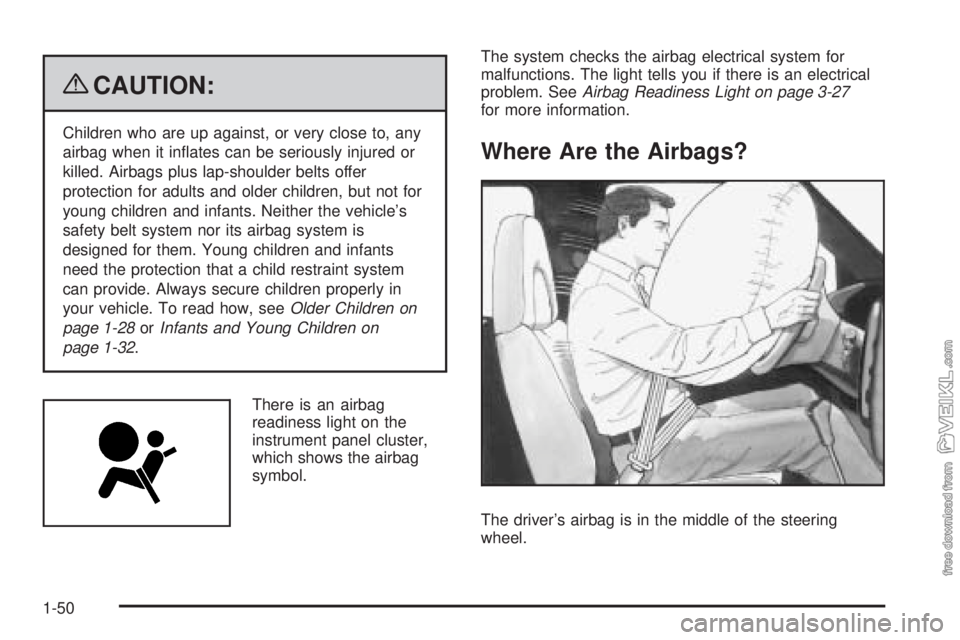
Where Are the Airbags?
The driver’s airbag is in the middle of the steering
wheel.
1-50
Page 62 of 376
Servicing Your Airbag-Equipped
Vehicle
Airbags affect how the vehicle should be serviced.
There are parts of the airbag system in several places
around the vehicle. Your dealer/retailer and the
service manual have information about servicing the
vehicle and the airbag system. To purchase a service
manual, seeService Publications Ordering Information
on page 7-10.
{CAUTION:
For up to 10 seconds after the ignition is turned off
and the battery is disconnected, an airbag can still
inflate during improper service. You can be injured
if you are close to an airbag when it inflates. Avoid
yellow connectors. They are probably part of the
airbag system. Be sure to follow proper service
procedures, and make sure the person performing
work for you is qualified to do so.
Adding Equipment to Your
Airbag-Equipped Vehicle
Q:Is there anything I might add to or change
about the vehicle that could keep the airbags
from working properly?
A:Yes. If you add things that change your vehicle’s
frame, bumper system, height, front end or side
sheet metal, they may keep the airbag system from
working properly. Changing or moving any parts
of the front seats, safety belts, the airbag sensing
and diagnostic module, steering wheel, instrument
panel, front sensors, or airbag wiring can affect
the operation of the airbag system.
If you have any questions about this, you should
contact Customer Assistance before you modify
your vehicle. The phone numbers and addresses
for Customer Assistance are in Step Two of
the Customer Satisfaction Procedure in this manual.
SeeCustomer Satisfaction Procedure on page 7-2.
1-58
Page 69 of 376
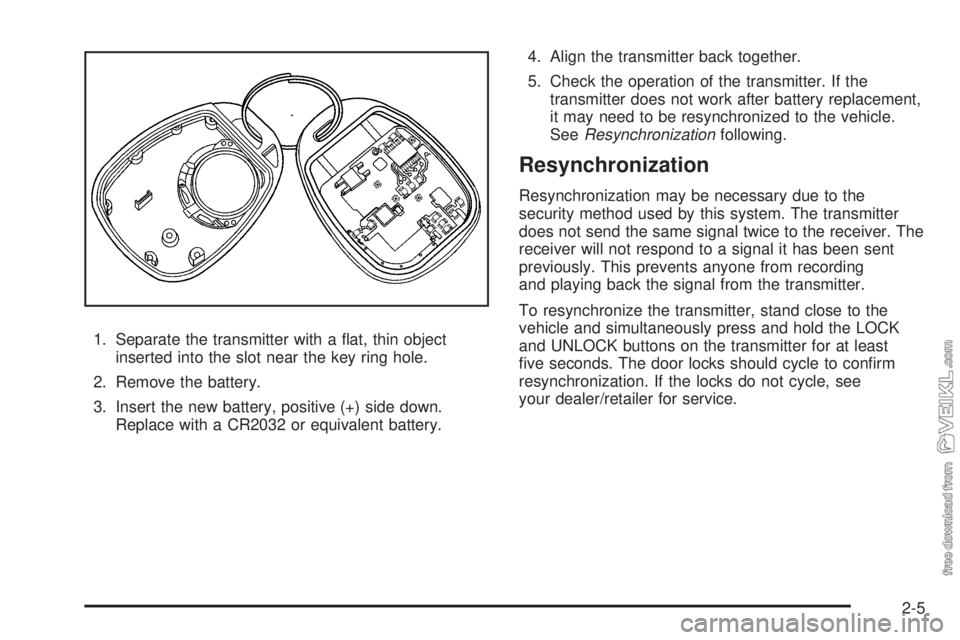
1. Separate the transmitter with a flat, thin object
inserted into the slot near the key ring hole.
2. Remove the battery.
3. Insert the new battery, positive (+) side down.
Replace with a CR2032 or equivalent battery.4. Align the transmitter back together.
5. Check the operation of the transmitter. If the
transmitter does not work after battery replacement,
it may need to be resynchronized to the vehicle.
SeeResynchronizationfollowing.
Resynchronization
Resynchronization may be necessary due to the
security method used by this system. The transmitter
does not send the same signal twice to the receiver. The
receiver will not respond to a signal it has been sent
previously. This prevents anyone from recording
and playing back the signal from the transmitter.
To resynchronize the transmitter, stand close to the
vehicle and simultaneously press and hold the LOCK
and UNLOCK buttons on the transmitter for at least
five seconds. The door locks should cycle to confirm
resynchronization. If the locks do not cycle, see
your dealer/retailer for service.
2-5
Page 176 of 376
Radio Reception
Frequency interference and static can occur during
normal radio reception if items such as cell phone
chargers, vehicle convenience accessories, and external
electronic devices are plugged into the accessory
power outlet. If there is interference or static, unplug the
item from the accessory power outlet.
AM
The range for most AM stations is greater than for FM,
especially at night. The longer range can cause station
frequencies to interfere with each other. For better radio
reception, most AM radio stations boost the power levels
during the day, and then reduce these levels during the
night. Static can also occur when things like storms and
power lines interfere with radio reception. When this
happens, try reducing the treble on your radio.
FM Stereo
FM stereo gives the best sound, but FM signals reach
only about 10 to 40 miles (16 to 65 km). Tall buildings or
hills can interfere with FM signals, causing the sound
to fade in and out.
Fixed Mast Antenna
The fixed mast antenna can withstand most car washes
without being damaged as long as it is securely attached
to the base. If the mast becomes slightly bent, straighten
it out by hand. If the mast is badly bent, replace it.
Occasionally check to make sure the antenna is
tightened to its base. If tightening is required, tighten by
hand until fully seated plus one quarter turn.
Chime Level Adjustment
The radio is used to adjust the vehicle’s chime level.
To change the volume level of the chime, press and hold
pushbutton 6 with the ignition on and the radio power
off. The volume level will change from the normal
level to loud, and HI will appear on the radio display.
To change back to the default or normal setting, press
and hold pushbutton 6 again. The volume level will
change from the loud level to normal, and LO will appear
on the radio display. Each time the chime volume is
changed, three chimes will sound as an example of the
new volume selected. Removing the radio and not
replacing it with a factory radio or chime module will
disable vehicle chimes.
3-58