automatic transmission CHEVROLET KODIAK 2009 Owner's Manual
[x] Cancel search | Manufacturer: CHEVROLET, Model Year: 2009, Model line: KODIAK, Model: CHEVROLET KODIAK 2009Pages: 376, PDF Size: 5.39 MB
Page 148 of 376
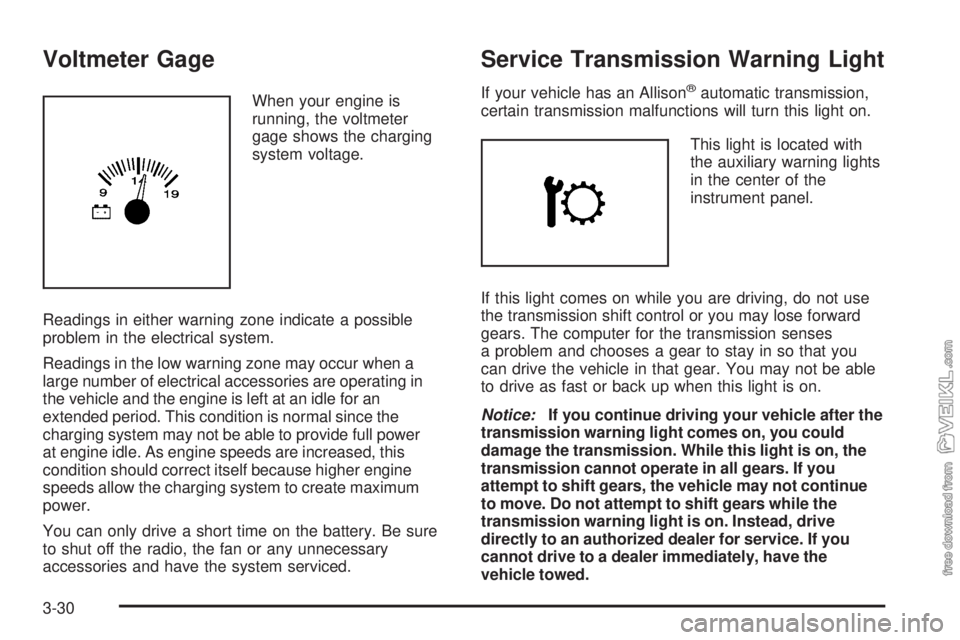
Voltmeter Gage
When your engine is
running, the voltmeter
gage shows the charging
system voltage.
Readings in either warning zone indicate a possible
problem in the electrical system.
Readings in the low warning zone may occur when a
large number of electrical accessories are operating in
the vehicle and the engine is left at an idle for an
extended period. This condition is normal since the
charging system may not be able to provide full power
at engine idle. As engine speeds are increased, this
condition should correct itself because higher engine
speeds allow the charging system to create maximum
power.
You can only drive a short time on the battery. Be sure
to shut off the radio, the fan or any unnecessary
accessories and have the system serviced.
Service Transmission Warning Light
If your vehicle has an Allison®automatic transmission,
certain transmission malfunctions will turn this light on.
This light is located with
the auxiliary warning lights
in the center of the
instrument panel.
If this light comes on while you are driving, do not use
the transmission shift control or you may lose forward
gears. The computer for the transmission senses
a problem and chooses a gear to stay in so that you
can drive the vehicle in that gear. You may not be able
to drive as fast or back up when this light is on.
Notice:If you continue driving your vehicle after the
transmission warning light comes on, you could
damage the transmission. While this light is on, the
transmission cannot operate in all gears. If you
attempt to shift gears, the vehicle may not continue
to move. Do not attempt to shift gears while the
transmission warning light is on. Instead, drive
directly to an authorized dealer for service. If you
cannot drive to a dealer immediately, have the
vehicle towed.
3-30
Page 149 of 376
Range Inhibit Warning Indicator
If your vehicle has an Allison 1000/2200/2300/
2500 series automatic transmission, a lighted bar
under the current gear selected will flash.
If your vehicle has an Allison 3000/3500 series automatic
transmission, the current gear selected on the pushbutton
display will flash.
The flashing bar or gear selection indicates that
transmission range shifts may not occur.
For detailed information on shift inhibit limitations, see
the Allison Automatic Transmission Operator’s Manual in
your vehicle for further information.
Brake System Warning Light
Your vehicle has either hydraulic or air brakes. Each
system has different warning lights.
Hydraulic Brake System Warning Lights
Vehicles with hydraulic brake systems have two brake
system warning lights on the instrument panel.
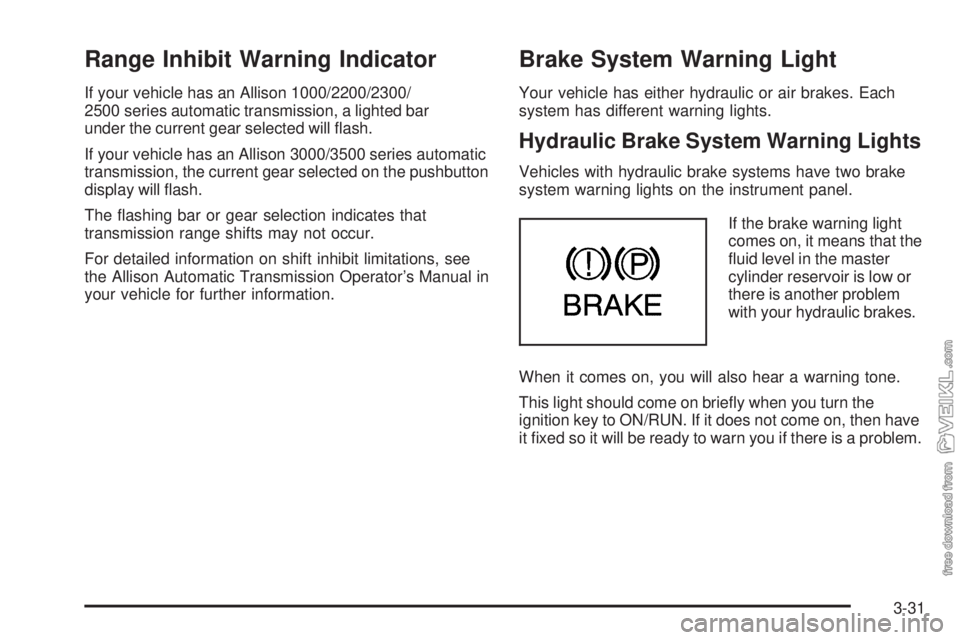
If the brake warning light
comes on, it means that the
fluid level in the master
cylinder reservoir is low or
there is another problem
with your hydraulic brakes.
When it comes on, you will also hear a warning tone.
This light should come on briefly when you turn the
ignition key to ON/RUN. If it does not come on, then have
it fixed so it will be ready to warn you if there is a problem.
3-31
Page 158 of 376
Engine Overspeed Warning Light
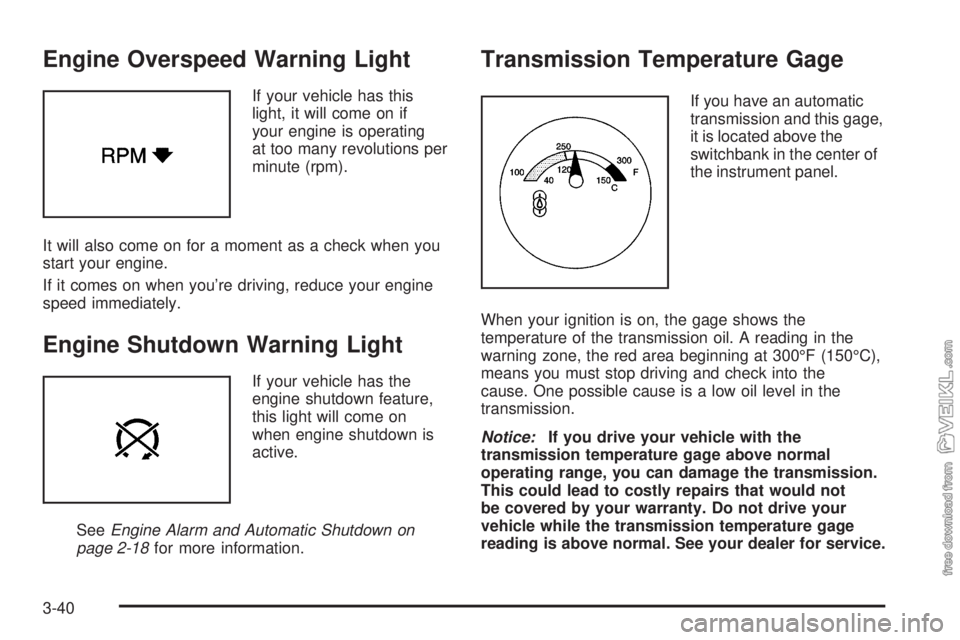
If your vehicle has this
light, it will come on if
your engine is operating
at too many revolutions per
minute (rpm).
It will also come on for a moment as a check when you
start your engine.
If it comes on when you’re driving, reduce your engine
speed immediately.
Engine Shutdown Warning Light
If your vehicle has the
engine shutdown feature,
this light will come on
when engine shutdown is
active.
SeeEngine Alarm and Automatic Shutdown on
page 2-18for more information.
Transmission Temperature Gage
If you have an automatic
transmission and this gage,
it is located above the
switchbank in the center of
the instrument panel.
When your ignition is on, the gage shows the
temperature of the transmission oil. A reading in the
warning zone, the red area beginning at 300°F (150°C),
means you must stop driving and check into the
cause. One possible cause is a low oil level in the
transmission.
Notice:If you drive your vehicle with the
transmission temperature gage above normal
operating range, you can damage the transmission.
This could lead to costly repairs that would not
be covered by your warranty. Do not drive your
vehicle while the transmission temperature gage
reading is above normal. See your dealer for service.
3-40
Page 184 of 376
Traction Control System (TCS)
The vehicle may have a traction control system that limits
wheel spin. This is especially useful in slippery road
conditions. The system operates only if it senses that one
or both of the rear wheels are spinning or beginning to
lose traction. When this happens, the system applies the
brake(s) at the affected wheel(s).
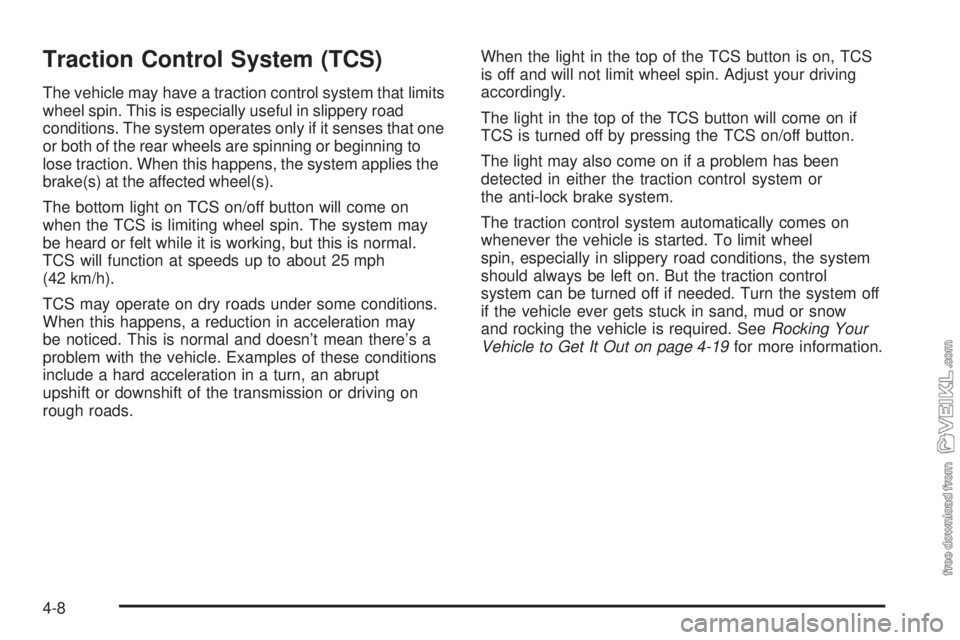
The bottom light on TCS on/off button will come on
when the TCS is limiting wheel spin. The system may
be heard or felt while it is working, but this is normal.
TCS will function at speeds up to about 25 mph
(42 km/h).
TCS may operate on dry roads under some conditions.
When this happens, a reduction in acceleration may
be noticed. This is normal and doesn’t mean there’s a
problem with the vehicle. Examples of these conditions
include a hard acceleration in a turn, an abrupt
upshift or downshift of the transmission or driving on
rough roads.When the light in the top of the TCS button is on, TCS
is off and will not limit wheel spin. Adjust your driving
accordingly.
The light in the top of the TCS button will come on if
TCS is turned off by pressing the TCS on/off button.
The light may also come on if a problem has been
detected in either the traction control system or
the anti-lock brake system.
The traction control system automatically comes on
whenever the vehicle is started. To limit wheel
spin, especially in slippery road conditions, the system
should always be left on. But the traction control
system can be turned off if needed. Turn the system off
if the vehicle ever gets stuck in sand, mud or snow
and rocking the vehicle is required. SeeRocking Your
Vehicle to Get It Out on page 4-19for more information.
4-8
Page 203 of 376
Service............................................................5-3
Accessories and Modifications..........................5-3
California Proposition 65 Warning.....................5-4
California Perchlorate Materials Requirements.....5-4
Doing Your Own Service Work.........................5-5
Engine Fan Breakage.....................................5-6
Fuel................................................................5-6
Gasoline Octane............................................5-6
Gasoline Specifications....................................5-7
Additives.......................................................5-7
Diesel Engine Fuel.........................................5-8
What Fuel to Use...........................................5-8
Very Cold Weather Operation.........................5-11
Water in Fuel...............................................5-11
Running Out of Fuel.....................................5-17
Fuel Filter Replacement.................................5-18
Fuels in Foreign Countries.............................5-19
Filling the Tank............................................5-20
Filling a Portable Fuel Container.....................5-22
Checking Things Under the Hood....................5-22
Hood Latches...............................................5-23
Engine Oil (DURAMAX Diesel Engine).............5-24
Engine Oil (Caterpillar Diesel Engine)..............5-27
Engine Oil (Isuzu Diesel Engine).....................5-28
Engine Oil (Gasoline Engine)..........................5-32
Engine Oil Life System (Gasoline Engine)........5-35Engine Oil Life System (DURAMAX/Isuzu
Diesel Engines).........................................5-36
Engine Oil Life System (Caterpillar
Diesel Engine)..........................................5-38
Engine Air Cleaner/Filter................................5-38
Automatic Transmission Fluid.........................5-42
Manual Transmission Fluid.............................5-42
Cooling System............................................5-43
Engine Coolant (Caterpillar Diesel Engines)......5-47
Coolant Surge Tank Pressure Cap..................5-47
Engine Overheating.......................................5-48
Engine Fan Noise.........................................5-49
Power Steering Fluid.....................................5-49
Windshield Washer Fluid................................5-50
Brakes........................................................5-52
Battery........................................................5-61
Jump Starting...............................................5-62
Rear Axle.......................................................5-67
Rear Axle Shift Motor....................................5-68
Four-Wheel Drive............................................5-68
Front Axle......................................................5-69
Noise Control System.....................................5-70
Tampering with Noise Control System
Prohibited.................................................5-70
Bulb Replacement..........................................5-71
Section 5 Service and Appearance Care
5-1
Page 210 of 376
Diesel Engine Fuel
For the Caterpillar®diesel, see the Caterpillar®
Operation & Maintenance Manual for information
concerning fuel usage.
Notice:Diesel fuel or fuel additives not
recommended in this manual could damage the fuel
system and engine. Your warranty would not
cover this damage. And:
•Diesel fuel that has been mixed with engine oil
or automatic transmission fluid could damage
the engine and emission controls.
•We do not test aftermarket diesel fuel additives.
Some additives, particularly those which
contain alcohol or water emulsifiers, could
damage the fuel system. If you believe that
unique circumstances call for a fuel additive to
be used, consult your dealer/retailer for
advice.
•If you ever run out of diesel fuel, it can be
difficult to restart the engine. To avoid this,
never let the tank get empty.
If gasoline is ever accidentally added to the fuel
tank, to avoid severe engine damage, do not run the
engine until the fuel tank can be drained.
If you run out of fuel,Running Out of Fuel on page 5-17
tells you how to restart the engine.
What Fuel to Use
Notice:Use of diesel fuel other than Ultra Low
Sulfur Diesel (15 ppm sulfur maximum) or engine oil
other than low ash CJ-4 oil will cause permanent
damage to the DPF and related components. This
damage would not be covered by your warranty.
The emission control system requires the use of diesel
fuel with ultra low-sulfur (0.0015% by weight, or 15 ppm,
maximum) content. Both Ultra Low Sulfur Diesel and Low
Sulfur Diesel fuels are available in the United States and
Ultra Low Sulfur Diesel fuel is available in Canada. In
Mexico, Ultra Low Sulfur Diesel fuel is not available in all
regions.
At a minimum, the diesel fuel you use should meet the
latest version of ASTM specification D 975 (Grades
No. 2-D or No. 1-D S15 commonly known as Ultra Low
Sulfur diesel) in the United States. In addition, the
Engine Manufacturers Association (EMA) has identified
properties of an improved diesel fuel for better engine
performance and durability. Diesel fuels corresponding to
the EMA Recommended Guideline on Premium Diesel
Fuel (FQP-1A) could provide better starting, less noise,
and better vehicle performance. If there are questions
about the fuel you are using, contact your fuel supplier.
5-8
Page 244 of 376
Automatic Transmission Fluid
When to Check
A good time to check your automatic transmission fluid
level is when the engine oil is checked. See your
Allison Automatic Transmission Operator’s Manual to
find out when to change your transmission fluid
and filters.
How to Check and What to Use
The Allison Automatic Transmission Operator’s Manual
that came with the vehicle shows how to check the
automatic transmission fluid and what fluid to use.
Automatic Transmission External Filter
Your automatic transmission filter requires periodic
replacement.
Consult the Allison Automatic Transmission Operator’s
Manual that came with the vehicle for proper change
intervals.
Manual Transmission Fluid
When to Check
A good time to have it checked is when the engine oil is
checked. Refer to the Maintenance Schedule to find out
when to check and change your manual transmission
fluid. SeeScheduled Maintenance on page 6-5.
How to Check and What to Use
Check the fluid level only when your engine is off, the
vehicle is parked on a level place, and the transmission
is cool enough for you to rest your fingers on the
transmission case.
To check the transmission fluid level, do the following:
1. Remove the filler plug.
2. Check to be sure that the lubricant level is up
to the bottom of the fill opening. On heavy duty
transmissions, an inch of oil level equals about
one gallon of fluid.
3. If the fluid level is good, reinstall the plug and be
sure it is fully seated. If the fluid level is low, add
more fluid as described in the next steps. Refer to
the Maintenance Schedule to determine what
kind of fluid to use. SeePart C: Recommended
Fluids and Lubricants on page 6-31.
5-42
Page 265 of 376
2. Get the vehicles close enough so the jumper cables
can reach, but be sure the vehicles are not touching
each other. If they are, it could cause a ground
connection you do not want. You would not be able
to start your vehicle, and the bad grounding could
damage the electrical systems.
To avoid the possibility of the vehicles rolling, set the
parking brake firmly on both vehicles involved in the
jump start procedure. Put an automatic transmission
in P (PARK) or a manual transmission in N (Neutral)
before setting the parking brake. If you have a
four-wheel-drive vehicle, be sure the transfer case
is in a drive gear, not in N (Neutral).
Notice:If you leave the radio or other accessories
on during the jump starting procedure, they could be
damaged. The repairs would not be covered by the
warranty. Always turn off the radio and other
accessories when jump starting the vehicle.
3. Turn off the ignition on both vehicles. Unplug
unnecessary accessories plugged into the cigarette
lighter or accessory power outlets. Turn off the
radio and all lamps that are not needed. This will
avoid sparks and help save both batteries, and
it could save the radio!4. Open the hood on the other vehicle and locate the
positive (+) and the negative (−) terminal locations
on that vehicle.
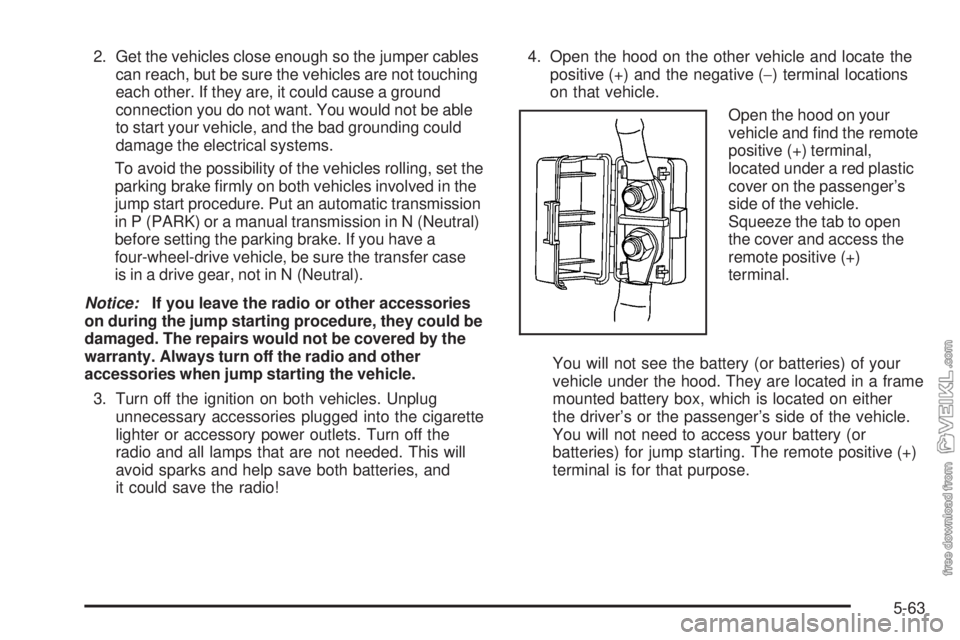
Open the hood on your
vehicle and find the remote
positive (+) terminal,
located under a red plastic
cover on the passenger’s
side of the vehicle.
Squeeze the tab to open
the cover and access the
remote positive (+)
terminal.
You will not see the battery (or batteries) of your
vehicle under the hood. They are located in a frame
mounted battery box, which is located on either
the driver’s or the passenger’s side of the vehicle.
You will not need to access your battery (or
batteries) for jump starting. The remote positive (+)
terminal is for that purpose.
5-63
Page 302 of 376
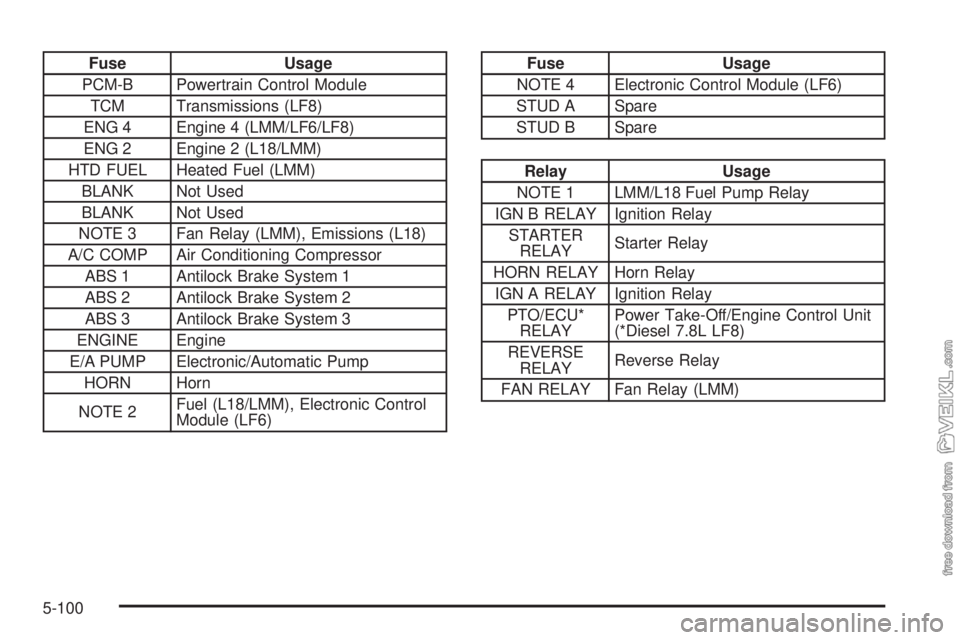
Fuse Usage
PCM-B Powertrain Control Module
TCM Transmissions (LF8)
ENG 4 Engine 4 (LMM/LF6/LF8)
ENG 2 Engine 2 (L18/LMM)
HTD FUEL Heated Fuel (LMM)
BLANK Not Used
BLANK Not Used
NOTE 3 Fan Relay (LMM), Emissions (L18)
A/C COMP Air Conditioning Compressor
ABS 1 Antilock Brake System 1
ABS 2 Antilock Brake System 2
ABS 3 Antilock Brake System 3
ENGINE Engine
E/A PUMP Electronic/Automatic Pump
HORN Horn
NOTE 2Fuel (L18/LMM), Electronic Control
Module (LF6)Fuse Usage
NOTE 4 Electronic Control Module (LF6)
STUD A Spare
STUD B Spare
Relay Usage
NOTE 1 LMM/L18 Fuel Pump Relay
IGN B RELAY Ignition Relay
STARTER
RELAYStarter Relay
HORN RELAY Horn Relay
IGN A RELAY Ignition Relay
PTO/ECU*
RELAYPower Take-Off/Engine Control Unit
(*Diesel 7.8L LF8)
REVERSE
RELAYReverse Relay
FAN RELAY Fan Relay (LMM)
5-100
Page 304 of 376
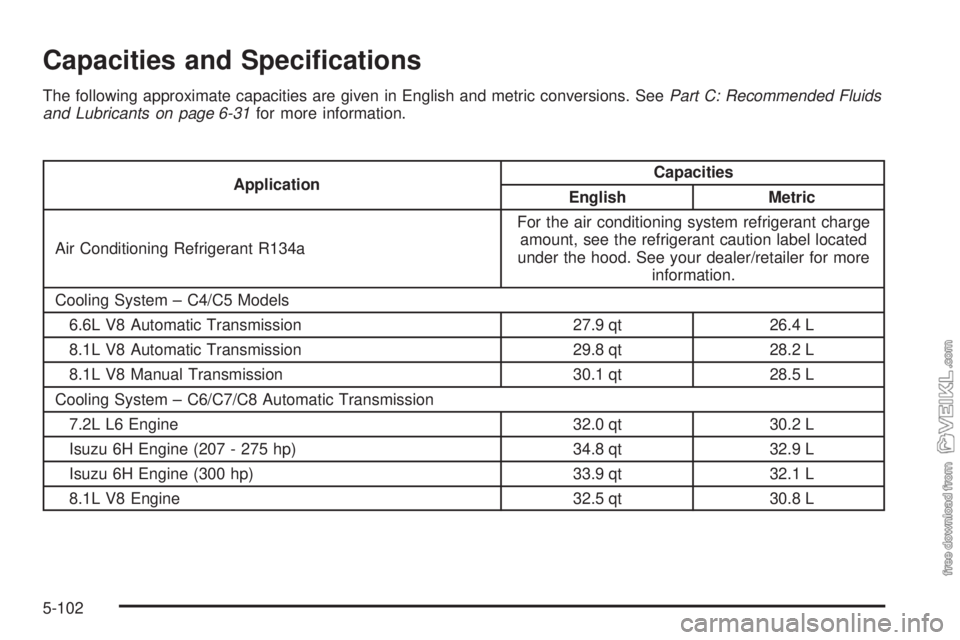
Capacities and Specifications
The following approximate capacities are given in English and metric conversions. SeePart C: Recommended Fluids
and Lubricants on page 6-31for more information.
ApplicationCapacities
English Metric
Air Conditioning Refrigerant R134aFor the air conditioning system refrigerant charge
amount, see the refrigerant caution label located
under the hood. See your dealer/retailer for more
information.
Cooling System – C4/C5 Models
6.6L V8 Automatic Transmission 27.9 qt 26.4 L
8.1L V8 Automatic Transmission 29.8 qt 28.2 L
8.1L V8 Manual Transmission 30.1 qt 28.5 L
Cooling System – C6/C7/C8 Automatic Transmission
7.2L L6 Engine 32.0 qt 30.2 L
Isuzu 6H Engine (207 - 275 hp) 34.8 qt 32.9 L
Isuzu 6H Engine (300 hp) 33.9 qt 32.1 L
8.1L V8 Engine 32.5 qt 30.8 L
5-102