cooling CHEVROLET KODIAK 2009 Owner's Manual
[x] Cancel search | Manufacturer: CHEVROLET, Model Year: 2009, Model line: KODIAK, Model: CHEVROLET KODIAK 2009Pages: 376, PDF Size: 5.39 MB
Page 332 of 376
❑Air brake automatic slack adjuster service (or every
500 hours, whichever occurs first).(33)
❑Check air brake relay valve operation and check for
leaks (or every month, or every 300 hours, whichever
occurs first).
❑Clean air brake application valve (or every 3 months,
or every 300 hours, whichever occurs first). Lubricate
linkage.
❑Air brake chamber service (or every 2 months,
whichever occurs first).(34)
❑Air brake system valve service (or every 3 months, or
every 900 hours, whichever occurs first).(37)
❑Air compressor dry element pleated paper air strainer
service (or every 2 months, or every 800 hours,
whichever occurs first).
❑C600, C700, and C800 Gasoline Engines Only:
Engine drive belts service (or every 12 months,
whichever occurs first).(17)
❑Thermostatically controlled engine cooling fan
service.(3) (19)
❑Shields and underhood insulation service.(3) (4) (20)
❑Rear axle air shift motor service.(10)
❑Air intake system service (or every 24 months,
whichever occurs first).(3) (4) (23)❑Evaporative Control System service, if equipped, (or
every 24 months, whichever occurs first).(2) (24) †
❑Gasoline Engine: Air compressor remote mounted air
filter dry element pleated paper air strainer service (or
every 6 months or every 1800 hours, whichever
occurs first).
96,000 Miles (152 000 km)
❑Lubricate U-joints (or every 6 months, whichever
occurs first).
97,500 Miles (156 000 km)
❑Gasoline Engine Only: Check engine oil life system.
If engine oil and filter are changed, reset system. See
“Engine Oil (Gasoline Engine)” in the Index.(2) (8)
❑Check fluid levels (or every 3 months, whichever
occurs first).(1) (5)
❑Chassis lubrication service (or every 6 months,
whichever occurs first).(11)
❑Wheels and tires service.(14)
❑Hydraulic brake service (or every 6 months, whichever
occurs first).(6) (36)
❑Parking brake service (or every 6 months, whichever
occurs first).(21)
❑Air brake service (or every 6 months, whichever
occurs first).(32)
6-18
Page 334 of 376
150,000 Miles (240 000 km)
❑Cooling system service (or every 60 months since
last service, whichever occurs first).(2) (29)
❑Diesel Engine Only: Inspect engine drive belt;
replace as necessary.
❑Isuzu Diesel Only: Diesel Particulate Filter (DPF)
service (or every 4,500 hours, whichever occurs
first). Then every 150,000 miles (240 000 km),
or every 4,500 hours, whichever occurs first.(7)
200,000 Miles (320 000 km)
❑Rear axle service — Eaton®, Rockwell®, Spicer®
axles (or every 12 months, whichever occurs
first).(30)
❑Remove, disassemble, clean, and inspect the air
brake trailer supply valve (or every 2 years, or
every 7,200 hours, whichever occurs first).
❑Diesel Engine Only: Inspect engine drive belt;
replace as necessary.
250,000 Miles (400 000 km)
❑Four-wheel drive only: Front axle service.(30)
❑Four-wheel drive only: Transfer case service.(30)
❑Manual transmission (except ZF 6-speed) fluid
replacement (or every 60 months, whichever occurs
first).
300,000 Miles (480 000 km)
❑Rear axle service — Eaton®, Rockwell®, Spicer®
axles (or every 12 months, whichever occurs
first).(30)
❑Remove, disassemble, clean, and inspect the air
brake air dryer (or every 3 years, or 10,800 hours,
whichever occurs first). Replace desiccant.
❑Isuzu Diesel Only: Diesel Particulate Filter (DPF)
service (or every 4,500 hours, whichever occurs
first). Then every 150,000 miles (240 000 km),
or every 4,500 hours, whichever occurs first.(7)
Footnotes
† = The U.S. Environmental Protection Agency or the
California Air Resources Board has determined that the
failure to perform this maintenance item will not nullify
the emission warranty or limit recall liability prior to
the completion of the vehicle’s useful life. We, however,
urge that all recommended maintenance services be
performed at the indicated intervals and the
maintenance be recorded.
(1)= If your vehicle has an Allison Transmission
®,
your owner manual is supplemented by an Allison
Transmission
®Operator’s Manual. Always refer to
these manuals for related maintenance services.
(2)= An Emission Control Service.
(3)= A Noise Emission Control Device.
6-20
Page 337 of 376
(14)= Adjust tire pressures as indicated on the
Certification or Tire Information label for optimum tire
life. SeeTires on page 5-76for further details.
Check tires for excessive or abnormal wear or damage.
Also check for damaged wheels. Replace wheels
and/or tires as needed.
(15)= Check spring-to-axle U-bolts and shackle bolts
for proper torque. See the service manual for torque
sequence and specifications. When parts are replaced,
the torque must be checked and adjusted more often
during the first 6,000 miles (10 000 km). Check torque at
500 miles (800 km) and 2,000 miles (3 000 km) after
first use of parts.
(16)= Check complete exhaust system, including DPF
pressure lines, and cab areas near the exhaust system
for broken, damaged, missing, or out-of-position parts.
Also inspect for open seams, holes, loose connections, or
other conditions which could let exhaust fumes seep into
the driver compartment. Needed repairs should be made
at once. To help maintain system integrity, replace
exhaust pipes whenever a new muffler is put on.
(17)= Check all gasoline engine drive belts for cracks,
fraying, and wear. Replace as needed.
(18)= Adjust valve lash. Incorrect valve clearance will
result in increased engine noise and reduced engine
output.(19)= With the engine off and below normal operating
temperature, check to see that the thermostatically
controlled engine cooling fan can be rotated by hand on
viscous-operated drives. Replace as needed.
(20)= Check shields and underhood insulation for
damage or looseness. Adjust or replace as needed.
(21)= Inspect parking brake drum and linings for wear
or cracks and check linkage and adjustment.
(22)= Wheel bearing service:
•Grease type — Clean, inspect, and lubricate with
the proper wheel bearing grease at designated
intervals or when hubs are removed. SeePart C:
Recommended Fluids and Lubricants on page 6-31.
•Oil-filled type — Some wheel bearings are
lubricated by axle lubricant. When you have oil-filled
hubs, use lubricant identical to that used in the
axle. Lubricant change intervals are the same for
front and rear axles. However, you must maintain
the proper oil level between change intervals.
SeeFront Wheel Bearings with Oil-Filled Hubs on
page 5-75andPart C: Recommended Fluids
and Lubricants on page 6-31.
(23)= Check the air intake system installation to
see that gaskets are seated properly and all hose
connections, fasteners, and other components are tight.
Tighten connections and fasteners or replace parts
as required.
6-23
Page 338 of 376

(24)= Evaporative Control System Service, if equipped:
Check all fuel and vapor lines and hoses for proper
connections and correct routing (or every 24 months,
whichever occurs first). Replace parts as needed.
(25)= Replace spark plugs. Inspect wires for damage.
Check the wire boot and boot heat shield fit at spark
plugs and coil. Replace parts as needed.
(26)= Check the fuel tank, fuel cap and fuel lines for
damage which could cause leakage. Inspect fuel cap for
correct sealing ability and any indications of damage.
Check fuel cap gasket for even filler neck imprint.
Replace parts as needed.
(27)= Check Exhaust Gas Recirculation (EGR) system
as described in the service manual. SeeService
Publications Ordering Information on page 7-10.
(28)= Inspect Electronic Vacuum Regulator Valve
(EVRV) filter for excessive contamination or plugging.
If needed, clean filter with solution of soap and water, let
dry and install.
(29)= Drain, flush, and refill cooling system. This service
can be complex; you should have your dealer/retailer
perform this service. SeePart C: Recommended Fluids
and Lubricants on page 6-31for what to use. Inspect
hoses. Clean radiator, condenser, pressure cap, and
neck. Pressure test cooling system and pressure cap.
For Caterpillar
®diesel engines, always refer to the
Caterpillar®Diesel Engine Operation & Maintenance
Manual for coolant recommendations and change
intervals.(30)= Change the lubricant. SeePart C: Recommended
Fluids and Lubricants on page 6-31.
(31)= Front axle service: Re-pack upper kingpin roller
bearing.
(32)= Air brake service:
•Inspect brake lines and hoses for proper hook-up,
binding, leaks, cracks, chafing, etc. Inspect drum
brake linings for wear or cracks. Inspect other brake
parts at each wheel, including drums and wheel
speed sensor wiring. Check brake pedal for
excessive free play or travel (or every 6 months,
whichever occurs first) and have serviced if needed.
Check brakes more often if driving habits and
conditions result in frequent braking. Replace air
dryer cartridge only if excessive oil or moisture is
present. A small amount of oil in the system is normal
and should not be considered as a reason to replace
the cartridge.
•Test air lines for leaks; tighten as needed. Replace
compressor filter.
•Inspect air parking brake chamber for leaks and
damage. Inspect lines and hoses for leaks, cracks,
chafing, etc. Also check all attachments for tightness,
wear, or damage. Note: The spring brake section of
the rear brake diaphragms are non-serviceable.
6-24
Page 342 of 376
Automatic Transmission Shift Indicator
Check
Check that the indicator points to the gear chosen.
Steering Check
Be alert for any changes in steering action, abnormal
front tire wear or steering wheel position. An inspection
or service is needed when the steering wheel is
harder to turn or has too much free play, or if there are
strange sounds when turning or parking.
Brake System Check
Be alert to the low air warning light or tone alarm, or
changes in braking action, such as repeated pulling to
one side, unusual sounds when braking or increased
brake pedal travel. Make sure air brake system reservoirs
are drained daily with full system air pressure, and check
system for leaks. Any of these conditions could indicate
the need for brake system inspection and/or service.
Engine Cooling System Service
Inspect the hoses and have them replaced if they are
cracked, swollen, or deteriorated. Inspect all pipes,
fittings, and clamps; replace as needed. Clean the
outside of the radiator and air conditioning condenser. To
help ensure proper operation, a pressure test of the
cooling system and pressure cap is recommended at
least once a year.
Exhaust System Inspection
Be alert for any changes in the sound of the exhaust
system or any smell of fumes. These are signs the
system may be leaking. Have it checked and/or repaired
at once. SeeEngine Exhaust on page 2-45and
Running the Vehicle While Parked on page 2-50.
Check to be sure that mud or dirt is not caked on the
exhaust system, especially in the area of the diesel
particulate filter and tailpipe. Clean the area as needed.
SeeDiesel Particulate Filter on page 2-46.
At high mileages, the DPF becomes loaded with ash.
This is normal. When the amount of ash loading is high,
see your dealer/retailer for DPF cleaning or replacement.
Windshield Wipers and Washers
Check
Check operation and condition of the wiper blades.
Check the flow of the washer spray.
Defroster Check
Move the control to the defrost symbol and the fan to HI
or the high symbol. Then check the airflow from the
ducts at the inside base of the windshield.
6-28
Page 367 of 376
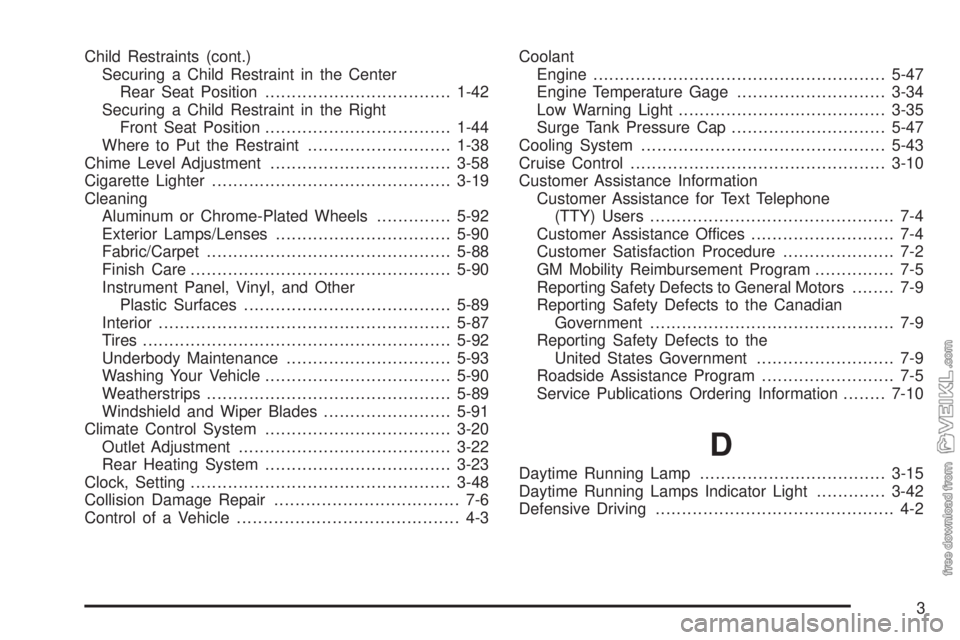
Child Restraints (cont.)
Securing a Child Restraint in the Center
Rear Seat Position...................................1-42
Securing a Child Restraint in the Right
Front Seat Position...................................1-44
Where to Put the Restraint...........................1-38
Chime Level Adjustment..................................3-58
Cigarette Lighter.............................................3-19
Cleaning
Aluminum or Chrome-Plated Wheels..............5-92
Exterior Lamps/Lenses.................................5-90
Fabric/Carpet..............................................5-88
Finish Care.................................................5-90
Instrument Panel, Vinyl, and Other
Plastic Surfaces.......................................5-89
Interior.......................................................5-87
Tires..........................................................5-92
Underbody Maintenance...............................5-93
Washing Your Vehicle...................................5-90
Weatherstrips..............................................5-89
Windshield and Wiper Blades........................5-91
Climate Control System...................................3-20
Outlet Adjustment........................................3-22
Rear Heating System...................................3-23
Clock, Setting.................................................3-48
Collision Damage Repair................................... 7-6
Control of a Vehicle.......................................... 4-3Coolant
Engine.......................................................5-47
Engine Temperature Gage............................3-34
Low Warning Light.......................................3-35
Surge Tank Pressure Cap.............................5-47
Cooling System..............................................5-43
Cruise Control................................................3-10
Customer Assistance Information
Customer Assistance for Text Telephone
(TTY) Users.............................................. 7-4
Customer Assistance Offices........................... 7-4
Customer Satisfaction Procedure..................... 7-2
GM Mobility Reimbursement Program............... 7-5
Reporting Safety Defects to General Motors........ 7-9
Reporting Safety Defects to the Canadian
Government.............................................. 7-9
Reporting Safety Defects to the
United States Government.......................... 7-9
Roadside Assistance Program......................... 7-5
Service Publications Ordering Information........7-10
D
Daytime Running Lamp...................................3-15
Daytime Running Lamps Indicator Light.............3-42
Defensive Driving............................................. 4-2
3