brake light CHEVROLET KODIAK 2009 Owner's Guide
[x] Cancel search | Manufacturer: CHEVROLET, Model Year: 2009, Model line: KODIAK, Model: CHEVROLET KODIAK 2009Pages: 376, PDF Size: 5.39 MB
Page 221 of 376
4. Install the new filter element.
5. Reinstall and tighten the filter container and
reconnect the water sensor wire to the filter.
6. Use the fuel filter priming procedure earlier in this
section to prime the fuel filter.
7. Tighten the air bleed valve by turning it clockwise
until hand-tight.
8. Start the engine and let it idle for five minutes.
Check the fuel filter and air bleed valve for leaks.
How to Reset Fuel Filter Change
Light - DURAMAX 6.6L (LMM) Engine
The engine controller calculates when to change the fuel
filter based on vehicle and fuel use. Whenever the
fuel filter is changed, reset the fuel filter light so
the engine controller can calculate when the next fuel
filter change is required. If the fuel filter is ever changed
prior to a change fuel filter light being turned on,
reset the fuel filter change light.To reset the Fuel Filter Change light:
1. Turn the ignition key to ON/RUN with the engine off
2. Fully press the accelerator and brake pedals at the
same time for 10 seconds. If the Fuel Filter Change
light flashes for 5 seconds, the system is resetting.
3. Turn the key to OFF.
If the Fuel Filter Change light comes back on when you
start the vehicle, the light has not been reset. Repeat
the procedure. SeeChange Fuel Filter Warning Light on
page 3-45for more information.
Fuels in Foreign Countries
If you plan on driving in another country outside the
United States or Canada, the proper fuel might be hard
to find. Never use leaded gasoline or any other fuel
not recommended in the previous text on fuel. Costly
repairs caused by use of improper fuel would not
be covered by the vehicle warranty.
To check the fuel availability, ask an auto club, or
contact a major oil company that does business in the
country where you will be driving.
5-19
Page 240 of 376
Engine Oil Life System (Caterpillar
Diesel Engine)
How to Reset the Engine Oil Life
System
The Engine Oil Life System calculates when to change
the engine oil and filter based on vehicle use. Whenever
the oil is changed, reset the system so it can calculate
when the next oil change is required. If a situation occurs
where the oil is changed prior to a change engine oil light
being turned on, reset the system.
To reset the Engine Oil Life System:
1. Turn the ignition key to ON/RUN with the
engine off.
2. Fully apply and hold the brake pedal while fully
pressing and releasing the accelerator pedal,
pausing slightly at each press and each release,
three times within five seconds.
3. Turn the key to OFF.
If the change engine oil light comes back on when the
vehicle is started, the Engine Oil Life System has
not reset. Repeat the procedure.
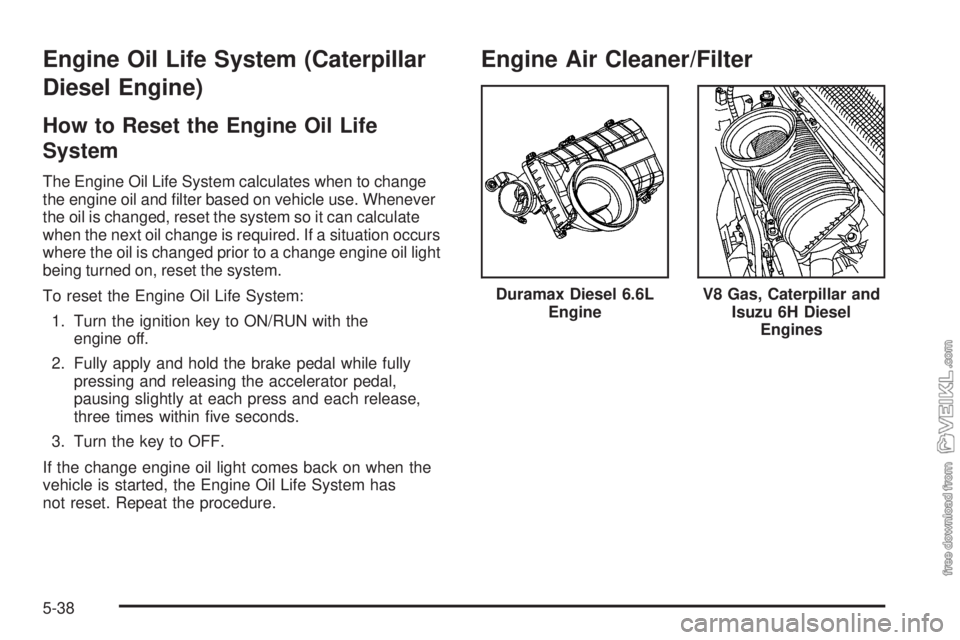
Engine Air Cleaner/Filter
Duramax Diesel 6.6L
EngineV8 Gas, Caterpillar and
Isuzu 6H Diesel
Engines
5-38
Page 252 of 376
How To Check Power Steering Fluid
Check your power steering fluid only when the engine is
warm. If the engine is not warm, you probably will not
get an accurate reading.
If the fluid level is between the MIN (Minimum) and
MAX (Maximum) marks, you have enough. If you need
fluid, add only enough of the proper fluid to bring it
in between the MIN and MAX marks.
If your power steering fluid level is low, this can cause
the brake or service brakes soon warning lights to come
on. In addition, the steering effort and emergency
brake distance could increase.
If either light remains on after you have added power
steering fluid to the proper level, then shut off the engine
for 10 seconds. This should reset the brake warning
lights. If one or both lights stay on, see “Hydraulic Brake
System Warning Lights” underBrake System Warning
Light on page 3-31for more information.
What to Use
To determine what kind of fluid to use, seePart C:
Recommended Fluids and Lubricants on page 6-31.
Notice:When adding power steering fluid or
making a complete fluid change, always use the
proper fluid. Failure to use the proper fluid can
cause leaks and damage hoses and seals.
Windshield Washer Fluid
What to Use
When you need windshield washer fluid, be sure to read
the manufacturer’s instructions before use. If you will
be operating your vehicle in an area where the
temperature may fall below freezing, use a fluid that has
sufficient protection against freezing.
5-50
Page 256 of 376
Four-Wheel Disc Brakes
(Hydraulic Only)
The vehicle has four-wheel disc brakes.
Some driving conditions or climates can cause a brake
squeal when the brakes are first applied or lightly
applied. This does not mean something is wrong with
the brakes.
Brake linings should always be replaced as complete
axle sets.
Four-Wheel and Six-Wheel Drum
Brakes (Air Only)
The brake drums should be removed and inspected
each time the tires are removed for rotation or changing.
When the front brakes are replaced, have the rear
brakes inspected, too.
Brake linings should always be replaced as complete
axle sets.
Brake Pedal Travel
See your dealer/retailer if the brake pedal does not
return to normal height, or if there is a rapid increase in
pedal travel. This could be a sign that brake service
might be required.
Brake Adjustment
Every brake stop, the brakes adjust for wear.
Brake Adjustment on Air Braked Vehicles
The vehicle has automatic slack adjusters. Every
brake stop, the brakes automatically adjust for wear.
Slack adjusters should never be manually adjusted
to correct excessive brake chamber pushrod stroke.
Excessive brake chamber pushrod stroke means
that the brake system needs to be serviced by a
qualified service technician.
Notice:Do not manually adjust automatic slack
adjusters. Manual adjustment of the automatic slack
adjusters can result in a degradation of the slack
adjuster performance over time. If the brake
chamber pushrod stroke is out of adjustment, the
brake system needs to be serviced by a qualified
service technician.
5-54
Page 265 of 376
2. Get the vehicles close enough so the jumper cables
can reach, but be sure the vehicles are not touching
each other. If they are, it could cause a ground
connection you do not want. You would not be able
to start your vehicle, and the bad grounding could
damage the electrical systems.
To avoid the possibility of the vehicles rolling, set the
parking brake firmly on both vehicles involved in the
jump start procedure. Put an automatic transmission
in P (PARK) or a manual transmission in N (Neutral)
before setting the parking brake. If you have a
four-wheel-drive vehicle, be sure the transfer case
is in a drive gear, not in N (Neutral).
Notice:If you leave the radio or other accessories
on during the jump starting procedure, they could be
damaged. The repairs would not be covered by the
warranty. Always turn off the radio and other
accessories when jump starting the vehicle.
3. Turn off the ignition on both vehicles. Unplug
unnecessary accessories plugged into the cigarette
lighter or accessory power outlets. Turn off the
radio and all lamps that are not needed. This will
avoid sparks and help save both batteries, and
it could save the radio!4. Open the hood on the other vehicle and locate the
positive (+) and the negative (−) terminal locations
on that vehicle.
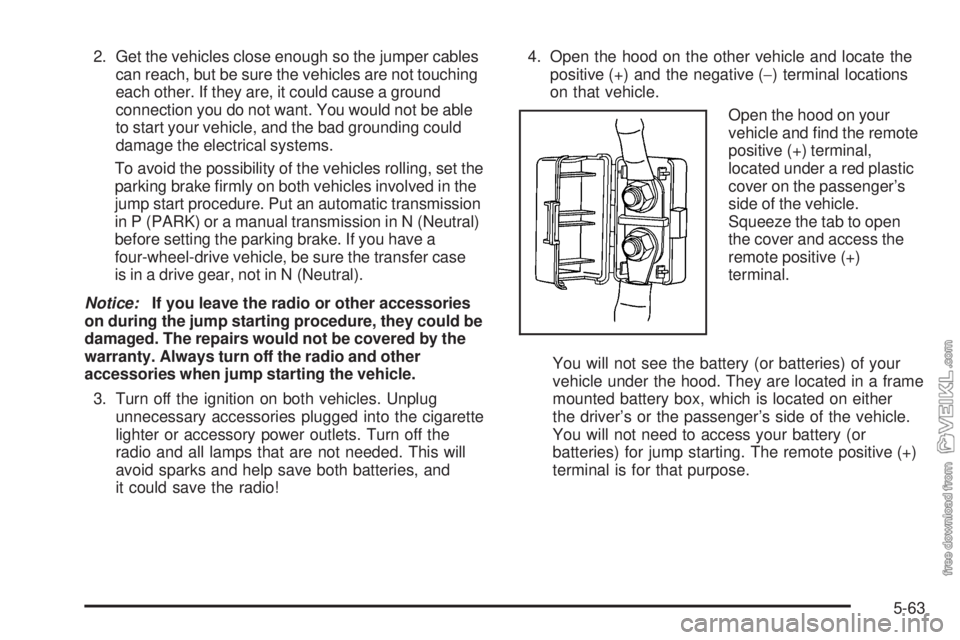
Open the hood on your
vehicle and find the remote
positive (+) terminal,
located under a red plastic
cover on the passenger’s
side of the vehicle.
Squeeze the tab to open
the cover and access the
remote positive (+)
terminal.
You will not see the battery (or batteries) of your
vehicle under the hood. They are located in a frame
mounted battery box, which is located on either
the driver’s or the passenger’s side of the vehicle.
You will not need to access your battery (or
batteries) for jump starting. The remote positive (+)
terminal is for that purpose.
5-63
Page 297 of 376
Electrical System
Add-On Electrical Equipment
Notice:Do not add anything electrical to the
vehicle unless you check with your dealer/retailer
first. Some electrical equipment can damage
the vehicle and the damage would not be covered
by the vehicle’s warranty. Some add-on electrical
equipment can keep other components from
working as they should.
Add-on equipment can drain the vehicle battery, even if
the vehicle is not operating.
The vehicle has an airbag system. Before attempting to
add anything electrical to the vehicle, seeServicing
Your Airbag-Equipped Vehicle on page 1-58.
Headlamp Wiring
The headlamp wiring is protected by a circuit breaker in
the light switch. An electrical overload will cause the lights
to go on and off, or in some cases to remain off. If this
happens, have your headlamp wiring checked right away.
Windshield Wiper Fuses
The windshield wiper motor is protected by a circuit
breaker inside the motor and a circuit breaker or fuse in
the fuse block. If the motor overheats, the wipers will
stop until the motor cools. If the overload is caused by
an electrical problem, be sure to get it fixed.
Fusible Links
A fusible link is a short piece of wire several gauge
sizes smaller than the circuit it protects. It will melt in an
overload situation, opening the circuit.
The starter and other circuits have fusible links. The size
is printed on the insulation. If the insulation is burned
beyond recognition, consult your dealer/retailer for the
proper size. Replace a fusible link with one of the same
size and insulation type. Fusible link insulation is a
special purpose high-temperature material.
Some examples of circuits with fusible links are the
hydraulic brake booster motor feed circuit, the generator
output circuit, and the intake heater feed circuit in
vehicles with a diesel engine.
5-95
Page 303 of 376
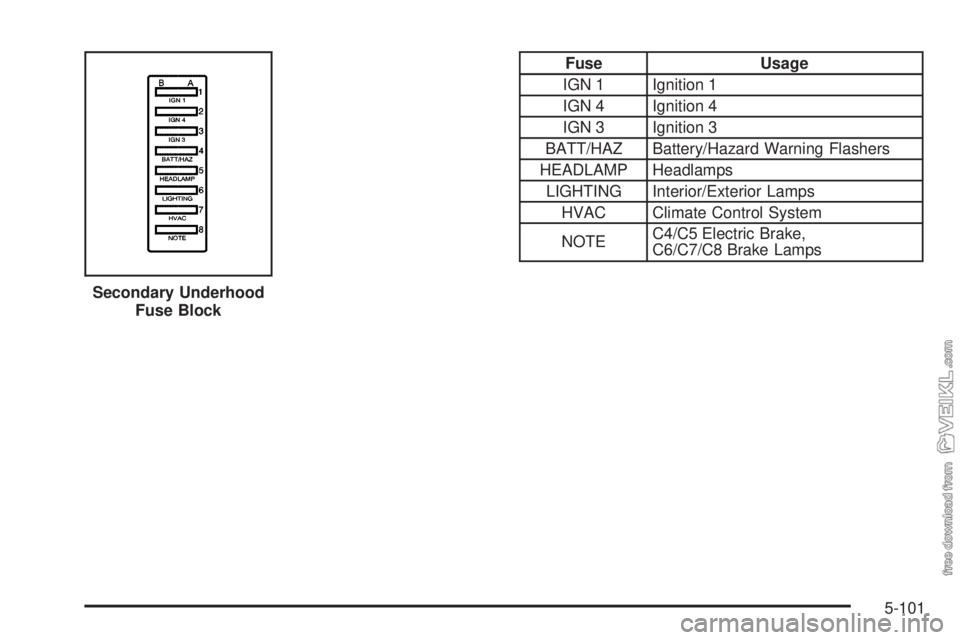
Fuse Usage
IGN 1 Ignition 1
IGN 4 Ignition 4
IGN 3 Ignition 3
BATT/HAZ Battery/Hazard Warning Flashers
HEADLAMP Headlamps
LIGHTING Interior/Exterior Lamps
HVAC Climate Control System
NOTEC4/C5 Electric Brake,
C6/C7/C8 Brake Lamps
Secondary Underhood
Fuse Block
5-101
Page 339 of 376
•Replace the air compressor filter element, mounted
on the air compressor. For remote air compressor
intake service, refer to engine air cleaner filter
replacement.
•Remove, disassemble, clean, and inspect the safety
valve, service brake chambers, quick release valves,
quick release/double check valve combinations,
parking brake control valve, double check valves,
pressure protection valves, and ether injector
(if equipped).
•Remove, disassemble, and clean the application
valve; replace parts showing wear.
•Remove, disassemble, clean, and inspect the spring
brake control valve; replace rubber parts.
(33)= Clean and lubricate air brake automatic slack
adjuster. Check pushrod travel and auto adjustment
operation. Have serviced if needed.
(34)= Air brake chamber service: Check operation,
mounting clamps, and air lines and check for leaks.
(35)= Trailer brake hand control valve service: Check
operation; lubricate cam and follower.(36)= Tighten the wheel stud nuts to the specified torque
values at 100 miles (160 km). Thereafter, tighten them
1,000 miles (1 600 km) after each time the wheel is
removed. SeeTightening the Wheel Nuts on page 5-80.
(37)= Inspect and clean any accumulated dirt, gravel,
or other foreign objects from the valves and valve boots
as needed. Using light oil, lubricate brake pedal to
brake application valve linkage components. Check any
rubber boots for cracks, holes, or deterioration and
replace if necessary.
(38)= Estimated minimum. Actual mileage depends on
fuel and oil consumed.
(39)= If the vehicle has the Isuzu diesel engine and is
used primarily for long trip, highway service, change
the engine oil and filter every 18,000 miles (28 800 km),
or every 12 months, or every 750 hours of engine
operation, whichever occurs first.
(40)= Make sure any safety belt reminder light and
safety belt assemblies are working properly. Look
for any other loose or damaged safety belt system parts.
If you see anything that might keep a safety belt
system from doing its job, have it repaired. Have any
torn or frayed safety belts replaced.
6-25
Page 342 of 376
Automatic Transmission Shift Indicator
Check
Check that the indicator points to the gear chosen.
Steering Check
Be alert for any changes in steering action, abnormal
front tire wear or steering wheel position. An inspection
or service is needed when the steering wheel is
harder to turn or has too much free play, or if there are
strange sounds when turning or parking.
Brake System Check
Be alert to the low air warning light or tone alarm, or
changes in braking action, such as repeated pulling to
one side, unusual sounds when braking or increased
brake pedal travel. Make sure air brake system reservoirs
are drained daily with full system air pressure, and check
system for leaks. Any of these conditions could indicate
the need for brake system inspection and/or service.
Engine Cooling System Service
Inspect the hoses and have them replaced if they are
cracked, swollen, or deteriorated. Inspect all pipes,
fittings, and clamps; replace as needed. Clean the
outside of the radiator and air conditioning condenser. To
help ensure proper operation, a pressure test of the
cooling system and pressure cap is recommended at
least once a year.
Exhaust System Inspection
Be alert for any changes in the sound of the exhaust
system or any smell of fumes. These are signs the
system may be leaking. Have it checked and/or repaired
at once. SeeEngine Exhaust on page 2-45and
Running the Vehicle While Parked on page 2-50.
Check to be sure that mud or dirt is not caked on the
exhaust system, especially in the area of the diesel
particulate filter and tailpipe. Clean the area as needed.
SeeDiesel Particulate Filter on page 2-46.
At high mileages, the DPF becomes loaded with ash.
This is normal. When the amount of ash loading is high,
see your dealer/retailer for DPF cleaning or replacement.
Windshield Wipers and Washers
Check
Check operation and condition of the wiper blades.
Check the flow of the washer spray.
Defroster Check
Move the control to the defrost symbol and the fan to HI
or the high symbol. Then check the airflow from the
ducts at the inside base of the windshield.
6-28
Page 343 of 376
Mirrors and Sun Visors Check
Check that friction joints hold mirrors and sun visors in
place.
Seat Adjuster Check
When adjusting a manual seat, be sure seat adjusters
latch by attempting to move the seat after latching.
Lamps Check
Check panel lighting, warning lights, indicator lights, and
interior lamps. On the outside, check: license plate lamps,
sidemarker lamps, reflectors or lights on outside mirrors,
headlamps, parking lamps, identification and clearance
lamps, taillamps, brake lamps, turn signals, backup
lamps, and hazard warning flashers. Have headlamp aim
checked at once if beams seem improperly aimed.
Glass, Mirrors, Lamps, and/or
Reflectors Condition Check
Look for broken, scratched, dirty, or damaged glass,
mirrors, lamps, or reflectors that could reduce the view
or visibility or cause injury. Replace, clean, or repair
promptly.
Door Latches Check
Check that doors close, latch, and lock tightly. Check for
broken, damaged, or missing parts that might prevent
tight latching.
Hood Latches Check
Check that the hood closes firmly. Check for broken,
damaged, loose, or missing parts that might prevent tight
latching. Make sure the secondary latch, if the vehicle
has one, keeps the hood from opening all the way when
the primary latch is released.
6-29