fuel CHEVROLET KODIAK 2009 Service Manual
[x] Cancel search | Manufacturer: CHEVROLET, Model Year: 2009, Model line: KODIAK, Model: CHEVROLET KODIAK 2009Pages: 376, PDF Size: 5.39 MB
Page 223 of 376
{CAUTION:
If you get fuel on yourself and then something
ignites it, you could be badly burned. Fuel can
spray out on you if you open the fuel cap too
quickly. This spray can happen if the tank is nearly
full, and is more likely in hot weather. Open the
fuel cap slowly and wait for any “hiss” noise to
stop. Then unscrew the cap all the way.
When reinstalling the cap, turn it clockwise until it is
tight.
Notice:If you need a new fuel cap, be sure to get
the right type. Your dealer/retailer can get one
for you. If you get the wrong type, it may not fit
properly. This may cause the malfunction indicator
lamp to light and may damage the fuel tank and
emissions system. SeeMalfunction Indicator Lamp
on page 3-36.If the vehicle has dual tanks, fill the driver side tank,
or forward tank, first. The fuel gage will give better
readings this way. The gage will show the total fuel left
in both tanks.
If the vehicle is a C4/C5 model and has dual tanks, the
engine must be off when refueling or the fuel transfer
system may become inoperable.
If the vehicle has a single tank with dual fillers, where
there is a filler on each side of the vehicle, do not
attempt to fill the tank through both fillers at the same
time. Do not fill the tank with both caps removed or
over-filling the tank and fuel spillage can result.
5-21
Page 224 of 376
Filling a Portable Fuel Container
{CAUTION:
Never fill a portable fuel container while it is in the
vehicle. Static electricity discharge from the
container can ignite the fuel vapor. You can be
badly burned and the vehicle damaged if this
occurs. To help avoid injury to you and others:
•Dispense fuel only into approved containers.
•Do not fill a container while it is inside a
vehicle, in a vehicle’s trunk, pickup bed, or on
any surface other than the ground.
•Bring the fill nozzle in contact with the inside
of the fill opening before operating the nozzle.
Contact should be maintained until the filling
is complete.
•Do not smoke while pumping fuel.
•Do not use a cellular phone while
pumping fuel.
Checking Things Under
the Hood
{CAUTION:
Things that burn can get on hot engine parts and
start a fire. These include liquids like fuel, oil,
coolant, brake fluid, windshield washer and other
fluids, and plastic or rubber. You or others could
be burned. Be careful not to drop or spill things
that will burn onto a hot engine.
5-22
Page 226 of 376
Engine Oil (DURAMAX Diesel
Engine)
Checking Engine Oil
It is a good idea to check the engine oil level every time
you get fuel.
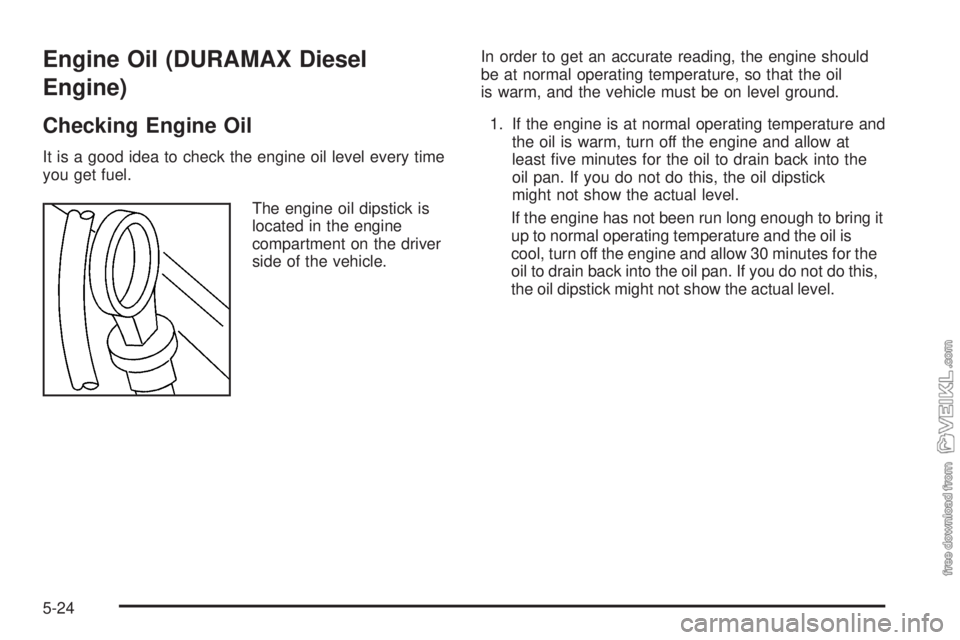
The engine oil dipstick is
located in the engine
compartment on the driver
side of the vehicle.In order to get an accurate reading, the engine should
be at normal operating temperature, so that the oil
is warm, and the vehicle must be on level ground.
1. If the engine is at normal operating temperature and
the oil is warm, turn off the engine and allow at
least five minutes for the oil to drain back into the
oil pan. If you do not do this, the oil dipstick
might not show the actual level.
If the engine has not been run long enough to bring it
up to normal operating temperature and the oil is
cool, turn off the engine and allow 30 minutes for the
oil to drain back into the oil pan. If you do not do this,
the oil dipstick might not show the actual level.
5-24
Page 230 of 376
Engine Oil (Isuzu Diesel Engine)
Checking Engine Oil
It is a good idea to check the engine oil level every time
you get fuel.
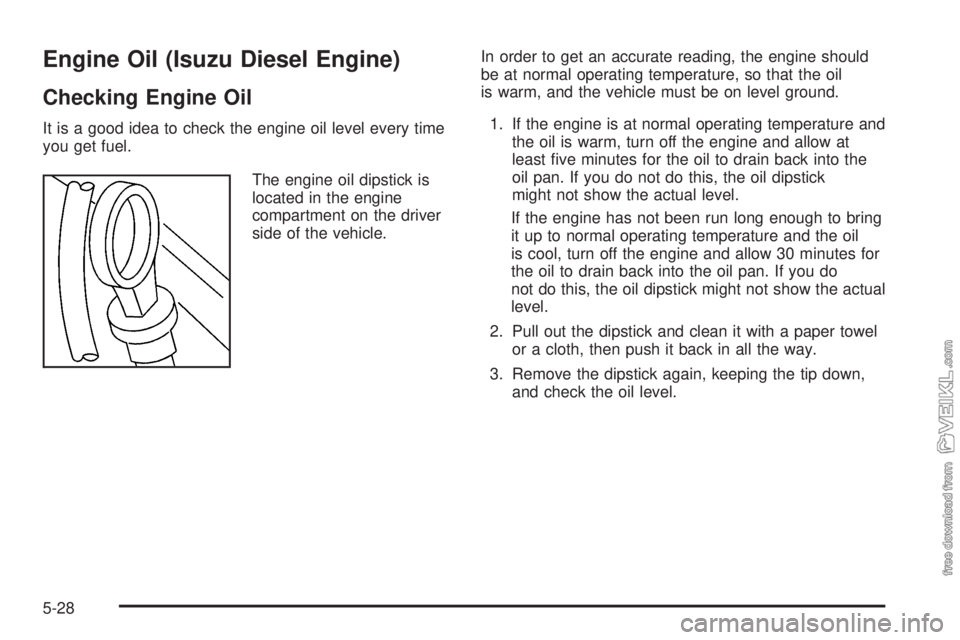
The engine oil dipstick is
located in the engine
compartment on the driver
side of the vehicle.In order to get an accurate reading, the engine should
be at normal operating temperature, so that the oil
is warm, and the vehicle must be on level ground.
1. If the engine is at normal operating temperature and
the oil is warm, turn off the engine and allow at
least five minutes for the oil to drain back into the
oil pan. If you do not do this, the oil dipstick
might not show the actual level.
If the engine has not been run long enough to bring
it up to normal operating temperature and the oil
is cool, turn off the engine and allow 30 minutes for
the oil to drain back into the oil pan. If you do
not do this, the oil dipstick might not show the actual
level.
2. Pull out the dipstick and clean it with a paper towel
or a cloth, then push it back in all the way.
3. Remove the dipstick again, keeping the tip down,
and check the oil level.
5-28
Page 234 of 376
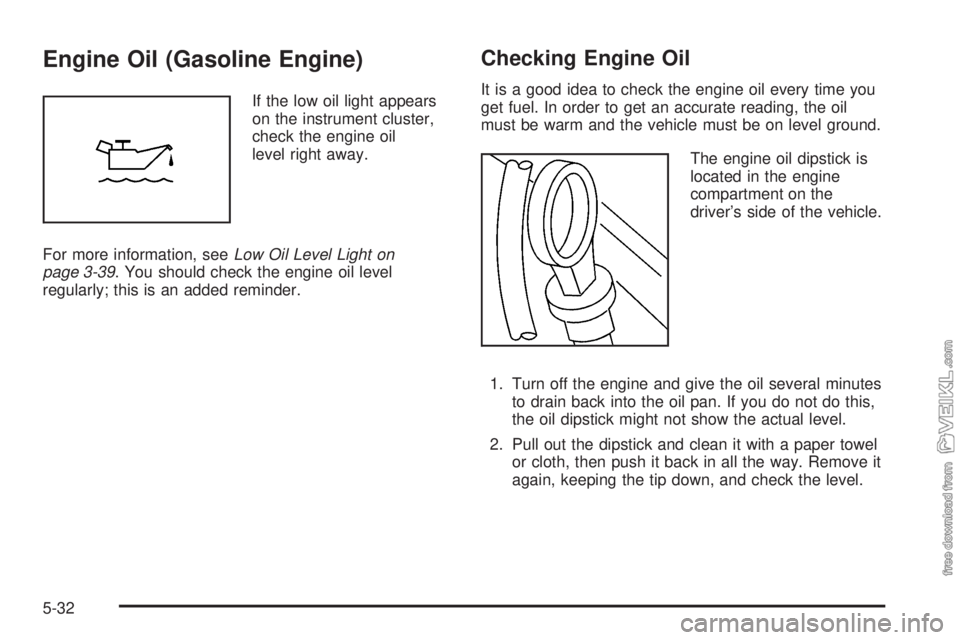
Engine Oil (Gasoline Engine)
If the low oil light appears
on the instrument cluster,
check the engine oil
level right away.
For more information, seeLow Oil Level Light on
page 3-39. You should check the engine oil level
regularly; this is an added reminder.
Checking Engine Oil
It is a good idea to check the engine oil every time you
get fuel. In order to get an accurate reading, the oil
must be warm and the vehicle must be on level ground.
The engine oil dipstick is
located in the engine
compartment on the
driver’s side of the vehicle.
1. Turn off the engine and give the oil several minutes
to drain back into the oil pan. If you do not do this,
the oil dipstick might not show the actual level.
2. Pull out the dipstick and clean it with a paper towel
or cloth, then push it back in all the way. Remove it
again, keeping the tip down, and check the level.
5-32
Page 251 of 376
If you get the overheat warning with no sign of steam,
try this for a minute or so:
1. In heavy traffic, let the engine idle in N (Neutral)
while stopped. If it is safe to do so, pull off the
road, shift to P (Park) or N (Neutral) and let
the engine idle.
2. Turn on your heater to full hot at the highest fan
speed and open the windows as necessary.
3. If climbing a hill, downshift to raise engine and fan
speeds.
If you no longer have the overheat warning, you can
drive. Just to be safe, drive slower for about 10 minutes.
If the warning does not come back on, you can drive
normally.
If the warning continues and you have not stopped, pull
over, stop, and park your vehicle right away.
If there is still no sign of steam, you can push down the
accelerator until the engine speed is about twice as
fast as normal idle speed for at least three minutes while
you are parked. If you still have the warning, turn off
the engine and get everyone out of the vehicle until it
cools down.
You may decide not to lift the hood but to get service
help right away.Engine Fan Noise
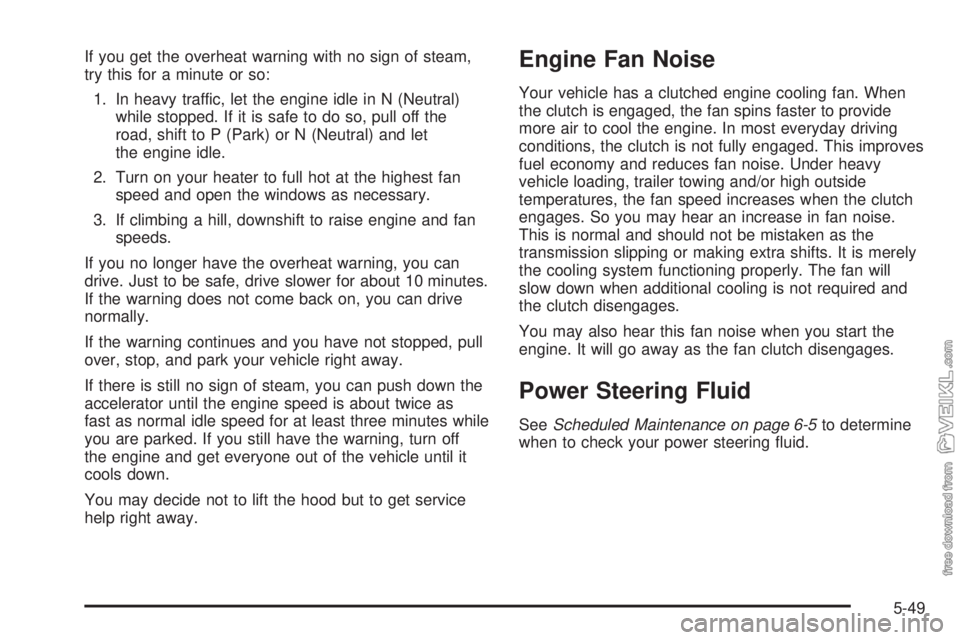
Your vehicle has a clutched engine cooling fan. When
the clutch is engaged, the fan spins faster to provide
more air to cool the engine. In most everyday driving
conditions, the clutch is not fully engaged. This improves
fuel economy and reduces fan noise. Under heavy
vehicle loading, trailer towing and/or high outside
temperatures, the fan speed increases when the clutch
engages. So you may hear an increase in fan noise.
This is normal and should not be mistaken as the
transmission slipping or making extra shifts. It is merely
the cooling system functioning properly. The fan will
slow down when additional cooling is not required and
the clutch disengages.
You may also hear this fan noise when you start the
engine. It will go away as the fan clutch disengages.
Power Steering Fluid
SeeScheduled Maintenance on page 6-5to determine
when to check your power steering fluid.
5-49
Page 274 of 376
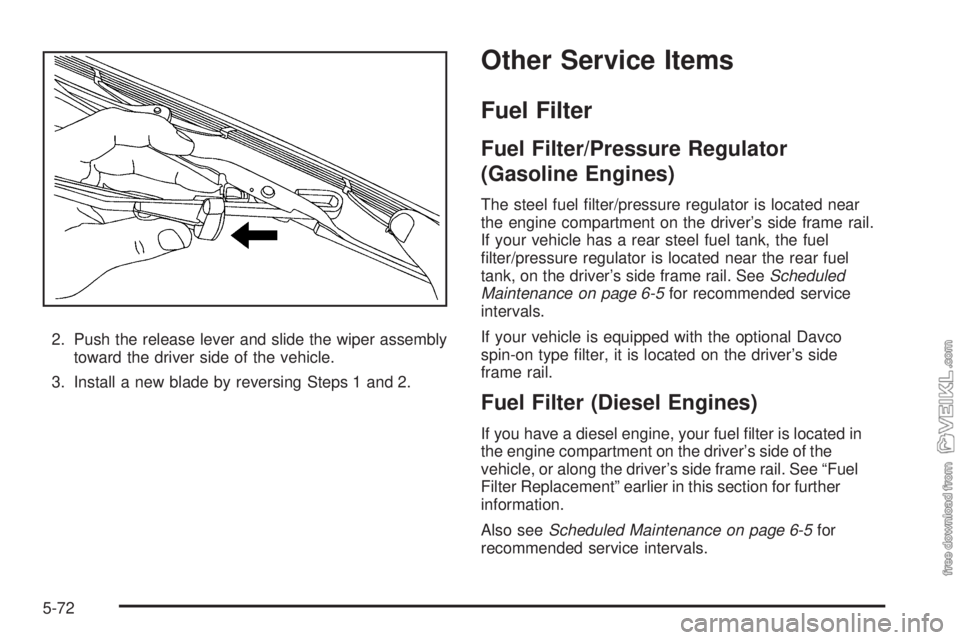
2. Push the release lever and slide the wiper assembly
toward the driver side of the vehicle.
3. Install a new blade by reversing Steps 1 and 2.
Other Service Items
Fuel Filter
Fuel Filter/Pressure Regulator
(Gasoline Engines)
The steel fuel filter/pressure regulator is located near
the engine compartment on the driver’s side frame rail.
If your vehicle has a rear steel fuel tank, the fuel
filter/pressure regulator is located near the rear fuel
tank, on the driver’s side frame rail. SeeScheduled
Maintenance on page 6-5for recommended service
intervals.
If your vehicle is equipped with the optional Davco
spin-on type filter, it is located on the driver’s side
frame rail.
Fuel Filter (Diesel Engines)
If you have a diesel engine, your fuel filter is located in
the engine compartment on the driver’s side of the
vehicle, or along the driver’s side frame rail. See “Fuel
Filter Replacement” earlier in this section for further
information.
Also seeScheduled Maintenance on page 6-5for
recommended service intervals.
5-72
Page 275 of 376
Primary Fuel Filter and Water
Separator
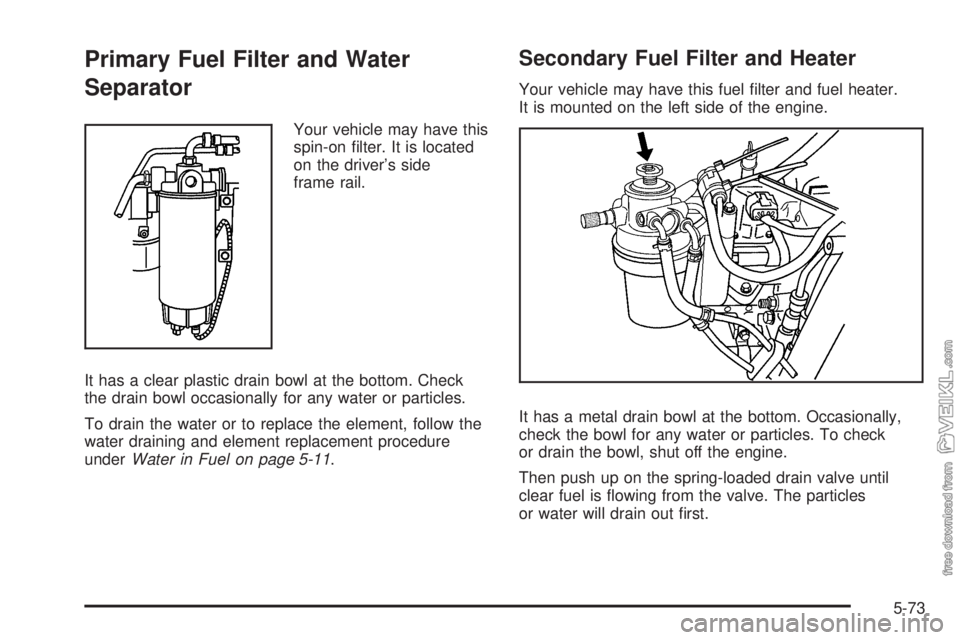
Your vehicle may have this
spin-on filter. It is located
on the driver’s side
frame rail.
It has a clear plastic drain bowl at the bottom. Check
the drain bowl occasionally for any water or particles.
To drain the water or to replace the element, follow the
water draining and element replacement procedure
underWater in Fuel on page 5-11.
Secondary Fuel Filter and Heater
Your vehicle may have this fuel filter and fuel heater.
It is mounted on the left side of the engine.
It has a metal drain bowl at the bottom. Occasionally,
check the bowl for any water or particles. To check
or drain the bowl, shut off the engine.
Then push up on the spring-loaded drain valve until
clear fuel is flowing from the valve. The particles
or water will drain out first.
5-73
Page 276 of 376
Secondary Fuel Filter and Water
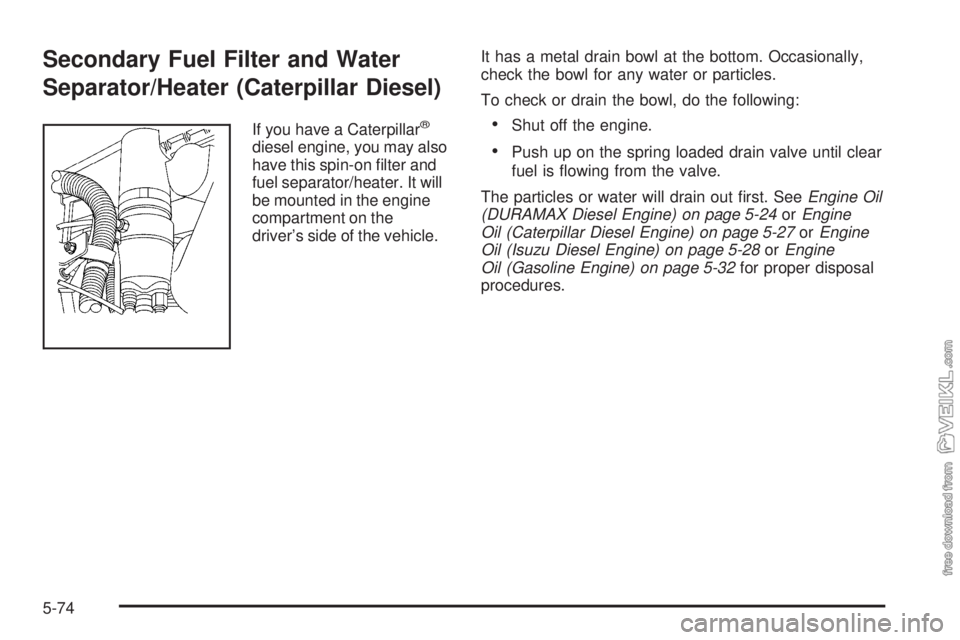
Separator/Heater (Caterpillar Diesel)
If you have a Caterpillar®
diesel engine, you may also
have this spin-on filter and
fuel separator/heater. It will
be mounted in the engine
compartment on the
driver’s side of the vehicle.It has a metal drain bowl at the bottom. Occasionally,
check the bowl for any water or particles.
To check or drain the bowl, do the following:
•Shut off the engine.
•Push up on the spring loaded drain valve until clear
fuel is flowing from the valve.
The particles or water will drain out first. SeeEngine Oil
(DURAMAX Diesel Engine) on page 5-24orEngine
Oil (Caterpillar Diesel Engine) on page 5-27orEngine
Oil (Isuzu Diesel Engine) on page 5-28orEngine
Oil (Gasoline Engine) on page 5-32for proper disposal
procedures.
5-74
Page 279 of 376
Inflation - Tire Pressure
Tires need the correct amount of air pressure to operate
effectively. The Certification or Tire Information label
shows the correct inflation pressures for your tires
when they are cold. Cold means your vehicle has been
sitting for at least three hours or driven no more than
1 mile (1.6 km).
Notice:Do not let anyone tell you that
under-inflation or over-inflation is all right. It is
not. If your tires do not have enough air
(under-inflation), you can get the following:
•Too much flexing
•Too much heat
•Tire overloading
•Premature or irregular wear
•Poor handling
•Reduced fuel economy
If your tires have too much air (over-inflation),
you can get the following:
•Unusual wear
•Poor handling
•Rough ride
•Needless damage from road hazards
When to Check
Check your tires once a month or more.
Also, check the tire pressure of the spare tire if your
vehicle has one.
How to Check
Use a good quality pocket-type gage to check tire
pressure. You cannot tell if your vehicle’s tires are
properly inflated simply by looking at them. Radial
tires may look properly inflated even when they are
underinflated. Check the tire’s inflation pressure when
the tires are cold. Cold means your vehicle has been
sitting for at least three hours or driven no more than
1 mile (1.6 km).
Remove the valve cap from the tire valve stem. Press
the tire gage firmly onto the valve to get a pressure
measurement. If the cold tire inflation pressure matches
the recommended pressure on the Certification or Tire
Information label, no further adjustment is necessary.
If the inflation pressure is low, add air until you reach the
recommended amount. If you overfill the tire, release air
by pushing on the metal stem in the center of the tire
valve. Re-check the tire pressure with the tire gage.
Be sure to put the valve caps back on the valve stems.
They help prevent leaks by keeping out dirt and moisture.
5-77