overheating CHEVROLET KODIAK 2009 Owners Manual
[x] Cancel search | Manufacturer: CHEVROLET, Model Year: 2009, Model line: KODIAK, Model: CHEVROLET KODIAK 2009Pages: 376, PDF Size: 5.39 MB
Page 76 of 376
Engine Starter Over-Crank
Protection
The vehicle may have an engine starter over-crank
protection system. If the starter motor overheats and
shuts off due to over-cranking, the motor must cool down
before it will reset and allow starter operation. It can take
up to six minutes before the starter will work again.
Starting the Gasoline Engine
The 8th digit of the Vehicle Identification Number (VIN)
shows the code letter for the engine. Use this number
to verify the type of engine in the vehicle. SeeVehicle
Identification Number (VIN) on page 5-94. Follow
the proper steps to start the engine.
To start a diesel engine, seeStarting the Diesel Engine
on page 2-14.
Automatic Transmission
Set the parking brake and move the shifter to N (Neutral)
or P (Park), if so equipped. The engine will not start in
any other position.
Manual Transmission
Set the parking brake, shift to N (Neutral) and hold the
clutch pedal to the floor while starting the engine.
Starter Motor Operation
•The starter motor will disengage if you release the
key or the engine reaches a predetermined engine
speed.
•To prevent overheating, the starter motor will
disengage after continuously operating for
15 seconds. You must release the key from the
start position to re-engage the starter.
•The starter motor will not engage if the engine is
already running.
•The starter motor will disengage if, after
two seconds, the starter pinion gear does not
engage the flywheel or there is no engine rpm
signal from the engine speed sensor.
2-12
Page 88 of 376
During this warm-up period, check the warning lights
and gages:
•If oil pressure does not begin to rise within
15 seconds of starting, stop the engine and find the
cause. SeeOil Pressure Gage on page 3-38for
more information.
•If the engine coolant temperature gage needle goes
into the hot area on the gage, stop the engine and
find the cause of the overheating. SeeEngine
Coolant Temperature Gage on page 3-34for more
information.
•If you have air brakes, the dual-needle air pressure
gage should read at least 115 psi (790 kPa) for both
service systems before you try to move the vehicle.
When air pressure is below 60 psi (420 kPa), the
LOW AIR light will come on and you will hear a
tone alarm. SeeBrake System Warning Light on
page 3-31for more information. If the pressure does
not build up or drops during warm-up, stop the
engine and find the cause before you try to move the
vehicle. Recommended air pressure before driving is
120 psi (830 kPa). SeeAir Pressure Gage on
page 3-47for more information.
•The charging system light should come on when the
ignition key is turned to ON/RUN or START and
should go out when the engine is running above idle.
If the light does not go out or comes back on during
normal engine operation, have the charging system
checked right away. (This light tells you if the
generator is not charging; it does not reflect the
condition of the battery.) SeeCharging System Light
on page 3-29for more information.
•The voltmeter charge indicator gage tells you the
condition of the battery’s charge. The gage should be
in the center area during engine operation. The red
area on the left indicates an undercharge condition;
the red area on the right indicates an overcharge.
If the gage is in either red area, have the battery and
charging system checked right away. SeeVoltmeter
Gage on page 3-30for more information.
Notice:Do not allow the engine to operate at low
idle for more than five minutes. This can cause low
engine operating temperatures which can affect
engine operation and reduce engine life. Engine idle
speed should be increased to 1200 rpm whenever
extended idle is required. Once started, the engine
should be placed under load to allow the engine
coolant temperature to reach 150°F (66°C) before
shutting off the engine.
2-24
Page 137 of 376
Accessory Power Outlet(s)
Accessory power outlets let you plug in auxiliary
electrical equipment, such as a cellular telephone.
The accessory power outlet is located on the
passenger’s side of the instrument panel.
To use an outlet, pull the cover down. When not using
it, always cover the outlet with the protective cap.
This circuit is protected by a fuse and has a maximum
current level.
Notice:Leaving electrical equipment on for
extended periods will drain the battery. Always turn
off electrical equipment when not in use and do not
plug in equipment that exceeds the maximum
amperage rating.
Certain electrical accessories may not be compatible
with the accessory power outlet and could result
in blown vehicle or adapter fuses. If you experience a
problem, see your dealer/retailer for additional
information on accessory power outlets.
Notice:Adding any electrical equipment to the
vehicle can damage it or keep other components
from working as they should. The repairs would not
be covered by the vehicle warranty. Do not use
equipment exceeding maximum amperage rating of
20 amperes. Check with your dealer/retailer before
adding electrical equipment.When adding electrical equipment, be sure to follow the
proper installation instructions included with the
equipment.
Notice:Improper use of the power outlet can cause
damage not covered by the warranty. Do not hang
any type of accessory or accessory bracket from the
plug because the power outlets are designed for
accessory power plugs only.
Ashtray(s) and Cigarette Lighter
For vehicles with an ashtray and a cigarette lighter, they
are located in the center floor console. To open the
removable ashtray, flip open the top.
Notice:If papers, pins, or other flammable items
are put in the ashtray, hot cigarettes or other
smoking materials could ignite them and possibly
damage the vehicle. Never put flammable items
in the ashtray.
To use the cigarette lighter, push it in all the way and let
it go. When it’s ready, it will pop back out by itself.
Notice:Holding a cigarette lighter in while it
is heating does not let the lighter back away from
the heating element when it is hot. Damage from
overheating can occur to the lighter or heating
element, or a fuse could be blown. Do not hold a
cigarette lighter in while it is heating.
3-19
Page 152 of 376
Trailer Antilock Brake System
Warning Light
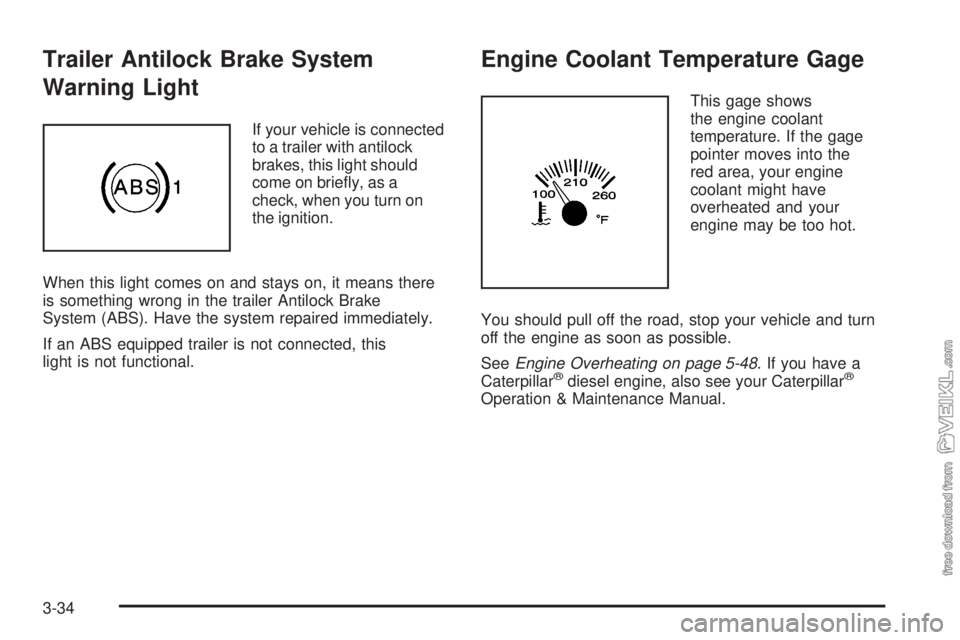
If your vehicle is connected
to a trailer with antilock
brakes, this light should
come on briefly, as a
check, when you turn on
the ignition.
When this light comes on and stays on, it means there
is something wrong in the trailer Antilock Brake
System (ABS). Have the system repaired immediately.
If an ABS equipped trailer is not connected, this
light is not functional.
Engine Coolant Temperature Gage
This gage shows
the engine coolant
temperature. If the gage
pointer moves into the
red area, your engine
coolant might have
overheated and your
engine may be too hot.
You should pull off the road, stop your vehicle and turn
off the engine as soon as possible.
SeeEngine Overheating on page 5-48. If you have a
Caterpillar
®diesel engine, also see your Caterpillar®
Operation & Maintenance Manual.
3-34
Page 203 of 376
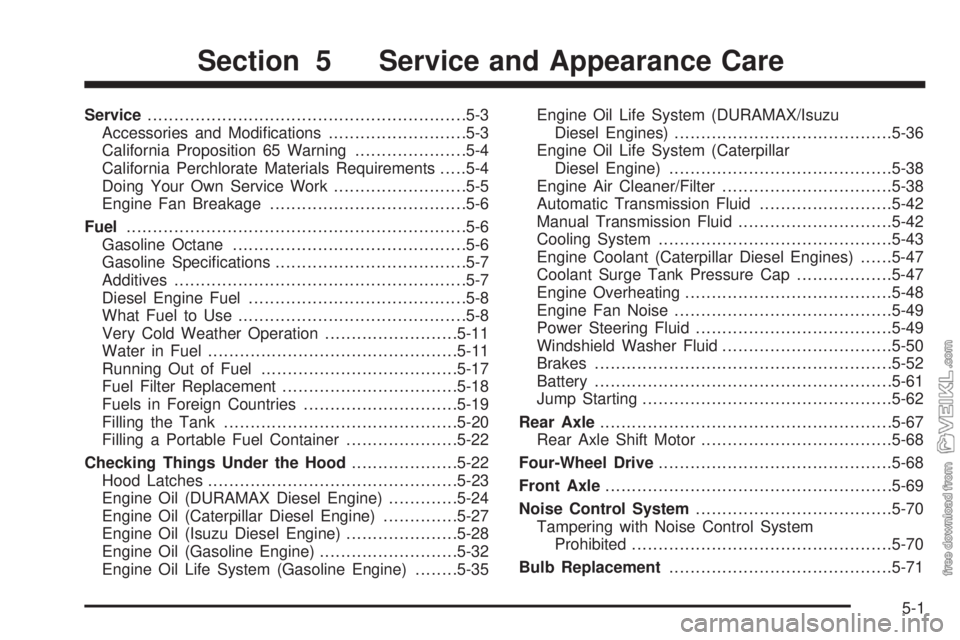
Service............................................................5-3
Accessories and Modifications..........................5-3
California Proposition 65 Warning.....................5-4
California Perchlorate Materials Requirements.....5-4
Doing Your Own Service Work.........................5-5
Engine Fan Breakage.....................................5-6
Fuel................................................................5-6
Gasoline Octane............................................5-6
Gasoline Specifications....................................5-7
Additives.......................................................5-7
Diesel Engine Fuel.........................................5-8
What Fuel to Use...........................................5-8
Very Cold Weather Operation.........................5-11
Water in Fuel...............................................5-11
Running Out of Fuel.....................................5-17
Fuel Filter Replacement.................................5-18
Fuels in Foreign Countries.............................5-19
Filling the Tank............................................5-20
Filling a Portable Fuel Container.....................5-22
Checking Things Under the Hood....................5-22
Hood Latches...............................................5-23
Engine Oil (DURAMAX Diesel Engine).............5-24
Engine Oil (Caterpillar Diesel Engine)..............5-27
Engine Oil (Isuzu Diesel Engine).....................5-28
Engine Oil (Gasoline Engine)..........................5-32
Engine Oil Life System (Gasoline Engine)........5-35Engine Oil Life System (DURAMAX/Isuzu
Diesel Engines).........................................5-36
Engine Oil Life System (Caterpillar
Diesel Engine)..........................................5-38
Engine Air Cleaner/Filter................................5-38
Automatic Transmission Fluid.........................5-42
Manual Transmission Fluid.............................5-42
Cooling System............................................5-43
Engine Coolant (Caterpillar Diesel Engines)......5-47
Coolant Surge Tank Pressure Cap..................5-47
Engine Overheating.......................................5-48
Engine Fan Noise.........................................5-49
Power Steering Fluid.....................................5-49
Windshield Washer Fluid................................5-50
Brakes........................................................5-52
Battery........................................................5-61
Jump Starting...............................................5-62
Rear Axle.......................................................5-67
Rear Axle Shift Motor....................................5-68
Four-Wheel Drive............................................5-68
Front Axle......................................................5-69
Noise Control System.....................................5-70
Tampering with Noise Control System
Prohibited.................................................5-70
Bulb Replacement..........................................5-71
Section 5 Service and Appearance Care
5-1
Page 250 of 376
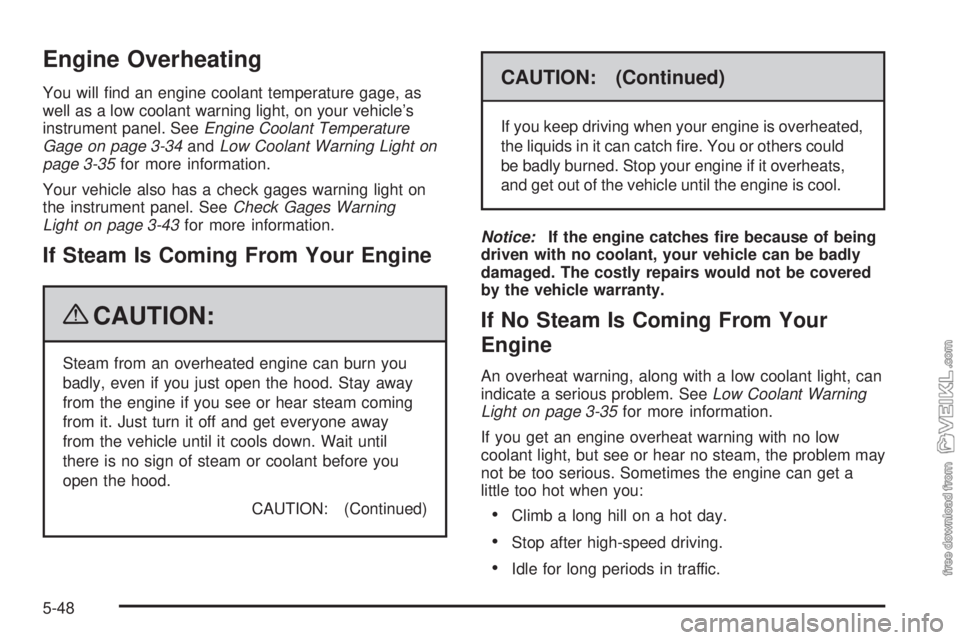
Engine Overheating
You will find an engine coolant temperature gage, as
well as a low coolant warning light, on your vehicle’s
instrument panel. SeeEngine Coolant Temperature
Gage on page 3-34andLow Coolant Warning Light on
page 3-35for more information.
Your vehicle also has a check gages warning light on
the instrument panel. SeeCheck Gages Warning
Light on page 3-43for more information.
If Steam Is Coming From Your Engine
{CAUTION:
Steam from an overheated engine can burn you
badly, even if you just open the hood. Stay away
from the engine if you see or hear steam coming
from it. Just turn it off and get everyone away
from the vehicle until it cools down. Wait until
there is no sign of steam or coolant before you
open the hood.
CAUTION: (Continued)
CAUTION: (Continued)
If you keep driving when your engine is overheated,
the liquids in it can catch fire. You or others could
be badly burned. Stop your engine if it overheats,
and get out of the vehicle until the engine is cool.
Notice:If the engine catches fire because of being
driven with no coolant, your vehicle can be badly
damaged. The costly repairs would not be covered
by the vehicle warranty.
If No Steam Is Coming From Your
Engine
An overheat warning, along with a low coolant light, can
indicate a serious problem. SeeLow Coolant Warning
Light on page 3-35for more information.
If you get an engine overheat warning with no low
coolant light, but see or hear no steam, the problem may
not be too serious. Sometimes the engine can get a
little too hot when you:
•Climb a long hill on a hot day.
•Stop after high-speed driving.
•Idle for long periods in traffic.
5-48
Page 278 of 376
Tires
Your new vehicle comes with high-quality tires
made by a leading tire manufacturer. If you ever
have questions about your tire warranty and where
to obtain service, see your vehicle Warranty booklet
for details. For additional information refer to the tire
manufacturer.
{CAUTION:
Poorly maintained and improperly used tires
are dangerous.
•Overloading your vehicle’s tires can
cause overheating as a result of too
much flexing. You could have an air-out
and a serious accident. SeeLoading the
Vehicle on page 4-20.
CAUTION: (Continued)
CAUTION: (Continued)
•
Underinflated tires pose the same danger
as overloaded tires. The resulting accident
could cause serious injury. Check all tires
frequently to maintain the recommended
pressure. Tire pressure should be
checked when your vehicle’s tires are
cold. SeeInflation - Tire Pressure on
page 5-77.
•Overinflated tires are more likely to be
cut, punctured, or broken by a sudden
impact — such as when you hit a pothole.
Keep tires at the recommended pressure.
•Worn, old tires can cause accidents. If the
tire’s tread is badly worn, or if your
vehicle’s tires have been damaged,
replace them.
5-76
Page 369 of 376
Engine (cont.)
Overheating................................................5-48
Overspeed Warning Light..............................3-40
Reduced Power Light...................................3-42
Shutdown Warning Light...............................3-40
Speed Limiter.............................................3-25
Starter Over-Crank Protection........................2-12
Starting Diesel............................................2-14
Starting the Gasoline...................................2-12
Entry Lighting.................................................3-17
Event Data Recorders.....................................7-12
Exhaust Brake Indicator Light...........................3-41
Exhaust Restrictor...........................................2-22
Extender, Safety Belt.......................................1-28
Exterior Lamps...............................................3-14
F
Filter
Engine Air Cleaner......................................5-38
Filter Minder Gage..........................................3-46
Finish Damage...............................................5-93
Fixed Mast Antenna........................................3-58
Flashers, Hazard Warning.................................. 3-6
Flat Tire........................................................5-85
Fluid
Automatic Transmission................................5-42
Power Steering...........................................5-49
Windshield Washer......................................5-50
Four-Wheel Drive....................................2-30, 5-68Front Axle......................................................5-69
Front Wheel Bearings with
Oil-Filled Hubs............................................5-75
Fuel............................................................... 5-6
Additives...................................................... 5-7
Change Filter Warning Light..........................3-45
Diesel Engine Fuel........................................ 5-8
Driving for Better Economy............................. 4-2
Filling a Portable Fuel Container....................5-22
Filling the Tank...........................................5-20
Filter..........................................................5-72
Filter Replacement.......................................5-18
Fuels in Foreign Countries............................5-19
Gage .........................................................3-44
Gasoline Octane........................................... 5-6
Gasoline Specifications.................................. 5-7
Primary Filter and Water Separator................5-73
Running Out of Fuel....................................5-17
Secondary Filter and Water
Separator/Heater......................................5-74
Very Cold Weather Operation........................5-11
Water in Fuel..............................................5-11
Water in Warning Light.................................3-45
What Fuel to Use.......................................... 5-8
Fuses
Fuses and Circuit Breakers...........................5-96
Instrument Panel Fuse Block.........................5-96
Underhood Fuse Block.................................5-99
Windshield Wiper.........................................5-95
5