brake fluid CHEVROLET LOW CAB FORWARD 2017 User Guide
[x] Cancel search | Manufacturer: CHEVROLET, Model Year: 2017, Model line: LOW CAB FORWARD, Model: CHEVROLET LOW CAB FORWARD 2017Pages: 414, PDF Size: 7.97 MB
Page 146 of 414
Chevrolet Low Cab Forward Owner Manual (GMNA-Localizing-U.S.-
10716700) - 2017 - crc - 12/6/16
Driving and Operating 145
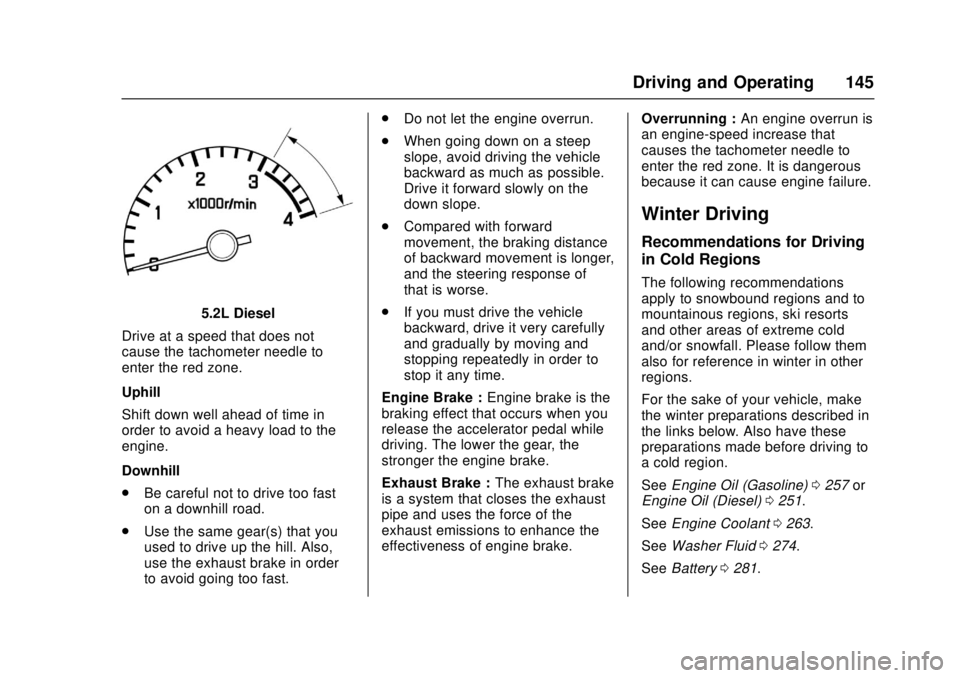
5.2L Diesel
Drive at a speed that does not
cause the tachometer needle to
enter the red zone.
Uphill
Shift down well ahead of time in
order to avoid a heavy load to the
engine.
Downhill
. Be careful not to drive too fast
on a downhill road.
. Use the same gear(s) that you
used to drive up the hill. Also,
use the exhaust brake in order
to avoid going too fast. .
Do not let the engine overrun.
. When going down on a steep
slope, avoid driving the vehicle
backward as much as possible.
Drive it forward slowly on the
down slope.
. Compared with forward
movement, the braking distance
of backward movement is longer,
and the steering response of
that is worse.
. If you must drive the vehicle
backward, drive it very carefully
and gradually by moving and
stopping repeatedly in order to
stop it any time.
Engine Brake : Engine brake is the
braking effect that occurs when you
release the accelerator pedal while
driving. The lower the gear, the
stronger the engine brake.
Exhaust Brake : The exhaust brake
is a system that closes the exhaust
pipe and uses the force of the
exhaust emissions to enhance the
effectiveness of engine brake. Overrunning :
An engine overrun is
an engine-speed increase that
causes the tachometer needle to
enter the red zone. It is dangerous
because it can cause engine failure.
Winter Driving
Recommendations for Driving
in Cold Regions
The following recommendations
apply to snowbound regions and to
mountainous regions, ski resorts
and other areas of extreme cold
and/or snowfall. Please follow them
also for reference in winter in other
regions.
For the sake of your vehicle, make
the winter preparations described in
the links below. Also have these
preparations made before driving to
a cold region.
See Engine Oil (Gasoline) 0257 or
Engine Oil (Diesel) 0251.
See Engine Coolant 0263.
See Washer Fluid 0274.
See Battery 0281.
Page 158 of 414
Chevrolet Low Cab Forward Owner Manual (GMNA-Localizing-U.S.-
10716700) - 2017 - crc - 12/6/16
Driving and Operating 157
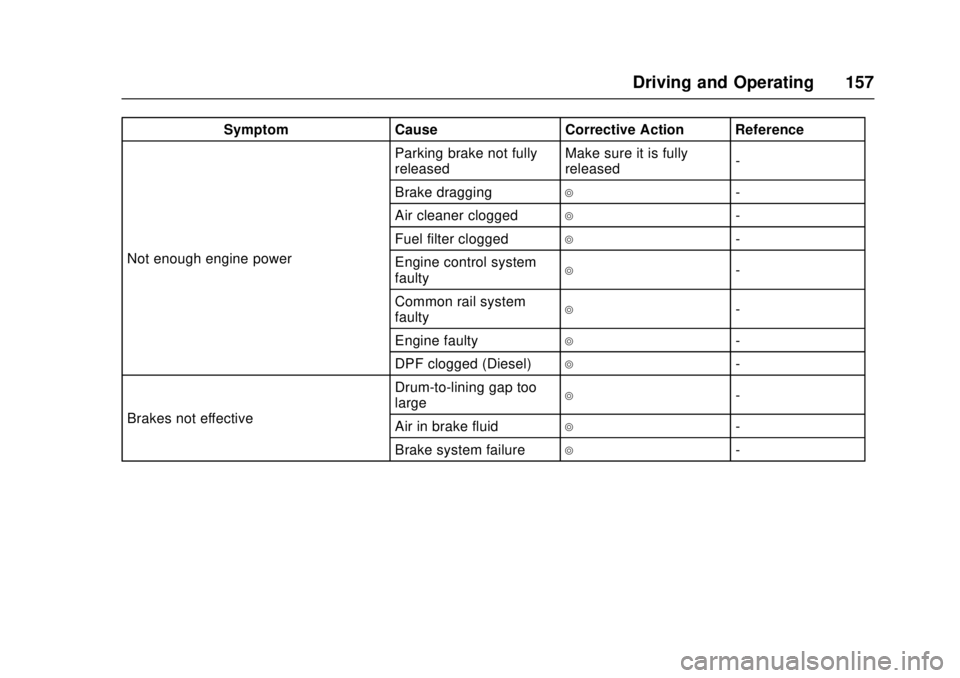
SymptomCauseCorrective Action Reference
Not enough engine power Parking brake not fully
released
Make sure it is fully
released
-
Brake dragging
4-
Air cleaner clogged
4-
Fuel filter clogged
4-
Engine control system
faulty
4-
Common rail system
faulty
4-
Engine faulty
4-
DPF clogged (Diesel)
4-
Brakes not effective Drum-to-lining gap too
large
4-
Air in brake fluid
4-
Brake system failure
4-
Page 159 of 414

Chevrolet Low Cab Forward Owner Manual (GMNA-Localizing-U.S.-
10716700) - 2017 - crc - 12/6/16
158 Driving and Operating
SymptomCauseCorrective Action Reference
Uneven braking Unbalanced air pressure
in tires
Adjust to proper air
pressureSee
Wheels and
Tires 0308
Tire unevenly worn Replace tire See
Wheels and
Tires 0308
Drum brake out of
adjustment
4-
Poor wheel alignment
4-
Exhaust brake not working (Diesel) The electrical system is
faulty
4-
Steering wheel hard to turn Loaded too far forward Load properly -
Power steering fluid level
too low
Add fluidSee
Power
Steering Fluid
0 273
Insufficient air in front
tires Adjust to proper inflation
pressureSee
Wheels and
Tires 0308
Page 167 of 414
Chevrolet Low Cab Forward Owner Manual (GMNA-Localizing-U.S.-
10716700) - 2017 - crc - 12/6/16
166 Driving and Operating
engine is running. If it stays on,
shut the engine off and find the
cause.
2. Look at the engine coolant temperature gauge. If the
gauge reaches the H (HOT)
area, stop the engine and find
the cause of the overheating.
3. Check that the battery warning light has gone out. The light
should go off and stay off at
normal idle speeds. If the light
does not go out or comes on
during normal operation, have
the charging system checked.
4. Check that the brake low vacuum warning light is out
and that the vacuum buzzer is
not sounding. It is normal for
the warning buzzer to sound
for a few seconds after the
engine starts. If the light and
buzzer remain on, do not drive
the vehicle until the cause has
been found and corrected.
5. Look at the brake system warning light. It should be out
when the parking brake is
released and the engine is running. If it stays on, it could
mean that the brake fluid level
is low. Check the brake fluid
reservoir. This condition must
be corrected before moving the
vehicle.
Caution
To reduce the chance of personal
injury and/or vehicle damage due
to engine overheating, never
leave the engine idling without an
alert driver present. If the engine
should overheat, as indicated by
the engine coolant temperature
gauge, immediate action is
required to correct the condition.
Continued operation of the
engine, even for a short time, may
result in a fire.
Starting the Engine
Do not keep the engine control
switch in the START position for
more than about 10 seconds.
Operating the starter for too long
might cause starter and battery
failure or may result in overheating. When the engine does not start,
wait for 20 to 30 seconds and then
turn the engine control switch again.
Before starting the engine sit in the
driver seat, check that the parking
brake is firmly engaged, the selector
lever is in the P or N (P is preferred)
position and the shift indicator also
shows P or N, and firmly press the
brake pedal to start the engine. See
Ignition Positions
0163.
{Warning
Do not keep the starter motor
engaged for more than
10 seconds at a time, or the
starter motor and the battery will
be adversely affected. Also, fire
may occur due to overheating.
Repeat the steps after a 20 to
30 seconds break.
1. Shift your selector lever to P (Park) or N (Neutral). Your
engine will not start in any
other position-that's a safety
Page 173 of 414

Chevrolet Low Cab Forward Owner Manual (GMNA-Localizing-U.S.-
10716700) - 2017 - crc - 12/6/16
172 Driving and Operating
If the Vehicle Has Not Been Used
for a Long Period
If a diesel vehicle has been
standing for an extended period of
time, the turbocharger bearings
should be pre-lubricated prior to
starting. See your authorized dealer
for more detailed information.
Before using a vehicle that has not
been driven for a long period, check
the engine and transmission for oil
leakage, and make sure the oil is at
the required levels. If there is
insufficient oil, it will not adequately
reach and lubricate components,
and a breakdown will result.
Start the engine and allow it to idle
for at least five minutes. Check for
abnormal noises.
For instructions on warming up the
engine, refer to“Starting the Engine”
previously in this section.
For diesel vehicles, if 1 year has
passed since the diesel exhaust
fluid (DEF) in the DEF tank was
added, the DEF in the tank should
be replaced. Be careful not to inhale
the ammonia odor when replacing the DEF. Also, please contact your
nearest dealer about the
replacement work.
Operating Temperature
Recommendations for Warming
Up the Engine
The engine is sufficiently warmed
up when the needle of the engine
coolant temperature gauge starts
to move.
Do not race the engine or quickly
accelerate before the engine has
sufficiently warmed up. Oil would
not have adequately reached and
lubricated components, and a
breakdown may result.
The exhaust pipe becomes
extremely hot while the engine is
idling. Before warming up the
engine, make sure there is no
flammable material, such as grass,
waste paper, oil, or old tires near the
exhaust pipe.
Engine Warm-up System
During cold ambient conditions, the
automatic engine warm-up system
operates to reduce engine warm-up
time during idling.
Automatic Engine Warm-up :
When the engine is idling with the
engine coolant temperature below
62 °C (144 °F), the engine warm-up
system automatically closes the
exhaust brake and increases engine
idle speed so that the engine is
warmed more quickly. Warm-up is
cancelled when the accelerator
pedal is pressed, and resumed
when the pedal is released.
Warm-up is automatically cancelled
entirely after the engine coolant
temperature rises above 65 °C
(149 °F).
Winter Cover
.
Do not cover the front of the
radiator with newspapers,
cardboard or any other
flammable material to raise the
engine coolant temperature.
Page 177 of 414

Chevrolet Low Cab Forward Owner Manual (GMNA-Localizing-U.S.-
10716700) - 2017 - crc - 12/6/16
176 Driving and Operating
4. Check that the brake lowvacuum warning light is out
and that the vacuum buzzer is
not sounding. It is normal for
the warning buzzer to sound
for a few seconds after the
engine starts. If the light and
buzzer remain on, do not drive
the vehicle until the cause has
been found and corrected.
5. Look at the brake system warning light. It should be out
when the parking brake is
released and the engine is
running. If it stays on, it could
mean that the brake fluid level
is low. Check the brake fluid
reservoir. This condition must
be corrected before moving the
vehicle.
{Warning
To reduce the chance of personal
injury and/or vehicle damage due
to engine overheating, never
leave the engine idling without an
alert driver present. If the engine
(Continued)
Warning (Continued)
should overheat, as indicated by
the engine coolant temperature
gauge, immediate action is
required to correct the condition.
Continued operation of the
engine, even for a short time, may
result in a fire.
For vehicles with a diesel engine,
do not engage the exhaust brake
while the engine is idling as this
may cause engine overheating.
You and others could be seriously
injured.
Avoid Unnecessary Idling of the
Diesel Engine
If the diesel engine idles too long,
the engine coolant temperature will
fall below the operating range. Low
engine operating temperature
causes several conditions that are
harmful to engine operation and life.
Incomplete combustion of fuel in an
engine that is not fully warmed-up
causes crankcase dilution and
forms lacquer and gummy deposits on valves, pistons, and rings. It also
causes rapid accumulation of
sludge within the engine.
Parking over Things
That Burn
{Warning
Exhaust parts and gases become
very hot when the DPF is being
regenerated.
Parking over flammable items
could allow them to touch hot
exhaust parts under your vehicle
and cause them to ignite. Do not
park over papers, leaves, grass
or other things that can burn. You
and others could be seriously
injured.
Keep Flammable Material Away
from the Vehicle
The exhaust pipe is extremely hot
immediately after vehicle operation.
Before parking, make sure the area
is free of flammable material (for
Page 190 of 414

Chevrolet Low Cab Forward Owner Manual (GMNA-Localizing-U.S.-
10716700) - 2017 - crc - 12/6/16
Driving and Operating 189
the selectable (switch) regeneration
required warning light (red) is
displayed on the DIC.
Continued driving without
performing DPF regeneration will
cause the check engine malfunction
indicator light and reduced engine
power indicator light to come on, an
engine power reduction, and may
cause damage to the DPF filter. See
Vehicle Messages (Diesel Only)
097.
The time needed to complete
regeneration differs depending on
the outside temperature.
The exhaust brake is activated
during DPF regeneration. The
exhaust brake starting to operate or
being disengaged will produce a
sound, but this does not indicate a
failure.
During regeneration, white smoke
may be temporarily produced from
the exhaust pipe. This results from
combustion of PM, it does not
indicate a failure. Regeneration is finished earlier
immediately after driving than when
the engine is cold.
The engine coolant temperature
may rise during regeneration.
DPF Regeneration during
Prolonged Idling
DPF regeneration may be initiated
automatically during prolonged
idling. If regeneration is initiated, the
regeneration in progress indicator
light (amber) comes on but this is
normal and does not indicate a
failure.
If driving is started or the PTO is
connected during DPF regeneration
by prolonged idling, the selectable
(switch) regeneration required
warning light (amber) comes on and
regeneration is suspended. Perform
Switch regeneration procedure in
order to complete the DPF
regeneration.
Prolonged idling may require more
frequent DPF regeneration.
See
Driver Information Center (DIC)
(Diesel Only) 093.Diesel Exhaust Fluid
Diesel exhaust fluid (DEF) is used
exclusively for the selective catalytic
reduction (SCR) system. Be sure to
use only API certified DEF. When
the SCR system detects DEF level
is nearly empty or incorrect fluids
(such as water or low concentrated
DEF.) are added, the SCR system
will turn on warning and indicator
lights and reduce engine power in
progressive stages to encourage
you to have the condition corrected.
Continuing to drive for too long after
these lights come on will eventually
result in a severe vehicle speed
limitation. See Vehicle Messages
(Diesel Only) 097
The DEF freezes below −11 °C (12 °
F). The SCR system is equipped
with a heating function which utilizes
the engine coolant, so the engine
can be started even when DEF is
frozen.
Page 205 of 414

Chevrolet Low Cab Forward Owner Manual (GMNA-Localizing-U.S.-
10716700) - 2017 - crc - 12/6/16
204 Driving and Operating
When the exhaust system warning
light comes on, promptly have the
vehicle inspected and serviced at a
dealer.
When a malfunction is detected in
the SCR system, the warning and
the indicator lights shown in the
table come on. SeeVehicle
Messages (Diesel Only) 097,
Malfunction Indicator Lamp (Check
Engine Light) 084, and Diesel
Exhaust Fluid (DEF) Warning Light
0 90.
When the Diesel Exhaust Fluid
(DEF) Tank is Empty
If the DEF tank is empty and
warning and indicator lights are on,
you must follow below procedure to
cancel the vehicle restriction: 1. Turn the engine control switch to the LOCK or ACC position,
and add DEF.
2. After adding DEF, turn the engine control switch to ON
position.
3. Wait until buzzer stops, warnings and indicators are
turned off. 4. If the buzzer does not stop,
return the engine control switch
back to the LOCK position and
add more DEF, and then start
over from step 2 above.
5. Restart the engine.
It may take a while until the warning
lights and indicators turn off and the
buzzer stops after turning the
engine control switch to the ON
position.
It is desirable to fill up the tank with
DEF to avoid DEF remaining level
warning indication from reappearing.
When the outside temperature is
low, refer to Adding DEF in Cold
Weather. See Driver Information
Center (DIC) (Diesel Only) 093,
Brake System Warning Light
(Parking Brake Light) 084, Warning
Buzzers 0101, and Winter Driving
0 145.Automatic
Transmission
On an automatic transmission
vehicle, the driver does not use a
clutch pedal when pulling away,
changing gears, or stopping. Only
the selector lever, accelerator pedal,
and brake pedal are used.
Practice learning the characteristics
of the automatic transmission
vehicle and how to correctly operate
it. When the vehicle is stationary,
remember to keep the brake pedal
firmly pressed, and if necessary,
move the selector lever in the P or
N position and apply the parking
brake.
Creep : With the engine running
and a gear position other than P or
N selected with the selector lever,
power reaches the wheels even
when the accelerator pedal is not
pressed, causing the vehicle to tend
to move.
Furthermore, the higher the engine
speed, the stronger the creep and
the greater the vehicle's tendency
to move.
Page 208 of 414

Chevrolet Low Cab Forward Owner Manual (GMNA-Localizing-U.S.-
10716700) - 2017 - crc - 12/6/16
Driving and Operating 207
Sit in the correct driving position,
and use your right foot to operate
the brake and accelerator pedals.
To avoid accidentally pressing the
wrong pedal, check the pedal
positions and practice putting your
foot on the desired pedal.
To start your vehicle:1. Firmly press the brake pedal. After making sure the selector
lever is placed into P or N, that
P or N is shown in the shift
indicator and that the parking
brake lever is fully pulled up,
place the engine control switch
into the ON position.
2. Start the engine and move the selector lever into D (diesel
engine) or D6/D4 (gasoline
engine) for forward movement,
or R for backward movement
while firmly pressing the brake
pedal with your right foot.
3. Make sure that the shift indicator indicates the correct
gear (D (diesel engine) or D6/
D4 (gasoline engine) for
forward movement, or R for
backward movement), release the parking brake, release the
brake pedal, and then
gradually press the accelerator
pedal. The vehicles starts
moving as you press the
accelerator pedal further.
On a steep slope:
Make sure that the shift indicator
indicates the correct gear (D (diesel
engine) or D6/D4 (gasoline engine)
for forward movement, or R for
backward movement), check the
area around the vehicle is clear,
release the brake pedal with your
right foot, and then slowly press the
accelerator pedal.
After you feel the vehicle start
moving, gradually release the
parking brake lever and start driving
the vehicle.
When the brake pedal is not
pressed, the shift lock system
operates and the selector lever
cannot be shifted from P to any
other position. See
Driver Information Center (DIC)
(Diesel Only) 093, Starting and
Stopping the Vehicle (Gasoline
Only) 0165 orStarting and
Stopping the Vehicle (Diesel Only)
0 168, Selector Lever 0214, and
Automatic Transmission Shift Lock
Control Function Check (Diesel
Only) 0285.
Normal Driving
When you move the selector lever
from P into D (diesel engine) or
D6 (gasoline engine), shifting takes
place in the automatic mode. Check
that D (diesel engine) or
D6 (gasoline engine) is displayed in
the shift indicator.
If the automatic transmission fluid
temperature is too low, the
transmission may not initially make
automatic shift to the 4th, 5th, and
6th gear. This condition is normal
and will be resolved as the fluid
temperature rises.
Page 210 of 414

Chevrolet Low Cab Forward Owner Manual (GMNA-Localizing-U.S.-
10716700) - 2017 - crc - 12/6/16
Driving and Operating 209
Driving conditionsSelector lever position
Normal uphill road Diesel engine
–D (overdrive off
switch ON)
Gasoline engine –D4
Steep uphill, steep slope, mountain
road with many sharp curves 2 or 1
Long uphill road 2
Downhill driving:
Do not overuse the foot brake. This
will cause the brakes to overheat,
reducing their effectiveness. On
long downward slopes or sharp
downhill sections of road, use the
engine brake together with the foot
brakes to control the speed.
On vehicles with a diesel engine,
when the selector lever is in the D
position, you can drive with the
overdrive off switch ON to allow a
gentle engine brake to be applied.
On vehicles with a 3.0L diesel
engine, push the overdrive off
switch to the ON position at speeds below 135 km/h (84 MPH) to
increase engine braking action
when traveling downgrade.
On vehicles with a 5.2L diesel
engine, push the overdrive off
switch to the ON position at speeds
below 101 km/h (63 MPH) to
increase engine braking action
when traveling downgrade.
On vehicles with a gasoline engine,
with the selector lever in the D4
position at speeds below
121 km/h (75 MPH) to increase
engine braking action when
traveling downgrade.
You can increase engine braking by
driving with the selector lever in the
2 position.To apply a stronger engine brake on
sharp downhill sections, shift the
selector lever to the 1 position when
required.
See
Control of a Vehicle 0133.
Driving at Low Speeds for
Sustained Periods
On vehicles with a 3.0L diesel
engine, any low speed applications
such as sweeper, road marking
machinery, trash collectors, highway
striping or moving, etc. require the
following treatment to prevent the
automatic transmission fluid (ATF)
from overheating:
Select 1 position during low speed
operation under 28 km/h (17 MPH).
Select 2 position during low speed
operation under 53 km/h (33 MPH).
On vehicles with a 5.2L diesel
engine, any low speed applications
such as sweeper, road marking
machinery, trash collectors, highway
striping or moving, etc. require the
following treatment to prevent the
automatic transmission fluid (ATF)
from overheating: