fuel CHEVROLET LOW CAB FORWARD 2017 User Guide
[x] Cancel search | Manufacturer: CHEVROLET, Model Year: 2017, Model line: LOW CAB FORWARD, Model: CHEVROLET LOW CAB FORWARD 2017Pages: 414, PDF Size: 7.97 MB
Page 95 of 414
Chevrolet Low Cab Forward Owner Manual (GMNA-Localizing-U.S.-
10716700) - 2017 - crc - 12/6/16
94 Instruments and Controls
DIC Menu Items
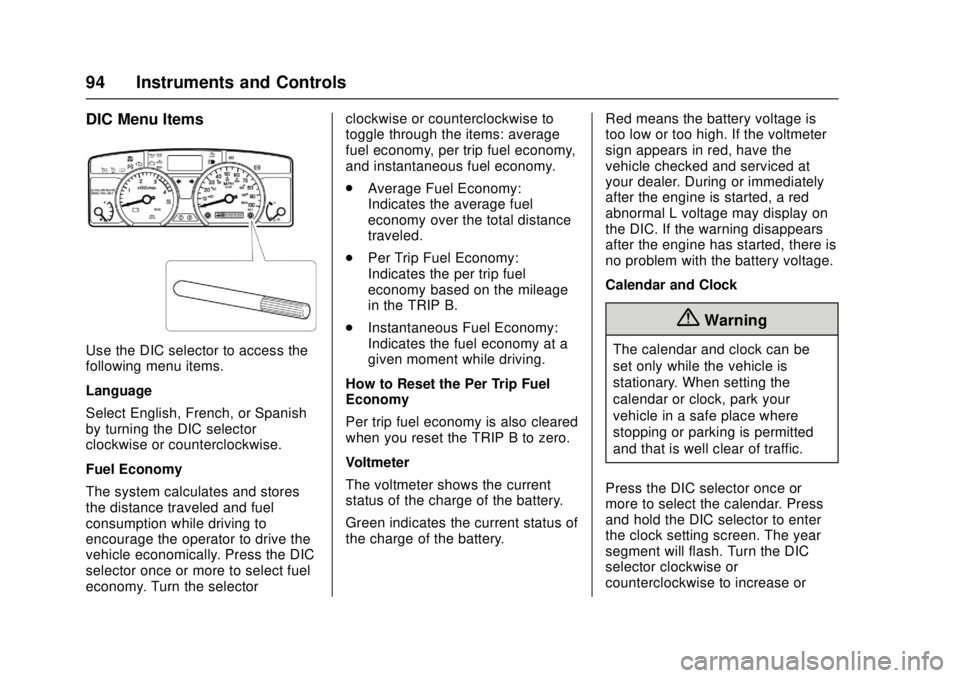
Use the DIC selector to access the
following menu items.
Language
Select English, French, or Spanish
by turning the DIC selector
clockwise or counterclockwise.
Fuel Economy
The system calculates and stores
the distance traveled and fuel
consumption while driving to
encourage the operator to drive the
vehicle economically. Press the DIC
selector once or more to select fuel
economy. Turn the selectorclockwise or counterclockwise to
toggle through the items: average
fuel economy, per trip fuel economy,
and instantaneous fuel economy.
.
Average Fuel Economy:
Indicates the average fuel
economy over the total distance
traveled.
. Per Trip Fuel Economy:
Indicates the per trip fuel
economy based on the mileage
in the TRIP B.
. Instantaneous Fuel Economy:
Indicates the fuel economy at a
given moment while driving.
How to Reset the Per Trip Fuel
Economy
Per trip fuel economy is also cleared
when you reset the TRIP B to zero.
Voltmeter
The voltmeter shows the current
status of the charge of the battery.
Green indicates the current status of
the charge of the battery. Red means the battery voltage is
too low or too high. If the voltmeter
sign appears in red, have the
vehicle checked and serviced at
your dealer. During or immediately
after the engine is started, a red
abnormal L voltage may display on
the DIC. If the warning disappears
after the engine has started, there is
no problem with the battery voltage.
Calendar and Clock
{Warning
The calendar and clock can be
set only while the vehicle is
stationary. When setting the
calendar or clock, park your
vehicle in a safe place where
stopping or parking is permitted
and that is well clear of traffic.
Press the DIC selector once or
more to select the calendar. Press
and hold the DIC selector to enter
the clock setting screen. The year
segment will flash. Turn the DIC
selector clockwise or
counterclockwise to increase or
Page 96 of 414
Chevrolet Low Cab Forward Owner Manual (GMNA-Localizing-U.S.-
10716700) - 2017 - crc - 12/6/16
Instruments and Controls 95
decrease the year. While in the year
setting screen, press the DIC
selector once to switch to the month
setting screen. The month segment
will flash. Use the same method to
set the month. While in the month
setting screen, press the DIC
selector again to switch to the day
setting mode. Adjust the day using
the selector.
Press and hold the DIC selector to
complete the calendar setting.
When complete, the normal
calendar display will resume. Use
this same method to set the hour
and minute when in the clock setting
screen.
Dimmer
The brightness of the DIC can be
adjusted while the light control
switch is off. Select this screen and
turn the DIC selector clockwise or
counterclockwise to brighten or dim
the illumination. The brightness is
linked to the adjustment of the
instrument panel light level control
while the light control switch is on.
SeeInstrument Panel Illumination
Control 0106.Warning Lights and Messages
.
Engine Overheat Warning Light
. Low Coolant Warning Light
. Water Separator Warning Light
. Air Cleaner Light
. Low Fuel Warning Light
. Regeneration Warning Lights
. Exhaust System Warning Light
. Refill DEF Warning Light
. DIC Errors
. Maintenance Data
. Hour Meter
See Vehicle Messages (Diesel
Only) 097.
Maintenance Data Functions
Display/Not Display the
Maintenance Data Function
Maintenance Light: On the DIC, go
to the Maintenance Indicator Light.
Switch the display by pressing and
holding the DIC selector for more
than two seconds. Turn the DIC
selector clockwise or
counterclockwise to switch the display. Complete the resetting by
pressing and holding the DIC
selector for more than two seconds.
To cancel the setting procedure,
press the DIC selector once. The
display will go back to the previous
screen.
Resetting/Setting the Change
Interval (Odometer Reading)
Engine Oil and Filter Light :
On
the DIC, go to the engine oil and
filter light. Enter the resetting screen
by pressing and holding the DIC
selector for more than two seconds.
Complete the resetting by pressing
and holding the DIC selector for
more than two seconds.
Transmission and Differential
Gear Oil Light, Fuel Filter Light,
Power Steering Fluid Light, and
Tire Rotation Light : On the DIC,
go to the particular maintenance
item to reset/adjust. Enter the
setting change screen by pressing
and holding the DIC selector. Set
the change interval by turning the
DIC selector. (Transmission and
Differential Oil, Steering Fluid, and
Tire Rotation Only). Turn clockwise
Page 98 of 414
Chevrolet Low Cab Forward Owner Manual (GMNA-Localizing-U.S.-
10716700) - 2017 - crc - 12/6/16
Instruments and Controls 97
Vehicle Messages
Vehicle Messages
(Diesel Only)
The Driver Information Center (DIC)
will display warnings, messages,
and other operation-related
information to alert of system
failures or other necessary checks
that should be performed. Use the
DIC selector to choose the desired
screen page or function.
Engine Overheat Warning
Light
OVERHEAT
This message displays and a
warning light appears when the
engine has overheated and the
engine coolant temperature gauge
needle reaches the red zone. At the
same time a buzzer sounds.
Immediately pull off to a safe place
to take the necessary actions and
check the vehicle. Do not shut down
an overheating engine immediately.Otherwise, the engine may seize
up. Take appropriate actions for
engine overheating.
This light will also activate the
engine alarm and automatic
shutdown system, if equipped.
See
Engine Alarm and Automatic
Shutdown (Diesel Only) 0174,
Engine Overheating 0269, Engine
Coolant 0263, and Engine Coolant
Temperature Gauge 082.
{Warning
When the engine coolant is still
hot, do not remove the radiator
cap. Hot vapor will come out and
you may be scalded. Add engine
coolant only when the engine
coolant temperature has dropped.
If this light comes on and stays on
while you are driving, your engine
coolant might have overheated
and your engine may be too hot.
You should pull off the road, stop
your vehicle and take appropriate
actions for engine overheating.
Low Coolant Warning Light
LOW COOLANT
If this message and light come on,
the system is low on engine coolant
and the engine may overheat.
A warning tone also sounds. If this
light comes on while driving, stop
the vehicle immediately and check
the cooling system for leaks. See
Engine Coolant 0263 and have the
vehicle serviced by your dealer. This
light will also activate the engine
alarm and automatic shutdown
system.
See Engine Alarm and Automatic
Shutdown (Diesel Only) 0174 and
Engine Shutdown Warning Light
0 91.
Water Separator (Fuel Filter)
Warning Light
WATER SEPARATOR
This message displays and a
warning light appears when the
level in the water separator on the
fuel line is beyond the specified
level. Drain water following the
instructions in the Water in Fuel
Page 99 of 414
Chevrolet Low Cab Forward Owner Manual (GMNA-Localizing-U.S.-
10716700) - 2017 - crc - 12/6/16
98 Instruments and Controls
section and make sure the warning
light goes out. SeeWater in Fuel
(Diesel) 0236.
If you continue driving with the
message displayed, the fuel
injection system may fail. See Water
in Fuel (Diesel) 0236.
Air Cleaner Light
CHECK AIR FILTER
This message displays and a
warning light appears when the next
air cleaner element service interval
is near or has already been
reached.
Replace the air cleaner element.
See Engine Air Cleaner/Filter 0263.
Low Fuel Warning Light
LOW FUEL
This message displays and a
warning light appears when the fuel
level in the tank becomes too low
while the engine is running. Add fuel
at the earliest possible time. If the
vehicle runs out of fuel, air bleeding
procedure must be performed. See
Fuel for Diesel Engines 0232,
Fuel Gauge 081, and Running Out
of Fuel (Diesel) 0238.
Regeneration Required
Warning Light
REGEN. REQUIRED
This light (amber) comes on when
Running regeneration or Switch
regeneration is required. When this
light comes on, perform DPF
regeneration soon. If the engine
continues to run without performing
DPF regeneration, this light will
change color from amber to red.
If this light turns red, perform DPF
regeneration immediately. If you do
not perform DPF regeneration, the
check engine malfunction indicator
light and reduced engine power
indicator light will come on,
imposing performance restriction on
the vehicle. If this happens, the
vehicle must be serviced at your
dealer. See Diesel Particulate Filter
0 180. If your vehicle is equipped with a
power take-off (PTO), monitor the
DIC for DPF related indicators. PTO
and other slow speed applications
may require more attention.Selectable (Switch)
Regeneration Required
Warning Light
SEL REGEN. REQUIRED
Performing the
“Selectable”
regeneration: After the Checking PM
Level Light is shown, this light
comes on in amber when
“Selectable” regeneration is
possible. When the DPF switch is
pressed with this light ON,
"Selectable" regeneration starts.
When the selectable regeneration or
switch regeneration is interrupted:
This light (amber) comes on when
the "Selectable" regeneration or
"Switch" regeneration is interrupted.
When this light comes on, perform
DPF regeneration promptly by
following the procedure for the
"Switch" regeneration. If you
continue to operate the vehicle
without performing DPF
Page 102 of 414
Chevrolet Low Cab Forward Owner Manual (GMNA-Localizing-U.S.-
10716700) - 2017 - crc - 12/6/16
Instruments and Controls 101
displays amber, the next change of
transmission oil and differential oil is
near or has been reached.
FUEL FILTER
When this message and light
display green, it shows the distance
remaining until the next fuel filter
change. When this message
displays amber, the next change of
fuel filter is near or has been
reached.
STEERING OIL
When this message and light
display green, it shows the distance
remaining until the next power
steering fluid change. When this
message displays amber, the next
change of power steering fluid is
near or has been reached.
TIRE ROTATION
When this message and light show
green with OFF, it means the
vehicle has been shipped from the
factory with no tire rotation interval
set. When this message displays
green it has the distance until the
next tire rotation displayed. Whenthis message displays amber the
next tire rotation is near or has
already been reached.
STARTER
When this message and light is
green, it displays the number of
engine starts remaining until a
starter motor is replaced. When this
message and light is amber, it
displays when the time for a starter
motor replacement is near or has
already been reached.
For the starter indicator light, the
displayed color will change from
green to amber when remaining
time is below 0 times and the
screen is selected.
For resetting or setting maintenance
data intervals, see
Driver
Information Center (DIC) (Diesel
Only) 093.
Hour Meter
HOUR METER
This message and light indicate how
many hours the engine has been
run. The figure(s) on the left side of the decimal point indicate hours
while the figure on the right side
indicates 1/10 of an hour.
Warning Buzzers
A warning buzzer may not sound if
there is a problem with the buzzer
system. If this occurs, the system
needs to be inspected. See your
dealer.
All Vehicles
A warning buzzer sounds under the
following conditions:
.
Seat Belt— continuous beep.
See Seat Belt Reminders 083.
Gasoline Vehicles
A warning buzzer sounds under the
following conditions:
.
Brake booster —continuous
beep. See Brake System
Warning Light (Parking Brake
Light) 084.
Page 133 of 414
Chevrolet Low Cab Forward Owner Manual (GMNA-Localizing-U.S.-
10716700) - 2017 - crc - 12/6/16
132 Driving and Operating
Driving and
Operating
Driving Information
Driver Behavior . . . . . . . . . . . . . . . 133
Distracted Driving . . . . . . . . . . . . 133
Control of a Vehicle . . . . . . . . . . . 133
Braking . . . . . . . . . . . . . . . . . . . . . . . 137
Steering . . . . . . . . . . . . . . . . . . . . . . 143
Driving on Wet Roads . . . . . . . . 143
Hill and Mountain Roads . . . . . 144
Winter Driving . . . . . . . . . . . . . . . . 145
If the Vehicle Is Stuck . . . . . . . . 148
Emergencies(Troubleshooting) . . . . . . . . . . . 148
Emergencies (Disabled Vehicle) . . . . . . . . . . . . . . . . . . . . . 161
Starting and Operating
New Vehicle Break-In . . . . . . . . . 162
Pedals . . . . . . . . . . . . . . . . . . . . . . . . 163
Ignition Positions . . . . . . . . . . . . . 163
Starting and Stopping theVehicle (Gasoline Only) . . . . . 165
Starting and Stopping the Vehicle (Diesel Only) . . . . . . . . 168
Operating Temperature . . . . . . . 172
Winter Cover . . . . . . . . . . . . . . . . . 172
Engine Heater . . . . . . . . . . . . . . . . 173 Engine Alarm and Automatic
Shutdown (Diesel Only) . . . . . 174
Idle Shutdown . . . . . . . . . . . . . . . . 174
High Idle System . . . . . . . . . . . . . 174
Engine Checks Before Operating . . . . . . . . . . . . . . . . . . . 175
Parking over Things That Burn . . . . . . . . . . . . . . . . . . . 176
Engine Exhaust
Engine Exhaust . . . . . . . . . . . . . . 178
Running the Vehicle WhileParked . . . . . . . . . . . . . . . . . . . . . . 179
Diesel Particulate Filter
Diesel Particulate Filter . . . . . . . 180
Diesel Exhaust Fluid
Diesel Exhaust Fluid . . . . . . . . . . 189
Automatic Transmission
Automatic Transmission . . . . . . 204
Selector Lever . . . . . . . . . . . . . . . . 214
Overdrive Off . . . . . . . . . . . . . . . . . 215
Brakes
Antilock BrakeSystem (ABS) . . . . . . . . . . . . . . . 217
Parking Brake . . . . . . . . . . . . . . . . 221
Exhaust Brake (Diesel Only) . . . . . . . . . . . . . . . . 222
Cruise Control
Cruise Control (Diesel) . . . . . . . 224
Cruise Control (Gas) . . . . . . . . . 227
Driver Assistance Systems
Speed Limiter (GasolineVehicle) . . . . . . . . . . . . . . . . . . . . . 231
Fuel
Fuel (Gasoline) . . . . . . . . . . . . . . . 231
Fuels in Foreign Countries . . . 232
Fuel for Diesel Engines . . . . . . . 232
Biodiesel . . . . . . . . . . . . . . . . . . . . . 233
Cold Weather Operation(Diesel) . . . . . . . . . . . . . . . . . . . . . 235
Water in Fuel (Diesel) . . . . . . . . 236
Running Out of Fuel (Diesel) . . . . . . . . . . . . . . . . . . . . . 238
Filling the Tank . . . . . . . . . . . . . . . 240
Conversions and Add-Ons
Add-On Electrical Equipment . . . . . . . . . . . . . . . . . . 241
Power Take-Off (PTO) . . . . . . . . 242
Page 136 of 414
Chevrolet Low Cab Forward Owner Manual (GMNA-Localizing-U.S.-
10716700) - 2017 - crc - 12/6/16
Driving and Operating 135
Never Stop the Engine While
Driving
{Warning
Do not move the engine control
switch away from the "ON"
position while the vehicle is being
driven.
If the engine stops while the
vehicle is moving, the brake
booster does not work, and the
brakes would not work properly.
The engine could also be
damaged.
Stopping the engine while driving
would be extremely dangerous
because the power steering
would stop working, making the
steering wheel extremely hard
to turn.
Stopping the engine while driving
would be extremely dangerous
because the warning lights,(Continued)
Warning (Continued)
indicator lights and other
electrical circuitry would
completely stop working.
Placing the engine control switch
in the "LOCK" position while
driving would be extremely
dangerous because the key could
come out, causing the steering
wheel to lock so that you could
not turn it.
You and others could be seriously
injured.
Avoid Unnecessary Idling of
the Engine
If the engine idles too long, the
engine coolant temperature will fall
below the operating range. Low
engine operating temperature
causes several conditions that are
harmful to engine operation and life.
Incomplete combustion of fuel in an
engine that is not fully warmed-up
causes crankcase dilution and
forms lacquer and gummy deposits on valves, pistons, and rings. It also
causes rapid accumulation of
sludge within the engine.
Driving at Night
Nighttime driving is more dangerous
than daytime driving because the
field of view is narrower. Keep your
speed down, and maintain an ample
headway distance.
Metallic Plinking Sound from
the Muffler
Immediately after stopping the
engine, you may hear a metallic
plinking sound from the muffler. This
sound occurs as the muffler cools
down and contracts. It does not
indicate an abnormality or
breakdown.
When the Silencer and
Exhaust Pipe are Hot
{Warning
When the engine is running and
immediately after vehicle
operation, the DPF, silencer, and
(Continued)
Page 137 of 414
Chevrolet Low Cab Forward Owner Manual (GMNA-Localizing-U.S.-
10716700) - 2017 - crc - 12/6/16
136 Driving and Operating
Warning (Continued)
exhaust pipe are extremely hot.
Be careful not to inadvertently
touch them when working near
them (for example, tilting the cab
or operating an attachment). You
and others could be seriously
injured.
Recommendations for Driving
in Hot Regions
The engine is more likely to
overheat in an environment where
the ambient temperature is high. To
prevent the engine from
overheating, pay attention to the
following points:
.If the engine does not contain
the appropriate concentration of
engine coolant, overheating is
likely to occur.
Refer to Engine Coolant 0263.
. Do not put well water, river water
or other hard water in the engine
cooling system. It would hasten
the formation of rust and scale. .
If foreign matter (insects, mud,
etc.) gets stuck in the radiator's
air passages, the cooling
system's performance will
deteriorate. Check the air
passages for clogging, and
remove any foreign matter using
water under low pressure.
Refer to Exterior Care 0334.
When Turning, the Rear
Wheels will Follow Tighter
Curves than the Front Wheels
Use the mirrors to confirm safety.
Sidewinds
If the vehicle catches a sidewind
and drifts sideways, firmly grip the
steering wheel, decelerate to a
speed that allows you to stay
completely in control, and make a
directional correction. The vehicle
may catch strong sidewinds in the
following situations:
.
Emerging from a tunnel
. Driving over a bridge
. Driving on an embankment
. Driving through a cutting .
Being overtaken by a large truck
or bus
. Overtaking a large truck or bus
Flat Tire
If a blowout or flat tire occurs while
you are driving, calmly grip the
steering wheel and gradually apply
the brakes to decelerate. (Hard
braking would be dangerous
because it could cause the steering
wheel to be pulled to one side.)
Stop the vehicle in a safe place, and
change the tire.
Hard Bump Under Vehicle
If the underside of the vehicle
receives a hard bump, stop in a safe
place where the vehicle will not
obstruct traffic and check for brake
fluid leakage, fuel leakage and
component damage. If any part of
the vehicle is damaged or broken,
promptly have the vehicle inspected
and repaired.
Highways
.Speeds on highways are higher
than those on regular roads, so
there is more danger. Also, a
Page 140 of 414
Chevrolet Low Cab Forward Owner Manual (GMNA-Localizing-U.S.-
10716700) - 2017 - crc - 12/6/16
Driving and Operating 139
Caution (Continued)
warning light comes on during
operation, have brake system
checked immediately.
Refer to Warning Lights, Gauges,
and Indicators 076.
When the Brakes Do Not Work
{Warning
It is very dangerous to suddenly
pull the parking brake lever all the
way while moving at high speed.
Reduce speed first by shifting
down and then gradually pull the
parking brake lever.
You and others could be seriously
injured.
(Diesel Only) The exhaust brake
should be turned on as soon as
service brake malfunction is
detected. This will slow the engine
speed. With the engine speed under
control and providing the grade conditions permit, the transmission
can be progressively downshifted
using the exhaust brake in each
gear. Eventually the exhaust brake
should slow the vehicle to a
controllable
“crawl.”Gradually pull
the parking brake lever while firmly
holding on to the steering wheel.
Stop the vehicle on the side of the
road. The vehicle should not be
driven further until corrective
measures are taken.
See Exhaust Brake (Diesel Only)
0 222 andParking Brake 0221.
(Gasoline Only) If the brakes do not
work in an unexpected situation,
promptly shift down from D6, D4,
2nd and then to 1st gear using the
selector lever to reduce the speed
and gradually pull the parking brake
lever to stop the vehicle on the side
of the road while firmly holding on to
the steering wheel.
See Parking Brake 0221. Riding the Brake
{Warning
"Riding the brake" by resting your
foot on the pedal, when you do
not intend to brake, can overheat
the brakes and wear out the
brake linings faster. This may also
damage the brakes and will waste
fuel. It can also result in reduced
braking performance.
You and others could be seriously
injured.
Applying the Parking Brake
Except in an emergency, do not
apply the parking brake until the
vehicle has come to a complete
stop. Applying the parking brake
before the vehicle has stopped can
cause a breakdown.
Refer to
Parking Brake 0221.
Parking Safely on a Slope
Avoid parking your vehicle on a
slope as much as possible and
choose a level and flat place. If you
Page 147 of 414
Chevrolet Low Cab Forward Owner Manual (GMNA-Localizing-U.S.-
10716700) - 2017 - crc - 12/6/16
146 Driving and Operating
When Ice Prevents You from
Putting Your Key in the Door
or Opening the Door
If you try to force the key into the
door, you could bend it. And if you
try to pull the door open with undue
force, the rubber seal around the
door could come unstuck or become
damaged. Use warm water to melt
the ice, then quickly wipe it away
and open the door.
If the wipers, electric door mirrors,
or power windows freeze up, also
use warm water to melt the ice and
then operate the system. Otherwise,
you could damage the mechanism
and drain the battery. After that,
wipe the water away.
Before Driving in Cold Regions
Getting In and Out of the Vehicle
The step can get icy in cold regions.
Be careful not to slip when getting in
and out of the vehicle.
Before Sitting in the Driver’s Seat
Remove snow and ice from your
shoes when getting into the vehicle.
If you try to drive with snow on your shoes, your shoes would slip on the
pedals and you would not be able to
press the pedals properly, meaning
that your driving would be
inconsistent. Also, the cabin could
become more humid, causing the
glass to fog up.
Check Fuel Level
Fuel consumption increases when
tire chains are used. Determine how
much fuel you need to reach your
destination and fill up the tank in
advance. Refer to
Fuel for Diesel
Engines 0232 orFuel (Gasoline)
0 231.
Removing Snow from Glass
and Underbody
Do not use a sharp implement to
remove snow. Sharp edges could
damage rubber parts.
To maintain an adequate field of
view, use a plastic scraper to
remove snow and frost from the
glass surfaces. By using a plastic
scraper, you can remove the snow
and frost without scratching the glass. At this time, check whether
the wiper blades are frozen onto the
glass.
Also, look under the vehicle and
remove any lumps of ice that are
stuck to the underbody. Be careful
not to damage components.
Driving on Snowy or Frozen
Roads
On slippery roads, never accelerate
rapidly, brake hard, decelerate
rapidly or make sharp turns of the
steering wheel.
There is a risk of reduced grip
between the tires and road surface
and of increased braking distances.
The danger of icy road surfaces is
particularly great on bridges, in
shady places and where there are
puddles.
Keep your speed down and be sure
to use tire chains or winter tires on
snowy or frozen road surfaces.
For diesel vehicles, use engine
brakes together with the foot brakes
to decelerate. Using the exhaust
brake on a slippery road surface
could cause the tires to slip.