fuel CHEVROLET LOW CAB FORWARD 2017 Owner's Guide
[x] Cancel search | Manufacturer: CHEVROLET, Model Year: 2017, Model line: LOW CAB FORWARD, Model: CHEVROLET LOW CAB FORWARD 2017Pages: 414, PDF Size: 7.97 MB
Page 152 of 414

Chevrolet Low Cab Forward Owner Manual (GMNA-Localizing-U.S.-
10716700) - 2017 - crc - 12/6/16
Driving and Operating 151
SymptomCauseCorrective Action Reference
Engine does not
start Starter turns over
(Diesel) No fuel
Make sure there are no
fuel leaks, and then
add fuel-
Air in the fuel system Bleed fuel system See
Running Out
of Fuel (Diesel)
0 238
Fuel filter clogged
4-
Fuel is frozen Warm fuel pipe with hot
water or wait until it gets
warmer-
Common rail system is
faulty
4-
Preheating system is
faulty
4-
Page 153 of 414
Chevrolet Low Cab Forward Owner Manual (GMNA-Localizing-U.S.-
10716700) - 2017 - crc - 12/6/16
152 Driving and Operating
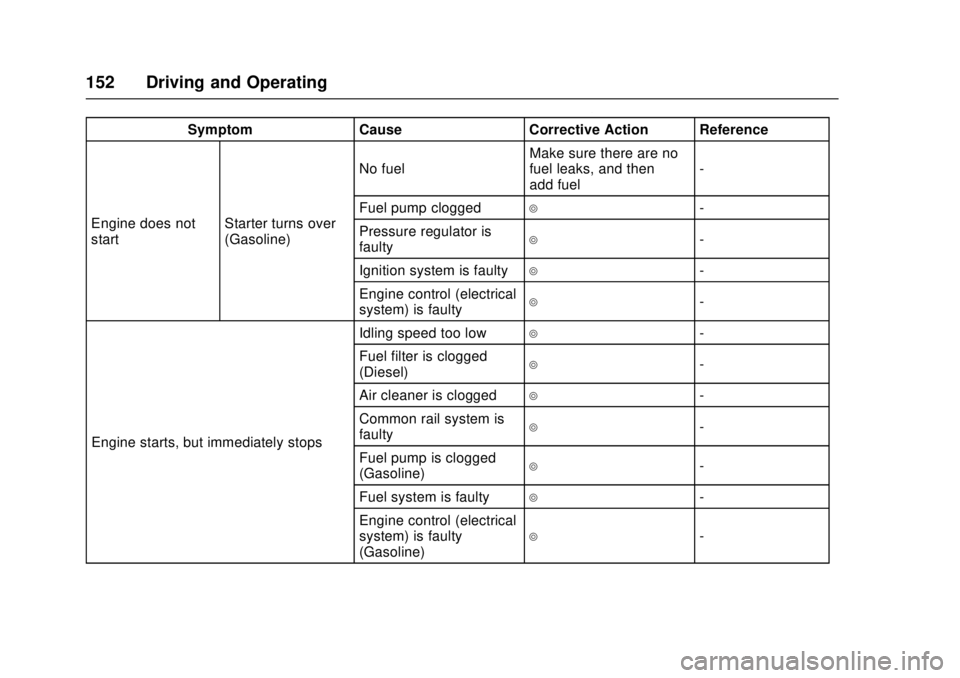
SymptomCauseCorrective Action Reference
Engine does not
start Starter turns over
(Gasoline) No fuel
Make sure there are no
fuel leaks, and then
add fuel-
Fuel pump clogged
4-
Pressure regulator is
faulty
4-
Ignition system is faulty
4-
Engine control (electrical
system) is faulty
4-
Engine starts, but immediately stops Idling speed too low
4-
Fuel filter is clogged
(Diesel)
4-
Air cleaner is clogged
4-
Common rail system is
faulty
4-
Fuel pump is clogged
(Gasoline)
4-
Fuel system is faulty
4-
Engine control (electrical
system) is faulty
(Gasoline)
4-
Page 154 of 414

Chevrolet Low Cab Forward Owner Manual (GMNA-Localizing-U.S.-
10716700) - 2017 - crc - 12/6/16
Driving and Operating 153
SymptomCauseCorrective Action Reference
Unsteady engine speed (Diesel) There is water or air in
the fuel system
Drain water from fuel
filter or bleed the systemSee
Running Out
of Fuel (Diesel)
0 238 orWater in
Fuel (Diesel) 0236
Fuel system is faulty
4-
Unsteady engine speed (Gasoline) Fuel system is faulty
4-
Ignition system is faulty
4-
Engine control (electrical
system) is faulty
4-
Page 155 of 414

Chevrolet Low Cab Forward Owner Manual (GMNA-Localizing-U.S.-
10716700) - 2017 - crc - 12/6/16
154 Driving and Operating
SymptomCauseCorrective Action Reference
White exhaust smoke (Diesel) Engine not sufficiently
warming up
Allow the engine to
warm up
-
Too much engine oil Correct the oil level See
Engine Oil
(Gasoline) 0257 or
Engine Oil (Diesel)
0 251
Engine Control system
faulty
4-
Fuel system faulty
4-
Exhaust injector
4-
Continuous idling for a
long period (more than
two hours) With the vehicle
stationary in a place
where it will not obstruct
traffic, hold down the
accelerator pedal and
check that white smoke
is not emitted
-
Page 156 of 414

Chevrolet Low Cab Forward Owner Manual (GMNA-Localizing-U.S.-
10716700) - 2017 - crc - 12/6/16
Driving and Operating 155
SymptomCauseCorrective Action Reference
Black exhaust smoke (Diesel) Engine Control system
faulty
4-
The air cleaner clogged
4-
Fuel system faulty
4-
Exhaust system clogged
4-
Exhaust injector
4-
Diesel particulate filter
(DPF) faulty
4-
Engine is overheating No engine coolant Add engine coolant
See
Engine
Coolant 0263
Front of radiator is
clogged with dirt Wash clean with tap
waterSee
Exterior Care
0 334
Radiator cap not
sufficiently tightened Make sure it is firmly
tightened or replace the
radiator cap
-
Fan belt loose Adjust the tension or
replace the beltSee
Engine Drive
Belt Routing 0396
Engine coolant dirty
4-
Fan clutch is faulty
4-
Radiator cap dirty or
faulty Clean or replace -
Page 158 of 414
Chevrolet Low Cab Forward Owner Manual (GMNA-Localizing-U.S.-
10716700) - 2017 - crc - 12/6/16
Driving and Operating 157
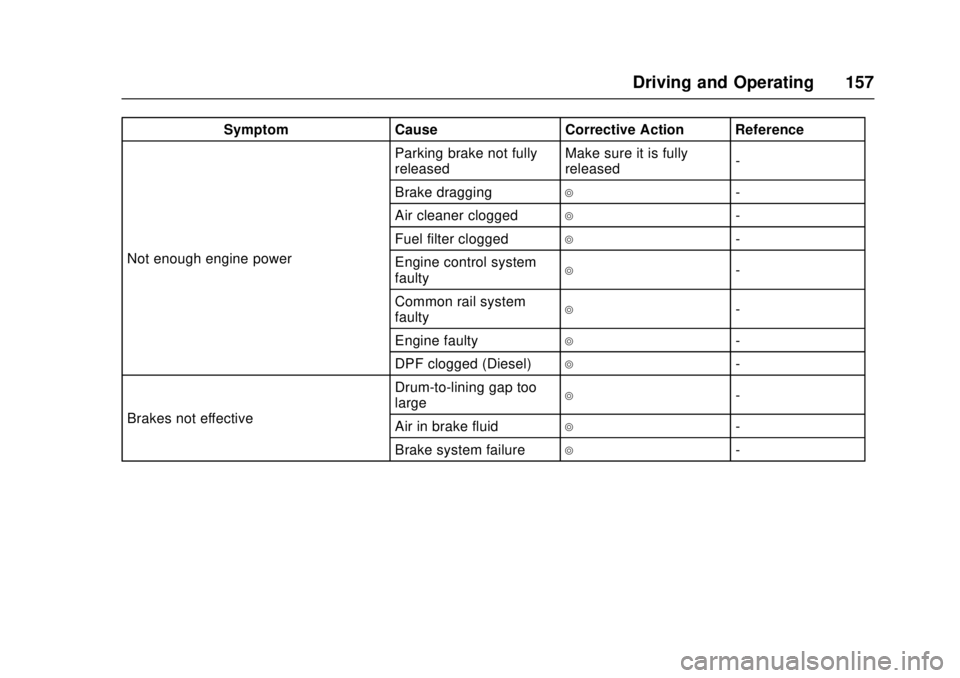
SymptomCauseCorrective Action Reference
Not enough engine power Parking brake not fully
released
Make sure it is fully
released
-
Brake dragging
4-
Air cleaner clogged
4-
Fuel filter clogged
4-
Engine control system
faulty
4-
Common rail system
faulty
4-
Engine faulty
4-
DPF clogged (Diesel)
4-
Brakes not effective Drum-to-lining gap too
large
4-
Air in brake fluid
4-
Brake system failure
4-
Page 162 of 414

Chevrolet Low Cab Forward Owner Manual (GMNA-Localizing-U.S.-
10716700) - 2017 - crc - 12/6/16
Driving and Operating 161
Emergencies (Disabled
Vehicle)
When the Vehicles
Breaks Down
When the Vehicle Stops While
Driving
The brake booster will no longer
operate, brake effectiveness will be
reduced. If the engine cannot be
started, promptly have the vehicle
inspected and repaired.
If the engine stopped because the
vehicle ran out of fuel while driving,
refueling alone will not be enough to
restart the engine. Bleed the fuel
system after refueling the vehicle.
When the Fuel Tank is Empty
SeeRunning Out of Fuel (Diesel)
0 238.
When the Engine Stalls and
Cannot Be Restarted
Move the selector lever to the "N"
position and push the vehicle to a
safe place.
{Warning
Vehicle operations will change, so
stop the vehicle in a safe place
with the following in mind.
The power steering system will
not work so the steering wheel
will be hard to turn. It will require
more strength than during normal
operation.
As the brake booster will no
longer be functional, brake
effectiveness will be greatly
reduced. Be sure to apply more
pressure than usual to the brake
pedal.
If the power assist steering
system goes out because the
engine has stopped or the assist
system has malfunctioned, the
vehicle can still be steered.
However, much greater effort is
needed, especially in sharp turns
or at low speeds.
You or others could be seriously
injured. When the Vehicle Breaks Down
During Driving
1. Use the hazard warning flasher any time to warn other drivers,
day or night, and pull the
vehicle immediately over to a
safe place that does not
impede traffic (shoulder). Place
the triangle reflectors to alert
other traffic to the presence of
your vehicle.
2. If the vehicle can be exited safely, have the other
passengers get out and wait in
a safe place.
3. If the vehicle can be exited safely, walk to a safe place and
take appropriate measures by
using the closest
telephone, etc.
See Hazard Warning Flashers
0 105.
Page 163 of 414

Chevrolet Low Cab Forward Owner Manual (GMNA-Localizing-U.S.-
10716700) - 2017 - crc - 12/6/16
162 Driving and Operating
If There is a Fuel Leak
{Danger
Leaking fuel from the vehicle is
dangerous due to possible
combustion or explosion. Stop the
engine immediately.
You or others could be seriously
injured or killed.
Starting and
Operating
New Vehicle Break-In
Good vehicle care begins with
proper break-in. While every new
vehicle goes through rigid factory
and dealer inspection and tests
before delivery, the care you give
your vehicle during the initial
break-in period can pay off in longer
life, better performance and more
economical operation.
It is therefore always recommended
that during the initial 1 000 km
(600 mile) break-in period, the
following few simple precautions are
carefully observed.
Follow the recommendations listed
below for gasoline and diesel
engines:
.Warm up the engine by driving
easily for the first few minutes
before placing it under load. .
Do not drive for extended
periods at any one constant
speed, either fast or slow, during
the first 800 km (500 miles).
. Use the correct gear to maintain
the desired road speed without
lugging the engine.
. Avoid racing the engine,
full-throttle starts and aggressive
application of brakes when
stopping.
. Keep tires properly inflated for
the load carried.
. Check lubricant levels in the
engine and transmission weekly.
. For vehicles with gasoline
engines, keep speeds below
121 km/h (75 MPH) for the first
800 km (500 miles).
Follow the additional diesel only
recommendations listed below:
. Keep speeds below 80 km/h
(50 MPH) for the first 800 km
(500 miles).
Page 166 of 414

Chevrolet Low Cab Forward Owner Manual (GMNA-Localizing-U.S.-
10716700) - 2017 - crc - 12/6/16
Driving and Operating 165
Turn the key against spring
pressure to energize the starter.
When key is released, spring
pressure returns it to the ON
position. Release the key as soon
as the engine has started.
If the key cannot be turned from the
LOCK position to the ON position,
lightly move the steering wheel
clockwise and counterclockwise
while trying to turn the key.
Starting and Stopping the
Vehicle (Gasoline Only)
Check around the Vehicle before
Starting the Engine
Proper care and operation will not
only extend the service life of your
vehicle but also improve fuel
economy.
Before pulling away, perform a
thorough safety check, making sure
there are no children or obstructions
around the vehicle. Take off the
chocks after confirming that the
parking brake is securely applied.Sit behind the wheel, adjust the seat
position, and buckle up the seat
belt. The passengers are also
required to buckle up the seat belts.
Adjust the positions of the steering
wheel and mirrors. Lock the doors.
Turn the power of the dome light or
accessories OFF before starting the
engine. See
Seat Position 044,
Seat Belts 049, Steering Wheel
Adjustment 072, and Mirrors039.
Keep the Floor Around the
Driver's Seat Clean and Tidy{Warning
It is extremely dangerous to have
empty cans, empty bottles or
other items rolling around on the
floor because they could get
trapped under the brake pedal
and prevent brake application.
For proper pedal operation, it is
also essential to lay floor mats
properly. Incorrectly installed floor
mats would hinder free movement
of the pedals. (Continued)
Warning (Continued)
Do not use the dashboard pocket
or the top of the dashboard as a
place to put items that could roll,
which could interfere with your
driving. You and others could be
seriously injured.
Choose Your Footwear Suitable
for Driving
{Warning
Choose footwear that ensures
proper operation of pedals when
driving the vehicle. Use of
footwear unsuitable for driving
may cause an accident.
Checks Before Operating
Allow the engine to warm up before
driving. While the engine is warming
up, the following checks should
be made: 1. Observe the engine oil pressure warning light. The
light should go out when the
Page 168 of 414
Chevrolet Low Cab Forward Owner Manual (GMNA-Localizing-U.S.-
10716700) - 2017 - crc - 12/6/16
Driving and Operating 167
feature. To restart when you're
already moving, use
N (Neutral) only.
Do not try to shift to P (Park) if
your vehicle is moving. If you
do, you could damage the
transmission. Shift to P (Park)
only when your vehicle is
stopped.
2. Do not push the accelerator pedal before starting your
engine. In some other vehicles
you might need to do this, but
because of your vehicle's
computer systems, you do not
need to.
3. Turn your ignition key to Start. When the engine starts, let go
of the key. The idle speed will
go down as your engine
gets warm.
4. If it does not start right away, hold your key in START. If it
doesn't start in 3 seconds,
push the accelerator pedal
about one-quarter of the way
down for 12 more seconds,
or until it starts. 5. If your engine still will not start
(or starts but then stops), it
could be flooded with too much
gasoline. Try this: Wait 20 to
30 seconds to let the starter
motor cool down. Then push
your accelerator pedal all the
way to the floor. Hold it there.
Then, hold the key in START
for no more than 10 seconds.
This clears the extra gasoline
from the engine.
If the engine still does not start, wait
another 20 to 30 seconds and do
Step 5 again.
Hot Engine Restart
If your engine is already hot and
then stalls, turn your ignition key to
ACC. Then, turn your key to ON,
and wait about 20 to 30 seconds
before you restart your engine.
When the engine starts, let go of the
key and the accelerator pedal.
Your engine is designed to work
with the electronics in your vehicle.
If you add electrical parts or
accessories, you could change the
way the fuel injection system operates. Before adding electrical
equipment, check with your dealer.
If you do not, your engine might not
perform properly.
If you ever have to have your
vehicle towed, see the part of this
manual that tells how to do it without
damaging your vehicle. See
Towing
the Vehicle 0332.
Recommendations for Warming
Up the Engine
The engine is sufficiently warmed
up when the needle of the engine
coolant temperature gauge starts
to move.
. Do not race the engine or
quickly accelerate before the
engine has sufficiently warmed
up. Oil would not have
adequately reached and
lubricated components, and a
breakdown may result.
. The exhaust pipe becomes
extremely hot while the engine is
idling. Before warming up the
engine, make sure there is no