maintenance CHEVROLET LOW CAB FORWARD 2017 User Guide
[x] Cancel search | Manufacturer: CHEVROLET, Model Year: 2017, Model line: LOW CAB FORWARD, Model: CHEVROLET LOW CAB FORWARD 2017Pages: 414, PDF Size: 7.97 MB
Page 101 of 414
Chevrolet Low Cab Forward Owner Manual (GMNA-Localizing-U.S.-
10716700) - 2017 - crc - 12/6/16
100 Instruments and Controls
result in a severe vehicle speed
limitation. SeeDiesel Exhaust Fluid
0 189.
When DIC ERROR is Displayed
ERROR
If the system has not yet been able
to access maintenance data,
ERROR is shown on the DIC.
If ERROR does not change
automatically to a distance or other
maintenance indication, have your
vehicle serviced at your dealer.
Maintenance Data Indicator
Lights
Maintenance data indicator lights
appear on the DIC when each
maintenance item is selected or
when the next change or service
interval of the item is near or has
been reached.
The distance or time shown is the
remaining or excess of them to /
from the change or service timing.
The positive distance or time shows
the remaining of that and the
negative distance or time shows the
excess of that. For the items listed below, the displayed color will
change from green to amber when
remaining distance is below
1 000 km (1,000 mi) and the screen
is selected.
These screens are also displayed
when the engine control switch
turns to the ON position after above
notification timing. The message
remains on the display until the DIC
selector is pressed once or the
vehicle is started.
The maintenance data function
indicates the distance remaining
before the next scheduled
maintenance. Scheduled
maintenance time is approaching
when the display turns from green
to amber. Have the vehicle checked
and serviced at your dealer as soon
as possible.
The vehicle needs to be maintained
more often if it is driven in severe
conditions.
MAINTENANCE ON or
MAINTENANCE OFF
This indicator displays and hides
maintenance items. When
MAINTENANCE ON is displayed,
maintenance items will be
displayed. When MAINTENANCE
OFF is displayed, maintenance
items will not be displayed.
When MAINTENANCE OFF is
displayed, there will be no display of
maintenance items such as rotation
intervals or replacement intervals
even when such intervals arrive.
ENG OIL & FILTER
When this message and light
display green, it shows the distance
remaining until the next engine oil
and filter change. When this
message displays amber, the next
change of engine oil and filter is
near or has been reached.
T/M & DIFF OIL
When this message and light
display green, it shows the distance
remaining until the next
transmission oil and differential oil
change. When this message
Page 102 of 414
Chevrolet Low Cab Forward Owner Manual (GMNA-Localizing-U.S.-
10716700) - 2017 - crc - 12/6/16
Instruments and Controls 101
displays amber, the next change of
transmission oil and differential oil is
near or has been reached.
FUEL FILTER
When this message and light
display green, it shows the distance
remaining until the next fuel filter
change. When this message
displays amber, the next change of
fuel filter is near or has been
reached.
STEERING OIL
When this message and light
display green, it shows the distance
remaining until the next power
steering fluid change. When this
message displays amber, the next
change of power steering fluid is
near or has been reached.
TIRE ROTATION
When this message and light show
green with OFF, it means the
vehicle has been shipped from the
factory with no tire rotation interval
set. When this message displays
green it has the distance until the
next tire rotation displayed. Whenthis message displays amber the
next tire rotation is near or has
already been reached.
STARTER
When this message and light is
green, it displays the number of
engine starts remaining until a
starter motor is replaced. When this
message and light is amber, it
displays when the time for a starter
motor replacement is near or has
already been reached.
For the starter indicator light, the
displayed color will change from
green to amber when remaining
time is below 0 times and the
screen is selected.
For resetting or setting maintenance
data intervals, see
Driver
Information Center (DIC) (Diesel
Only) 093.
Hour Meter
HOUR METER
This message and light indicate how
many hours the engine has been
run. The figure(s) on the left side of the decimal point indicate hours
while the figure on the right side
indicates 1/10 of an hour.
Warning Buzzers
A warning buzzer may not sound if
there is a problem with the buzzer
system. If this occurs, the system
needs to be inspected. See your
dealer.
All Vehicles
A warning buzzer sounds under the
following conditions:
.
Seat Belt— continuous beep.
See Seat Belt Reminders 083.
Gasoline Vehicles
A warning buzzer sounds under the
following conditions:
.
Brake booster —continuous
beep. See Brake System
Warning Light (Parking Brake
Light) 084.
Page 127 of 414
Chevrolet Low Cab Forward Owner Manual (GMNA-Localizing-U.S.-
10716700) - 2017 - crc - 12/6/16
126 Climate Controls
Climate Controls
Climate Control Systems
Climate Control Systems . . . . . 126
Air Vents
Air Vents . . . . . . . . . . . . . . . . . . . . . 129
Maintenance
Passenger Compartment AirFilter . . . . . . . . . . . . . . . . . . . . . . . . 130
Service . . . . . . . . . . . . . . . . . . . . . . . 131
Climate Control
Systems
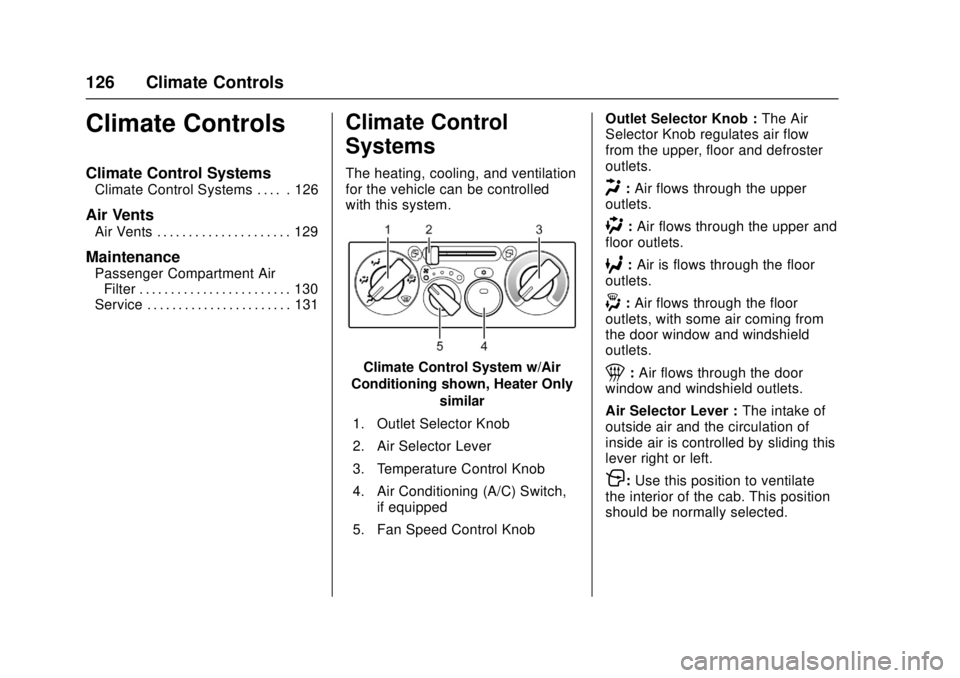
The heating, cooling, and ventilation
for the vehicle can be controlled
with this system.
Climate Control System w/Air
Conditioning shown, Heater Only similar
1. Outlet Selector Knob
2. Air Selector Lever
3. Temperature Control Knob
4. Air Conditioning (A/C) Switch, if equipped
5. Fan Speed Control Knob Outlet Selector Knob :
The Air
Selector Knob regulates air flow
from the upper, floor and defroster
outlets.
H: Air flows through the upper
outlets.
): Air flows through the upper and
floor outlets.
6: Air is flows through the floor
outlets.
-: Air flows through the floor
outlets, with some air coming from
the door window and windshield
outlets.
1: Air flows through the door
window and windshield outlets.
Air Selector Lever : The intake of
outside air and the circulation of
inside air is controlled by sliding this
lever right or left.
P: Use this position to ventilate
the interior of the cab. This position
should be normally selected.
Page 131 of 414

Chevrolet Low Cab Forward Owner Manual (GMNA-Localizing-U.S.-
10716700) - 2017 - crc - 12/6/16
130 Climate Controls
Air Flow Direction Control Lever
Use the tab to adjust the airflow
direction from the outlet. To close
the outlet, move the tab fully down.
Maintenance
Passenger Compartment
Air Filter
Removing the Inside Air Filter
1. Remove the 2 clips securingthe cover. Remove the clips in
the order of the inner clip (1)
followed by the outer clip (2).
2. Remove the cover by pushing it upwards.
3. Remove and clean the filter.Use a vacuum cleaner or the
like to clean dust and dirt from
its surface.
Avoid interference with electric
harnesses when removing the filter.
In order to avoid filter damage, hard
brushes should not be used for filter
cleaning.
Installing the Inside Air Filter
Install the filter in the reverse order
to removal.
Ensure that the filter is returned
securely to its original position.
Failure to observe this precaution
can lead to rattling during travel.
Page 149 of 414

Chevrolet Low Cab Forward Owner Manual (GMNA-Localizing-U.S.-
10716700) - 2017 - crc - 12/6/16
148 Driving and Operating
.Do not use a sharp implement to
remove snow. Sharp edges
could damage rubber parts.
Refer to Antilock Brake System
(ABS) 0217.
Remove snow that has stuck to the
inside of the fenders and to the
brake hoses. Otherwise, it may
damage components. After driving
on a salted road, wash the
underside of the vehicle as soon as
possible to prevent the salt from
causing rust. Spraying water under
high pressure is an effective way to
get the salt off.
After washing the vehicle, wipe the
door openings dry.
If the Vehicle Is Stuck
When Driving on Bad Roads
Freeing the Vehicle from Sand,
Mud, Snow, and Ice
If your vehicle gets stuck in sand,
mud, snow or ice, move the selector
lever from "Second" to "Reverse".
Apply a light pressure to the
accelerator pedal while the
transmission is in gear. Remove your foot from the accelerator and
press the brake pedal while shifting.
Do not race the engine. For best
traction, avoid spinning the wheels.
When you cannot avoid driving
through deep mud, using tire chains
is an effective way to avoid getting
stuck.
Do not allow wheels to spin freely in
mud, sand, snow, ice or other poor
road conditions. This free spinning
will damage the rear axle. Even
vehicles equipped with LSD (Limited
Slip Differential) have traction
limitations. If your vehicle gets stuck
and it is difficult to extricate,
immediately stop driving and have
the vehicle towed. Spinning wheels
for an extended period of time may
cause abnormal noises or
malfunction to LSD.
Do not spin wheels faster than
32 km/h (20 MPH). Damage may
result from excessive wheel
spinning, including tire, transmission
and/or rear axle malfunction.
When driving in sand or mud, avoid
hard braking, sudden acceleration
and sharp turns of the steering
wheel. Such actions could get the
vehicle stuck and make it difficult to
extricate.
After driving through deep mud: any
mud stuck to the vehicle can harm
the steering, brakes and powertrain.
Wash the vehicle and remove all
mud and other incrustation.
The vehicle speed sensors are fitted
on the wheels. When removing mud
and other incrustation, take great
care not to damage the
components.
Do not use a sharp implement to
remove mud. Sharp edges could
damage rubber parts.
Refer to
Antilock Brake System
(ABS) 0217 andExterior Care
0 334.Emergencies
(Troubleshooting)
Troubleshooting
Performing regular inspections and
maintenance prevents damage. Be
sure to perform inspections and
maintenance at regular intervals.
Page 172 of 414
Chevrolet Low Cab Forward Owner Manual (GMNA-Localizing-U.S.-
10716700) - 2017 - crc - 12/6/16
Driving and Operating 171
a gasoline engine. So, your engine
must crank faster than a gasoline
engine before it will start.
To be sure the engine can turn fast
enough to start, use SAE 10W-40
viscosity engine oil when prevailing
temperatures drop below 0 °C (32 °
F). See the oil quality and oil
viscosity recommendations. Using
the proper viscosity oil will make
starting easier down to -23 °C (-10 °
F). When prevailing temperatures
drop below -23 °C (-10 °F), the
optional engine block heater may be
needed for starting.
Maintenance Items to Aid Cold
Weather Starting
Since the basic principle of diesel
engine ignition is based on
compression, the diesel engine is
somewhat harder to start than a
gasoline engine when the
temperature is below freezing.
To help prevent hard starting
problems, special attention should
be given to following normal
maintenance items:1. Neglecting to have the fuel
filter and water separator
serviced can be one of the
major contributors to hard
starting. If water is permitted to
accumulate in the primary filter,
it will freeze and make starting
the engine impossible.
2. Make sure the fuel tank vent is open.
3. Always refuel at the end of a day's operation. Moisture will
condense in an empty tank;
therefore, the tank should be
filled before leaving the vehicle
standing for an extended
period.
Do not use starting aids in the air
intake system. Such aids can cause
immediate engine damage. See
Fuel for Diesel Engines 0232.
Stopping the Engine
When stopping the diesel engine,
take the following steps: 1. Bring the vehicle to a complete stop.
2. Firmly apply the parking brake. 3. Move the selector lever to the
P position and make sure that
the shift indicator shows P.
4. Allow the engine to idle for approximately 3 minutes.
5. Turn the engine control switch to the ACC or LOCK position.
Do not shut down the engine
immediately after driving the vehicle.
Otherwise, a seizure or other
failures may result.
To prevent the battery from going
dead, turn the engine control switch
to the ACC or LOCK position after
stopping the engine. If you leave the
vehicle for an extended period of
time, place the engine control switch
in the LOCK position.
Let the engine idle for 3 minutes
before shutting off the engine. This
allows the turbocharger to slow
down while keeping the bearings
lubricated.
Page 179 of 414

Chevrolet Low Cab Forward Owner Manual (GMNA-Localizing-U.S.-
10716700) - 2017 - crc - 12/6/16
178 Driving and Operating
Engine Exhaust
Engine Exhaust Emissions
Caution (Carbon Monoxide)
{Warning
Do not breathe exhaust gas
because it contains carbon
monoxide, which by itself has no
color or odor. Carbon monoxide is
a dangerous gas. It can cause
unconsciousness and can be
lethal.
Do not keep the engine running
for any length of time in a place
that is poorly ventilated. It is
particularly dangerous to run the
engine in a garage or other indoor
place that could easily fill with
exhaust gases because you could
suffer carbon monoxide
poisoning.
Inspect the exhaust pipe from
time to time. If you notice any
defect (for example, a damaged
joint, or a hole or crack caused by(Continued)
Warning (Continued)
corrosion), have checks and
maintenance performed by the
nearest dealer. Continuing to use
the vehicle without having the
defect repaired would be
dangerous because exhaust
gases could get into the cab and
cause carbon monoxide
poisoning.
If at any time you think exhaust
fumes are entering the cab, have
the cause determined and
corrected as soon as possible.
If you must drive under these
conditions, drive only with all
windows fully open. Prevent
carbon monoxide from entering
the cab. The best way is to keep
the engine exhaust system, cab
and cab ventilation system
properly maintained.
We recommend that the exhaust
system and cab be inspected by
a competent technician:(Continued)
Warning (Continued)
.Each time the vehicle has
an oil change.
. Whenever a change is
noticed in the sound of the
exhaust system.
. Whenever the exhaust
system, underbody or cab is
damaged or becomes
corroded.
To allow proper operation of your
vehicle's ventilation system, keep
the air inlet grille clear of snow,
leaves or other obstructions at all
times. Do not park with the
engine running or idle this vehicle
for more than 10 minutes with the
ventilation system control switch
in the OFF position. Even with the
ventilation system on, running the
engine while parked or stopped
for longer periods of time is not
recommended. Entry of carbon
monoxide into the cab is possible
with a poorly repaired, damaged, (Continued)
Page 180 of 414

Chevrolet Low Cab Forward Owner Manual (GMNA-Localizing-U.S.-
10716700) - 2017 - crc - 12/6/16
Driving and Operating 179
Warning (Continued)
or corroded exhaust system or
cab. Do not run the engine in
confined areas (such as garages,
next to a building or near another
stopped vehicles with engine
running) any more than needed to
move the vehicle.
When the vehicle has to be
stopped in an unconfined area
with the engine running for any
more than a few minutes, take the
following steps:. Adjust the heating or cooling
system to force outside air
into the cab.
. With temperature and outlet
selector knob in any
position:
. Set the air selector lever to
the fresh air position.
. Set the fan speed control
knob to the maximum speed
position.
(Continued)
Warning (Continued)
.Keep the exhaust tailpipe
area clear of snow and
other material to help
reduce the buildup of
exhaust gases under the
vehicle.
This is particularly important when
parked in blizzard conditions. You
and others could be seriously
injured.
See Climate Control Systems 0126
and Maintenance Schedule 0345.
Running the Vehicle
While Parked
Caution
To reduce the chance of personal
injury and/or vehicle damage due
to engine overheating, never
leave the engine idling without an
alert driver present. If the engine
(Continued)
Caution (Continued)
should overheat, as indicated by
the engine coolant temperature
gauge, immediate action is
required to correct the condition.
Continued operation of the
engine, even for a short time, may
result in a fire. Do not engage the
exhaust brake while the engine is
idling as this may cause engine
overheating.
Avoid Unnecessary Idling of the
Diesel Engine
If the engine idles too long, the
engine coolant temperature will fall
below the operating range. Low
engine operating temperature
causes several conditions that are
harmful to engine operation and life.
Incomplete combustion of fuel in an
engine that is not fully warmed-up
causes crankcase dilution and
forms lacquer and gummy deposits
on valves, pistons, and rings. It also
causes rapid accumulation of
sludge within the engine.
Page 181 of 414

Chevrolet Low Cab Forward Owner Manual (GMNA-Localizing-U.S.-
10716700) - 2017 - crc - 12/6/16
180 Driving and Operating
Diesel Particulate
Filter
Diesel Particulate Filter (DPF)
The DPF purifies diesel exhaust
gases of particulate matter (PM). PM
is filtered from the exhaust gas and
collected in the DPF. When PM is
collected to the predetermined level
by the engine control module, the
DPF automatically burns the PM in
a process called regeneration.
Regeneration may not be completed
under certain driving conditions.
If this occurs, the multi-information
display (DIC) will provide prompts to
properly complete DPF
regeneration.
The following sections will provide
details on DPF regeneration. Follow
the steps carefully to keep the DPF
in good working order. SeeDriver
Information Center (DIC) (Diesel
Only) 093, Recommended Fluids
and Lubricants 0378, and Engine
Oil (Gasoline) 0257 orEngine Oil
(Diesel) 0251.
{Warning
Exhaust parts and gases become
very hot when the DPF is being
regenerated.
Parking over flammable items
could allow them to touch hot
exhaust parts under your vehicle
and cause them to ignite. Do not
park over papers, leaves, grass
or other things that can burn. You
and others could be seriously
injured.
This content is to restore the
function of the DPF and it is not a
malfunction. However, the check
engine malfunction indicator light
and reduced engine power indicator
light may come on and the power
output may be limited if driving or
power take-off (PTO) operation is
continued for a long time with the
regeneration required warning light
or selectable (switch) regeneration
required warning light (amber/
red) on. This is to prevent the DPF from
being damaged. When operating
PTO during parking, check to
ensure that the regeneration
required warning light or selectable
(switch) regeneration required
warning light (amber/red) on the DIC
is not on.
Engine oil that supports DPF (low
ash oil) is recommended. Use of low
ash oil extends the maintenance
interval of the DPF filter.
Do not modify the DPF or exhaust
pipe. Changing the alignment,
length or diameter of the exhaust
pipe would adversely affect the
exhaust system's exhaust emission
reduction function. If any
modification is necessary to install a
component to the rear of the
vehicle, consult your dealer.
Although the DPF filter automatically
undergoes regeneration (burning of
the accumulated PM) when a
certain amount of PM has
accumulated, driving conditions can
prevent completion of regeneration.
Page 223 of 414

Chevrolet Low Cab Forward Owner Manual (GMNA-Localizing-U.S.-
10716700) - 2017 - crc - 12/6/16
222 Driving and Operating
Inspection
Pull the parking brake lever slowly
from the fully released position while
counting the clicks produced as the
lever engages ratchet plate notches
to check that it can be raised the
proper amount and the lever is held
firmly.
If the number of notches is not
within the standard value range
below, adjust it to the standard
value. Lever stroke is 6 to 8
notches.
Number of notches before parking
brake is set when lever is pulled
slowly from released position withpull force of about 147 N (15 kgf/
33 lbs).
See
Maintenance Schedule 0345
and Additional Maintenance and
Care 0375.
Exhaust Brake
(Diesel Only)
Exhaust Brake Switch
When turned on, the system
increases the amount of power
absorbed by the engine while
coasting in gear. Whenever slowing
down the vehicle, such as on down
grades, in city traffic or approaching
stop signals, this brake system may
be used.
To turn on the exhaust brake system
while driving, pull the lever
backward. The exhaust brake
indicator light comes on. For
vehicles with the 3.0L diesel engine,
the exhaust brake will engage
automatically when the accelerator
pedal is released and vehicle speed
is above 5 km/h (3 MPH). For
vehicles with the 5.2L diesel engine,
the exhaust brake will engage