maintenance CHEVROLET LOW CAB FORWARD 2017 Owner's Guide
[x] Cancel search | Manufacturer: CHEVROLET, Model Year: 2017, Model line: LOW CAB FORWARD, Model: CHEVROLET LOW CAB FORWARD 2017Pages: 414, PDF Size: 7.97 MB
Page 246 of 414

Chevrolet Low Cab Forward Owner Manual (GMNA-Localizing-U.S.-
10716700) - 2017 - crc - 12/6/16
Vehicle Care 245
General Information
Your authorized dealer has trained
technicians and genuine parts to
service your vehicle properly. For
expert advice and quality service,
see your authorized dealer.
California Proposition
65 Warning
Most motor vehicles, including this
one, as well as many of its service
parts and fluids, contain and/or emit
chemicals known to the State of
California to cause cancer and birth
defects or other reproductive harm.
Engine exhaust, many parts and
systems (including some inside the
vehicle), many fluids and some
component wear by-products
contain and/or emit these
chemicals.
California Perchlorate
Materials Requirements
Certain types of automotive
applications, such as airbag
initiators, seat belt pretensioners,
and lithium batteries contained inremote keyless transmitters, may
contain perchlorate materials.
Special handling may be necessary.
For additional information, see
www.dtsc.ca.gov/hazardouswaste/
perchlorate.
Accessories and
Modifications
Factory-Approved Accessories
Your dealer can furnish a wide
range of comfort, convenience, and
safety accessories, especially
designed for you and your new
truck. They can install all of the
safety accessories you will need to
comply with local, state and D.O.T.
regulations and advise you how to
comply with these regulations.
Be sure to ask your authorized
dealer about the accessories.
Vehicle Checks
Doing Your Own
Service Work
Precautions for Checking and
Adjustments
Your authorized dealer has trained
technicians and genuine parts to
service your vehicle properly. For
expert advice and quality service,
see your authorized dealer.
{Warning
To help avoid personal injury, take
care when doing any
maintenance or making any
check or repair. Follow
manufacturer's instructions for all
materials used during service and
maintenance of this vehicle.
If used or handled improperly,
they may be hazardous. Improper
or incomplete service can also
affect the vehicle and result in
personal injury, or damage to the
(Continued)
Page 247 of 414
Chevrolet Low Cab Forward Owner Manual (GMNA-Localizing-U.S.-
10716700) - 2017 - crc - 12/6/16
246 Vehicle Care
Warning (Continued)
vehicle or its equipment. If you
have any questions about
carrying out some service, have
the work done by a skilled
technician.
To prevent personal injury, keep
hands, tools and clothing clear of
the engine cooling fan when the
engine is running.
The engine, exhaust pipe and
radiator will be hot immediately
after the vehicle is driven. Be
careful around these parts to
prevent burns. Perform all checks
when the engine is cold.
Do not perform work near an
open flame or other heat sources.
Do not let the engine run in poorly
ventilated garages or sheds. This
could cause carbon monoxide
poisoning.(Continued)
Warning (Continued)
Performing maintenance work on
a truck or chassis can be
dangerous. In trying to do some
jobs, you can be seriously injured.
Do your own maintenance work
only if you have the required
know-how and the proper tools
and equipment for the job. If you
have any doubts, contact your
dealer.
You and others could be seriously
injured.
For gasoline vehicles, pull firmly on
the parking brake lever and put the
transmission in neutral. Move the
selector lever to “P”and make sure
the shift indicator displays "P".
For diesel vehicles, pull firmly on the
parking brake lever and move the
selector lever to "P" and make sure
the shift indicator displays "P".
Make sure to turn off the engine and
remove the key from the engine
control switch before performing any
checks. Select a place with a solid and level
surface to perform the checking and
maintenance work. Make sure to
chock the wheels. It would be very
dangerous if the vehicle started
to move.
For gasoline vehicles, when
performing work on the electrical
system, be sure to remove the cable
from the negative terminal on the
battery.
For diesel vehicles, when
performing work on the electrical
system, begin by turning the engine
control switch to the "LOCK"
position, wait at least 3 minutes, and
then disconnect the negative cable
from the negative terminal on
battery. If the negative cable is
disconnected within 3 minutes, the
engine control module may
malfunction.
For gasoline vehicles, when working
on the fuel line or fuel pump,
remove the fuel tank filler cap. The
fuel system is under pressure and
the fuel will overspill unless the
pressure is relieved, possibly
leading to combustion or a fire.
Page 248 of 414

Chevrolet Low Cab Forward Owner Manual (GMNA-Localizing-U.S.-
10716700) - 2017 - crc - 12/6/16
Vehicle Care 247
For diesel vehicles, when working
on the fuel line or fuel filter, remove
the fuel tank filler cap. The fuel
system is under pressure and the
fuel will overspill unless the
pressure is relieved, possibly
leading to combustion or a fire.
Do not make engine adjustments
yourself. Be sure to consult your
dealer.
Use only appropriate tools.
Oils, brake fluid and engine coolant
have lubrication, cooling and rust
prevention functions. If these liquids
deteriorate through loss or
contamination, it will cause a
decline in the performance of the
parts and such problems as seizure
or malfunctioning. Replenish or
change these liquids when
performing the checks (daily and
periodic checks) as required by the
relevant regulations or in
accordance with the Maintenance
Schedule (when either the specified
driving distance or period of time,
whichever comes first, has expired).Confirm that all systems and
components are normal after
performing the work.
Do not leave the removed parts or
tools in the engine compartment.
They could damage the equipment if
caught in the belts or other moving
components.
Dirty water, dirt and other impurities
seriously impair the effectiveness of
the oil, grease and fluids, and
damage the parts. Exercise all due
caution to prevent waste or other
refuse from coming in contact with
parts or materials that have been
removed when changing or
replenishing them.
Do not step on the engine or climb
onto it. You could cause an engine
failure by, for example, damaging
the cylinder head cover or various
connectors.
Electric Welding
Careless electric welding of vehicle
parts can cause welding current to
flow back through the vehicle’s
ground circuit and damage electrical
and electronic parts so that they donot function normally. Whenever
electric welding is necessary,
consult your dealer.
Cab Tilting
Before Tilting the Cab (Single Cab
Model)
{Warning
To help avoid personal injury and
property damage:
. Park the vehicle on level
ground and check that there
is enough space in front of
and above the cab.
. Set the parking brake firmly
and block the front wheels.
. Move the selector lever in
the "P" position.
. Secure loose articles in
the cab.
. Stop the engine.
. Close the cab door.
(Continued)
Page 252 of 414

Chevrolet Low Cab Forward Owner Manual (GMNA-Localizing-U.S.-
10716700) - 2017 - crc - 12/6/16
Vehicle Care 251
Engine Coolant Reserve Tank
Inspection Cover (Crew Cab
Model) 5.2L Diesel
To gain access to the engine
coolant reserve tank, remove the
inspection cover located under the
rear left seat.
Engine Oil (Diesel)
Engine oil is an important factor
determining engine performance
and longevity. Be sure to use only
the specified oil and oil filters. The
engine oil level must be checked
and the oil should be changed
regularly according to the
Maintenance Schedule.The engine oil performs the
following important functions:
.
It prevents engine parts from
becoming worn.
. It cools engine parts.
. It cleans engine parts.
. It seals the combustion
chambers and prevents rust.
Replace the engine oil at regular
intervals.
When particulate matter (PM) has
accumulated to a preset level in the
diesel particulate filter (DPF), the
filter is automatically regenerated
through combustion. To make this
regeneration (combustion) possible,
a small amount of fuel is injected
into the engine combustion chamber
after firing. This causes fuel to
gradually become mixed with the
engine oil, and the engine oil level
may rise beyond the original level.
This does not indicate a malfunction
of the engine.
Access to the Engine
Single Cab Model
Access to the engine oil dipstick is
located on the engine left side after
tilting the cab. See Cab Tilting
0 247.
Crew Cab Model
The engine oil dipstick is under the
engine inspection sub cover located
beneath the driver's seat.
Page 255 of 414

Chevrolet Low Cab Forward Owner Manual (GMNA-Localizing-U.S.-
10716700) - 2017 - crc - 12/6/16
254 Vehicle Care
Adding oil above the "Position A"
mark on the oil dipstick could result
in faulty engine operation. Be sure
to check the oil level by using the oil
dipstick.
Failure to use the recommended
engine oil could result in engine or
DPF breakdown, or in poor fuel
efficiency. Be sure to use the
recommended engine oil.
Choosing the Right Quality Oil
If you do not use the oil intended for
a vehicle equipped with a Diesel
Particulate Filter (DPF), both the
engine and the DPF may break
down and fuel economy may
decrease. Be sure, therefore, to use
the oil intended for vehicles
equipped with DPF.
GM recommends engine oil that
supports DPF (Low ash oil). Use of
engine oil that does not support low
ash will increase the PM produced
by engine combustion.
Consequently, the maintenance
interval of the DPF filter will be
reduced.Oil Identification Logo
A logo (symbol) is used on most oil
containers to help you select the oil
you should use. The top portion of
the logo shows the oil quality by API
designations such as CK4 or others.
The center portion of the logo
shows the SAE viscosity grade,
such as SAE *W-40 (* indicates
viscosity on the low temperature
side). You should look for this logo
on the oil container, and use ONLY
oil containing the logo.
Change Intervals
The oil and oil filter change intervals
for your engine are based on the
use of recommended oil quality and
viscosity, as well as high-quality
filters such as genuine GM oil filters.
Using oil other than recommended,
or oil and filter change intervals
longer than recommended, could
reduce engine life. Damage to
engines due to improper
maintenance or use of incorrect oil
quality and/or viscosity is not
covered by the new vehicle
warranty.
Your engine was filled with a
high-quality engine oil when it was
built. You do not have to change this
oil before the first recommended
change interval. Oil and filter
change intervals depend on how
you use your vehicle. For
information on the proper oil and
filter change intervals. See
Maintenance Schedule
0345.
Page 257 of 414

Chevrolet Low Cab Forward Owner Manual (GMNA-Localizing-U.S.-
10716700) - 2017 - crc - 12/6/16
256 Vehicle Care
This Engine Oil Viscosity Grade
Chart shows general information.
For this vehicle, oil with *W-40
viscosity is recommended.
Changing the Engine Oil and
Oil Filter
Engine oil and the oil filter are
important factors in engine
performance and lifespan. Be sure
to use only the specified oil and oilfilters. The engine oil level must be
checked and the oil should be
changed regularly according to the
Maintenance Schedule.
Use the indicated oil quantities only
as guidelines when changing the
engine oil. After changing the oil,
make sure the oil is at the required
level. See
Capacities and
Specifications 0389. Failure to use the recommended
engine oil could result in engine or
DPF breakdown, or in poor fuel
efficiency. Be sure to use the
recommended engine oil.
Engine oil change precaution:
.
When adding oil, remove the
dipstick.
. After adding oil, wait for at least
5 minutes before starting the
engine. Be sure to reinstall the
dipstick.
Discarded Parts, Oils and
Other Liquids
When changing oils, filters, engine
coolant or other liquids, be sure to
have a container ready in advance
for their disposal.
Use methods conforming to legal
requirements for discarding or
disposing of parts, oils, filters or
engine coolant after change or
replacement.
Do not dispose of used engine oil,
fuel or any other oil in a careless
manner such as pouring it on the
ground, into sewers, or into streams
Page 258 of 414
Chevrolet Low Cab Forward Owner Manual (GMNA-Localizing-U.S.-
10716700) - 2017 - crc - 12/6/16
Vehicle Care 257
or bodies of water. Instead, recycle
it by taking it to a used oil collection
facility which may be found in your
community.
Engine Oil (Gasoline)
To ensure proper engine
performance and long life, careful
attention must be paid to engine oil.
Following these simple, but
important steps will help protect
your investment:
.Use engine oil approved to the
proper specification and of the
proper viscosity grade. See
“Selecting the Right Engine Oil”
in this section.
. Check the engine oil level
regularly and maintain the
proper oil level. See “Checking
Engine Oil” and“When to Add
Engine Oil” in this section.
. Change the engine oil at the
appropriate time. See
Maintenance Schedule 0345.
. Always dispose of engine oil
properly. See “What to Do with
Used Oil” in this section.
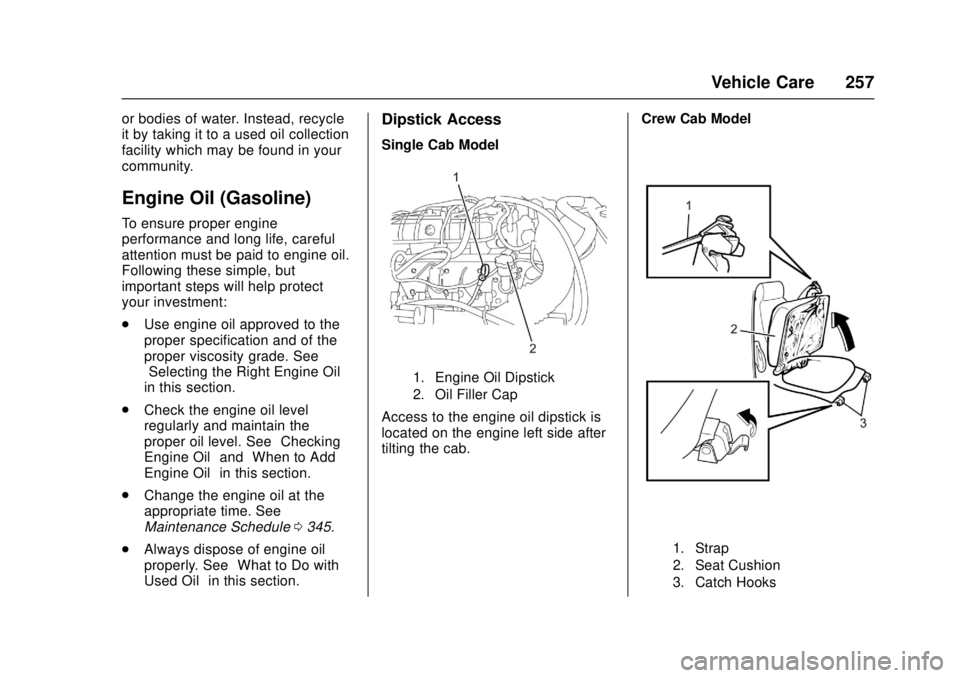
Dipstick Access
Single Cab Model
1. Engine Oil Dipstick
2. Oil Filler Cap
Access to the engine oil dipstick is
located on the engine left side after
tilting the cab. Crew Cab Model
1. Strap
2. Seat Cushion
3. Catch Hooks
Page 264 of 414

Chevrolet Low Cab Forward Owner Manual (GMNA-Localizing-U.S.-
10716700) - 2017 - crc - 12/6/16
Vehicle Care 263
.Diesel Engine Dipstick H
(HOT) —Transmission fluid
temperature Approx. 70 -
80 °C (158 - 176 °F).
. For diesel engines, the “C
(COLD)” range on the
dipstick is a guide used by
your dealer for specialized
equipment used to replace
or service the automatic
transmission fluid. When
performing your own
inspections, always use the
“H (HOT)” range after
warming up the vehicle.
The fluid must be hot to
ensure an accurate check.
The fluid level rises as
temperature increases.
6. If the fluid level is too low, add the specified fluid through the
dipstick guide tube. Also, check
whether there are no fluid
leaks.
7. Insert the dipstick securely into position.{Warning
Be extremely careful not to burn
yourself when checking the oil
level if the engine temperature is
high. Protect yourself with
gloves etc.
You and others could be seriously
injured.
Discarded parts, oil, grease and
fluids could have an adverse effect
on the environment. It is difficult to
dispose of these, so have your
dealer handle all checks and
replacements.
Engine Air Cleaner/Filter
Air Cleaner
Use of clogged air cleaner element
not only causes a deterioration in
the engine output but also increased
fuel consumption and dark exhaust
smoke. Be sure to use a genuine air cleaner
element. If other air cleaner element
is used, it may cause the sensor to
output a wrong signal.
See
Maintenance Schedule 0345.
Air Cleaner Indicator Light
(Diesel Vehicles Only)
When the air cleaner indicator light
comes on, check the air cleaner
element. If the air cleaner element is
clogged, replace the air cleaner
element.
See Vehicle Messages (Diesel
Only) 097.
See Maintenance Schedule 0345.
Engine Coolant
Protection of Engine against
Overcooling
Overcooling of the engine not only
accelerates wear of the vital engine
parts but also hurts fuel economy.
Page 265 of 414

Chevrolet Low Cab Forward Owner Manual (GMNA-Localizing-U.S.-
10716700) - 2017 - crc - 12/6/16
264 Vehicle Care
Engine Coolant in Cold
Weather
To prevent the engine damage due
to freezing of the engine coolant,
mix the coolant and water at the
ratio of 50/50.
Replace rubber hoses whenever
they crack or are damaged; even
minor cracks allow engine coolant
solution to leak.
{Warning
If your engine cooling system
overheats, seeEngine
Overheating 0269. Continued
operation of the engine even for a
short time may result in a fire and
the possibility of personal injury
and/or severe vehicle damage.
You and others could be seriously
injured.
Your vehicle has an engine coolant
recovery system, expansion bottle
and/or an engine coolant reserve
tank system. Engine coolant in the
system expands with heat and overflows into the reserve tank.
When the system cools, engine
coolant is drawn back into the
radiator.
The engine cooling system has
been filled at the factory with a
quality engine coolant. It is
important to use proper engine
coolant to prevent damage to
engine cooling system components.
The engine cooling system is
designed to use engine coolant
rather than plain water. See
Recommended Fluids and
Lubricants
0378.
See the Maintenance Schedule to
find out when the engine coolant
must be replaced. Note that
changing the engine coolant is
needed to replenish the rust
inhibitors to make certain that all
parts of the engine cooling system
work well.
{Warning
Check, replenish or change the
engine coolant only after the
engine has sufficiently
cooled down.
Do not loosen or remove the cap
of the radiator or engine coolant
reserve tank cap when the engine
coolant is still hot. Hot vapor or
boiling water may burst out and
cause a burn.
When removing the radiator cap
or engine coolant reserve tank
cap, use a thick cloth to cover the
cap and turn it slowly.
Engine coolant is toxic and must
not be ingested. If the engine
coolant is mistakenly ingested,
seek prompt medical attention.
If the engine coolant gets in your
eyes, rinse your eyes immediately
with a large amount of water for
15 minutes or longer. Also, if your (Continued)
Page 274 of 414

Chevrolet Low Cab Forward Owner Manual (GMNA-Localizing-U.S.-
10716700) - 2017 - crc - 12/6/16
Vehicle Care 273
Power Steering Fluid
The power steering fluid level must
be checked and it must be changed
according to the Maintenance
Schedule. SeeMaintenance
Schedule 0345.
When replenishing power steering
fluid or flushing the power steering
system, always use ATF
(Dexron
®-VI). Failure to use the
proper fluid may damage the power
steering system seals and hoses,
leading to fluid leakage.
Checking the Power Steering
Fluid Level
For the 3.0L diesel vehicles, the
fluid level is correct if it is between
the “MAX” and“MIN” lines on the
reserve tank. If the level is lower
that the “MIN”line, add fluid up to
the “MAX” line.
For the 5.2L diesel vehicles, the
fluid level is correct if it is between
the“MAX” and“MIN” lines on the
reserve tank. If the level is lower
that the “MIN”line, add fluid up to
the “MAX” line.
The reserve tank is located at the
rear of the engine compartment on
the right. When you have finished
checking the fluid level, securely
install the cap and cover.
For single cab gasoline vehicles, the
fluid level is correct if it is between
the "MAX" and "MIN" lines on the oil
dipstick. If the level is lower than the
"MIN" line, add fluid up to the
"MAX" line.
The reserve tank is located at the
front left side of the engine.