reset CHEVROLET LOW CAB FORWARD 2017 User Guide
[x] Cancel search | Manufacturer: CHEVROLET, Model Year: 2017, Model line: LOW CAB FORWARD, Model: CHEVROLET LOW CAB FORWARD 2017Pages: 414, PDF Size: 7.97 MB
Page 227 of 414
Chevrolet Low Cab Forward Owner Manual (GMNA-Localizing-U.S.-
10716700) - 2017 - crc - 12/6/16
226 Driving and Operating
at the decreased vehicle speed.
If you want to decrease the speed
quickly, press the brake pedal to
cancel cruise control and decelerate
to the desired vehicle speed. Then,
operate the cruise control set switch
When Decreasing Vehicle Speed
Slightly
If the cruise control set switch is
operated and released immediately,
the set vehicle speed decreases
1.6 km/h (1 MPH) per operation.
This operation can be performed 6
times (3.0L diesel) or 10 times (5.2L
diesel) consecutively.When Canceling Cruise Control
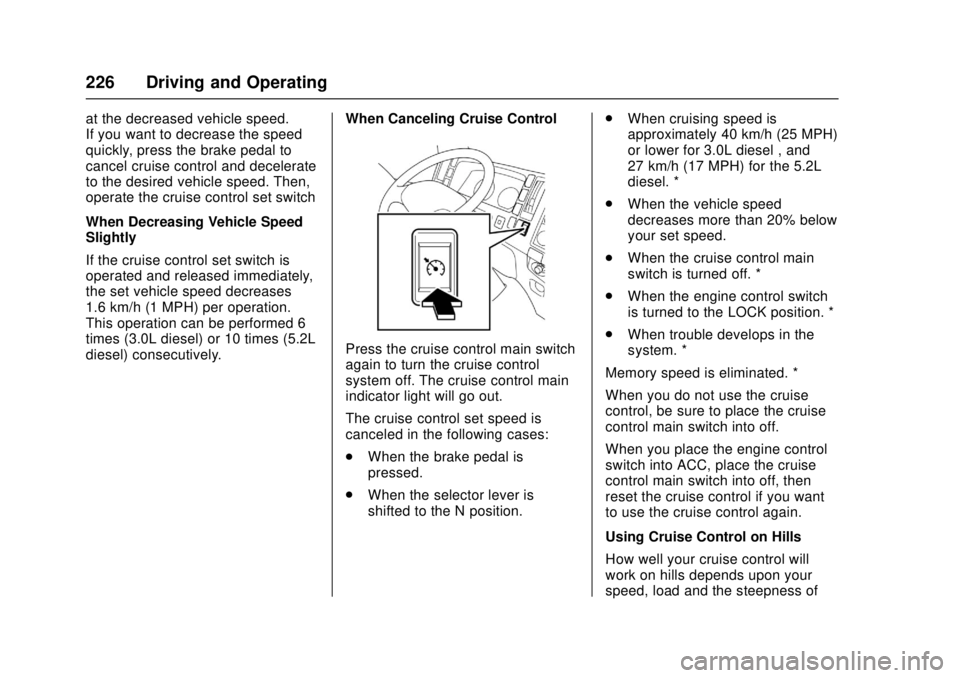
Press the cruise control main switch
again to turn the cruise control
system off. The cruise control main
indicator light will go out.
The cruise control set speed is
canceled in the following cases:
.
When the brake pedal is
pressed.
. When the selector lever is
shifted to the N position. .
When cruising speed is
approximately 40 km/h (25 MPH)
or lower for 3.0L diesel , and
27 km/h (17 MPH) for the 5.2L
diesel. *
. When the vehicle speed
decreases more than 20% below
your set speed.
. When the cruise control main
switch is turned off. *
. When the engine control switch
is turned to the LOCK position. *
. When trouble develops in the
system. *
Memory speed is eliminated. *
When you do not use the cruise
control, be sure to place the cruise
control main switch into off.
When you place the engine control
switch into ACC, place the cruise
control main switch into off, then
reset the cruise control if you want
to use the cruise control again.
Using Cruise Control on Hills
How well your cruise control will
work on hills depends upon your
speed, load and the steepness of
Page 228 of 414
Chevrolet Low Cab Forward Owner Manual (GMNA-Localizing-U.S.-
10716700) - 2017 - crc - 12/6/16
Driving and Operating 227
the hills. When going up steep hills,
you may want to step on the
accelerator pedal to maintain your
speed. When going downhill, you
may have to brake or shift to a lower
gear to keep your speed down. Of
course, applying the brake takes
you out of cruise control. Many
drivers find this to be too much
trouble and do not use cruise
control on steep hills.
When Returning to Cruise Control
Driving
If you have canceled cruise control
under the following conditions, you
can return to the cruise control
driving condition before cancellation
when you operate and release the
cruise control resume switch. The
moment the resume switch is
released, the cruise set indicator
light comes on.
.When pressing the brake pedal.
. When the selector lever is
shifted to the N position.
When the vehicle speed decreases
to 30 km/h (19 MPH) or less for the
3.0L diesel, and 40 km/h (25 MPH) or less for the 5.2L diesel, it is not
possible to return to the cruise
control driving. You must reset the
cruise control.
If the cruise control is turned back
on while the vehicle speed exceeds
what is set prior to the cancellation
of cruise control, the set vehicle
speed cannot be changed until the
vehicle reaches to the set speed.
Also, the vehicle speed must be 1
MPH below the previously set
vehicle speed.
For the 5.2L diesel engine, if you
hold the switch at the +RES
position, the vehicle will keep going
faster until you release the switch or
apply the brake. So unless you want
to go faster, do not hold the switch
at the +RES position.
Exhaust Brake Function
Diesel Vehicles Equipped with
Exhaust Brake-interlocked Cruise
Automatic activation of the exhaust
brake during cruise control driving
suppresses an increase in the
speed on a downhill slope,
decreasing the need for the driver toapply the regular brake pedal. The
exhaust brake does not activate
when the exhaust brake switch is
turn off.
The maximum slope angle at which
the system can control the vehicle
speed increase is different
depending on the load the vehicle is
carrying.
Automatic Activation and
Automatic Release of Exhaust
Brake
The exhaust brake is engaged when
the vehicle speed exceeds the set
speed on a downhill slope.
The exhaust brake is disengaged
when the vehicle slows down close
to the set.
Cruise Control (Gas)
The cruise control function allows
you to drive the vehicle at a
constant speed without operating
the accelerator pedal. Use this
function when the vehicle speed is
between 48 and 117 km/h (30 and
73 MPH) (48 and 97 km/h (30 and
60 MPH) for vehicles equipped with
Page 231 of 414
Chevrolet Low Cab Forward Owner Manual (GMNA-Localizing-U.S.-
10716700) - 2017 - crc - 12/6/16
230 Driving and Operating
When Canceling Cruise Control
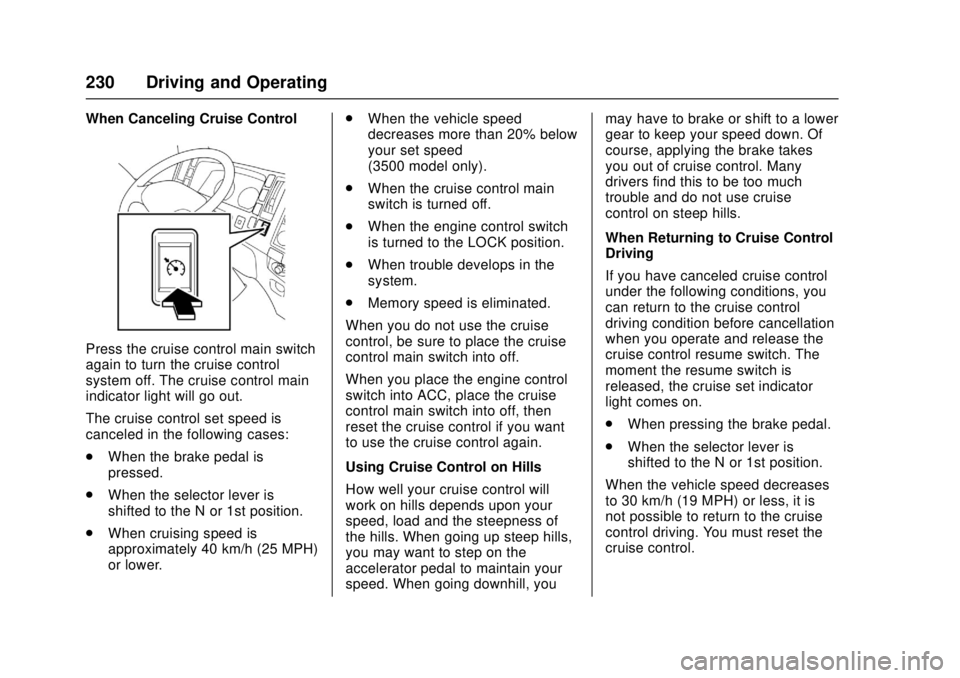
Press the cruise control main switch
again to turn the cruise control
system off. The cruise control main
indicator light will go out.
The cruise control set speed is
canceled in the following cases:
.When the brake pedal is
pressed.
. When the selector lever is
shifted to the N or 1st position.
. When cruising speed is
approximately 40 km/h (25 MPH)
or lower. .
When the vehicle speed
decreases more than 20% below
your set speed
(3500 model only).
. When the cruise control main
switch is turned off.
. When the engine control switch
is turned to the LOCK position.
. When trouble develops in the
system.
. Memory speed is eliminated.
When you do not use the cruise
control, be sure to place the cruise
control main switch into off.
When you place the engine control
switch into ACC, place the cruise
control main switch into off, then
reset the cruise control if you want
to use the cruise control again.
Using Cruise Control on Hills
How well your cruise control will
work on hills depends upon your
speed, load and the steepness of
the hills. When going up steep hills,
you may want to step on the
accelerator pedal to maintain your
speed. When going downhill, you may have to brake or shift to a lower
gear to keep your speed down. Of
course, applying the brake takes
you out of cruise control. Many
drivers find this to be too much
trouble and do not use cruise
control on steep hills.
When Returning to Cruise Control
Driving
If you have canceled cruise control
under the following conditions, you
can return to the cruise control
driving condition before cancellation
when you operate and release the
cruise control resume switch. The
moment the resume switch is
released, the cruise set indicator
light comes on.
.
When pressing the brake pedal.
. When the selector lever is
shifted to the N or 1st position.
When the vehicle speed decreases
to 30 km/h (19 MPH) or less, it is
not possible to return to the cruise
control driving. You must reset the
cruise control.
Page 244 of 414

Chevrolet Low Cab Forward Owner Manual (GMNA-Localizing-U.S.-
10716700) - 2017 - crc - 12/6/16
Driving and Operating 243
Optional PTO switches are available
from your dealer to ease installation
of a PTO.
The optional PTO main switch and
PTO engine speed control switch
can be used increase the engine
idle r/min without additional
programming. Pressing the PTO
main switch once will activate the
PTO mode and raise the idle up
speed up to the preset 800 r/min.
Once in PTO mode the PTO engine
speed control switch can be used to
adjust the idle speeds between the
preset 1,300 and 1,700 r/min.
Moving the selector lever from park
or neutral, applying the brake pedal
or releasing the parking brake will
cancel PTO mode and return the
engine idle speed to normal. For
additional details about PTO
programming, contact your dealer.
Page 252 of 414

Chevrolet Low Cab Forward Owner Manual (GMNA-Localizing-U.S.-
10716700) - 2017 - crc - 12/6/16
Vehicle Care 251
Engine Coolant Reserve Tank
Inspection Cover (Crew Cab
Model) 5.2L Diesel
To gain access to the engine
coolant reserve tank, remove the
inspection cover located under the
rear left seat.
Engine Oil (Diesel)
Engine oil is an important factor
determining engine performance
and longevity. Be sure to use only
the specified oil and oil filters. The
engine oil level must be checked
and the oil should be changed
regularly according to the
Maintenance Schedule.The engine oil performs the
following important functions:
.
It prevents engine parts from
becoming worn.
. It cools engine parts.
. It cleans engine parts.
. It seals the combustion
chambers and prevents rust.
Replace the engine oil at regular
intervals.
When particulate matter (PM) has
accumulated to a preset level in the
diesel particulate filter (DPF), the
filter is automatically regenerated
through combustion. To make this
regeneration (combustion) possible,
a small amount of fuel is injected
into the engine combustion chamber
after firing. This causes fuel to
gradually become mixed with the
engine oil, and the engine oil level
may rise beyond the original level.
This does not indicate a malfunction
of the engine.
Access to the Engine
Single Cab Model
Access to the engine oil dipstick is
located on the engine left side after
tilting the cab. See Cab Tilting
0 247.
Crew Cab Model
The engine oil dipstick is under the
engine inspection sub cover located
beneath the driver's seat.
Page 270 of 414
Chevrolet Low Cab Forward Owner Manual (GMNA-Localizing-U.S.-
10716700) - 2017 - crc - 12/6/16
Vehicle Care 269
2. Fill the radiator to the base ofthe filler neck (2).
.Add enough engine coolant
to provide the required
cooling, freezing and
corrosion protection.
. Install the radiator cap.
3. Run the engine until the engine coolant temperature rises to
normal level, and idle the
engine for 10 minutes.
4. Turn off the engine. Make sure that the engine is cool.
Remove the radiator cap and
add engine coolant to the
radiator until it reaches the
base of the filler neck.
5. Install the radiator cap.
Check, replenish or change the
engine coolant only after the engine
has sufficiently cooled down.
When the engine is still hot, take
care to prevent engine coolant from
contact with the exhaust manifold.
Any such contact could result in
exhaust manifold damage. If you use the proper quality engine
coolant, there is no need to add
extra inhibitors or additives which
claim to improve the system. They
may be harmful to the proper
operation of the system.
Do not overfill the engine coolant
reserve tank.
If the level of engine coolant
changes rapidly, have your vehicle
inspected at your dealer.
Thermostat
The engine coolant temperature is
controlled by thermostat(s). The
thermostats stop engine coolant
flow through the radiator until a
preset temperature is reached. The
thermostats are installed in the
engine coolant outlet on the engine
block. The same thermostats are
used in both winter and summer.
When a replacement is needed,
genuine GM parts are
recommended.
Radiator Pressure Cap
The radiator cap, a 103 kPa (15 psi)
pressure type for gasoline vehicles
and a 108 kPa (16 psi) for dieselvehicles, must be installed tightly,
otherwise engine coolant may be
lost and damage to the engine may
result from overheating. The radiator
pressure cap should be checked
periodically for proper operation. If a
replacement is required, a genuine
GM part is recommended.
Engine Overheating
When the Engine Overheats
The engine cooling system may
overheat if the engine coolant level
is too low, if there is a sudden loss
of engine coolant (such as radiator
hose failure), or if other problems
occur. It may also temporarily
overheat during severe operating
conditions such as:
.
Climbing a long hill on a hot day.
. Stopping after high-speed
driving.
. Idling for long periods in traffic.
If engine power drops and the
needle on the engine coolant
temperature gauge goes up above
the upper limit of the safety zone
and enters the "H" zone, the engine