engine oil CHEVROLET LOW CAB FORWARD 2017 Workshop Manual
[x] Cancel search | Manufacturer: CHEVROLET, Model Year: 2017, Model line: LOW CAB FORWARD, Model: CHEVROLET LOW CAB FORWARD 2017Pages: 414, PDF Size: 7.97 MB
Page 273 of 414

Chevrolet Low Cab Forward Owner Manual (GMNA-Localizing-U.S.-
10716700) - 2017 - crc - 12/6/16
272 Vehicle Care
4. If no steam or engine coolantcan be seen or heard from the
engine compartment:
.Tilt the cab or open the
engine access cover.
‐If the engine coolant is
boiling, wait until it stops
before proceeding.
‐ Look at the see-through
reserve tank. The
engine coolant level
should be between the
"MAX" and "MIN" lines
on the reserve tank.
‐ If necessary, pour
engine coolant (See
Engine Coolant 0263
for the proper coolant
and water mixture) into
the reserve tank only,
not directly into the
radiator. Also, do not
check engine coolant
level at the radiator.
. Make sure the fan belts are
not broken, or off the
pulleys, and that the fan
turns when the engine is started. Make sure the fan
blade and pulleys are not
broken.
. Diesel engine only, check
the radiator hoses and
connections, heater hoses
and connections, radiator,
water pump, EGR cooler,
and SCR system and hoses
for leakage.
. Gasoline engine only, if the
engine coolant level in the
reserve tank is low, look for
leaks at the radiator hoses
and connections, heater
hoses and connections,
radiator, and water pump.
If the engine coolant level in
the reserve tank is at the
correct level but there is still
an indication on the
instrument panel of an
overheat condition:
You must let the engine
cool first. You may then add
engine coolant directly to
the radiator. See "Adding
Engine Coolant" under
Engine Coolant 0263. 5. Inspect to see if there is any
dirt, etc. attached to the front
surface of the radiator. Also,
inspect to see if there is
anything blocking the core.
If there is anything attached,
clean and remove it.
6. After the inspection, regardless of the vehicle condition, please
contact the nearest dealer.
Once the engine coolant
temperature gauge no longer
signals an overheat condition, you
can resume driving at a reduced
speed. Return to normal driving
after about 10 minutes if the gauge
pointer does not again show an
overheat condition.
When tap water only has been used
for engine coolant in an emergency,
change the engine coolant as soon
as possible.
Engine damage may be caused if
an overheating engine is suddenly
refilled with water. Instead, refill
slowly.
Page 274 of 414

Chevrolet Low Cab Forward Owner Manual (GMNA-Localizing-U.S.-
10716700) - 2017 - crc - 12/6/16
Vehicle Care 273
Power Steering Fluid
The power steering fluid level must
be checked and it must be changed
according to the Maintenance
Schedule. SeeMaintenance
Schedule 0345.
When replenishing power steering
fluid or flushing the power steering
system, always use ATF
(Dexron
®-VI). Failure to use the
proper fluid may damage the power
steering system seals and hoses,
leading to fluid leakage.
Checking the Power Steering
Fluid Level
For the 3.0L diesel vehicles, the
fluid level is correct if it is between
the “MAX” and“MIN” lines on the
reserve tank. If the level is lower
that the “MIN”line, add fluid up to
the “MAX” line.
For the 5.2L diesel vehicles, the
fluid level is correct if it is between
the“MAX” and“MIN” lines on the
reserve tank. If the level is lower
that the “MIN”line, add fluid up to
the “MAX” line.
The reserve tank is located at the
rear of the engine compartment on
the right. When you have finished
checking the fluid level, securely
install the cap and cover.
For single cab gasoline vehicles, the
fluid level is correct if it is between
the "MAX" and "MIN" lines on the oil
dipstick. If the level is lower than the
"MIN" line, add fluid up to the
"MAX" line.
The reserve tank is located at the
front left side of the engine.
Page 275 of 414
Chevrolet Low Cab Forward Owner Manual (GMNA-Localizing-U.S.-
10716700) - 2017 - crc - 12/6/16
274 Vehicle Care
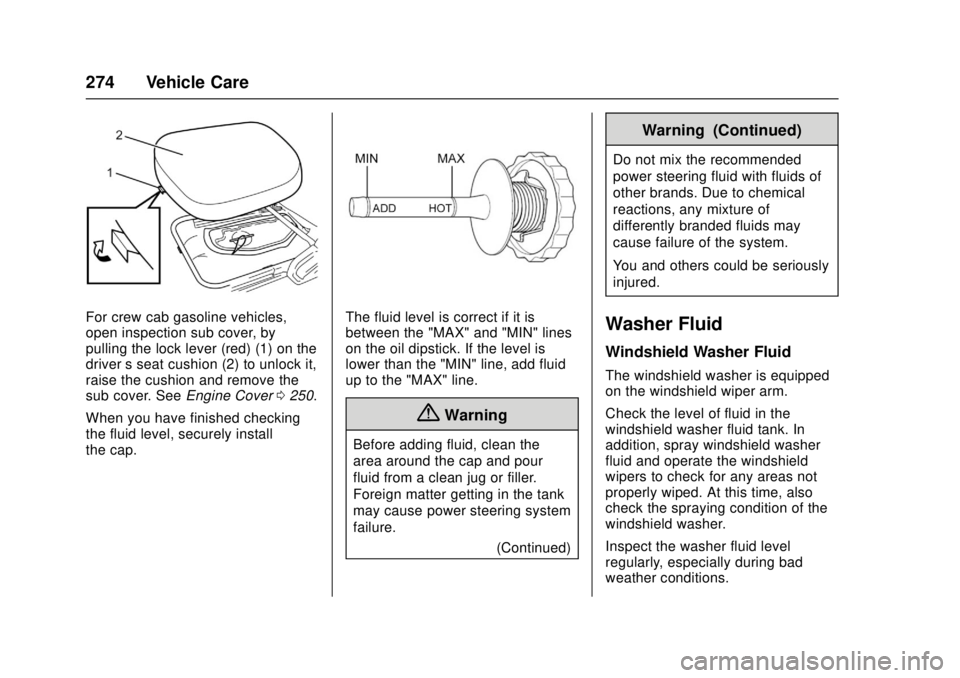
For crew cab gasoline vehicles,
open inspection sub cover, by
pulling the lock lever (red) (1) on the
driver’s seat cushion (2) to unlock it,
raise the cushion and remove the
sub cover. See Engine Cover0250.
When you have finished checking
the fluid level, securely install
the cap.The fluid level is correct if it is
between the "MAX" and "MIN" lines
on the oil dipstick. If the level is
lower than the "MIN" line, add fluid
up to the "MAX" line.
{Warning
Before adding fluid, clean the
area around the cap and pour
fluid from a clean jug or filler.
Foreign matter getting in the tank
may cause power steering system
failure. (Continued)
Warning (Continued)
Do not mix the recommended
power steering fluid with fluids of
other brands. Due to chemical
reactions, any mixture of
differently branded fluids may
cause failure of the system.
You and others could be seriously
injured.
Washer Fluid
Windshield Washer Fluid
The windshield washer is equipped
on the windshield wiper arm.
Check the level of fluid in the
windshield washer fluid tank. In
addition, spray windshield washer
fluid and operate the windshield
wipers to check for any areas not
properly wiped. At this time, also
check the spraying condition of the
windshield washer.
Inspect the washer fluid level
regularly, especially during bad
weather conditions.
Page 278 of 414

Chevrolet Low Cab Forward Owner Manual (GMNA-Localizing-U.S.-
10716700) - 2017 - crc - 12/6/16
Vehicle Care 277
Another characteristic of the HBB
system is that the brake pedal may
be depressed easily to the floor with
the vehicle at a stop. This is not a
sign of malfunction.
When the engine is running, the
system automatically charges the
accumulator whenever pressure has
been reduced after braking. Auto
charge may be activated without
braking, depending on temperature
changes in the accumulator. During
auto charge, a hissing and clicking
sound can be heard. This is not a
malfunction.
With the engine running, a booming
sound can be heard during hard
braking. This comes from the
brake-fluid pump. It is not a
malfunction.
Applying continuous hard braking
for a long time will lead to
considerable temperature rise in the
HBB pump. Such overworking of the
brakes is best avoided.Vacuum or hydraulic power
assisted brakes
If the engine stops, do not pump the
brakes. The system is designed to
stop the vehicle with reserve power
assist if the brake pedal is held
down. This reserve is greatly
reduced each time you apply and
release the brakes. If, when you
turn the steering wheel during
braking, the vehicle does not turn,
release some pressure from the
brake pedal.
In a Vehicle Equipped with a HBB,
Do Not Keep the Brake Pedal
Depressed for an Extended Period
Caution
Failure to follow the above
instruction will cause the oil inside
the HBB oil pump to get very hot.
This could damage the HBB tank
and deteriorate seals and also
could cause damage to the HBB
oil pump, HBB unit and/or HBB
hosing. Eventual leakage of HBB
(Continued)
Caution (Continued)
oil, sudden increase in brake
pedal resistance and fire could
unexpectedly result in an
accident.
Hydraulic Brake Booster (HBB)
Fluid (5500HD/5500XD Series)
The HBB system has been
designed to use ATF Dexron fluid is
used with this system, rubber
components may be damaged, oil
may leak and the system may
malfunction. It is important to
remember that the fluid used in the
hydro-booster is completely different
in characteristics from the brake
fluid used in the master and wheel
cylinders.
If hydro-booster fluid and brake fluid
from the master cylinder are
mistakenly mixed together and
used, rubber components will
deteriorate as a result of insufficient
lubrication. Any resultant oil leakage
or system malfunction can in turn
lead to dragging brakes or other
Page 321 of 414
Chevrolet Low Cab Forward Owner Manual (GMNA-Localizing-U.S.-
10716700) - 2017 - crc - 12/6/16
320 Vehicle Care
Warning (Continued)
wheels should be serviced
only by trained people using
the proper equipment.
. Never add air to your tires
unless an accurate pressure
gauge is also used. When
putting air in a tire on the
vehicle, stand to the side
and use a clip-on chuck and
hose extension. In choosing
the right tire pressure, be
careful not to exceed the
maximum pressure
capability shown on the tire;
see the tire pressure charts
at the end of this manual.
. Tire mounting or repair can
result in serious personal
injury or death, if not
performed correctly. This
section has detailed
instructions for proper wheel
and tire replacement, so be
sure to read and follow
them. Truck fleet owners
(Continued)
Warning (Continued)
and operators: You can get
written instructions on truck
tire demounting, repair and
mounting from Rubber
Manufacturers Association
(RMA), 1400 K Street N.W.,
Washington, D.C. 20005,
and also from many tire
stores.
Wheel Nut Torque
{Warning
Never use oil or grease on studs
or nuts. Use the torque specified
for the type of wheels on the
vehicle. Snug all wheel nuts and
then tighten to the specified
torque in the numerical sequence
shown. Improperly tightened
wheel nuts could eventually allow
the wheel to come off while the
vehicle is moving, possibly (Continued)
Warning (Continued)
causing loss of control and
personal injury and property
damage.
When the vehicle, wheel or
fasteners are new, have a
technician tighten wheel stud nuts
and rim clamp nuts with a torque
wrench at 1 040 km (650 mi). This is
necessary because the clamping
system used on the wheels must
seat before the fastener will hold a
uniform clamp load and remain fully
tightened. Also have a technician
tighten wheel stud nuts and rim
clamp nuts with a torque wrench
after installing any wheel.
For diesel engines, in addition, nut
tightness on all wheels should be
set with a torque wrench every
10 400 km (6,500 mi).
For gas engines, in addition, nut
tightness on all wheels should be
set with a torque wrench every
12 000 km (7,500 mi).
Page 337 of 414

Chevrolet Low Cab Forward Owner Manual (GMNA-Localizing-U.S.-
10716700) - 2017 - crc - 12/6/16
336 Vehicle Care
floor. Do not apply water from a
high-pressure washer nozzle
directly to the electric connectors.
Failure to observe this precaution
can lead to faulty operation of the
electrical system. If an automatic
car or truck-wash is used with
vehicles having dark or metallic
coating, the painted surfaces can be
damaged by the brushes, lose their
luster or be very noticeably
scratched.
Do not direct a large amount of
water at the air inlet openings. Do
not apply water to the engine
compartment or at electrical
components. Failure to observe this
precaution can lead to a poorly
starting and operating engine and
problems in the electrical system.
Ensure that mirrors and the antenna
are retracted before washing the
vehicle.
If an automatic car or truck-wash
must be used, avoid a
high-temperature, high pressure
type machine. Failure to observe
this precaution can lead to heat
deformation and breakage of plastic
components, or to water leaks intothe cab. When using an automatic
car or truck-wash, ensure that a
distance of at least 0.4 m
(15.75 inches) is maintained
between the nozzle and the vehicle,
and when washing door windows,
that the spray is perpendicular to
the surface of the glass.
Ensure that all detergent is fully
washed and wiped away.
Particularly in the case of strong
alkaline detergents (typically those
for industrial uses), there is a
danger that hairline cracks can
develop in lighting-cluster lenses if
the vehicle is operated without
detergent being fully wiped away.
Always read the detergent
manufacturer's instructions carefully
before use. Airborne dirt that
adheres to plastic front bumpers as
a result of rain, for example, can be
difficult to remove. In such a case,
use a commercially-available
cleaner to clean away the dirt, and
then apply a wax for use with plastic
components.Vehicle Storage
In order to maintain your vehicle's
attractive appearance as long as
possible, special consideration must
be given to its storage location.
If the vehicle is stored or kept for an
extended period of time in any of
the following locations, a chemical
change may occur in the paint work,
resulting in staining, discoloration,
rusting, and corrosion of
components.
.
Locations where a large amount
of oily matter, soot, heavy smoke
or metal powder can adhere to
the vehicle.
. Areas around pharmaceutical
plants and other facilities that
discharge chemical matter.
. Coastal areas
. Locations where a large amount
of dead bugs, bird droppings or
tree sap can adhere to the
vehicle.
Page 338 of 414

Chevrolet Low Cab Forward Owner Manual (GMNA-Localizing-U.S.-
10716700) - 2017 - crc - 12/6/16
Vehicle Care 337
Polishing and Waxing
Periodic polishing and waxing is
recommended to remove built-up
residue and eliminate any
"weathered" appearance.
Your authorized dealer offers
several polishes and cleaners which
have proven value in maintaining
original finish appearance and
durability.
Painted and chrome-plated surfaces
should be waxed once or twice a
month, or whenever water is being
poorly repelled on the surfaces.
Ensure that wax is not applied in
direct sunlight, and that the
temperature of the painted surface
is no more than 40 °C (104 °F).
Always follow the instructions
provided with your wax product.
Do not use wax containing abrasive
material. Failure to observe this
precaution can lead to scratching of
painted surfaces or plastic
components.
The application of wax to rubber
component surfaces can result in
permanent whitening.Wax must not be applied to the
windshield. Failure to observe this
precaution can result in irregular
reflection of light, impairing
your view.
Protecting Exterior Bright Metal
Parts
Bright metal parts should be
cleaned regularly to keep their
luster. Washing with water is all that
is usually needed.
Use special care with aluminum
trim. To avoid damaging protective
trim, never use auto or chrome
polish, steam or caustic soap to
clean aluminum. A coating of wax,
rubbed to a high polish, is
recommended for all bright metal
parts.
Weatherstrip Lubrication
All weatherstrips should be
periodically lubricated (minimum of
every 6 months) with a silicone
grease lubricant. A thin film of
silicone grease lubricant should be
applied using a clean cloth. Silicone
grease application will lengthen
weatherstrip life, help sealing, and
assist in eliminating squeaks.
Windshield Care
Wax must not be applied to the
windshield. A layer of wax can
impair your view in rainy weather
and can also lead to rough
movements of the windshield wiper.
If engine oil or grease comes into
contact with the windshield, staining
or discoloration may result. It must
be immediately cleaned away.
If not fully cleaned by the windshield
wipers, the windshield should be
cleaned using glass cleaner. If your
windshield is not clear after using
the windshield washer, or if the
wiper blade chatters when running,
wax or other material may be on the
blade or windshield.
The windshield wipers on your truck
can be pulled out from the
windshield to provide easier access
for cleaning.
Clean the outside of the windshield
with a non-abrasive cleaner. Your
windshield is clean if beads do not
Page 340 of 414

Chevrolet Low Cab Forward Owner Manual (GMNA-Localizing-U.S.-
10716700) - 2017 - crc - 12/6/16
Vehicle Care 339
Cooling efficiency is compromised
when there is dirt or dust plugging
air passages in the radiator core
and charge air cooler core (diesel).
This can also cause corrosion of
these cores. Wash the radiator core
with tap water every 24 months.
Make sure to turn the engine off and
remove the key from the engine
control switch before cleaning
cores.
The engine, exhaust pipe, and
radiator will be hot immediately after
the vehicle is driven. Be careful
around these parts to prevent burns.
Clean the engine when it is cold.
Do not clean the radiator, charge air
cooler (diesel) and their surrounding
areas using water that is supplied
under high pressure. Doing so may
cause damage.
When cleaning the radiator core (1)
and charge air cooler core (2) , do
not crush or damage the fins (3).
The fins are very fragile so be
careful not to bend them out of
shape. If they become deformed,
their cooling efficiency will be
impaired. Before cleaning, take
steps to ensure that no water will
splash onto the surrounding
electrical components and wires.
If stubborn dirt still remains even
after the radiator core and charge
air cooler core (diesel) have been
cleaned, have the vehicle inspected
and serviced.
Corrosion Protection
Your vehicle has been designed and
built to resist corrosion. Special
materials and protective finishes
were used on most parts of your
vehicle when it was built to help
maintain good appearance,
strength, and reliable operation.
However, some parts which
normally are not visible (such as
those under the vehicle and under
the hood) are such that surface rust
will not affect their reliability. So
corrosion protection is not needed
or used on these parts.
Sheet Metal Damage
If your vehicle is damaged and
requires sheet metal repair or
replacement, make sure the body
repair shop applies anti-corrosion
material to the parts repaired or
replaced so that corrosion protection
is restored. (Also see "Finish
Damage" which follows.)
Foreign Material Deposits
Calcium chloride and other salts,
ice-melting agents, road oil and tar,
tree sap, bird droppings, chemicals
Page 348 of 414

Chevrolet Low Cab Forward Owner Manual (GMNA-Localizing-U.S.-
10716700) - 2017 - crc - 12/6/16
Service and Maintenance 347
maintenance schedule is not
followed, or is improperly carried
out, no amount of correct vehicle
operation will prevent malfunction.
If vehicle application, operation and
preventive maintenance schedules
and procedures are followed and
properly carried out, the life of the
vehicle will be greatly extended.
For example, regular attention to the
engine oil is essential. The oil level
must be periodically checked and oil
added whenever needed. Also, the
oil should be changed at the
intervals specified with the proper
quality and viscosity of oil. If your
engine should run excessively low
on oil or if the oil has lost its
lubricating qualities because of old
age, serious engine damage could
occur.
Page 349 of 414
Chevrolet Low Cab Forward Owner Manual (GMNA-Localizing-U.S.-
10716700) - 2017 - crc - 12/6/16
348 Service and Maintenance
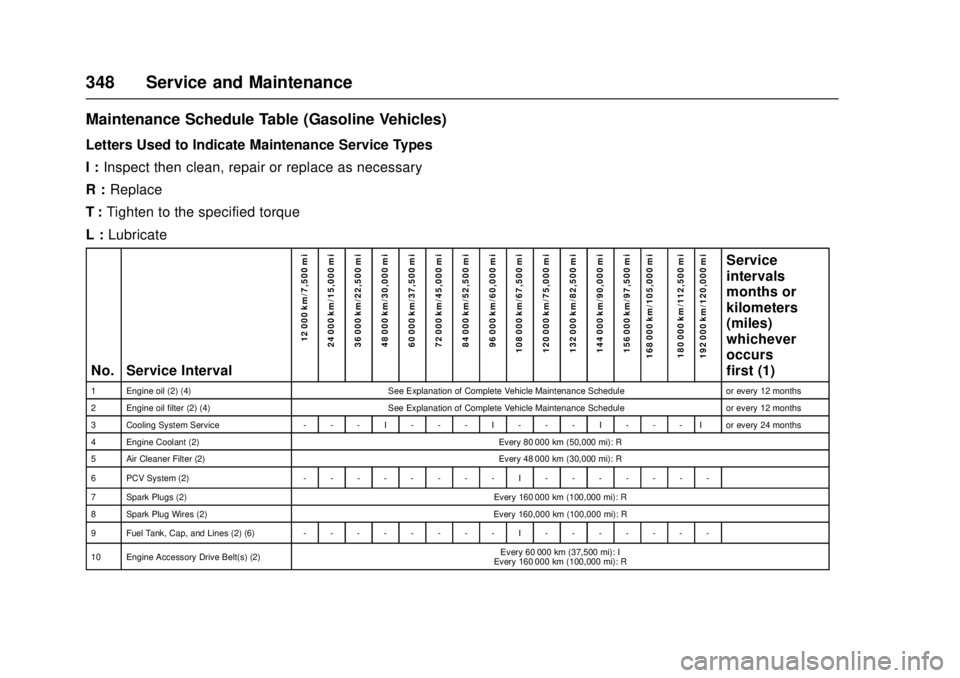
Maintenance Schedule Table (Gasoline Vehicles)
Letters Used to Indicate Maintenance Service Types
I :Inspect then clean, repair or replace as necessary
R : Replace
T : Tighten to the specified torque
L : Lubricate
No. Service Interval
12 000 km/7,500 mi
24 000 km/15,000 mi
36 000 km/22,500 mi
48 000 km/30,000 mi
60 000 km/37,500 mi
72 000 km/45,000 mi
84 000 km/52,500 mi
96 000 km/60,000 mi
108 000 km/67,500 mi
120 000 km/75,000 mi
132 000 km/82,500 mi
144 000 km/90,000 mi
156 000 km/97,500 mi
168 000 km/105,000 mi
180 000 km/112,500 mi
192 000 km/120,000 mi
Service
intervals
months or
kilometers
(miles)
whichever
occurs
first (1)
1 Engine oil (2) (4) See Explanation of Complete Vehicle Maintenance Schedule or every 12 months
2 Engine oil filter (2) (4) See Explanation of Complete Vehicle Maintenance Schedule or every 12 months
3 Cooling System Service - - - I - - - I - - - I - - - I or every 24 months
4 Engine Coolant (2) Every 80 000 km (50,000 mi): R
5 Air Cleaner Filter (2) Every 48 000 km (30,000 mi): R
6 PCV System (2) - - - - - - - - I - - - - - - -
7 Spark Plugs (2) Every 160 000 km (100,000 mi): R
8 Spark Plug Wires (2) Every 160,000 km (100,000 mi): R
9 Fuel Tank, Cap, and Lines (2) (6) - - - - - - - - I - - - - - - -
10 Engine Accessory Drive Belt(s) (2) Every 60 000 km (37,500 mi): I
Every 160 000 km (100,000 mi): R