engine oil CHEVROLET LOW CAB FORWARD 2017 User Guide
[x] Cancel search | Manufacturer: CHEVROLET, Model Year: 2017, Model line: LOW CAB FORWARD, Model: CHEVROLET LOW CAB FORWARD 2017Pages: 414, PDF Size: 7.97 MB
Page 109 of 414
Chevrolet Low Cab Forward Owner Manual (GMNA-Localizing-U.S.-
10716700) - 2017 - crc - 12/6/16
108 Infotainment System
Infotainment
System
Radio
AM-FM Radio . . . . . . . . . . . . . . . . 108
Radio Reception . . . . . . . . . . . . . . 112
Fixed Mast Antenna . . . . . . . . . . 113
Audio Players
CD Player . . . . . . . . . . . . . . . . . . . . 114
USB Port . . . . . . . . . . . . . . . . . . . . . 121
Auxiliary Devices . . . . . . . . . . . . . 124
Trademarks and License
Agreements
Trademarks and LicenseAgreements . . . . . . . . . . . . . . . . . 125
Radio
AM-FM Radio
Control Panel
{Warning
Adjust the radio or CD player only
while the vehicle is stationary.
Adjusting them while the vehicle
is moving could cause an
accident. You and others could be
seriously injured.
Adjust the volume so that sound
outside of the vehicle can be heard.
If outside sound cannot be heard,
accidents may be harder to avoid.
Do not install a radio equipment
antenna near the vehicle's radio
antenna. This could cause
unwanted noise on the radio or
while playing a CD.
The radio or CD/USB player can be
used when the engine control switch
is in the "ACC" or "ON" position. Continued use while engine is
stopped may cause the battery to
discharge.
Take care not to spill liquids, etc. on
the radio or CD player. It may cause
damage to the player.
Do not disassemble or apply oil to
radio or CD player.
Page 118 of 414
Chevrolet Low Cab Forward Owner Manual (GMNA-Localizing-U.S.-
10716700) - 2017 - crc - 12/6/16
Infotainment System 117
Using the Audio System
{Warning
Adjust the radio or CD player only
while the vehicle is stationary.
Adjusting them while the vehicle
is moving could cause an
accident. You and others could be
seriously injured.
Adjust the volume so that sound
outside of the vehicle can be heard.
If outside sound cannot be heard,
accidents may be harder to avoid.
Do not install a radio equipment
antenna near the vehicle's radio
antenna. This could cause
unwanted noise on the radio or
while playing a CD.
The radio or CD/USB player can be
used when the engine control switch
is in the "ACC" or "ON" position.
Continued use while the engine is
stopped may cause the battery to
discharge. Take care not to spill liquids, etc. on
the radio or CD player. It may cause
damage to the player.
Do not disassemble or apply oil to
the radio or CD player.
Disc
When it is cold or when it is raining,
the car windows will fog up and
cause dew (water drops) to form in
the vehicle compartment
(condensation). When this happens,
the audio may skip, and playback
will stop. Ventilate the vehicle
compartment and dehumidify before
resuming use.
The audio may skip due to violent
vibrations when the car is traveling
across harsh roads.
Never insert foreign objects into the
disc insertion slot.
Do not insert a wet disc into the
player.
This player uses an invisible laser
beam which could cause hazardous
radiation exposure if directed
outside the player. Be sure to
operate the player correctly.Playback may not be possible due
to recording conditions or disc
characteristics, scratches, dirt,
or deterioration.
Usable Discs
Most music CDs can be used. CD-R
and CD-RW discs recorded
according to the CD-DA format can
also be played.
CD-R (CD-Recordable), CD-RW
(CD-ReWritable) may not be able to
play back due to the recording
condition, characteristics of the disc,
damage, dirt or deterioration due to
long exposure to the environment of
the vehicle compartment. CD-R,
CD-RW that are not finalized and
CD-R and CD-RW that are saved in
the UDF format cannot be played
(excluding MP3/WMA).
CD-TEXT function is only
compatible with commercial CD
compatible with CD-TEXT.
Characters may not display
accurately in CD-R and CD-RW.
Page 143 of 414

Chevrolet Low Cab Forward Owner Manual (GMNA-Localizing-U.S.-
10716700) - 2017 - crc - 12/6/16
142 Driving and Operating
Frequent use of the foot brakes can
cause vapor lock and brake fade,
resulting in reduced brake
effectiveness.
Brake Fade :Frequent use of the
brakes can cause the brakes to
overheat so that the frictional force
of the brake linings decreases and
the brakes become less effective
than normal. This phenomenon is
called brake fade.
Vapor Lock : If the brakes overheat
due to frequent use, the heat can
cause the brake fluid to boil so that
air bubbles are created in the brake
fluid. Pressing the brake pedal
simply compresses the air bubbles;
pressure is not transmitted to the
wheel cylinders, so the brakes'
effectiveness sharply deteriorates.
This phenomenon is called
vapor lock.
Even so, you should be very careful
when using engine braking in a low
gear because the engine is likely to
over-rev.
See Exhaust Brake (Diesel Only)
0 222 andSelector Lever 0214. On diesel vehicles, do not adjust the
exhaust brake valve.
The engine should never be allowed
to exceed the governed speed.
Supplement the exhaust brake with
vehicle service brakes intermittently
and/or shift to higher transmission
gear to prevent engine overspeed.
A rule of thumb for gear selection is
that the vehicle should be driven
down a grade in the same gear that
would be used to climb that grade.
{Warning
To reduce the risk of personal
injury, before going down a steep
or long grade, reduce speed, turn
on the exhaust brake and shift the
transmission to the next lower
gear. This will help control your
speed. Do not hold the brake
pedal down too long or too often
while going down a steep or long
grade. This could cause the
brakes to get hot and not to work
as well. As a result, the truck will
(Continued)
Warning (Continued)
not slow down at the usual rate.
Failure to take these steps could
result in loss of vehicle control.
You and others could be seriously
injured.
Brake Effectiveness When the
Vehicle Has Been Driven on a
Flooded Road or Washed
{Warning
When the vehicle is driven on a
flooded road, parked on a flooded
road or washed, water can get
into the brakes and reduce their
effectiveness. If the brakes do not
work well afterward, drive slowly
and gently press the brake pedal
several times until the brakes dry
out and start working normally.
Always do this after driving
through water or washing the
vehicle to help reduce the risk of(Continued)
Page 144 of 414

Chevrolet Low Cab Forward Owner Manual (GMNA-Localizing-U.S.-
10716700) - 2017 - crc - 12/6/16
Driving and Operating 143
Warning (Continued)
personal injury. Before parking
the vehicle in winter, press the
brake pedal several times in the
same way to get rid of moisture in
the brakes. Otherwise, the
moisture in the brakes may freeze
and make the vehicle immovable.
You and others could be seriously
injured.
If the vehicle must be driven on a
flooded road or is parked in an area
that becomes flooded, promptly
perform a check for the following
points:
. Effectiveness of the brakes
. Water-ingress or damage to
drum brakes, disc brakes
. Engine damage due to
water-ingress
. Shorting of electrical
components .
Oil level and degradation
(cloudiness) of the engine,
transmission, differential
. Greasing of each components
(lubrication)
Steering
Do Not Leave the Steering
Wheel Fully Turned for a
Long Time
{Warning
If you leave the steering wheel
fully turned for a long time, the oil
in the power steering oil pump will
become extremely hot. This
would cause poor lubrication, oil
tank damage and seal
deterioration, leading to power
steering oil pump damage, power
steering unit damage and power
steering hose damage. As a
result the steering wheel could
become extremely hard to turn
and a fire or other accident could
occur.
(Continued)
Warning (Continued)
You and others could be seriously
injured.
Steering Wheel
If the steering parts have excess
play or looseness or if any abnormal
condition is noted, have the steering
system checked immediately.
Driving on Wet Roads
Driving on Slippery Surface or
Driving in Bad Weather (Rain,
Icy Roads, Snowy Roads, etc.)
In bad weather, visibility is reduced
and slippery road surfaces increase
stopping distances. Drive more
slowly than you would in good
weather. Also, avoid sharp turns of
the steering wheel and hard
braking. Use engine brakes together
with the foot brakes to decelerate.
For diesel vehicles, using the
exhaust brake on a slippery road
surface could cause the tires to slip.
Page 146 of 414
Chevrolet Low Cab Forward Owner Manual (GMNA-Localizing-U.S.-
10716700) - 2017 - crc - 12/6/16
Driving and Operating 145
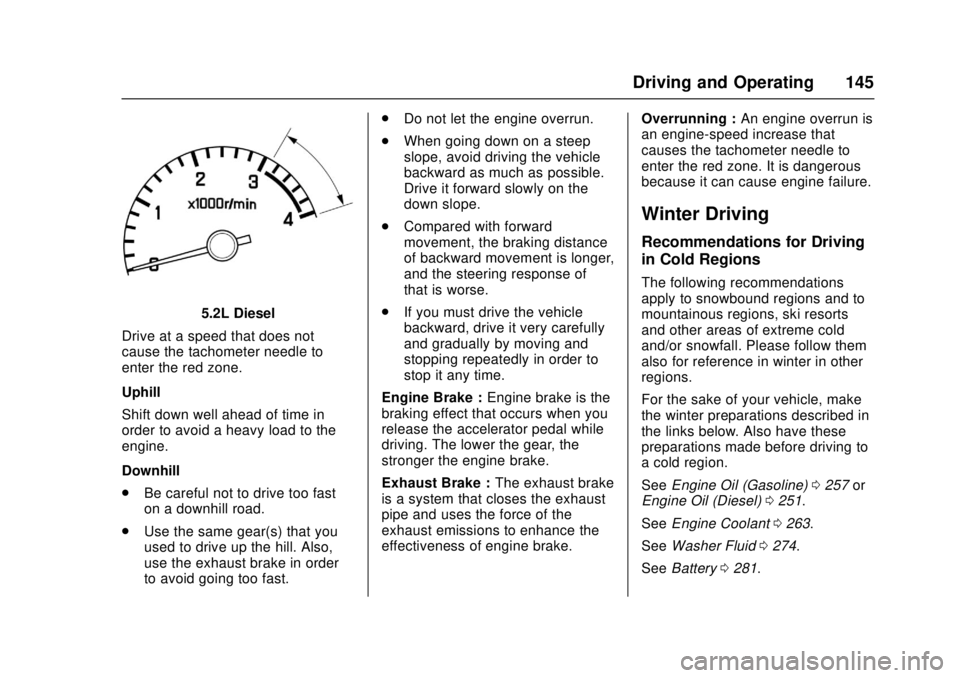
5.2L Diesel
Drive at a speed that does not
cause the tachometer needle to
enter the red zone.
Uphill
Shift down well ahead of time in
order to avoid a heavy load to the
engine.
Downhill
. Be careful not to drive too fast
on a downhill road.
. Use the same gear(s) that you
used to drive up the hill. Also,
use the exhaust brake in order
to avoid going too fast. .
Do not let the engine overrun.
. When going down on a steep
slope, avoid driving the vehicle
backward as much as possible.
Drive it forward slowly on the
down slope.
. Compared with forward
movement, the braking distance
of backward movement is longer,
and the steering response of
that is worse.
. If you must drive the vehicle
backward, drive it very carefully
and gradually by moving and
stopping repeatedly in order to
stop it any time.
Engine Brake : Engine brake is the
braking effect that occurs when you
release the accelerator pedal while
driving. The lower the gear, the
stronger the engine brake.
Exhaust Brake : The exhaust brake
is a system that closes the exhaust
pipe and uses the force of the
exhaust emissions to enhance the
effectiveness of engine brake. Overrunning :
An engine overrun is
an engine-speed increase that
causes the tachometer needle to
enter the red zone. It is dangerous
because it can cause engine failure.
Winter Driving
Recommendations for Driving
in Cold Regions
The following recommendations
apply to snowbound regions and to
mountainous regions, ski resorts
and other areas of extreme cold
and/or snowfall. Please follow them
also for reference in winter in other
regions.
For the sake of your vehicle, make
the winter preparations described in
the links below. Also have these
preparations made before driving to
a cold region.
See Engine Oil (Gasoline) 0257 or
Engine Oil (Diesel) 0251.
See Engine Coolant 0263.
See Washer Fluid 0274.
See Battery 0281.
Page 151 of 414

Chevrolet Low Cab Forward Owner Manual (GMNA-Localizing-U.S.-
10716700) - 2017 - crc - 12/6/16
150 Driving and Operating
SymptomCauseCorrective Action Reference
Engine does not
start Starter does not
turn over, or weak Discharged batteries Recharge or replace See
Battery0281
Battery terminals
detached, loose,
or corroded After repairing corroded
section, connect the
terminals firmly
-
Starter ground wire
terminal detached,
loose, or corroded After repairing corroded
section, connect the
terminals firmly
-
Engine oil viscosity
too high Change to an oil with
proper viscositySee
Engine Oil
(Gasoline) 0257 or
Engine Oil (Diesel)
0 251
Starter or electrical
system is faulty
4-
Page 155 of 414

Chevrolet Low Cab Forward Owner Manual (GMNA-Localizing-U.S.-
10716700) - 2017 - crc - 12/6/16
154 Driving and Operating
SymptomCauseCorrective Action Reference
White exhaust smoke (Diesel) Engine not sufficiently
warming up
Allow the engine to
warm up
-
Too much engine oil Correct the oil level See
Engine Oil
(Gasoline) 0257 or
Engine Oil (Diesel)
0 251
Engine Control system
faulty
4-
Fuel system faulty
4-
Exhaust injector
4-
Continuous idling for a
long period (more than
two hours) With the vehicle
stationary in a place
where it will not obstruct
traffic, hold down the
accelerator pedal and
check that white smoke
is not emitted
-
Page 157 of 414

Chevrolet Low Cab Forward Owner Manual (GMNA-Localizing-U.S.-
10716700) - 2017 - crc - 12/6/16
156 Driving and Operating
SymptomCauseCorrective Action Reference
Oil pressure is low Improper engine oil
viscosity
Change to an oil with
proper viscositySee
Engine Oil
(Gasoline) 0257 or
Engine Oil (Diesel)
0 251
Engine oil level too low Add engine oil See
Engine Oil
(Gasoline) 0257 or
Engine Oil (Diesel)
0 251
Engine inner
components are faulty
4-
Meter, indicator/warning
lights or switches faulty
4-
Page 166 of 414

Chevrolet Low Cab Forward Owner Manual (GMNA-Localizing-U.S.-
10716700) - 2017 - crc - 12/6/16
Driving and Operating 165
Turn the key against spring
pressure to energize the starter.
When key is released, spring
pressure returns it to the ON
position. Release the key as soon
as the engine has started.
If the key cannot be turned from the
LOCK position to the ON position,
lightly move the steering wheel
clockwise and counterclockwise
while trying to turn the key.
Starting and Stopping the
Vehicle (Gasoline Only)
Check around the Vehicle before
Starting the Engine
Proper care and operation will not
only extend the service life of your
vehicle but also improve fuel
economy.
Before pulling away, perform a
thorough safety check, making sure
there are no children or obstructions
around the vehicle. Take off the
chocks after confirming that the
parking brake is securely applied.Sit behind the wheel, adjust the seat
position, and buckle up the seat
belt. The passengers are also
required to buckle up the seat belts.
Adjust the positions of the steering
wheel and mirrors. Lock the doors.
Turn the power of the dome light or
accessories OFF before starting the
engine. See
Seat Position 044,
Seat Belts 049, Steering Wheel
Adjustment 072, and Mirrors039.
Keep the Floor Around the
Driver's Seat Clean and Tidy{Warning
It is extremely dangerous to have
empty cans, empty bottles or
other items rolling around on the
floor because they could get
trapped under the brake pedal
and prevent brake application.
For proper pedal operation, it is
also essential to lay floor mats
properly. Incorrectly installed floor
mats would hinder free movement
of the pedals. (Continued)
Warning (Continued)
Do not use the dashboard pocket
or the top of the dashboard as a
place to put items that could roll,
which could interfere with your
driving. You and others could be
seriously injured.
Choose Your Footwear Suitable
for Driving
{Warning
Choose footwear that ensures
proper operation of pedals when
driving the vehicle. Use of
footwear unsuitable for driving
may cause an accident.
Checks Before Operating
Allow the engine to warm up before
driving. While the engine is warming
up, the following checks should
be made: 1. Observe the engine oil pressure warning light. The
light should go out when the
Page 168 of 414
Chevrolet Low Cab Forward Owner Manual (GMNA-Localizing-U.S.-
10716700) - 2017 - crc - 12/6/16
Driving and Operating 167
feature. To restart when you're
already moving, use
N (Neutral) only.
Do not try to shift to P (Park) if
your vehicle is moving. If you
do, you could damage the
transmission. Shift to P (Park)
only when your vehicle is
stopped.
2. Do not push the accelerator pedal before starting your
engine. In some other vehicles
you might need to do this, but
because of your vehicle's
computer systems, you do not
need to.
3. Turn your ignition key to Start. When the engine starts, let go
of the key. The idle speed will
go down as your engine
gets warm.
4. If it does not start right away, hold your key in START. If it
doesn't start in 3 seconds,
push the accelerator pedal
about one-quarter of the way
down for 12 more seconds,
or until it starts. 5. If your engine still will not start
(or starts but then stops), it
could be flooded with too much
gasoline. Try this: Wait 20 to
30 seconds to let the starter
motor cool down. Then push
your accelerator pedal all the
way to the floor. Hold it there.
Then, hold the key in START
for no more than 10 seconds.
This clears the extra gasoline
from the engine.
If the engine still does not start, wait
another 20 to 30 seconds and do
Step 5 again.
Hot Engine Restart
If your engine is already hot and
then stalls, turn your ignition key to
ACC. Then, turn your key to ON,
and wait about 20 to 30 seconds
before you restart your engine.
When the engine starts, let go of the
key and the accelerator pedal.
Your engine is designed to work
with the electronics in your vehicle.
If you add electrical parts or
accessories, you could change the
way the fuel injection system operates. Before adding electrical
equipment, check with your dealer.
If you do not, your engine might not
perform properly.
If you ever have to have your
vehicle towed, see the part of this
manual that tells how to do it without
damaging your vehicle. See
Towing
the Vehicle 0332.
Recommendations for Warming
Up the Engine
The engine is sufficiently warmed
up when the needle of the engine
coolant temperature gauge starts
to move.
. Do not race the engine or
quickly accelerate before the
engine has sufficiently warmed
up. Oil would not have
adequately reached and
lubricated components, and a
breakdown may result.
. The exhaust pipe becomes
extremely hot while the engine is
idling. Before warming up the
engine, make sure there is no