radiator CHEVROLET LOW CAB FORWARD 2017 Owner's Manual
[x] Cancel search | Manufacturer: CHEVROLET, Model Year: 2017, Model line: LOW CAB FORWARD, Model: CHEVROLET LOW CAB FORWARD 2017Pages: 414, PDF Size: 7.97 MB
Page 7 of 414
Chevrolet Low Cab Forward Owner Manual (GMNA-Localizing-U.S.-
10716700) - 2017 - crc - 12/6/16
6 Introduction
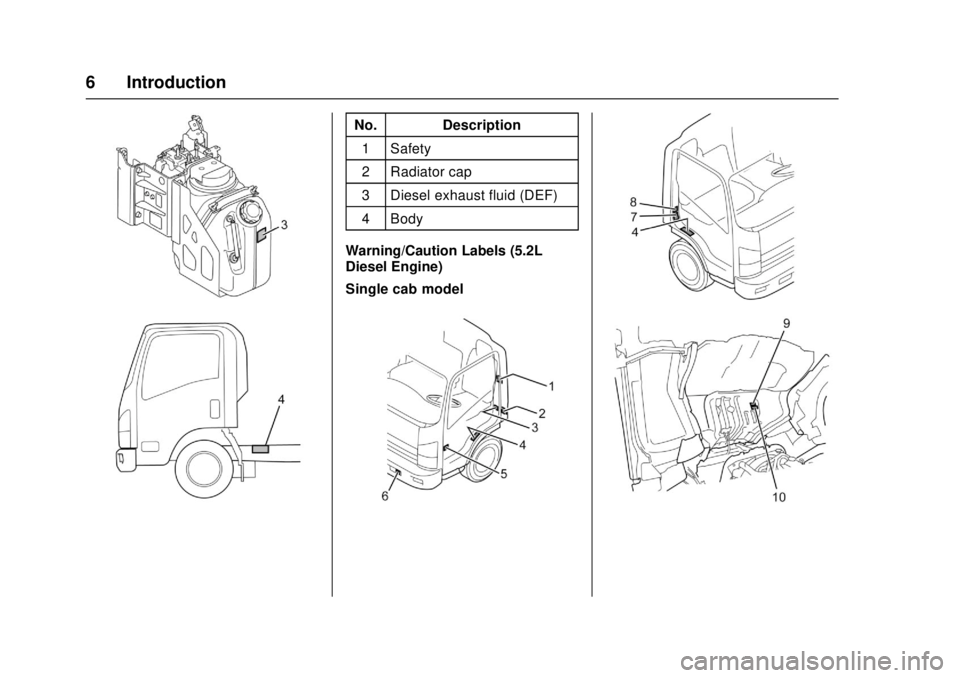
No. Description1 Safety
2 Radiator cap
3 Diesel exhaust fluid (DEF)
4 Body
Warning/Caution Labels (5.2L
Diesel Engine)
Single cab model
Page 10 of 414
Chevrolet Low Cab Forward Owner Manual (GMNA-Localizing-U.S.-
10716700) - 2017 - crc - 12/6/16
Introduction 9
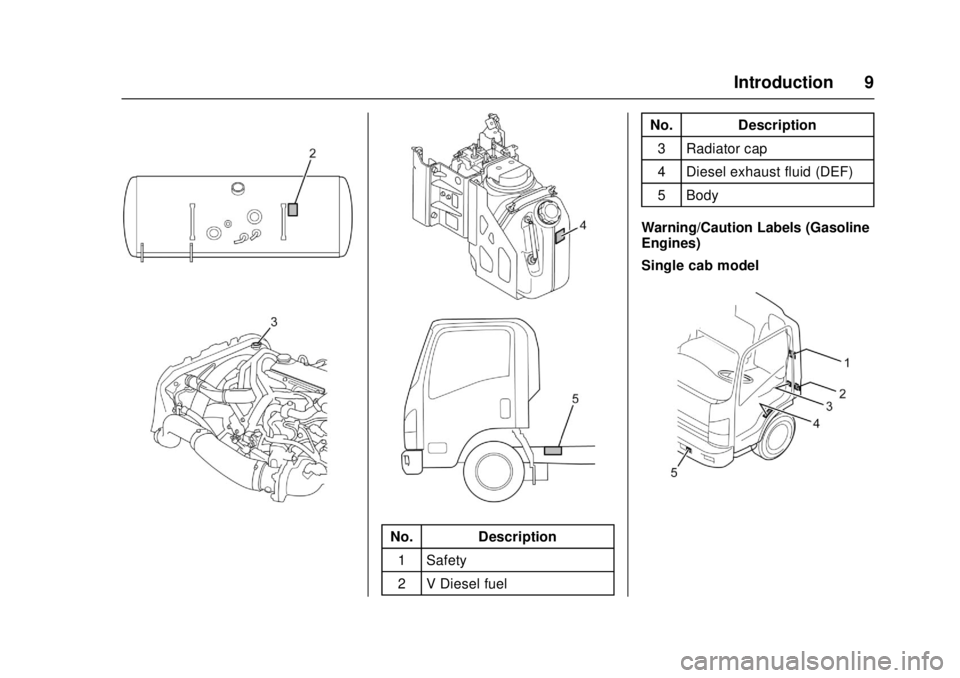
No. Description1 Safety
2 V Diesel fuel No. Description
3 Radiator cap
4 Diesel exhaust fluid (DEF)
5 Body
Warning/Caution Labels (Gasoline
Engines)
Single cab model
Page 13 of 414
Chevrolet Low Cab Forward Owner Manual (GMNA-Localizing-U.S.-
10716700) - 2017 - crc - 12/6/16
12 Introduction
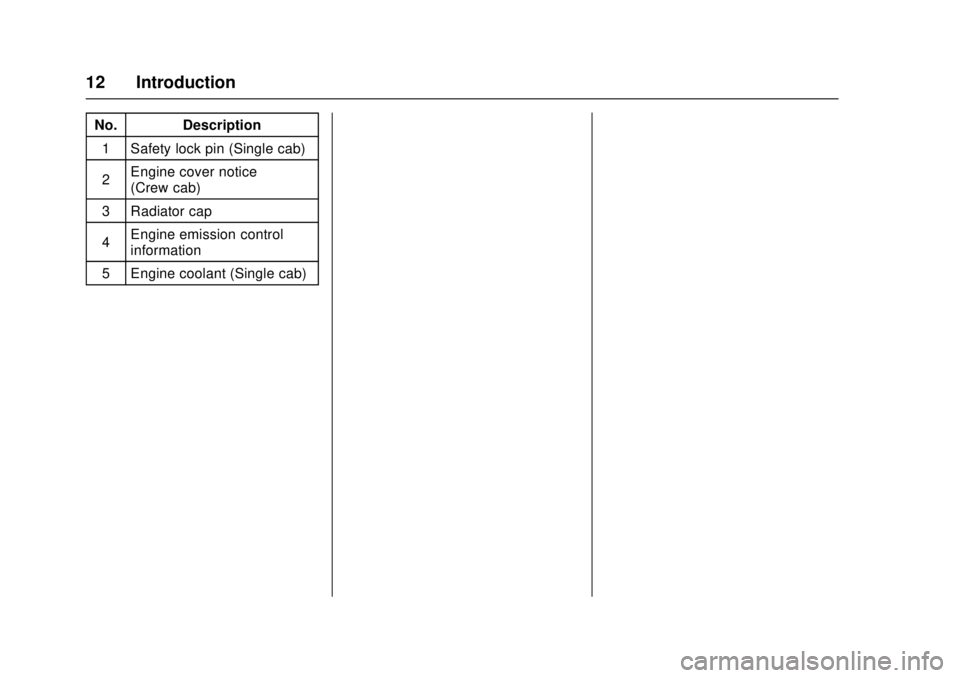
No. Description1 Safety lock pin (Single cab)
2 Engine cover notice
(Crew cab)
3 Radiator cap
4 Engine emission control
information
5 Engine coolant (Single cab)
Page 98 of 414
Chevrolet Low Cab Forward Owner Manual (GMNA-Localizing-U.S.-
10716700) - 2017 - crc - 12/6/16
Instruments and Controls 97
Vehicle Messages
Vehicle Messages
(Diesel Only)
The Driver Information Center (DIC)
will display warnings, messages,
and other operation-related
information to alert of system
failures or other necessary checks
that should be performed. Use the
DIC selector to choose the desired
screen page or function.
Engine Overheat Warning
Light
OVERHEAT
This message displays and a
warning light appears when the
engine has overheated and the
engine coolant temperature gauge
needle reaches the red zone. At the
same time a buzzer sounds.
Immediately pull off to a safe place
to take the necessary actions and
check the vehicle. Do not shut down
an overheating engine immediately.Otherwise, the engine may seize
up. Take appropriate actions for
engine overheating.
This light will also activate the
engine alarm and automatic
shutdown system, if equipped.
See
Engine Alarm and Automatic
Shutdown (Diesel Only) 0174,
Engine Overheating 0269, Engine
Coolant 0263, and Engine Coolant
Temperature Gauge 082.
{Warning
When the engine coolant is still
hot, do not remove the radiator
cap. Hot vapor will come out and
you may be scalded. Add engine
coolant only when the engine
coolant temperature has dropped.
If this light comes on and stays on
while you are driving, your engine
coolant might have overheated
and your engine may be too hot.
You should pull off the road, stop
your vehicle and take appropriate
actions for engine overheating.
Low Coolant Warning Light
LOW COOLANT
If this message and light come on,
the system is low on engine coolant
and the engine may overheat.
A warning tone also sounds. If this
light comes on while driving, stop
the vehicle immediately and check
the cooling system for leaks. See
Engine Coolant 0263 and have the
vehicle serviced by your dealer. This
light will also activate the engine
alarm and automatic shutdown
system.
See Engine Alarm and Automatic
Shutdown (Diesel Only) 0174 and
Engine Shutdown Warning Light
0 91.
Water Separator (Fuel Filter)
Warning Light
WATER SEPARATOR
This message displays and a
warning light appears when the
level in the water separator on the
fuel line is beyond the specified
level. Drain water following the
instructions in the Water in Fuel
Page 137 of 414
Chevrolet Low Cab Forward Owner Manual (GMNA-Localizing-U.S.-
10716700) - 2017 - crc - 12/6/16
136 Driving and Operating
Warning (Continued)
exhaust pipe are extremely hot.
Be careful not to inadvertently
touch them when working near
them (for example, tilting the cab
or operating an attachment). You
and others could be seriously
injured.
Recommendations for Driving
in Hot Regions
The engine is more likely to
overheat in an environment where
the ambient temperature is high. To
prevent the engine from
overheating, pay attention to the
following points:
.If the engine does not contain
the appropriate concentration of
engine coolant, overheating is
likely to occur.
Refer to Engine Coolant 0263.
. Do not put well water, river water
or other hard water in the engine
cooling system. It would hasten
the formation of rust and scale. .
If foreign matter (insects, mud,
etc.) gets stuck in the radiator's
air passages, the cooling
system's performance will
deteriorate. Check the air
passages for clogging, and
remove any foreign matter using
water under low pressure.
Refer to Exterior Care 0334.
When Turning, the Rear
Wheels will Follow Tighter
Curves than the Front Wheels
Use the mirrors to confirm safety.
Sidewinds
If the vehicle catches a sidewind
and drifts sideways, firmly grip the
steering wheel, decelerate to a
speed that allows you to stay
completely in control, and make a
directional correction. The vehicle
may catch strong sidewinds in the
following situations:
.
Emerging from a tunnel
. Driving over a bridge
. Driving on an embankment
. Driving through a cutting .
Being overtaken by a large truck
or bus
. Overtaking a large truck or bus
Flat Tire
If a blowout or flat tire occurs while
you are driving, calmly grip the
steering wheel and gradually apply
the brakes to decelerate. (Hard
braking would be dangerous
because it could cause the steering
wheel to be pulled to one side.)
Stop the vehicle in a safe place, and
change the tire.
Hard Bump Under Vehicle
If the underside of the vehicle
receives a hard bump, stop in a safe
place where the vehicle will not
obstruct traffic and check for brake
fluid leakage, fuel leakage and
component damage. If any part of
the vehicle is damaged or broken,
promptly have the vehicle inspected
and repaired.
Highways
.Speeds on highways are higher
than those on regular roads, so
there is more danger. Also, a
Page 156 of 414

Chevrolet Low Cab Forward Owner Manual (GMNA-Localizing-U.S.-
10716700) - 2017 - crc - 12/6/16
Driving and Operating 155
SymptomCauseCorrective Action Reference
Black exhaust smoke (Diesel) Engine Control system
faulty
4-
The air cleaner clogged
4-
Fuel system faulty
4-
Exhaust system clogged
4-
Exhaust injector
4-
Diesel particulate filter
(DPF) faulty
4-
Engine is overheating No engine coolant Add engine coolant
See
Engine
Coolant 0263
Front of radiator is
clogged with dirt Wash clean with tap
waterSee
Exterior Care
0 334
Radiator cap not
sufficiently tightened Make sure it is firmly
tightened or replace the
radiator cap
-
Fan belt loose Adjust the tension or
replace the beltSee
Engine Drive
Belt Routing 0396
Engine coolant dirty
4-
Fan clutch is faulty
4-
Radiator cap dirty or
faulty Clean or replace -
Page 173 of 414

Chevrolet Low Cab Forward Owner Manual (GMNA-Localizing-U.S.-
10716700) - 2017 - crc - 12/6/16
172 Driving and Operating
If the Vehicle Has Not Been Used
for a Long Period
If a diesel vehicle has been
standing for an extended period of
time, the turbocharger bearings
should be pre-lubricated prior to
starting. See your authorized dealer
for more detailed information.
Before using a vehicle that has not
been driven for a long period, check
the engine and transmission for oil
leakage, and make sure the oil is at
the required levels. If there is
insufficient oil, it will not adequately
reach and lubricate components,
and a breakdown will result.
Start the engine and allow it to idle
for at least five minutes. Check for
abnormal noises.
For instructions on warming up the
engine, refer to“Starting the Engine”
previously in this section.
For diesel vehicles, if 1 year has
passed since the diesel exhaust
fluid (DEF) in the DEF tank was
added, the DEF in the tank should
be replaced. Be careful not to inhale
the ammonia odor when replacing the DEF. Also, please contact your
nearest dealer about the
replacement work.
Operating Temperature
Recommendations for Warming
Up the Engine
The engine is sufficiently warmed
up when the needle of the engine
coolant temperature gauge starts
to move.
Do not race the engine or quickly
accelerate before the engine has
sufficiently warmed up. Oil would
not have adequately reached and
lubricated components, and a
breakdown may result.
The exhaust pipe becomes
extremely hot while the engine is
idling. Before warming up the
engine, make sure there is no
flammable material, such as grass,
waste paper, oil, or old tires near the
exhaust pipe.
Engine Warm-up System
During cold ambient conditions, the
automatic engine warm-up system
operates to reduce engine warm-up
time during idling.
Automatic Engine Warm-up :
When the engine is idling with the
engine coolant temperature below
62 °C (144 °F), the engine warm-up
system automatically closes the
exhaust brake and increases engine
idle speed so that the engine is
warmed more quickly. Warm-up is
cancelled when the accelerator
pedal is pressed, and resumed
when the pedal is released.
Warm-up is automatically cancelled
entirely after the engine coolant
temperature rises above 65 °C
(149 °F).
Winter Cover
.
Do not cover the front of the
radiator with newspapers,
cardboard or any other
flammable material to raise the
engine coolant temperature.
Page 174 of 414

Chevrolet Low Cab Forward Owner Manual (GMNA-Localizing-U.S.-
10716700) - 2017 - crc - 12/6/16
Driving and Operating 173
.If you allow the engine to warm
up but the engine coolant
temperature does not rise, have
the nearest dealer inspect the
thermostat.
Radiator Grille Covers
{Warning
Radiator shutters, winter fronts,
or grille covers are not to be used
and may cause the engine's
radiator cooling fan to fatigue
from the alternate unloading and
loading of the blades as they
pass by the masked area
followed by the unmasked area.
After the fan has been fatigued, it
may suddenly break apart while
rotating, possibly causing
personal injury to anyone
standing nearby, and equipment
damage. You and others could be
seriously injured.
Engine Heater
Engine Block and Oil Pan Heater
If the vehicle is parked in a garage,
the block and pan heaters should
not be needed until the garage
temperature drops below −23°C
(−10°F) regardless of outside
temperature.
The engine block and oil pan
heaters are designed to warm the
block and oil pan areas that will let
the engine run faster. To use the
heaters:
1. On single cab vehicles, tilt the cab.
2. Unwrap the electrical cord and remove the protective cap.
3. Plug the cord into any three-prong 110 volt outlet
(normal household current).
It may require several hours to
sufficiently heat the engine.
Outside temperature, oil
viscosity, etc., will affect how
long the block and oil pan
heater should remain plugged
in. Contact your dealer for the
conditions in your area. 4. After using the heater(s), be
sure to restore the cord
properly, to help keep it away
from moving engine parts.
If the cord is too short, use a heavy
duty, three-prong extension cord. Do
not use an extension cord such as
you would use for a lamp, because
the cord may overheat.
The engine should go through a
warm-up period to warm up the
engine oil before placing engine
under load. This will ensure proper
lubrication of the engine. See Cab
Tilting 0247.
Page 247 of 414
Chevrolet Low Cab Forward Owner Manual (GMNA-Localizing-U.S.-
10716700) - 2017 - crc - 12/6/16
246 Vehicle Care
Warning (Continued)
vehicle or its equipment. If you
have any questions about
carrying out some service, have
the work done by a skilled
technician.
To prevent personal injury, keep
hands, tools and clothing clear of
the engine cooling fan when the
engine is running.
The engine, exhaust pipe and
radiator will be hot immediately
after the vehicle is driven. Be
careful around these parts to
prevent burns. Perform all checks
when the engine is cold.
Do not perform work near an
open flame or other heat sources.
Do not let the engine run in poorly
ventilated garages or sheds. This
could cause carbon monoxide
poisoning.(Continued)
Warning (Continued)
Performing maintenance work on
a truck or chassis can be
dangerous. In trying to do some
jobs, you can be seriously injured.
Do your own maintenance work
only if you have the required
know-how and the proper tools
and equipment for the job. If you
have any doubts, contact your
dealer.
You and others could be seriously
injured.
For gasoline vehicles, pull firmly on
the parking brake lever and put the
transmission in neutral. Move the
selector lever to “P”and make sure
the shift indicator displays "P".
For diesel vehicles, pull firmly on the
parking brake lever and move the
selector lever to "P" and make sure
the shift indicator displays "P".
Make sure to turn off the engine and
remove the key from the engine
control switch before performing any
checks. Select a place with a solid and level
surface to perform the checking and
maintenance work. Make sure to
chock the wheels. It would be very
dangerous if the vehicle started
to move.
For gasoline vehicles, when
performing work on the electrical
system, be sure to remove the cable
from the negative terminal on the
battery.
For diesel vehicles, when
performing work on the electrical
system, begin by turning the engine
control switch to the "LOCK"
position, wait at least 3 minutes, and
then disconnect the negative cable
from the negative terminal on
battery. If the negative cable is
disconnected within 3 minutes, the
engine control module may
malfunction.
For gasoline vehicles, when working
on the fuel line or fuel pump,
remove the fuel tank filler cap. The
fuel system is under pressure and
the fuel will overspill unless the
pressure is relieved, possibly
leading to combustion or a fire.
Page 265 of 414

Chevrolet Low Cab Forward Owner Manual (GMNA-Localizing-U.S.-
10716700) - 2017 - crc - 12/6/16
264 Vehicle Care
Engine Coolant in Cold
Weather
To prevent the engine damage due
to freezing of the engine coolant,
mix the coolant and water at the
ratio of 50/50.
Replace rubber hoses whenever
they crack or are damaged; even
minor cracks allow engine coolant
solution to leak.
{Warning
If your engine cooling system
overheats, seeEngine
Overheating 0269. Continued
operation of the engine even for a
short time may result in a fire and
the possibility of personal injury
and/or severe vehicle damage.
You and others could be seriously
injured.
Your vehicle has an engine coolant
recovery system, expansion bottle
and/or an engine coolant reserve
tank system. Engine coolant in the
system expands with heat and overflows into the reserve tank.
When the system cools, engine
coolant is drawn back into the
radiator.
The engine cooling system has
been filled at the factory with a
quality engine coolant. It is
important to use proper engine
coolant to prevent damage to
engine cooling system components.
The engine cooling system is
designed to use engine coolant
rather than plain water. See
Recommended Fluids and
Lubricants
0378.
See the Maintenance Schedule to
find out when the engine coolant
must be replaced. Note that
changing the engine coolant is
needed to replenish the rust
inhibitors to make certain that all
parts of the engine cooling system
work well.
{Warning
Check, replenish or change the
engine coolant only after the
engine has sufficiently
cooled down.
Do not loosen or remove the cap
of the radiator or engine coolant
reserve tank cap when the engine
coolant is still hot. Hot vapor or
boiling water may burst out and
cause a burn.
When removing the radiator cap
or engine coolant reserve tank
cap, use a thick cloth to cover the
cap and turn it slowly.
Engine coolant is toxic and must
not be ingested. If the engine
coolant is mistakenly ingested,
seek prompt medical attention.
If the engine coolant gets in your
eyes, rinse your eyes immediately
with a large amount of water for
15 minutes or longer. Also, if your (Continued)