light CHEVROLET LOW CAB FORWARD 2018 Owner's Manual
[x] Cancel search | Manufacturer: CHEVROLET, Model Year: 2018, Model line: LOW CAB FORWARD, Model: CHEVROLET LOW CAB FORWARD 2018Pages: 358, PDF Size: 6.32 MB
Page 294 of 358
Chevrolet Low Cab Forward Owner Manual (GMNA-Localizing-U.S.-
11254764) - 2018 - crc - 12/5/16
Vehicle Care 293
After Towing
After towing the vehicle, block the
rear wheels and install axle shafts
or driveshaft.
Apply the parking brake before
disconnecting from the towing
vehicle. Check and fill rear axle with
oil, if required.
Rear End Towing
When towing a vehicle with rear
wheels raised, secure the steering
wheel to maintain straight-ahead
position. Make certain that the front
axle is not loaded beyond the front
axle gross axle weight rating
(GAWR) as indicated on the
vehicle's VIN and weight rating
plate.
Special Towing Instructions1. All state and local laws regarding such items as
warning signals, night
illumination, speed, etc., must
be followed. 2. Safety chains must be used.
3. No vehicle should ever be
towed over 88 km/h (55 mph).
4. Loose or protruding parts of damaged vehicles should be
secured prior to moving.
5. A safety chain system completely independent of the
primary lifting and towing
attachment must be used.
6. Operators should refrain from going under a vehicle which is
being lifted by the towing
equipment unless the vehicle is
adequately supported by safety
stands.
7. No towing operation which for any reason jeopardizes the
safety of the wrecker operator
or any bystanders or other
motorists should be attempted.Appearance Care
Exterior Care
Exterior Finish
The paint finish on your vehicle
provides beauty, depth of color,
gloss retention and durability.
While cleaning the vehicle, do not
grip the roofmarker lights to prevent
damage or water leakage.
Washing
The best way to preserve your
vehicle's finish is to keep it clean by
washing it often.
Wash the vehicle in lukewarm or
cold water. Do not use hot water or
wash your vehicle in the direct rays
of the sun. Do not use strong soap
or chemical detergents. All cleaning
agents should be flushed promptly
from the surface and not allowed to
dry on the finish.
These vehicles are designed to
operate under normal environmental
conditions to withstand natural
elements. However, unusual
Page 296 of 358
Chevrolet Low Cab Forward Owner Manual (GMNA-Localizing-U.S.-
11254764) - 2018 - crc - 12/5/16
Vehicle Care 295
floor. Do not apply water from a
high-pressure washer nozzle
directly to the electric connectors.
Failure to observe this precaution
can lead to faulty operation of the
electrical system. If an automatic
car or truck-wash is used with
vehicles having dark or metallic
coating, the painted surfaces can be
damaged by the brushes, lose their
luster or be very noticeably
scratched.
Do not direct a large amount of
water at the air inlet openings. Do
not apply water to the engine
compartment or at electrical
components. Failure to observe this
precaution can lead to a poorly
starting and operating engine and
problems in the electrical system.
Ensure that mirrors and the antenna
are retracted before washing the
vehicle.
If an automatic car or truck-wash
must be used, avoid a
high-temperature, high pressure
type machine. Failure to observe
this precaution can lead to heat
deformation and breakage of plastic
components, or to water leaks intothe cab. When using an automatic
car or truck-wash, ensure that a
distance of at least 0.4 m
(15.75 inches) is maintained
between the nozzle and the vehicle,
and when washing door windows,
that the spray is perpendicular to
the surface of the glass.
Ensure that all detergent is fully
washed and wiped away.
Particularly in the case of strong
alkaline detergents (typically those
for industrial uses), there is a
danger that hairline cracks can
develop in lighting-cluster lenses if
the vehicle is operated without
detergent being fully wiped away.
Always read the detergent
manufacturer's instructions carefully
before use. Airborne dirt that
adheres to plastic front bumpers as
a result of rain, for example, can be
difficult to remove. In such a case,
use a commercially-available
cleaner to clean away the dirt, and
then apply a wax for use with plastic
components.Vehicle Storage
In order to maintain your vehicle's
attractive appearance as long as
possible, special consideration must
be given to its storage location.
If the vehicle is stored or kept for an
extended period of time in any of
the following locations, a chemical
change may occur in the paint work,
resulting in staining, discoloration,
rusting, and corrosion of
components.
.
Locations where a large amount
of oily matter, soot, heavy smoke
or metal powder can adhere to
the vehicle
. Areas around pharmaceutical
plants and other facilities that
discharge chemical matter
. Coastal areas
. Locations where a large amount
of dead bugs, bird droppings or
tree sap can adhere to the
vehicle
Page 297 of 358
Chevrolet Low Cab Forward Owner Manual (GMNA-Localizing-U.S.-
11254764) - 2018 - crc - 12/5/16
296 Vehicle Care
Polishing and Waxing
Periodic polishing and waxing is
recommended to remove built-up
residue and eliminate any
"weathered" appearance.
Your authorized dealer offers
several polishes and cleaners which
have proven value in maintaining
original finish appearance and
durability.
Painted and chrome-plated surfaces
should be waxed once or twice a
month, or whenever water is being
poorly repelled on the surfaces.
Ensure that wax is not applied in
direct sunlight, and that the
temperature of the painted surface
is no more than 40 °C (104 °F).
Always follow the instructions
provided with your wax product.
Do not use wax containing abrasive
material. Failure to observe this
precaution can lead to scratching of
painted surfaces or plastic
components.
The application of wax to rubber
component surfaces can result in
permanent whitening.Wax must not be applied to the
windshield. Failure to observe this
precaution can result in irregular
reflection of light, impairing
your view.
Protecting Exterior Bright Metal
Parts
Bright metal parts should be
cleaned regularly to keep their
luster. Washing with water is all that
is usually needed.
Use special care with aluminum
trim. To avoid damaging protective
trim, never use auto or chrome
polish, steam or caustic soap to
clean aluminum. A coating of wax,
rubbed to a high polish, is
recommended for all bright metal
parts.
Weatherstrip Lubrication
All weatherstrips should be
periodically lubricated (minimum of
every 6 months) with a silicone
grease lubricant. A thin film of
silicone grease lubricant should be
applied using a clean cloth. Silicone
grease application will lengthen
weatherstrip life, help sealing, and
assist in eliminating squeaks.
Windshield Care
Wax must not be applied to the
windshield. A layer of wax can
impair your view in rainy weather
and can also lead to rough
movements of the windshield wiper.
If engine oil or grease comes into
contact with the windshield, staining
or discoloration may result. It must
be immediately cleaned away.
If not fully cleaned by the windshield
wipers, the windshield should be
cleaned using glass cleaner. If your
windshield is not clear after using
the windshield washer, or if the
wiper blade chatters when running,
wax or other material may be on the
blade or windshield.
The windshield wipers on your truck
can be pulled out from the
windshield to provide easier access
for cleaning.
Clean the outside of the windshield
with a non-abrasive cleaner. Your
windshield is clean if beads do not
Page 298 of 358
Chevrolet Low Cab Forward Owner Manual (GMNA-Localizing-U.S.-
11254764) - 2018 - crc - 12/5/16
Vehicle Care 297
form when rinsing with water. Clean
the blade by wiping with a cloth
soaked in a solution of one-half
water and one-half methanol
alcohol. Then rinse the blade with
water.
The windshield wiper arms may be
swung out, away from the glass, to
provide easy access for cleaning.
Do not hang on to the roofmarker
lights while cleaning the windshield
or damage may occur (resulting in
possible water leakage).
External Diesel Engine
Cleaning
The engine does not need periodic
cleaning, nor is it recommended.
If you insist on cleaning the engine,
clean it only when it is cold, never
when it is warm or hot, and never
when the engine is running.
Spraying or pouring water or other
fluids on your engine when it is
warm or hot, or when it is running,
can cause serious damage to the
engine and its components,
particularly the fuel supply pump.
Handling the Radiator and
Charge Air Cooler
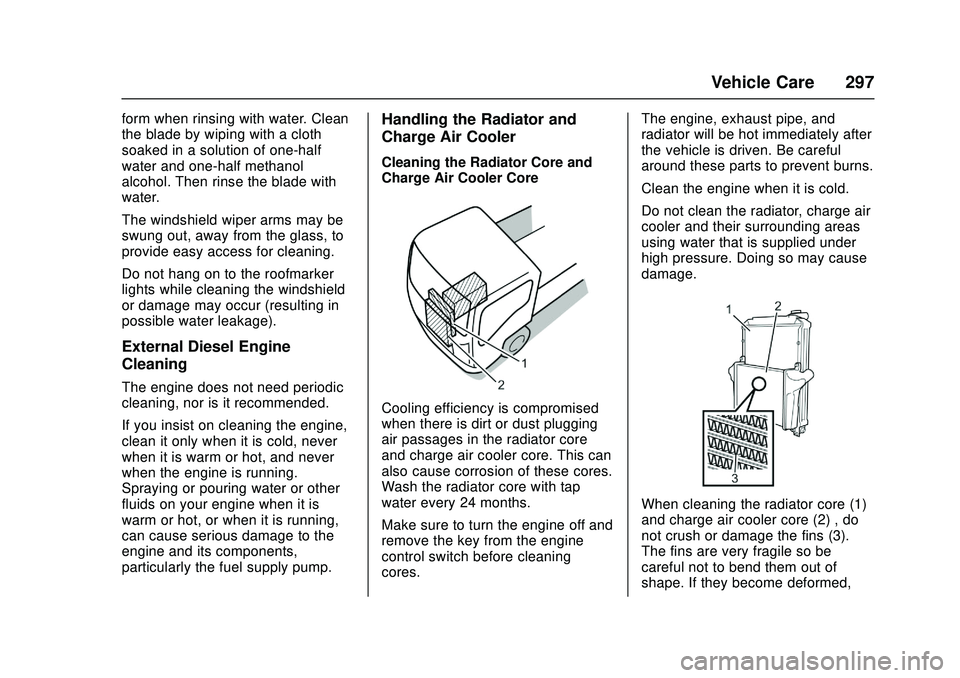
Cleaning the Radiator Core and
Charge Air Cooler Core
Cooling efficiency is compromised
when there is dirt or dust plugging
air passages in the radiator core
and charge air cooler core. This can
also cause corrosion of these cores.
Wash the radiator core with tap
water every 24 months.
Make sure to turn the engine off and
remove the key from the engine
control switch before cleaning
cores.The engine, exhaust pipe, and
radiator will be hot immediately after
the vehicle is driven. Be careful
around these parts to prevent burns.
Clean the engine when it is cold.
Do not clean the radiator, charge air
cooler and their surrounding areas
using water that is supplied under
high pressure. Doing so may cause
damage.
When cleaning the radiator core (1)
and charge air cooler core (2) , do
not crush or damage the fins (3).
The fins are very fragile so be
careful not to bend them out of
shape. If they become deformed,
Page 301 of 358
Chevrolet Low Cab Forward Owner Manual (GMNA-Localizing-U.S.-
11254764) - 2018 - crc - 12/5/16
300 Vehicle Care
cleaning products contain these
compounds. Be sure to read
cleaning product labels carefully.
Air fresheners (liquid, solid, gel or
plate types) must not come into
direct contact with, or spill onto,
interior components such as the air
conditioning or audio system.
Compounds contained in these
products can cause discoloration,
staining or peeling of paint.
Glass cleaners that contain these
compounds must not be used to
clean the inside of the windshield or
window glass. To clean the glass,
wipe it using a cloth wet with warm
or cold water.
To avoid possible permanent
discoloration of light colored seats,
Do not let materials with non-fast
colors come into contact with seat
trim materials until these materials
are totally dry. This includes certain
types of casual clothing, such as
colored denims, corduroys, leathers
and suedes; also decorative paper,
With the use of modern trim
materials, it is very important that
you use proper cleaning techniquesand cleaners. Failing to do this on
the first cleaning may result in water
spots, spot rings or setting of stains
or soilage - all of which are more
difficult to remove in a second
cleaning.
Dust and loose dirt that collect on
interior fabric should be removed
often with a vacuum cleaner or soft
bristle brush. Wipe vinyl or leather
trim regularly with a clean, damp
cloth. Normal trim soils, spots or
stains can be cleaned with these
cleaners.
Remember these basic steps before
cleaning:
.
Remove stains as quickly as
possible before they
become "set".
. Use a clean cloth or sponge,
and change to a clean area
often. A soft brush maybe used
if stains persist.
. Use solvent-type cleaners only
in a well ventilated area: also, do
not saturate the stained area. .
If a ring forms after spot
cleaning, clean the entire area
immediately.
. Follow specific instructions on
cleaner labels.
General Cleaning of Soiled or
Water Spotted Fabric Type
Trim with Foam Type Cleaner
Vacuum the area thoroughly to
remove any loose dirt.
Always clean a whole trim panel or
section. Mask surrounding trim
along stitch or welt lines.
Use suds on a clean sponge. Do
not brush wet suede. Do not
saturate the material or rub it
harshly. Immediately after cleaning,
remove suds with a sponge and
rinse with a clean wet sponge. Wipe
off remaining residue with a slightly
damp absorbent towel or cloth.
Important —Immediately after
wiping, force-dry the fabric with an
air hose. A heat dryer or heat lamp
may be used. Use caution with a
heat dryer or lamp to help prevent
damage.
Page 302 of 358
Chevrolet Low Cab Forward Owner Manual (GMNA-Localizing-U.S.-
11254764) - 2018 - crc - 12/5/16
Vehicle Care 301
When trim materials with a sheen or
luster finish are dry, wipe the fabric
lightly with a soft, dry, clean cloth to
restore its sheen or luster. For
suede, raise nap with dry scrub
brush and vacuum to remove any
final traces of residue.
Spot Cleaning Fabric Type
Trim with Solvent Type Cleaner
Before trying to remove a spot or
stain from fabric, try to find out the
type and age of the spot or stain.
Some spots or stains can be
removed with water or a mild soap
solution. Spots or stains should
always be removed as soon as
possible.
Some types of stains or soilage,
such as lipstick, inks and grease,
are very difficult (sometimes
impossible) to remove completely.
When cleaning this type of stain or
soilage, be sure not to enlarge the
soiled area.
.Gently scrape excess stain from
the trim material with a clean,
dull knife or scraper. Use very
little cleaner, light pressure, and
clean cloths (preferably cheesecloth). Cleaning should
start at the outside of the stain
"feathering" towards the center.
Keep changing to a clean
section of cloth.
. When you clean a stain from
fabric, immediately dry the area
with an air hose, heat dryer,
or heat lamp to help prevent a
cleaning ring. (Use caution with
heat dryer or lamp to help
prevent fabric damage.)
. If a ring forms, immediately
repeat the cleaning operation
over a slightly larger area with
emphasis on "feathering"
towards its center. If a ring still
remains, mask off surrounding
trim sections and clean the
entire soiled area with foam type
cleaner.
See “Removal of Specific
Stains.”
Removal of Specific Stains
Greasy or Oily Stains –Includes
grease, oil, butter, margarine, shoe
polish, coffee with cream, chewing
gum, cosmetic creams, vegetable
oils, wax crayon, tar and asphalts.
. Carefully scrape off excess
stain; then use solvent type
cleaner.
. Shoe polish, wax crayons, tar
and asphalts will stain if left on
trim; they should be removed as
soon as possible. Use care as
cleaner will dissolve them and
may cause them to "bleed".
Non-Greasy Stains –Includes
catsup, coffee (black), egg, fruit,
fruit juice, milk, soft drinks, wine,
vomit and blood.
. Carefully scrape off excess
stain; then sponge the stain with
cool water.
. If a stain remains, use
Multi-Purpose Powdered
Cleaner (Foam type) as
previously described.
Page 303 of 358
Chevrolet Low Cab Forward Owner Manual (GMNA-Localizing-U.S.-
11254764) - 2018 - crc - 12/5/16
302 Vehicle Care
.If an odor lingers after cleaning
vomit or urine, treat the area
with a water-baking soda
solution: 5 milliliters (1 teaspoon)
of baking soda to 250 milliliters
(1 cup) of lukewarm water.
. Finally, if needed, clean lightly
with Fabric Cleaner
(Solvent type).
Combination Stains –Includes
candy, ice cream, mayonnaise, chili
sauce and unknown stains.
. Carefully scrape off excess
stain; then clean with cool water
and allow to dry.
. If stain remains, clean it with
Fabric Cleaner (Solvent type).
Cleaning Vinyl Trim
Ordinary soilage can be removed
from vinyl or leather with warm
water and mild soap, such as
saddle soap or oil soap, or an
equivalent.
.Apply a small amount of soap
solution and let it soak for a few
minutes to loosen dirt; then, rub
briskly with a clean, damp cloth to remove dirt and traces of
soap. This may be done several
times, if needed.
. Soilage such as tars, asphalts,
shoe polish, etc., will stain if left
on trim. They should be wiped
off as quickly as possible and
the area cleaned with a clean
cloth dampened with solvent
type vinyl leather cleaner.
Fabric Seat Covering and
Carpet Care
Remove dirt and dust using a
home-use electric vacuum cleaner.
Do not remove the carpet. Use
standard household cleaning
products and methods to remove
stains from food, drink and the like.
Be sure to use neutral detergents or
cleaning products indicated as
higher alcohol based detergents.
Glass Surfaces
Glass surfaces should be cleaned
on a regular basis. Use of glass
cleaner or a liquid household glass
cleaner will remove normal tobacco
smoke and dust films sometimes
caused by ingredients used in vinyls
and interior plastics.
Page 312 of 358

Chevrolet Low Cab Forward Owner Manual (GMNA-Localizing-U.S.-
11254764) - 2018 - crc - 12/5/16
Service and Maintenance 311
No. Service Interval16 000 km/10,000 mi
24 000 km/15,000 mi
32 000 km/20,000 mi
48 000 km/30,000 mi
64 000 km/40,000 mi
72 000 km/45,000 mi
80 000 km/50,000 mi
96 000 km/60,000 mi
112 000 km/70,000 mi
120 000 km/75,000 mi
128 000 km/80,000 mi
144 000 km/90,000 mi
160 000 km/100,000 mi
168 000 km/105,000 mi
176 000 km/110,000 mi
Service intervals
months or
kilometers
(miles)
whichever
occurs first (1)
39 DEF supply pump filter
element
Every 192 000 km (120,000 miles): R or every
24 months
40 Starter When the starter indicator light (amber) comes on: R
Page 313 of 358

Chevrolet Low Cab Forward Owner Manual (GMNA-Localizing-U.S.-
11254764) - 2018 - crc - 12/5/16
312 Service and Maintenance
Remarks
(1)In case this column is blank,
follow kilometers (miles).
(2) Use of oils other than CK-4 may
require shorter maintenance
intervals and may cause
nonconformity to regulations. (CJ-4
can be used while it is available.)
Use of oils with other viscosity than
*W-40 may also require shorter
maintenance intervals and may
cause a problem with engine
durability.
(3) Refer to "Air Cleaner Indicator
Light" under Engine Air Cleaner/
Filter 0231.
(4) Initial check at 1 040 km
(650 miles) is required.
(5) Be sure to discard used grease
seal, and always use new grease
seal for installation.
Explanation of Complete
Vehicle Maintenance Schedule
The following is a brief explanation
of each of the services listed in the
preceding Complete Vehicle
Maintenance Schedule. 1. Engine Noise :
These
components have an effect on the
control of noise emissions.
Service Interval Maintenance procedureEngine
Every 16 000 km (10,000 miles) Inspect sound absorption materials for
tears, broken out sections or
attachment. Repair or replace as
necessary.
Cooling System
Every 16 000 km (10,000 miles) Inspect fan, shroud and radiator for
attachment, tears or cleanliness.
Replace as necessary.
Air intake system
Every 24 000 km (1,500 miles) Inspect all ducts, hoses and intake
silencers for leaks or chafing. Repair or
replace as necessary.
Exhaust system
Every 16 000 km (10,000 miles) Inspect silencer, pipes, gaskets, clamps
and mounting for exhaust gas leaks or
looseness. Repair or replace as
necessary.
Cab
Every 16 000 km (10,000 miles) Inspect sound absorption materials for
tears, broken out sections or
attachment. Repair or replace as
necessary.
2. Valve Lash : Incorrect valve
clearance will result in increased
engine noise and lower engine output, thereby adversely affecting
engine performance. Retorque
Page 314 of 358

Chevrolet Low Cab Forward Owner Manual (GMNA-Localizing-U.S.-
11254764) - 2018 - crc - 12/5/16
Service and Maintenance 313
rocker shaft bracket nuts before
checking and adjusting valve
clearance.
Check and adjust valve clearance
every 80 000 km (50,000 miles) or
12 months whichever occurs first.
3. Engine Oil and Oil Filter :
Change at interval noted below
depending upon driving conditions.
•Normal Service —Change every
16 000 km (10,000 miles) or
12 months whichever occurs first.
• Severe Service —Change every
8 000 km (5,000 miles) or 3 months
if you often drive under one or more
of these conditions: (a) driving in
dusty areas, (b) frequent idling or
idling for long periods, (c) driving
6 km (4 miles) or less in freezing
weather, or other short trips in cold
weather, where the engine does not
thoroughly warm up.
Change oil and filter as soon as you
can after driving in a dust storm.
When recommended oil is used, it
conforms to this maintenance
schedule. (Recommended oil: CK-4
(API designations)) 4. Fuel Filter :
Replace the fuel
filter every 24 000 km (15,000 miles)
or more frequently if clogged or
replace when the fuel filter indicator
light comes on (if equipped).
5. Pre-Fuel Filter/Water
separator : Replace the fuel filter
every 24 000 km (15,000 miles) or
more frequently if clogged or
replace when the fuel filter indicator
light comes on (if equipped).
6. Air Cleaner Filter : The level of
dirt in the air cleaner element can
be checked against the indicator.
Replace the air cleaner filter when
the Driver Information Center (DIC)
shows "CHECK AIR FILTER".
7. Damage to Air Intake Ducts and
Hoses : Check for damage of air
intake ducts and hoses and that
those are correctly installed every
24 000 km (15,000 miles) or
12 months. Replace or adjust those
if necessary. 8. Drive Belts :
Check belt driving
the fan, alternator or A/C
compressor every 16 000 km
(10,000 miles). Look for cracks,
fraying, wear, and proper tension.
9. Engine Bolt Torques : Loosened
bolts result in lower engine output.
Check and adjust manifold
mounting, and injectors to correct
torque every 80 000 km
(50,000 miles).
10. Rotate Tires : To equalize wear,
rotate tires and adjust tire pressures
every 10 400 km (6,500 miles). See
Tire Rotation 0284.
11. Engine Cooling System : At
12 months or 16 000 km
(10,000 miles) intervals, wash
radiator cap and filler neck with
clean water, pressure test system
and radiator cap for proper pressure
holding capacity, tighten hose
clamps and inspect condition of all
cooling and heater hoses. Replace
hoses if cracked, swollen or
otherwise deteriorated. Have the
hoses replaced by your authorized
dealer.