ECU CHEVROLET LOW CAB FORWARD 2018 User Guide
[x] Cancel search | Manufacturer: CHEVROLET, Model Year: 2018, Model line: LOW CAB FORWARD, Model: CHEVROLET LOW CAB FORWARD 2018Pages: 358, PDF Size: 6.32 MB
Page 187 of 358

Chevrolet Low Cab Forward Owner Manual (GMNA-Localizing-U.S.-
11254764) - 2018 - crc - 12/5/16
186 Driving and Operating
Starting
Start the engine in either the P or
the N position. The engine should
not start in any other selector
position. If it does, something is
wrong. Have your truck checked by
your dealer as soon as possible.
Always apply either the foot brake
or the parking brake before shifting
into any driving position. This will
prevent creeping.
The engine should be running at
idle when shifting from P or N to one
of the driving positions. See
Selector Lever0194.
Caution
Do not apply water from a
high-pressure washer nozzle
directly to the electric connectors.
Failure to observe this precaution
can lead to faulty operation of the
electrical system.
Caution
Never move the selector into the
P position when the vehicle is in
motion. This will damage the
automatic transmission.
Firmly press the brake pedal to
prevent the vehicle from moving
even if it is stopped on a level road,
and move the selector lever into P
and firmly apply the parking brake
as needed.
The engine speed rises and
creeping will be stronger than usual
during the conditions noted below.
Keep the brake pedal firmly
pressed:
. Immediately after engine
start up.
. While the air conditioner is
running.
. During the diesel particulate filter
(DPF) regeneration. How to Use the Automatic
Transmission{Warning
Before starting the engine, move
the selector lever into P or N (P is
preferred), make sure the shift
indicator indicates P or N, pull up
the parking brake lever and firmly
press the brake pedal.
When moving the selector lever to
any position other than P, be sure
to press the brake pedal.
Never leave the driver's seat with
the selector lever placed in D, 2,
1 or R. The vehicle may start
moving. When leaving the driver's
seat, be sure to move the selector
lever into P and securely set the
parking brake.
When you move the selector lever
into D, 2, 1 or R, creep will cause
the vehicle to move.
(Continued)
Page 192 of 358

Chevrolet Low Cab Forward Owner Manual (GMNA-Localizing-U.S.-
11254764) - 2018 - crc - 12/5/16
Driving and Operating 191
If you cannot move the selector
lever from the P position after
starting the engine, perform the
following necessary checks:
.Check that you are firmly
pressing the brake pedal.
. Check if the area where your
vehicle is parked is not a slope.
. If your vehicle is parked on a
downhill slope, the push
operation of the selector lever
may become heavy to move. In
this case, you can operate the
selector lever more smoothly by
pushing the selector lever
towards the front of the vehicle
while pushing the button.
Shift Lock System
When Starting Your Vehicle
The selector lever cannot be
operated from the P position to any
other position without the brake
pedal being pressed. Be sure to
operate the lever while pressing the
brake pedal. When Parking Your Vehicle
The key cannot be removed unless
the selector lever is securely placed
in the P position (key interlock
system). Be sure to place the
selector lever in the P position when
parking the vehicle.
The shift lock system is a system for
safety to prevent incorrect operation
of the automatic transmission. Use it
correctly and drive safely.
If You Cannot Move the Selector
Lever from the P Position
Caution
When the selector cannot be
operated from the P position to
any other position even after
performing the operation below
repeatedly, the shift lock system
may have a failure. Have the
vehicle inspected at your dealer.
If you cannot move the selector
lever from the P position after
starting the engine, perform the
following checks:
.
Check that you are firmly
pressing the brake pedal. When
the brake pedal is not pressed,
the shift lock system operates
and the selector lever cannot be
shifted from P to any other
position.
. Check if the area where your
vehicle is parked is not a slope.
. If your vehicle is parked on a
downside slope, the operation of
the selector lever may become
heavy to move. In this case, you
can operate the selector lever
more smoothly by moving the
selector lever towards the front
of the vehicle while pressing the
button.
Page 197 of 358
Chevrolet Low Cab Forward Owner Manual (GMNA-Localizing-U.S.-
11254764) - 2018 - crc - 12/5/16
196 Driving and Operating
Overdrive Off Indicator Light
Indicator lightFunction Usage conditions
Goes Off. 6-Speed (4-speed + overdrive) automatic
change (Overdrive ON). Use under normal driving conditions.
Comes On. 4-speed automatic change, but no change to
overdrive (overdrive OFF). Used when a light engine brake is required.
Doing so will reduce the number of gear
changes making the ride smoother on roads
that have many hills.
. During cold weather, the
transmission may not shift to the
5th or 6th gear (overdrive) until
the engine warms up.
. Even if the engine is stopped
with the overdrive OFF, the
overdrive will be ON the next
time the engine is started.
Brakes
Antilock Brake
System (ABS)
Wheels may be locked and slip
during sudden braking or braking on
a slippery road surface such as a
snowy road. ABS is a device to
prevent the wheels from locking by
detecting a slippery condition during
braking and securing the directional
stability and handling stability of the
vehicle. ABS only assists in limited
road conditions and will not prevent
an accident if you exceed safe
driving speeds for road conditions.
Always drive safely.
{Warning
The braking distance on slippery
road surfaces is longer than that
on a normal dry paved road even
with an ABS-equipped vehicle. In
addition the braking distance can
be slightly longer in deep snow
and on a gravel road when ABS
is activated. Therefore, always
keep in mind the road condition
and tire condition (type of tires
and worn condition), observe safe
driving habits and drive the
vehicle while keeping a proper
distance between vehicles.
(Continued)
Page 205 of 358
Chevrolet Low Cab Forward Owner Manual (GMNA-Localizing-U.S.-
11254764) - 2018 - crc - 12/5/16
204 Driving and Operating
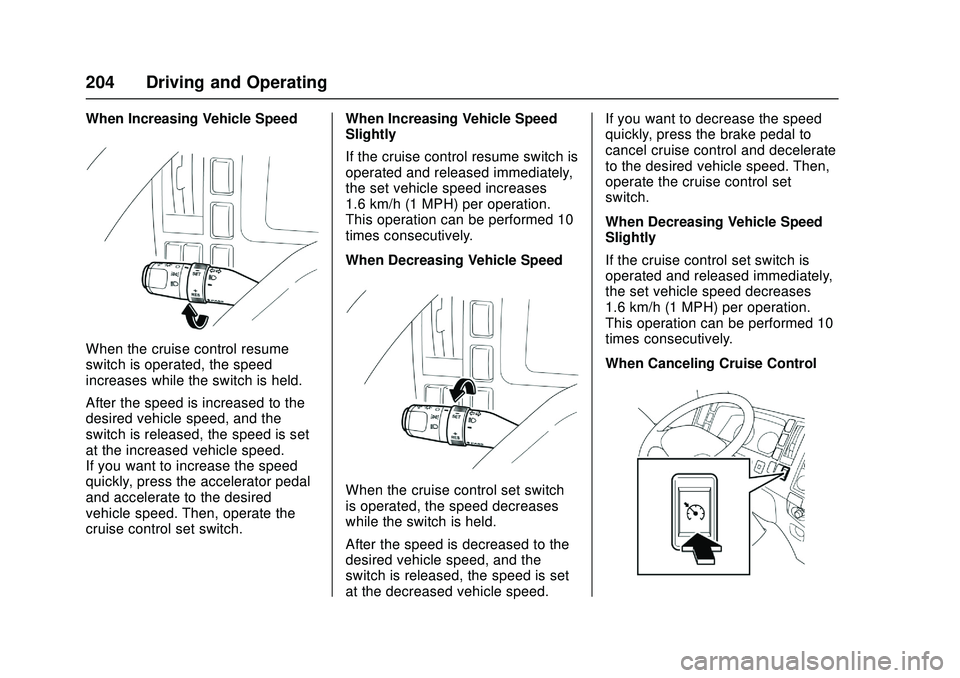
When Increasing Vehicle Speed
When the cruise control resume
switch is operated, the speed
increases while the switch is held.
After the speed is increased to the
desired vehicle speed, and the
switch is released, the speed is set
at the increased vehicle speed.
If you want to increase the speed
quickly, press the accelerator pedal
and accelerate to the desired
vehicle speed. Then, operate the
cruise control set switch.When Increasing Vehicle Speed
Slightly
If the cruise control resume switch is
operated and released immediately,
the set vehicle speed increases
1.6 km/h (1 MPH) per operation.
This operation can be performed 10
times consecutively.
When Decreasing Vehicle Speed
When the cruise control set switch
is operated, the speed decreases
while the switch is held.
After the speed is decreased to the
desired vehicle speed, and the
switch is released, the speed is set
at the decreased vehicle speed.If you want to decrease the speed
quickly, press the brake pedal to
cancel cruise control and decelerate
to the desired vehicle speed. Then,
operate the cruise control set
switch.
When Decreasing Vehicle Speed
Slightly
If the cruise control set switch is
operated and released immediately,
the set vehicle speed decreases
1.6 km/h (1 MPH) per operation.
This operation can be performed 10
times consecutively.
When Canceling Cruise Control
Page 221 of 358

Chevrolet Low Cab Forward Owner Manual (GMNA-Localizing-U.S.-
11254764) - 2018 - crc - 12/5/16
220 Vehicle Care
contamination, it will cause a
decline in the performance of the
parts and such problems as seizure
or malfunctioning. Replenish or
change these liquids when
performing the checks (daily and
periodic checks) as required by the
relevant regulations or in
accordance with the Maintenance
Schedule (when either the specified
driving distance or period of time,
whichever comes first, has expired).
Confirm that all systems and
components are normal after
performing the work.
Do not leave the removed parts or
tools in the engine compartment.
They could damage the equipment if
caught in the belts or other moving
components.
Dirty water, dirt and other impurities
seriously impair the effectiveness of
the oil, grease and fluids, and
damage the parts. Exercise all due
caution to prevent waste or other
refuse from coming in contact with
parts or materials that have been
removed when changing or
replenishing them.Do not step on the engine or climb
onto it. You could cause an engine
failure by, for example, damaging
the cylinder head cover or various
connectors.
Electric Welding
Careless electric welding of vehicle
parts can cause welding current to
flow back through the vehicle’s
ground circuit and damage electrical
and electronic parts so that they do
not function normally. Whenever
electric welding is necessary,
consult your dealer.
Cab Tilting
Before Tilting the Cab (Single Cab
Model)
{Warning
To help avoid personal injury and
property damage:
(Continued)
Warning (Continued)
.Park the vehicle on level
ground and check that there
is enough space in front of
and above the cab.
. Set the parking brake firmly
and block the front wheels.
. Move the selector lever in
the "P" position.
. Secure loose articles in
the cab.
. Stop the engine.
. Close the cab door.
. Keep the area surrounding
the cab clear.
You and others could be seriously
injured.
Tilting the Cab 1. Check that all personnel are clear of the cab.
2. Read the label on the rear of the cab.
Page 222 of 358
Chevrolet Low Cab Forward Owner Manual (GMNA-Localizing-U.S.-
11254764) - 2018 - crc - 12/5/16
Vehicle Care 221
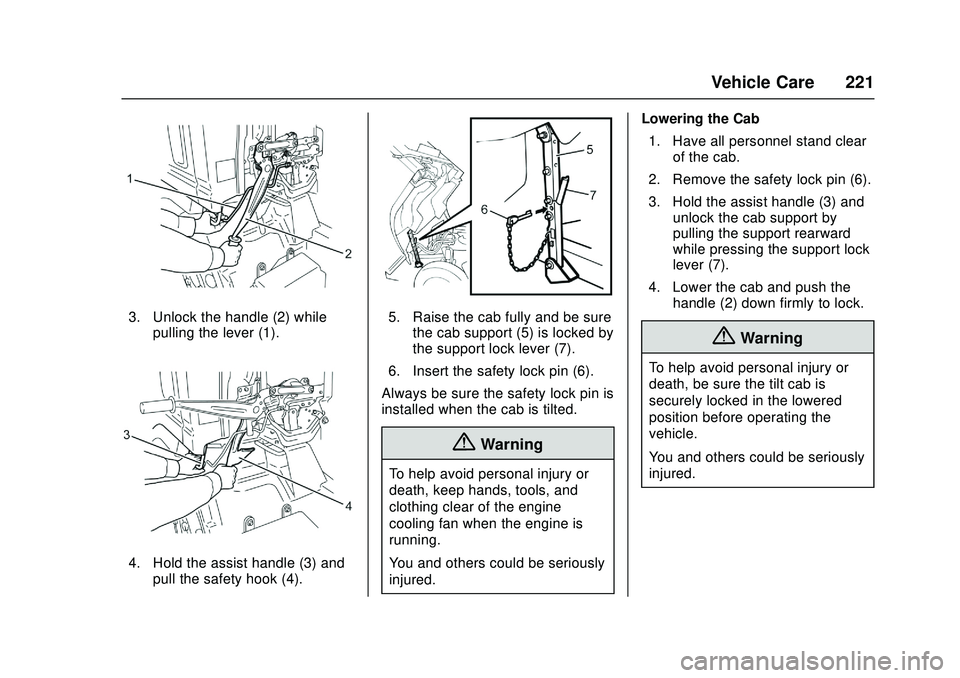
3. Unlock the handle (2) whilepulling the lever (1).
4. Hold the assist handle (3) andpull the safety hook (4).
5. Raise the cab fully and be surethe cab support (5) is locked by
the support lock lever (7).
6. Insert the safety lock pin (6).
Always be sure the safety lock pin is
installed when the cab is tilted.
{Warning
To help avoid personal injury or
death, keep hands, tools, and
clothing clear of the engine
cooling fan when the engine is
running.
You and others could be seriously
injured. Lowering the Cab
1. Have all personnel stand clear of the cab.
2. Remove the safety lock pin (6).
3. Hold the assist handle (3) and unlock the cab support by
pulling the support rearward
while pressing the support lock
lever (7).
4. Lower the cab and push the handle (2) down firmly to lock.
{Warning
To help avoid personal injury or
death, be sure the tilt cab is
securely locked in the lowered
position before operating the
vehicle.
You and others could be seriously
injured.
Page 232 of 358

Chevrolet Low Cab Forward Owner Manual (GMNA-Localizing-U.S.-
11254764) - 2018 - crc - 12/5/16
Vehicle Care 231
.Dipstick H (HOT) —
Transmission fluid
temperature Approx.
70 - 80 °C (158 - 176 °F).
. The “C (COLD)” range on
the dipstick is a guide used
by your dealer for
specialized equipment used
to replace or service the
automatic transmission
fluid. When performing your
own inspections, always
use the “H (HOT)” range
after warming up the
vehicle.
The fluid must be hot to
ensure an accurate check.
The fluid level rises as
temperature increases.
6. If the fluid level is too low, add the specified fluid through the
dipstick guide tube. Also, check
whether there are no fluid
leaks.
7. Insert the dipstick securely into position.{Warning
Be extremely careful not to burn
yourself when checking the oil
level if the engine temperature is
high. Protect yourself with
gloves etc.
You and others could be seriously
injured.
Discarded parts, oil, grease and
fluids could have an adverse effect
on the environment. It is difficult to
dispose of these, so have your
dealer handle all checks and
replacements.
Engine Air Cleaner/Filter
Air Cleaner
Use of clogged air cleaner element
not only causes a deterioration in
the engine output but also increased
fuel consumption and dark exhaust
smoke. Be sure to use a genuine air cleaner
element. If other air cleaner element
is used, it may cause the sensor to
output a wrong signal.
See
Maintenance Schedule 0303.
Air Cleaner Indicator Light
When the air cleaner indicator light
comes on, check the air cleaner
element. If the air cleaner element is
clogged, replace the air cleaner
element.
See Vehicle Messages 086.
See Maintenance Schedule 0303.
Engine Coolant
Protection of Engine Against
Overcooling
Overcooling of the engine not only
accelerates wear of the vital engine
parts but also hurts fuel economy.
Engine Coolant in Cold
Weather
To prevent the engine damage due
to freezing of the engine coolant,
mix the coolant and water at the
ratio of 50/50.
Page 234 of 358

Chevrolet Low Cab Forward Owner Manual (GMNA-Localizing-U.S.-
11254764) - 2018 - crc - 12/5/16
Vehicle Care 233
Warning (Continued)
Engine coolant is flammable, and
therefore, it must be kept away
from flames and other heat
sources. Engine coolant also
could ignite if it comes in contact
with a hot surface, such as the
exhaust manifold. Exercise
caution to prevent this from
happening.
You and others could be seriously
injured.
Preparing Engine Coolant
To prevent engine damage due to
freezing of the engine coolant and
to protect the cooling system from
corrosion, use a mixture of the
recommended type antifreeze and
water. If the engine of the vehicle is
at −30 °C (−22 °F) or above, the
coolant concentration should be
50%. Direct use of “50/50
Pre-diluted” product which is already
diluted to 50% concentration is
recommended. If the outside
temperature engine or vehicle is used at
−30 °C (−22 °F) or below,
coolant concentration of 55% is
recommended.
It is the owner ’s responsibility to:
. Maintain the engine cooling
system freeze protection at or
above −30 °C (−22 °F) (at or
below −30 °C (−22 °F) in colder
climates to ensure protection
against corrosion and loss of
engine coolant from boiling.
A 50/50 (55/45 for colder
climates) mixture of the
recommended type antifreeze
and water will provide freeze
protection to at or above −30 °C
(−22 °F), (at or below −30 °C
(−22 °F) in colder climates) and
boil protection to 128 °C
(262 °F). Periodic replacement
of engine coolant is needed to
replenish the anticorrosion
additives that wear out with use.
Engine coolant that has become
dark in color shows that it needs
to be changed.
. Use only the recommended
coolant. See Recommended
Fluids and Lubricants 0326. .
Do not use methanol-base
antifreeze, alcohol or plain water
alone in your vehicle at any time.
They will boil at a lower point
than that at which the engine
coolant temperature gauge will
warn of overheating, and they do
not provide proper protection
against corrosion.
Engine Coolant Quantity
For the quantity of engine coolant,
see Capacities and Specifications
0 335. After changing the engine
coolant, check that the engine
coolant is up to the specified level.
{Warning
For storage, close the cap of
coolant container securely and
keep it in a place inaccessible to
children.
You and others could be seriously
injured.
Using any coolant other than that
recommended by your dealer could
cause damage to the engine,
Page 236 of 358

Chevrolet Low Cab Forward Owner Manual (GMNA-Localizing-U.S.-
11254764) - 2018 - crc - 12/5/16
Vehicle Care 235
The radiator cap (1) opens and
closes in double action. When
removing the radiator cap, take
caution not to damage the cap and
the filler neck (2).
Turn the cap slowly to the left until it
reaches a“stop”. Do not press down
while turning the cap.
Wait until any remaining pressure
(indicated by a hissing sound) is
relieved, then press down on the
cap and continue turning it to
the left. Also, check to make sure there are
no leaks from the radiator or
radiator hose. Check for fluid or
stains on the ground showing leaks
where the vehicle is parked. Contact
your dealer if you discover leaks.
Using the vehicle when there are
leaks can lead to engine seizure.
Adding Engine Coolant
Single Cab Model
Crew Cab Model
When the engine coolant level in the
engine coolant reserve tank is
below the “MIN”line, open the
reserve tank cap and fill to near the
“MAX” line with engine coolant.
Wash the reserve tank cap and filler
neck with clean water. Tighten the
cap securely after the engine
coolant has been replenished.
Page 241 of 358

Chevrolet Low Cab Forward Owner Manual (GMNA-Localizing-U.S.-
11254764) - 2018 - crc - 12/5/16
240 Vehicle Care
after about 10 minutes if the gauge
pointer does not again show an
overheat condition.
When tap water only has been used
for engine coolant in an emergency,
change the engine coolant as soon
as possible.
Engine damage may be caused if
an overheating engine is suddenly
refilled with water. Instead, refill
slowly.
Power Steering Fluid
The power steering fluid level must
be checked and it must be changed
according to the Maintenance
Schedule. SeeMaintenance
Schedule 0303.
When replenishing power steering
fluid or flushing the power steering
system, always use ATF
(Dexron
®-VI). Failure to use the
proper fluid may damage the power
steering system seals and hoses,
leading to fluid leakage.
Checking the Power Steering
Fluid Level
The fluid level is correct if it is
between the “MAX”and“MIN” lines
on the reserve tank. If the level is
lower that the “MIN”line, add fluid
up to the “MAX”line.
The reserve tank is located at the
rear of the engine compartment on
the right. When you have finished
checking the fluid level, securely
install the cap and cover.
When you have finished checking
the fluid level, securely install
the cap.
The fluid level is correct if it is
between the "MAX" and "MIN" lines
on the oil dipstick. If the level is
lower than the "MIN" line, add fluid
up to the "MAX" line.
{Warning
Before adding fluid, clean the
area around the cap and pour
fluid from a clean jug or filler.
Foreign matter getting in the tank
may cause power steering system
failure. (Continued)