ECU CHEVROLET LOW CAB FORWARD 2018 Owner's Guide
[x] Cancel search | Manufacturer: CHEVROLET, Model Year: 2018, Model line: LOW CAB FORWARD, Model: CHEVROLET LOW CAB FORWARD 2018Pages: 358, PDF Size: 6.32 MB
Page 248 of 358
Chevrolet Low Cab Forward Owner Manual (GMNA-Localizing-U.S.-
11254764) - 2018 - crc - 12/5/16
Vehicle Care 247
Remove the inspection cover (1) on
the left- hand side of the instrument
panel by turning it with your fingers.
Check that the fluid level in the
reservoir is between the "MAX" and
"ADD" lines.
If the fluid surface cannot easily be
seen, rock the vehicle gently.
Adding Brake Fluid
If the level of brake fluid has
dropped below the "ADD" line,
remove the cap (2) and add fluid.
Take care to avoid filling beyond the
"MAX" line.
Tighten the cap securely after the
fluid has been added.
When adding brake fluid to the tank,
take care to prevent dirt and water
from entering it. Any dirt or water in
the system could cause the vehicle
to lose braking functions.
Inspect and change brake fluid
according to the Maintenance
Schedule.
Use the recommended brake fluid
when adding brake fluid.Never mix the specified brake fluid
with fluids of another brand.
Be careful not to spill brake fluid
onto painted surfaces or to let it
come in contact with skin. If fluid is
spilled onto a painted surface or
comes in contact with skin, wash
away the fluid with water and
immediately wipe the area clean.
Brake fluid readily absorbs moisture.
Therefore, it is necessary to close
the brake fluid container tightly for
storage.
If the brake fluid level decreases
rapidly, there may be a problem in
the brake system or brake pads or
shoe linings may have worn out.
Have your vehicle inspected by the
nearest dealer immediately.
Battery
Working Near Battery
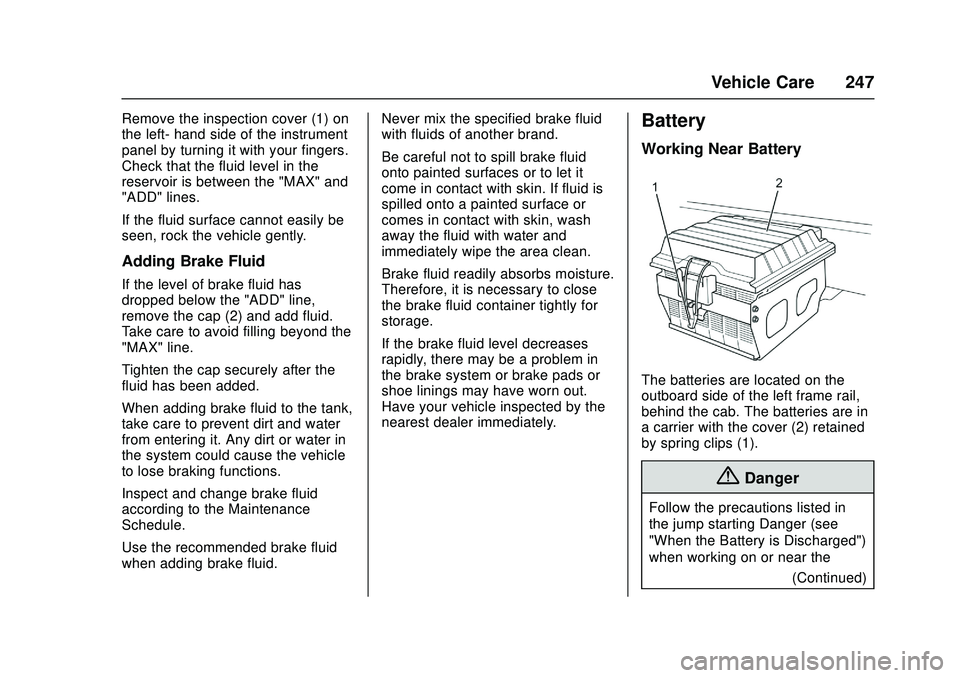
The batteries are located on the
outboard side of the left frame rail,
behind the cab. The batteries are in
a carrier with the cover (2) retained
by spring clips (1).
{Danger
Follow the precautions listed in
the jump starting Danger (see
"When the Battery is Discharged")
when working on or near the
(Continued)
Page 252 of 358
Chevrolet Low Cab Forward Owner Manual (GMNA-Localizing-U.S.-
11254764) - 2018 - crc - 12/5/16
Vehicle Care 251
Engine:
Removal or rendering engine speed
governor, if so equipped, inoperative
so as to allow engine speed to
exceed manufacturer specifications.
Fan and Drive:
.Removal of fan clutch or
rendering clutch inoperative.
. Removal of the fan shroud.
Air Intake:
. Removal of air cleaner silencer.
. Reversing air cleaner cover.
Exhaust:
. Removal of muffler, catalytic
converter, and/or resonator.
. Removal of exhaust pipes and
exhaust pipe clamps.
. Removal or modification of
diesel particulate filter (DPF).
. Removal or modification of
selective catalytic reduction
(SCR) catalyst.Automatic Transmission
Shift Lock Control
Function Check
When the Selector Lever
Cannot be Moved From the "P"
Position
Perform the following when the
selector lever cannot be moved from
the "P" position.
Caution
When the selector cannot be
operated from the P position to
any other position even after
performing the operation below
repeatedly, the shift lock system
may have a failure. Have the
vehicle inspected at your dealer.
When performing the below
operations, make sure the parking
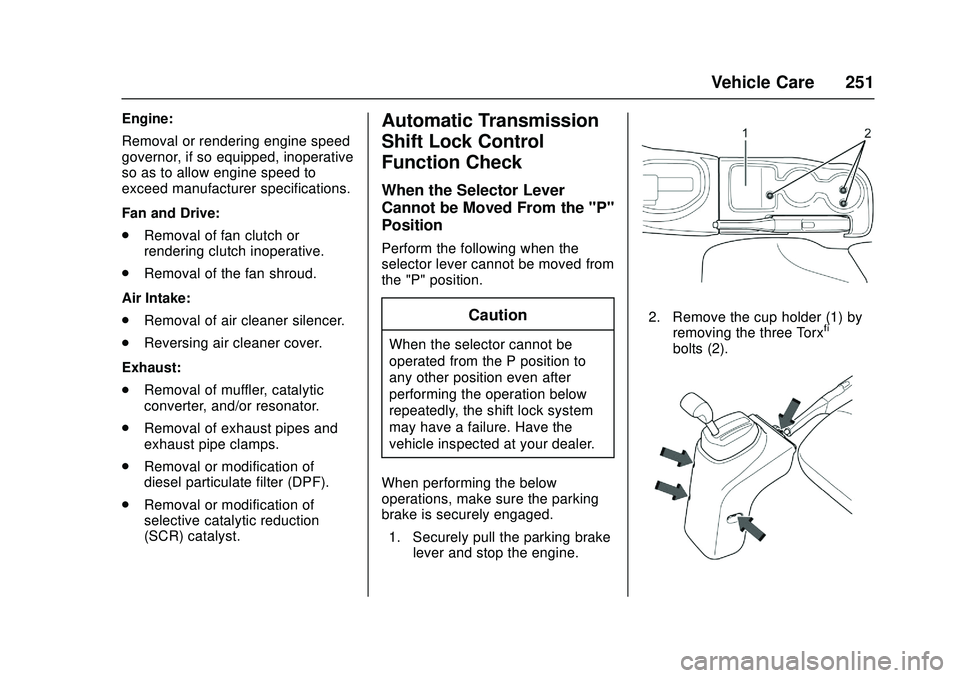
brake is securely engaged. 1. Securely pull the parking brake lever and stop the engine.
2. Remove the cup holder (1) byremoving the three Torx®
bolts (2).
Page 255 of 358

Chevrolet Low Cab Forward Owner Manual (GMNA-Localizing-U.S.-
11254764) - 2018 - crc - 12/5/16
254 Vehicle Care
2. Continue pushing in the wiperrubber insert until the wiper
blade's hook engages with the
hole in it, and then confirm that
the rubber insert is securely
held in place.
3. Attach the wiper blade to the wiper arm.Headlamp Aiming
For vertical aiming, turn the two
screws indicated by arrows in the
diagram.
1. Remove the rubber beneath the headlight.
2. Two screws should be turned in the same direction at the
same time to adjust aiming.
3. When the headlamp aiming is out of position, contact your
dealer.
Bulb Replacement
Bulbs
1. Check each bulb for blowout.
2. If a bulb has blown out, replaceit. Always place the engine
control switch in the “LOCK”
position and place all the other
switches in the “OFF”position
before replacing the blown
bulbs.
3. If you need assistance replacing any bulbs, contact
your dealer.
Turn Signals
The flasher unit activates both the
turn signal circuits and the hazard
circuit. Should a lamp burn out, the
flasher unit will continue to operate.
Check the turn signal lamps visually
before the vehicle is used.
Page 260 of 358

Chevrolet Low Cab Forward Owner Manual (GMNA-Localizing-U.S.-
11254764) - 2018 - crc - 12/5/16
Vehicle Care 259
8. Remove the rubber boot (2).Push the right side of the
clip (1) that holds the bulb (3)
in place and slide it upwards to
disengage the clip.
9. Remove the bulb (1) from thesocket (2) and replace with a
new one.
10. After replacing the bulb, reverse steps 1-8 to install.
Do not touch the glass of the bulb
with your hand. Soiling the glass will
cause the bulb to blow out.
When attaching the rubber boot,
press in both the outside and inside
circumference of it. Make sure that
the rubber boot, the headlamp
assembly, and the bulb are securely
installed without any raised section.
If the rubber boot is not firmly in
place, water could get inside the
headlamp and lead to a breakdown.
Replacing Parking Lamps
1. Refer to “Replacing the
Headlamps” and remove the
headlamp assembly.
2. Pull the bulb out from the parking lamp socket and
replace with a new one.
Page 261 of 358

Chevrolet Low Cab Forward Owner Manual (GMNA-Localizing-U.S.-
11254764) - 2018 - crc - 12/5/16
260 Vehicle Care
3. To install the lamps, performthe same sequence of
operations in reverse, taking
care to turn the connector
clockwise to lock it securely.
If the socket is not locked securely,
water could get inside the lamp and
lead to a breakdown.
Replacing a Front Turn
Signal Lamp
Do not replace a bulb with other
than the specified wattage. This will
cause abnormal flashing,
particularly for turn signal lamps. When replacing a bulb, make sure
the light switch is OFF.
1. While referring to “Replacing
the Headlights”, tilt the turn
signal lamp assembly down
toward the front of the vehicle
and remove it.
2. Disconnect the connector for the turn signal light and then
remove the socket.
3. Pull the bulb from the socketand replace it with a new one.
4. To install the lamps, perform the same sequence of
operations in reverse, taking
care to turn the connector
clockwise to lock it securely.
If the socket is not locked securely,
water could get inside the light and
lead to a breakdown.
Page 263 of 358

Chevrolet Low Cab Forward Owner Manual (GMNA-Localizing-U.S.-
11254764) - 2018 - crc - 12/5/16
262 Vehicle Care
3. When the clip (1) has beenremoved, pull the lamp out
while sliding it out toward the
rear of the vehicle.
4. Loosen the socket by turning it counterclockwise.5. Pull the bulb out from the
socket and replace it with a
new one.
6. To install the lights, perform the same sequence of operations
in reverse taking care of the
following points:
A. Turn the socket clockwiseto lock securely.
If the socket is not locked
securely, water could get
inside the light and lead to
a breakdown.B. Insert the clip on the backof the rear part of the light
into the door panel.
C. Push the front part of the light into the door panel,
and insert the clip on the
back of the front part of the
light in the door panel.
Page 269 of 358
Chevrolet Low Cab Forward Owner Manual (GMNA-Localizing-U.S.-
11254764) - 2018 - crc - 12/5/16
268 Vehicle Care
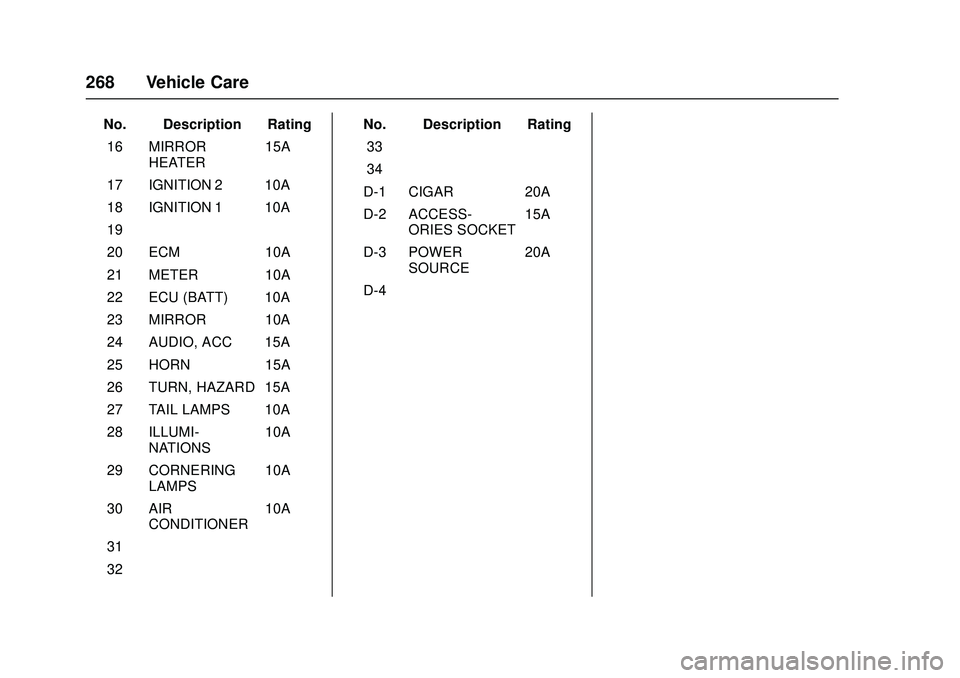
No. Description Rating16 MIRROR HEATER 15A
17 IGNITION 2 10A
18 IGNITION 1 10A
19 – –
20 ECM 10A
21 METER 10A
22 ECU (BATT) 10A
23 MIRROR 10A
24 AUDIO, ACC 15A
25 HORN 15A
26 TURN, HAZARD 15A
27 TAIL LAMPS 10A
28 ILLUMI- NATIONS 10A
29 CORNERING LAMPS 10A
30 AIR CONDITIONER 10A
31 – –
32 – – No. Description Rating
33 – –
34 – –
D-1 CIGAR 20A
D-2 ACCESS- ORIES SOCKET 15A
D-3 POWER SOURCE 20A
D-4 – –
Page 292 of 358
Chevrolet Low Cab Forward Owner Manual (GMNA-Localizing-U.S.-
11254764) - 2018 - crc - 12/5/16
Vehicle Care 291
7. If the engine in the disabledvehicle starts, remove the
jumper cables in the reverse
sequence as they were
connected.Towing the Vehicle
Consult your dealer or a
professional towing service if the
disabled vehicle must be towed.
Proper equipment must be used to
prevent damage to vehicles during
any towing. State and local laws
which apply to vehicles in tow must
be followed. Vehicles should not be
towed at speeds in excess of
88 km/h (55 mph).
Connect to the main structural parts
of the vehicle. Do not attach to
bumpers, tow hooks or brackets.
Use only equipment designed for
this purpose. Follow the instructions
of the wrecker manufacturer.
A safety chain system must
be used.
The procedures below must be
followed when towing to prevent
possible damage. Front End Towing (Front Wheels
Off Ground)
To prepare a disabled vehicle for
front end towing with front wheels
raised off the ground, the following
steps are necessary:
.
Block the rear wheels of the
disabled vehicle.
. Disconnect the driveshaft at the
rear axle. Secure the driveshaft
to the frame or crossmember.
When towing, disconnect the
driveshaft at the rear axle to ensure
the transmission is not damaged.
The rear end of the driveshaft must
be disconnected and safely secured
if the 80 km (50 mi) or 48 km/h
(30 mph) is exceeded.
If there is damage or suspected
damage to the rear axle, remove the
axle shafts. Cover the hub openings
to prevent the loss of lubricant or
entry of dirt or foreign objects.
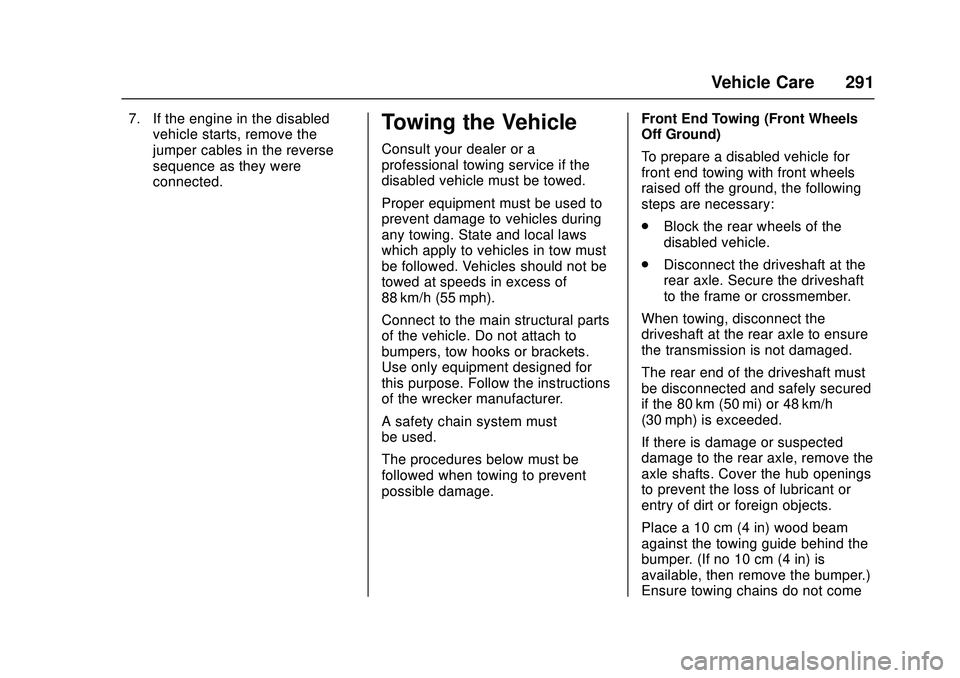
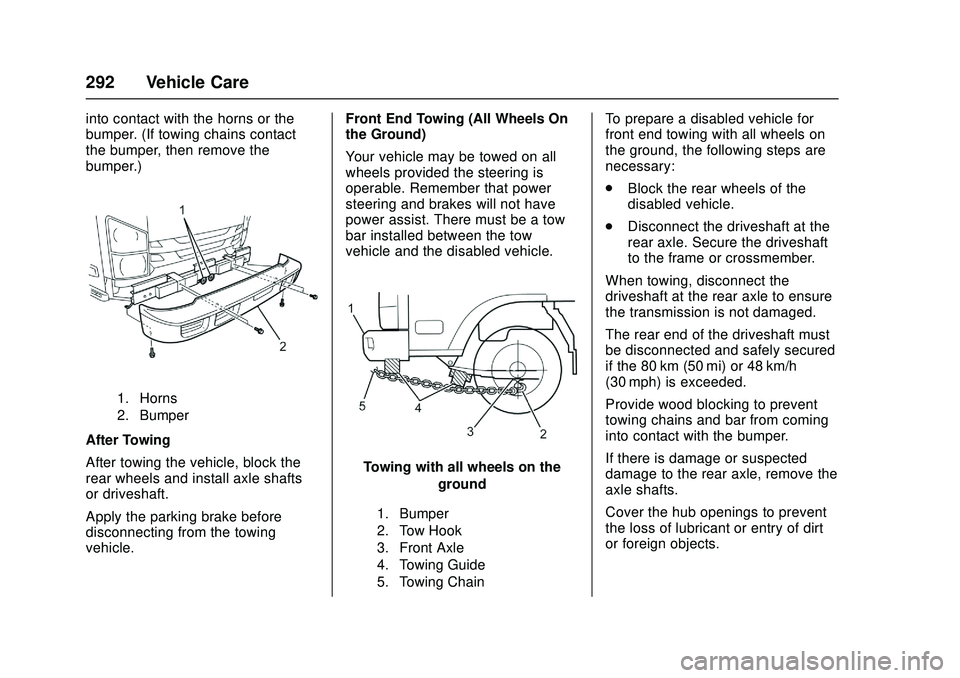
Place a 10 cm (4 in) wood beam
against the towing guide behind the
bumper. (If no 10 cm (4 in) is
available, then remove the bumper.)
Ensure towing chains do not come
Page 293 of 358
Chevrolet Low Cab Forward Owner Manual (GMNA-Localizing-U.S.-
11254764) - 2018 - crc - 12/5/16
292 Vehicle Care
into contact with the horns or the
bumper. (If towing chains contact
the bumper, then remove the
bumper.)
1. Horns
2. Bumper
After Towing
After towing the vehicle, block the
rear wheels and install axle shafts
or driveshaft.
Apply the parking brake before
disconnecting from the towing
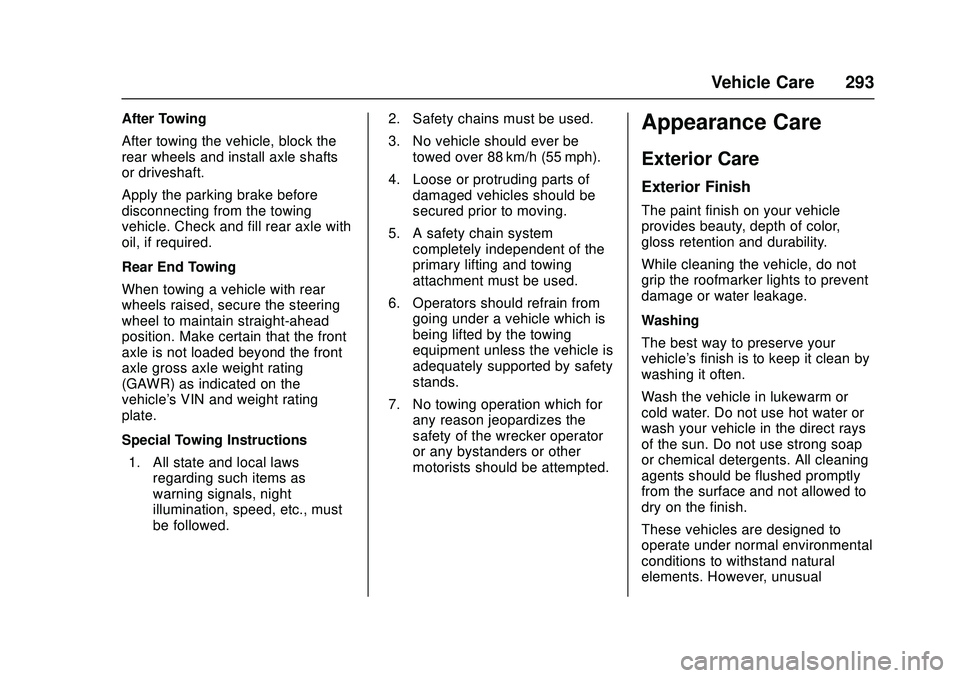
vehicle.Front End Towing (All Wheels On
the Ground)
Your vehicle may be towed on all
wheels provided the steering is
operable. Remember that power
steering and brakes will not have
power assist. There must be a tow
bar installed between the tow
vehicle and the disabled vehicle.
Towing with all wheels on the
ground
1. Bumper
2. Tow Hook
3. Front Axle
4. Towing Guide
5. Towing Chain
To prepare a disabled vehicle for
front end towing with all wheels on
the ground, the following steps are
necessary:
.Block the rear wheels of the
disabled vehicle.
. Disconnect the driveshaft at the
rear axle. Secure the driveshaft
to the frame or crossmember.
When towing, disconnect the
driveshaft at the rear axle to ensure
the transmission is not damaged.
The rear end of the driveshaft must
be disconnected and safely secured
if the 80 km (50 mi) or 48 km/h
(30 mph) is exceeded.
Provide wood blocking to prevent
towing chains and bar from coming
into contact with the bumper.
If there is damage or suspected
damage to the rear axle, remove the
axle shafts.
Cover the hub openings to prevent
the loss of lubricant or entry of dirt
or foreign objects.
Page 294 of 358
Chevrolet Low Cab Forward Owner Manual (GMNA-Localizing-U.S.-
11254764) - 2018 - crc - 12/5/16
Vehicle Care 293
After Towing
After towing the vehicle, block the
rear wheels and install axle shafts
or driveshaft.
Apply the parking brake before
disconnecting from the towing
vehicle. Check and fill rear axle with
oil, if required.
Rear End Towing
When towing a vehicle with rear
wheels raised, secure the steering
wheel to maintain straight-ahead
position. Make certain that the front
axle is not loaded beyond the front
axle gross axle weight rating
(GAWR) as indicated on the
vehicle's VIN and weight rating
plate.
Special Towing Instructions1. All state and local laws regarding such items as
warning signals, night
illumination, speed, etc., must
be followed. 2. Safety chains must be used.
3. No vehicle should ever be
towed over 88 km/h (55 mph).
4. Loose or protruding parts of damaged vehicles should be
secured prior to moving.
5. A safety chain system completely independent of the
primary lifting and towing
attachment must be used.
6. Operators should refrain from going under a vehicle which is
being lifted by the towing
equipment unless the vehicle is
adequately supported by safety
stands.
7. No towing operation which for any reason jeopardizes the
safety of the wrecker operator
or any bystanders or other
motorists should be attempted.Appearance Care
Exterior Care
Exterior Finish
The paint finish on your vehicle
provides beauty, depth of color,
gloss retention and durability.
While cleaning the vehicle, do not
grip the roofmarker lights to prevent
damage or water leakage.
Washing
The best way to preserve your
vehicle's finish is to keep it clean by
washing it often.
Wash the vehicle in lukewarm or
cold water. Do not use hot water or
wash your vehicle in the direct rays
of the sun. Do not use strong soap
or chemical detergents. All cleaning
agents should be flushed promptly
from the surface and not allowed to
dry on the finish.
These vehicles are designed to
operate under normal environmental
conditions to withstand natural
elements. However, unusual