Proper oil CHEVROLET LOW CAB FORWARD 2018 User Guide
[x] Cancel search | Manufacturer: CHEVROLET, Model Year: 2018, Model line: LOW CAB FORWARD, Model: CHEVROLET LOW CAB FORWARD 2018Pages: 358, PDF Size: 6.32 MB
Page 220 of 358

Chevrolet Low Cab Forward Owner Manual (GMNA-Localizing-U.S.-
11254764) - 2018 - crc - 12/5/16
Vehicle Care 219
Warning (Continued)
vehicle or its equipment. If you
have any questions about
carrying out some service, have
the work done by a skilled
technician.
To prevent personal injury, keep
hands, tools and clothing clear of
the engine cooling fan when the
engine is running.
The engine, exhaust pipe and
radiator will be hot immediately
after the vehicle is driven. Be
careful around these parts to
prevent burns. Perform all checks
when the engine is cold.
Do not perform work near an
open flame or other heat sources.
Do not let the engine run in poorly
ventilated garages or sheds. This
could cause carbon monoxide
poisoning.(Continued)
Warning (Continued)
Performing maintenance work on
a truck or chassis can be
dangerous. In trying to do some
jobs, you can be seriously injured.
Do your own maintenance work
only if you have the required
know-how and the proper tools
and equipment for the job. If you
have any doubts, contact your
dealer.
You and others could be seriously
injured.
Pull firmly on the parking brake
lever and move the selector lever to
"P" and make sure the shift indicator
displays "P".
Make sure to turn off the engine and
remove the key from the engine
control switch before performing any
checks.
Select a place with a solid and level
surface to perform the checking and
maintenance work. Make sure to chock the wheels. It would be very
dangerous if the vehicle started
to move.
When performing work on the
electrical system, begin by turning
the engine control switch to the
"LOCK" position, wait at least
3 minutes, and then disconnect the
negative cable from the negative
terminal on battery. If the negative
cable is disconnected within
3 minutes, the engine control
module may malfunction.
When working on the fuel line or
fuel filter, remove the fuel tank filler
cap. The fuel system is under
pressure and the fuel will overspill
unless the pressure is relieved,
possibly leading to combustion or
a fire.
Do not make engine adjustments
yourself. Be sure to consult your
dealer.
Use only appropriate tools.
Oils, brake fluid and engine coolant
have lubrication, cooling and rust
prevention functions. If these liquids
deteriorate through loss or
Page 221 of 358

Chevrolet Low Cab Forward Owner Manual (GMNA-Localizing-U.S.-
11254764) - 2018 - crc - 12/5/16
220 Vehicle Care
contamination, it will cause a
decline in the performance of the
parts and such problems as seizure
or malfunctioning. Replenish or
change these liquids when
performing the checks (daily and
periodic checks) as required by the
relevant regulations or in
accordance with the Maintenance
Schedule (when either the specified
driving distance or period of time,
whichever comes first, has expired).
Confirm that all systems and
components are normal after
performing the work.
Do not leave the removed parts or
tools in the engine compartment.
They could damage the equipment if
caught in the belts or other moving
components.
Dirty water, dirt and other impurities
seriously impair the effectiveness of
the oil, grease and fluids, and
damage the parts. Exercise all due
caution to prevent waste or other
refuse from coming in contact with
parts or materials that have been
removed when changing or
replenishing them.Do not step on the engine or climb
onto it. You could cause an engine
failure by, for example, damaging
the cylinder head cover or various
connectors.
Electric Welding
Careless electric welding of vehicle
parts can cause welding current to
flow back through the vehicle’s
ground circuit and damage electrical
and electronic parts so that they do
not function normally. Whenever
electric welding is necessary,
consult your dealer.
Cab Tilting
Before Tilting the Cab (Single Cab
Model)
{Warning
To help avoid personal injury and
property damage:
(Continued)
Warning (Continued)
.Park the vehicle on level
ground and check that there
is enough space in front of
and above the cab.
. Set the parking brake firmly
and block the front wheels.
. Move the selector lever in
the "P" position.
. Secure loose articles in
the cab.
. Stop the engine.
. Close the cab door.
. Keep the area surrounding
the cab clear.
You and others could be seriously
injured.
Tilting the Cab 1. Check that all personnel are clear of the cab.
2. Read the label on the rear of the cab.
Page 225 of 358
Chevrolet Low Cab Forward Owner Manual (GMNA-Localizing-U.S.-
11254764) - 2018 - crc - 12/5/16
224 Vehicle Care
Checking the Engine Oil Level
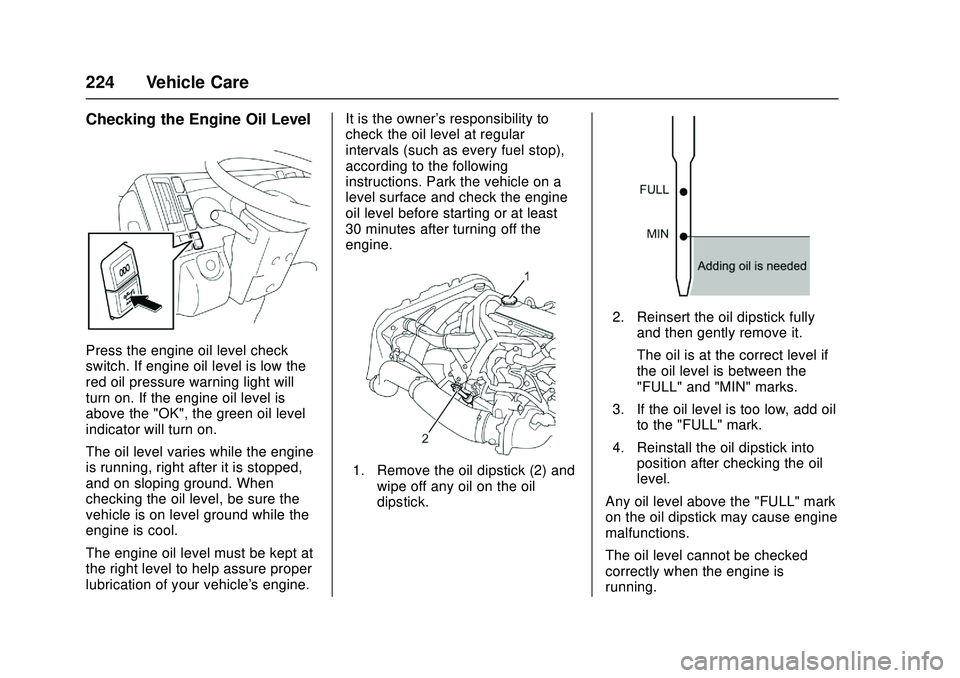
Press the engine oil level check
switch. If engine oil level is low the
red oil pressure warning light will
turn on. If the engine oil level is
above the "OK", the green oil level
indicator will turn on.
The oil level varies while the engine
is running, right after it is stopped,
and on sloping ground. When
checking the oil level, be sure the
vehicle is on level ground while the
engine is cool.
The engine oil level must be kept at
the right level to help assure proper
lubrication of your vehicle's engine.It is the owner's responsibility to
check the oil level at regular
intervals (such as every fuel stop),
according to the following
instructions. Park the vehicle on a
level surface and check the engine
oil level before starting or at least
30 minutes after turning off the
engine.
1. Remove the oil dipstick (2) and
wipe off any oil on the oil
dipstick.
2. Reinsert the oil dipstick fullyand then gently remove it.
The oil is at the correct level if
the oil level is between the
"FULL" and "MIN" marks.
3. If the oil level is too low, add oil to the "FULL" mark.
4. Reinstall the oil dipstick into position after checking the oil
level.
Any oil level above the "FULL" mark
on the oil dipstick may cause engine
malfunctions.
The oil level cannot be checked
correctly when the engine is
running.
Page 227 of 358
Chevrolet Low Cab Forward Owner Manual (GMNA-Localizing-U.S.-
11254764) - 2018 - crc - 12/5/16
226 Vehicle Care
Consequently, the maintenance
interval of the DPF filter will be
reduced.
Oil Identification Logo
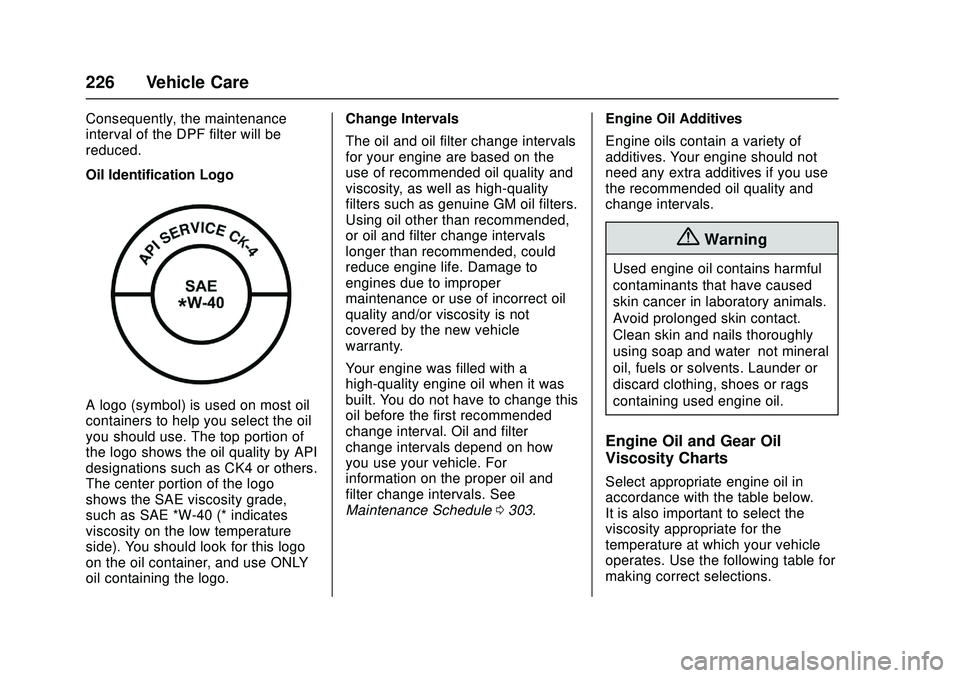
A logo (symbol) is used on most oil
containers to help you select the oil
you should use. The top portion of
the logo shows the oil quality by API
designations such as CK4 or others.
The center portion of the logo
shows the SAE viscosity grade,
such as SAE *W-40 (* indicates
viscosity on the low temperature
side). You should look for this logo
on the oil container, and use ONLY
oil containing the logo.Change Intervals
The oil and oil filter change intervals
for your engine are based on the
use of recommended oil quality and
viscosity, as well as high-quality
filters such as genuine GM oil filters.
Using oil other than recommended,
or oil and filter change intervals
longer than recommended, could
reduce engine life. Damage to
engines due to improper
maintenance or use of incorrect oil
quality and/or viscosity is not
covered by the new vehicle
warranty.
Your engine was filled with a
high-quality engine oil when it was
built. You do not have to change this
oil before the first recommended
change interval. Oil and filter
change intervals depend on how
you use your vehicle. For
information on the proper oil and
filter change intervals. See
Maintenance Schedule
0303. Engine Oil Additives
Engine oils contain a variety of
additives. Your engine should not
need any extra additives if you use
the recommended oil quality and
change intervals.
{Warning
Used engine oil contains harmful
contaminants that have caused
skin cancer in laboratory animals.
Avoid prolonged skin contact.
Clean skin and nails thoroughly
using soap and water–not mineral
oil, fuels or solvents. Launder or
discard clothing, shoes or rags
containing used engine oil.
Engine Oil and Gear Oil
Viscosity Charts
Select appropriate engine oil in
accordance with the table below.
It is also important to select the
viscosity appropriate for the
temperature at which your vehicle
operates. Use the following table for
making correct selections.
Page 233 of 358

Chevrolet Low Cab Forward Owner Manual (GMNA-Localizing-U.S.-
11254764) - 2018 - crc - 12/5/16
232 Vehicle Care
Replace rubber hoses whenever
they crack or are damaged; even
minor cracks allow engine coolant
solution to leak.
{Warning
If your engine cooling system
overheats, seeEngine
Overheating 0237. Continued
operation of the engine even for a
short time may result in a fire and
the possibility of personal injury
and/or severe vehicle damage.
You and others could be seriously
injured.
Your vehicle has an engine coolant
recovery system, expansion bottle
and/or an engine coolant reserve
tank system. Engine coolant in the
system expands with heat and
overflows into the reserve tank.
When the system cools, engine
coolant is drawn back into the
radiator.
The engine cooling system has
been filled at the factory with a
quality engine coolant. It is important to use proper engine
coolant to prevent damage to
engine cooling system components.
The engine cooling system is
designed to use engine coolant
rather than plain water. See
Recommended Fluids and
Lubricants
0326.
See the Maintenance Schedule to
find out when the engine coolant
must be replaced. Note that
changing the engine coolant is
needed to replenish the rust
inhibitors to make certain that all
parts of the engine cooling system
work well.
{Warning
Check, replenish or change the
engine coolant only after the
engine has sufficiently
cooled down.
Do not loosen or remove the cap
of the radiator or engine coolant
reserve tank cap when the engine (Continued)
Warning (Continued)
coolant is still hot. Hot vapor or
boiling water may burst out and
cause a burn.
When removing the radiator cap
or engine coolant reserve tank
cap, use a thick cloth to cover the
cap and turn it slowly.
Engine coolant is toxic and must
not be ingested. If the engine
coolant is mistakenly ingested,
seek prompt medical attention.
If the engine coolant gets in your
eyes, rinse your eyes immediately
with a large amount of water for
15 minutes or longer. Also, if your
eyes are still irritated or otherwise
feel abnormal, seek immediate
medical attention.
If the engine coolant gets on your
skin, rinse it off using a soap with
a large amount of water. Also,
if abnormality is seen, seek
medical attention.(Continued)
Page 234 of 358

Chevrolet Low Cab Forward Owner Manual (GMNA-Localizing-U.S.-
11254764) - 2018 - crc - 12/5/16
Vehicle Care 233
Warning (Continued)
Engine coolant is flammable, and
therefore, it must be kept away
from flames and other heat
sources. Engine coolant also
could ignite if it comes in contact
with a hot surface, such as the
exhaust manifold. Exercise
caution to prevent this from
happening.
You and others could be seriously
injured.
Preparing Engine Coolant
To prevent engine damage due to
freezing of the engine coolant and
to protect the cooling system from
corrosion, use a mixture of the
recommended type antifreeze and
water. If the engine of the vehicle is
at −30 °C (−22 °F) or above, the
coolant concentration should be
50%. Direct use of “50/50
Pre-diluted” product which is already
diluted to 50% concentration is
recommended. If the outside
temperature engine or vehicle is used at
−30 °C (−22 °F) or below,
coolant concentration of 55% is
recommended.
It is the owner ’s responsibility to:
. Maintain the engine cooling
system freeze protection at or
above −30 °C (−22 °F) (at or
below −30 °C (−22 °F) in colder
climates to ensure protection
against corrosion and loss of
engine coolant from boiling.
A 50/50 (55/45 for colder
climates) mixture of the
recommended type antifreeze
and water will provide freeze
protection to at or above −30 °C
(−22 °F), (at or below −30 °C
(−22 °F) in colder climates) and
boil protection to 128 °C
(262 °F). Periodic replacement
of engine coolant is needed to
replenish the anticorrosion
additives that wear out with use.
Engine coolant that has become
dark in color shows that it needs
to be changed.
. Use only the recommended
coolant. See Recommended
Fluids and Lubricants 0326. .
Do not use methanol-base
antifreeze, alcohol or plain water
alone in your vehicle at any time.
They will boil at a lower point
than that at which the engine
coolant temperature gauge will
warn of overheating, and they do
not provide proper protection
against corrosion.
Engine Coolant Quantity
For the quantity of engine coolant,
see Capacities and Specifications
0 335. After changing the engine
coolant, check that the engine
coolant is up to the specified level.
{Warning
For storage, close the cap of
coolant container securely and
keep it in a place inaccessible to
children.
You and others could be seriously
injured.
Using any coolant other than that
recommended by your dealer could
cause damage to the engine,
Page 238 of 358

Chevrolet Low Cab Forward Owner Manual (GMNA-Localizing-U.S.-
11254764) - 2018 - crc - 12/5/16
Vehicle Care 237
may be lost and damage to the
engine may result from overheating.
The radiator pressure cap should be
checked periodically for proper
operation. If a replacement is
required, a genuine GM part is
recommended.
Engine Overheating
When the Engine Overheats
The engine cooling system may
overheat if the engine coolant level
is too low, if there is a sudden loss
of engine coolant (such as radiator
hose failure), or if other problems
occur. It may also temporarily
overheat during severe operating
conditions such as:
.Climbing a long hill on a hot day.
. Stopping after high-speed
driving.
. Idling for long periods in traffic.
If engine power drops and the
needle on the engine coolant
temperature gauge goes up above
the upper limit of the safety zone
and enters the "H" zone, the engine
is overheating. The engine overheat warning light will come on and the
warning buzzer will sound. Either
steam or boiling engine coolant will
squirt out of the radiator. The
vehicle will also have an
“OVER
HEAT” message displayed. Take the
following corrective actions
immediately.
{Warning
To help avoid being burned:
Do not tilt the cab or open the
engine access cover if you see or
hear steam or engine coolant
escaping from the engine
compartment. Wait until no steam
or engine coolant can be seen or
heard before tilting the cab or
opening the engine cover.
Do not remove the radiator cap or
engine coolant reserve tank cap if
the engine coolant in the tank is
boiling. Also do not remove the
radiator cap while the engine and
radiator are still hot. Scalding fluid
(Continued)
Warning (Continued)
and steam can be blown out
under pressure if either cap is
taken off too soon.
You and others could be seriously
injured.
If Steam Is Coming from the
Engine Compartment
{Warning
If the engine coolant temperature
gauge shows an overheat
condition or you have other
reasons to suspect the engine
may be overheating, continued
operation of the engine (other
than as described here) even for
a short period of time may cause
a fire and the result in personal
injury and severe vehicle
damage. Take immediate action
as outlined.
You and others could be seriously
injured.
Page 240 of 358
Chevrolet Low Cab Forward Owner Manual (GMNA-Localizing-U.S.-
11254764) - 2018 - crc - 12/5/16
Vehicle Care 239
Warning (Continued)
refilling, and replacement of
coolant only when its temperature
has cooled.
When removing the radiator cap
and reserve tank cap, use a thick
cloth to cover the cap and turn it
little by little.
You and others could be seriously
injured.
4. If no steam or engine coolant can be seen or heard from the
engine compartment:
.Tilt the cab or open the
engine access cover.
‐If the engine coolant is
boiling, wait until it stops
before proceeding.
‐ Look at the see-through
reserve tank. The
engine coolant level
should be between the
"MAX" and "MIN" lines
on the reserve tank. ‐
If necessary, pour
engine coolant (See
Engine Coolant 0231
for the proper coolant
and water mixture) into
the reserve tank only,
not directly into the
radiator. Also, do not
check engine coolant
level at the radiator.
. Make sure the fan belts are
not broken, or off the
pulleys, and that the fan
turns when the engine is
started. Make sure the fan
blade and pulleys are not
broken.
. Check the radiator hoses
and connections, heater
hoses and connections,
radiator, water pump, EGR
cooler, and SCR system
and hoses for leakage.
If you do not find a leak or
other problem, carefully add
engine coolant to the
reserve tank. If the engine coolant level in
the reserve tank is at the
correct level but there is still
an indication on the
instrument panel of an
overheat condition:
You must let the engine
cool first. You may then add
engine coolant directly to
the radiator. See
“Adding
Engine Coolant” under
Engine Coolant 0231.
5. Inspect to see if there is any dirt, etc. attached to the front
surface of the radiator. Also,
inspect to see if there is
anything blocking the core.
If there is anything attached,
clean and remove it.
6. After the inspection, regardless of the vehicle condition, please
contact the nearest dealer.
Once the engine coolant
temperature gauge no longer
signals an overheat condition, you
can resume driving at a reduced
speed. Return to normal driving
Page 241 of 358

Chevrolet Low Cab Forward Owner Manual (GMNA-Localizing-U.S.-
11254764) - 2018 - crc - 12/5/16
240 Vehicle Care
after about 10 minutes if the gauge
pointer does not again show an
overheat condition.
When tap water only has been used
for engine coolant in an emergency,
change the engine coolant as soon
as possible.
Engine damage may be caused if
an overheating engine is suddenly
refilled with water. Instead, refill
slowly.
Power Steering Fluid
The power steering fluid level must
be checked and it must be changed
according to the Maintenance
Schedule. SeeMaintenance
Schedule 0303.
When replenishing power steering
fluid or flushing the power steering
system, always use ATF
(Dexron
®-VI). Failure to use the
proper fluid may damage the power
steering system seals and hoses,
leading to fluid leakage.
Checking the Power Steering
Fluid Level
The fluid level is correct if it is
between the “MAX”and“MIN” lines
on the reserve tank. If the level is
lower that the “MIN”line, add fluid
up to the “MAX”line.
The reserve tank is located at the
rear of the engine compartment on
the right. When you have finished
checking the fluid level, securely
install the cap and cover.
When you have finished checking
the fluid level, securely install
the cap.
The fluid level is correct if it is
between the "MAX" and "MIN" lines
on the oil dipstick. If the level is
lower than the "MIN" line, add fluid
up to the "MAX" line.
{Warning
Before adding fluid, clean the
area around the cap and pour
fluid from a clean jug or filler.
Foreign matter getting in the tank
may cause power steering system
failure. (Continued)
Page 283 of 358
Chevrolet Low Cab Forward Owner Manual (GMNA-Localizing-U.S.-
11254764) - 2018 - crc - 12/5/16
282 Vehicle Care
Danger (Continued)
.Note that taking off and
mounting tires on wheels
requires proper tools, safety
equipment and special
training. A person can be
severely injured or killed
and damage can result from
using the wrong service
methods. Truck tires and
wheels should be serviced
only by trained people using
the proper equipment.
. Never add air to your tires
unless an accurate pressure
gauge is also used. When
putting air in a tire on the
vehicle, stand to the side
and use a clip-on chuck and
hose extension. In choosing
the right tire pressure, be
careful not to exceed the
maximum pressure
capability shown on the tire;
see the tire pressure charts
in this manual.
(Continued)
Danger (Continued)
.Tire mounting or repair can
result in serious personal
injury or death, if not
performed correctly. This
section has detailed
instructions for proper wheel
and tire replacement, so be
sure to read and follow
them. Truck fleet owners
and operators: You can get
written instructions on truck
tire demounting, repair and
mounting from Rubber
Manufacturers Association
(RMA), 1400 K Street N.W.,
Washington, D.C. 20005,
and also from many tire
stores.
Wheel Nut Torque
{Warning
Never use oil or grease on studs
or nuts. Use the torque specified
for the type of wheels on the (Continued)
Warning (Continued)
vehicle. Snug all wheel nuts and
then tighten to the specified
torque in the numerical sequence
shown. Improperly tightened
wheel nuts could eventually allow
the wheel to come off while the
vehicle is moving, possibly
causing loss of control and
personal injury and property
damage.
When the vehicle, wheel or
fasteners are new, have a
technician tighten wheel stud nuts
and rim clamp nuts with a torque
wrench at 1 040 km (650 mi). This is
necessary because the clamping
system used on the wheels must
seat before the fastener will hold a
uniform clamp load and remain fully
tightened. Also have a technician
tighten wheel stud nuts and rim
clamp nuts with a torque wrench
after installing any wheel.