air condition CHEVROLET LOW CAB FORWARD 2018 User Guide
[x] Cancel search | Manufacturer: CHEVROLET, Model Year: 2018, Model line: LOW CAB FORWARD, Model: CHEVROLET LOW CAB FORWARD 2018Pages: 358, PDF Size: 6.32 MB
Page 160 of 358
Chevrolet Low Cab Forward Owner Manual (GMNA-Localizing-U.S.-
11254764) - 2018 - crc - 12/5/16
Driving and Operating 159
Engine Exhaust
Engine Exhaust Emissions
Caution (Carbon Monoxide)
{Warning
Do not breathe exhaust gas
because it contains carbon
monoxide, which by itself has no
color or odor. Carbon monoxide is
a dangerous gas. It can cause
unconsciousness and can be
lethal.
Do not keep the engine running
for any length of time in a place
that is poorly ventilated. It is
particularly dangerous to run the
engine in a garage or other indoor
place that could easily fill with
exhaust gases because you could
suffer carbon monoxide
poisoning.
Inspect the exhaust pipe from
time to time. If you notice any
defect (for example, a damaged
joint, or a hole or crack caused by(Continued)
Warning (Continued)
corrosion), have checks and
maintenance performed by the
nearest dealer. Continuing to use
the vehicle without having the
defect repaired would be
dangerous because exhaust
gases could get into the cab and
cause carbon monoxide
poisoning.
If at any time you think exhaust
fumes are entering the cab, have
the cause determined and
corrected as soon as possible.
If you must drive under these
conditions, drive only with all
windows fully open. Prevent
carbon monoxide from entering
the cab. The best way is to keep
the engine exhaust system, cab
and cab ventilation system
properly maintained.
We recommend that the exhaust
system and cab be inspected by
a competent technician:(Continued)
Warning (Continued)
.Each time the vehicle has
an oil change.
. Whenever a change is
noticed in the sound of the
exhaust system.
. Whenever the exhaust
system, underbody or cab is
damaged or becomes
corroded.
To allow proper operation of your
vehicle's ventilation system, keep
the air inlet grille clear of snow,
leaves or other obstructions at all
times. Do not park with the
engine running or idle this vehicle
for more than 10 minutes with the
ventilation system control switch
in the OFF position. Even with the
ventilation system on, running the
engine while parked or stopped
for longer periods of time is not
recommended. Entry of carbon
monoxide into the cab is possible
with a poorly repaired, damaged, (Continued)
Page 161 of 358

Chevrolet Low Cab Forward Owner Manual (GMNA-Localizing-U.S.-
11254764) - 2018 - crc - 12/5/16
160 Driving and Operating
Warning (Continued)
or corroded exhaust system or
cab. Do not run the engine in
confined areas (such as garages,
next to a building or near another
stopped vehicles with engine
running) any more than needed to
move the vehicle.
When the vehicle has to be
stopped in an unconfined area
with the engine running for any
more than a few minutes, take the
following steps:. Adjust the heating or cooling
system to force outside air
into the cab.
. With temperature and outlet
selector knob in any
position:
. Set the air selector lever to
the fresh air position.
. Set the fan speed control
knob to the maximum speed
position.
(Continued)
Warning (Continued)
.Keep the exhaust tailpipe
area clear of snow and
other material to help
reduce the buildup of
exhaust gases under the
vehicle.
This is particularly important when
parked in blizzard conditions. You
and others could be seriously
injured.
See Climate Control Systems 0115
and Maintenance Schedule 0303.
Running the Vehicle
While Parked
Caution
To reduce the chance of personal
injury and/or vehicle damage due
to engine overheating, never
leave the engine idling without an
alert driver present. If the engine
(Continued)
Caution (Continued)
should overheat, as indicated by
the engine coolant temperature
gauge, immediate action is
required to correct the condition.
Continued operation of the
engine, even for a short time, may
result in a fire. Do not engage the
exhaust brake while the engine is
idling as this may cause engine
overheating.
Avoid Unnecessary Idling of the
Diesel Engine
If the engine idles too long, the
engine coolant temperature will fall
below the operating range. Low
engine operating temperature
causes several conditions that are
harmful to engine operation and life.
Incomplete combustion of fuel in an
engine that is not fully warmed-up
causes crankcase dilution and
forms lacquer and gummy deposits
on valves, pistons, and rings. It also
causes rapid accumulation of
sludge within the engine.
Page 163 of 358

Chevrolet Low Cab Forward Owner Manual (GMNA-Localizing-U.S.-
11254764) - 2018 - crc - 12/5/16
162 Driving and Operating
The selectable (switch) regeneration
required warning light (amber) will
turn on when regeneration cannot
be completed automatically. Perform
Running or Switch regeneration in
accordance with the proper
procedure. This is to restore DPF
function and is normal.
The exhaust pipe mixes air with the
exhaust gas to lower its temperature
before it leaves the exhaust pipe.
The frequency of regeneration
increases especially under the
following environments:
‐Midwinter.
‐ Continuous low-speed driving for
long hours (The frequency of
regeneration increases
particularly with special
equipment vehicles such as
sweeper vehicles which mainly
travel at low speed. The
frequency of regeneration is
higher as compared to delivery
vehicles which mainly travel at
standard high speed). Automatic regeneration is performed
under normal driving conditions
(DPF soot accumulation status level
5, and in rare cases, may be
performed at continuously
low-speeds for long hours, except
PM level 5); however, the
regeneration required warning light
(amber) may be displayed in the
DIC under the following driving
conditions:
‐
When only low-speed driving at/
under vehicle speed of 15 km/h
(9 MPH) is performed.
‐ When frequent engine start and
stop are performed.
‐ When the engine stops every
time before the engine is
warmed up.
‐ When continuous idling (over
1 hour) is frequently performed.
If the vehicle is stationary with the
engine idling during DPF
regeneration, the exhaust brake or
exhaust throttle operates. Operating
sounds will be heard when the exhaust brake or exhaust throttle is
activated or deactivated. The
sounds do not indicate a fault.
White smoke could be emitted
briefly from the exhaust pipe in the
following situations, but it is not
indicating a fault.
‐
Combustion of PM during DPF
regeneration.
‐ During DPF regeneration of a
new vehicle which has been
driven a certain distance. The
vehicle may not emit white
smoke during its initial operation
when new.
‐ Long continuous idling.
The exhaust brake may
automatically be activated in order
to prevent emission of white smoke
if the engine idles continuously over
an extended period of time.
White smoke may be produced
during switch regeneration; do not
perform switch regeneration in any
poorly ventilated indoor place.
White smoke may be produced
during DPF regeneration when a
new vehicle has been driven a
Page 165 of 358

Chevrolet Low Cab Forward Owner Manual (GMNA-Localizing-U.S.-
11254764) - 2018 - crc - 12/5/16
164 Driving and Operating
The DPF performs regeneration
automatically when a certain
quantity of PM accumulates in the
filter.
Depending upon running conditions,
however, the regeneration may
sometimes not be completed. In this
case, the regeneration required
warning light (amber) will come on,
so promptly operate the emergency
regeneration according to the
Emergency Regeneration
Procedure. This operation recovers
the function of the DPF. It does not
mean that a breakdown has
occurred.
The engine speed may increase
and the exhaust brake may activate
while the vehicle is stopped with the
engine idling. When this occurs, the
DPF is automatically regenerated.
This does not indicate a failure.
The system generates a sound
during the automatic regeneration
and its cancellation. This does not
indicate a failure.DPF SwitchThe DPF switch is used to burn PM
(regenerate the filter). You can
initiate regeneration when the
regeneration required warning light
or selectable (switch) regeneration
required warning light turns on with
short repeated beeps.
Continuing driving without
performing the regeneration will
cause the check engine malfunction
indicator light and reduced engine
power indicator light to come on.
The DPF then must be repaired at
the nearest dealer.
Emergency Regeneration
Procedure
If the regeneration required warning
light (amber) or selectable (switch)
regeneration required warning light
(amber) turns on the DIC, the DPF
could not satisfactorily complete
automatic regeneration and driver
action is required. If the
regeneration required warning light
(Not selectable (switch)
regeneration warning light) is turned
on, you can choose from Running
Page 187 of 358

Chevrolet Low Cab Forward Owner Manual (GMNA-Localizing-U.S.-
11254764) - 2018 - crc - 12/5/16
186 Driving and Operating
Starting
Start the engine in either the P or
the N position. The engine should
not start in any other selector
position. If it does, something is
wrong. Have your truck checked by
your dealer as soon as possible.
Always apply either the foot brake
or the parking brake before shifting
into any driving position. This will
prevent creeping.
The engine should be running at
idle when shifting from P or N to one
of the driving positions. See
Selector Lever0194.
Caution
Do not apply water from a
high-pressure washer nozzle
directly to the electric connectors.
Failure to observe this precaution
can lead to faulty operation of the
electrical system.
Caution
Never move the selector into the
P position when the vehicle is in
motion. This will damage the
automatic transmission.
Firmly press the brake pedal to
prevent the vehicle from moving
even if it is stopped on a level road,
and move the selector lever into P
and firmly apply the parking brake
as needed.
The engine speed rises and
creeping will be stronger than usual
during the conditions noted below.
Keep the brake pedal firmly
pressed:
. Immediately after engine
start up.
. While the air conditioner is
running.
. During the diesel particulate filter
(DPF) regeneration. How to Use the Automatic
Transmission{Warning
Before starting the engine, move
the selector lever into P or N (P is
preferred), make sure the shift
indicator indicates P or N, pull up
the parking brake lever and firmly
press the brake pedal.
When moving the selector lever to
any position other than P, be sure
to press the brake pedal.
Never leave the driver's seat with
the selector lever placed in D, 2,
1 or R. The vehicle may start
moving. When leaving the driver's
seat, be sure to move the selector
lever into P and securely set the
parking brake.
When you move the selector lever
into D, 2, 1 or R, creep will cause
the vehicle to move.
(Continued)
Page 239 of 358

Chevrolet Low Cab Forward Owner Manual (GMNA-Localizing-U.S.-
11254764) - 2018 - crc - 12/5/16
238 Vehicle Care
If you see or hear escaping steam
or have any other reason to suspect
there is a serious overheat
condition, stop and park the vehicle
as soon as it is safe to do so, turn
on the hazard warning flasher and
then turn off the engine immediately
and safely exit the vehicle.
If Steam Is Not Coming from the
Engine Compartment
If the engine coolant temperature
gauge shows an overheat condition,
or you have reason to suspect the
engine may be overheating, take
the following steps:1. Operate the hazard warning flasher and pull the vehicle
immediately over to a safe
place that does not impede
traffic and park it.
2. Idle the engine and wait until the engine coolant temperature
drops to safety zone. If your air
conditioner (if equipped) is on,
turn it off. And turn on the
heater to help the engine
expel heat. 3. When the needle of the engine
coolant temperature gauge
returns to the middle of the
safety zone, stop the engine.
If the needle of engine coolant
temperature gauge does not
drop inside into the safety
zone, turn the engine off and
have your vehicle serviced at
the nearest dealer.
When the cooling fan for the
radiator is not turning, turn off
the engine immediately.
{Warning
Even when the engine has been
stopped, the engine coolant in the
radiator remains under pressure.
Immediately removing the radiator
cap could cause steam or hot
water to blow out, and you could
be scalded as a result. The
engine coolant in the reserve tank
may also be hot. Immediately
removing the cap could cause hot
water to blow out, and possibly
scald you. Perform inspection,
(Continued)
Page 269 of 358
Chevrolet Low Cab Forward Owner Manual (GMNA-Localizing-U.S.-
11254764) - 2018 - crc - 12/5/16
268 Vehicle Care
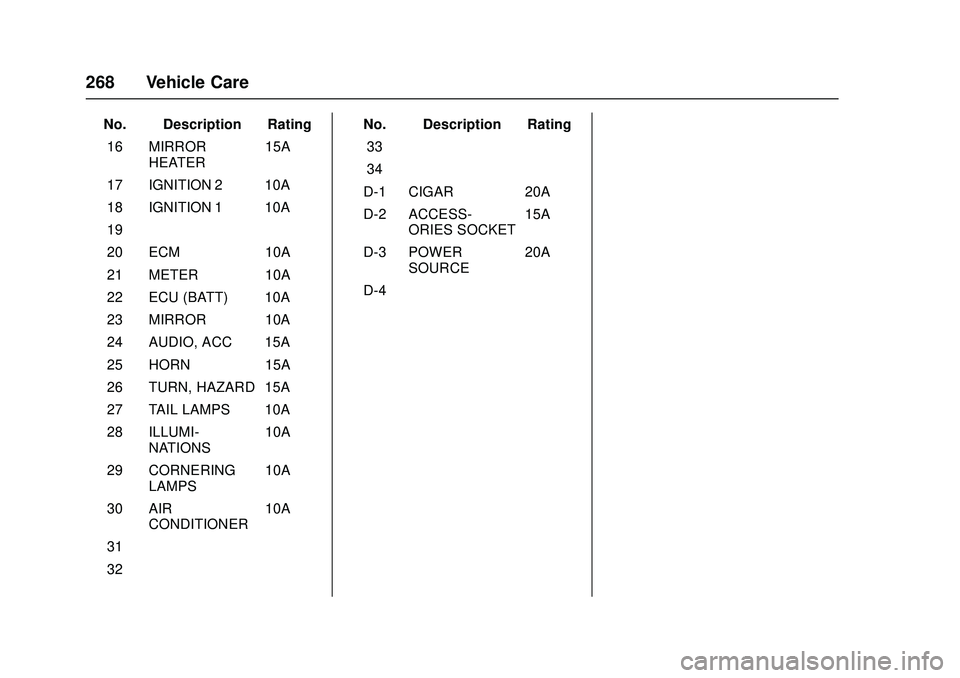
No. Description Rating16 MIRROR HEATER 15A
17 IGNITION 2 10A
18 IGNITION 1 10A
19 – –
20 ECM 10A
21 METER 10A
22 ECU (BATT) 10A
23 MIRROR 10A
24 AUDIO, ACC 15A
25 HORN 15A
26 TURN, HAZARD 15A
27 TAIL LAMPS 10A
28 ILLUMI- NATIONS 10A
29 CORNERING LAMPS 10A
30 AIR CONDITIONER 10A
31 – –
32 – – No. Description Rating
33 – –
34 – –
D-1 CIGAR 20A
D-2 ACCESS- ORIES SOCKET 15A
D-3 POWER SOURCE 20A
D-4 – –
Page 275 of 358
Chevrolet Low Cab Forward Owner Manual (GMNA-Localizing-U.S.-
11254764) - 2018 - crc - 12/5/16
274 Vehicle Care
In addition, when trucks are driven
continuously on high-crown roads,
an increase in air pressure of
35 kPa (5 psi) in the outer tire of a
dual tire operation will prolong outer
tire life. Be sure not to exceed the
inflation pressure limits shown on
the“VIN, Weight Rating, and
Greenhouse Gas (GHG) Emissions
Plate.” SeeVehicle Identification
Number (VIN) 0330.
Wheel and Tire Balancing
Proper tire balancing provides the
best riding comfort and helps to
reduce tire tread wear.
Out-of-balance tires can cause
annoying vehicle vibration and
uneven tire wear, such as cupping
and flat spots. See your authorized
dealer for wheel balancing.
Front End Alignment
Proper front end alignment improves
tire tread mileage. Your vehicle's
front end suspension parts should
be inspected often and aligned
when needed. (See the
Maintenance Schedule for more
information.) Improper alignment will
not cause the vehicle to vibrate; however, improper toe-in alignment
will cause front tires to roll at an
angle that will result in faster tire
wear. Incorrect caster or camber
alignment will cause your front tires
to wear unevenly, and may cause
the vehicle to "pull" to the left or
right.
Tire Traction
A decrease in driving, cornering and
braking traction occurs when water,
snow, ice, gravel or other material is
on the road surface. Driving
practices and vehicle speed should
be adjusted to the road conditions.
When driving on wet or slushy
roads, it is possible for a wedge of
water to build up between the tire
and road surface. This is known as
hydroplaning, and may cause partial
or complete loss of traction, vehicle
control and stopping ability; this
condition is also more likely with
worn tires.
To reduce the chance of traction
loss, follow these tips:
.
Slow down during rainstorms or
when roads are slushy. .
Slow down if the road has
standing water or puddles.
. Replace tires when front tread
depth is 3.2 mm (4/32 in.) and
rear tread depth is 1.6 mm
(2/32 in.).
. Keep tires properly inflated.
Tire Replacement
Recommendations
{Warning
Do not mix different construction
types of tires on your vehicle such
as radial, bias and bias-belted
tires except in emergencies,
because vehicle handling could
be affected and may result in loss
of vehicle control, or personal
injury or death.
Consult your dealer before
replacing wheels. Never use
wheels that are not designed for
the vehicle. Doing so would
impede safe vehicle operation.
Page 279 of 358
Chevrolet Low Cab Forward Owner Manual (GMNA-Localizing-U.S.-
11254764) - 2018 - crc - 12/5/16
278 Vehicle Care
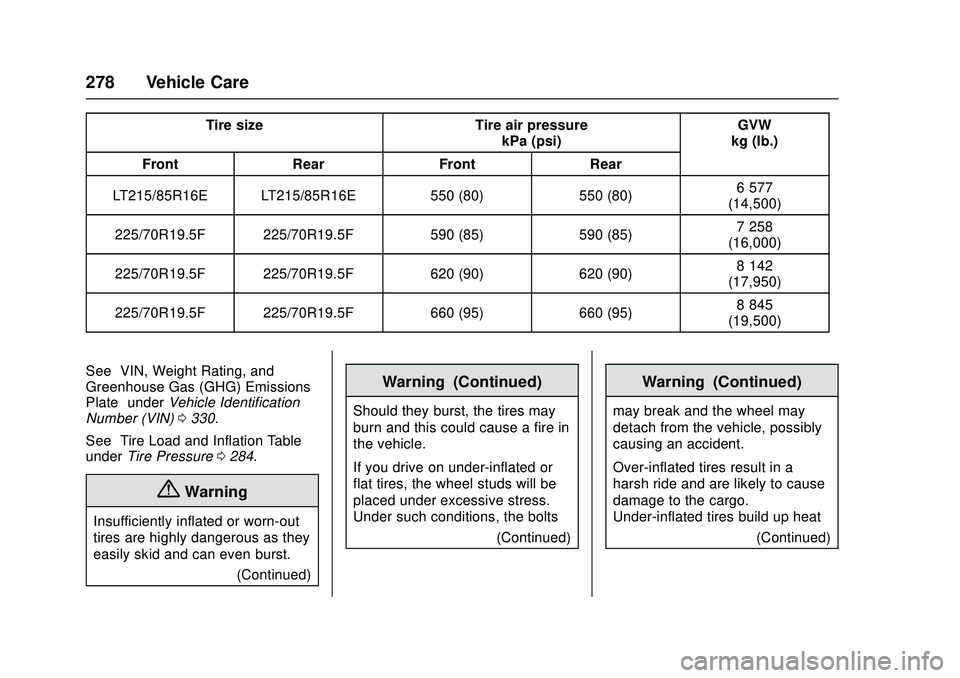
Tire sizeTire air pressure
kPa (psi) GVW
kg (lb.)
Front RearFront Rear
LT215/85R16E LT215/85R16E 550 (80)550 (80) 6 577
(14,500)
225/70R19.5F 225/70R19.5F 590 (85)590 (85) 7 258
(16,000)
225/70R19.5F 225/70R19.5F 620 (90)620 (90) 8 142
(17,950)
225/70R19.5F 225/70R19.5F 660 (95)660 (95) 8 845
(19,500)
See “VIN, Weight Rating, and
Greenhouse Gas (GHG) Emissions
Plate” underVehicle Identification
Number (VIN) 0330.
See “Tire Load and Inflation Table”
under Tire Pressure 0284.
{Warning
Insufficiently inflated or worn-out
tires are highly dangerous as they
easily skid and can even burst.
(Continued)
Warning (Continued)
Should they burst, the tires may
burn and this could cause a fire in
the vehicle.
If you drive on under-inflated or
flat tires, the wheel studs will be
placed under excessive stress.
Under such conditions, the bolts
(Continued)
Warning (Continued)
may break and the wheel may
detach from the vehicle, possibly
causing an accident.
Over-inflated tires result in a
harsh ride and are likely to cause
damage to the cargo.
Under-inflated tires build up heat(Continued)
Page 301 of 358
Chevrolet Low Cab Forward Owner Manual (GMNA-Localizing-U.S.-
11254764) - 2018 - crc - 12/5/16
300 Vehicle Care
cleaning products contain these
compounds. Be sure to read
cleaning product labels carefully.
Air fresheners (liquid, solid, gel or
plate types) must not come into
direct contact with, or spill onto,
interior components such as the air
conditioning or audio system.
Compounds contained in these
products can cause discoloration,
staining or peeling of paint.
Glass cleaners that contain these
compounds must not be used to
clean the inside of the windshield or
window glass. To clean the glass,
wipe it using a cloth wet with warm
or cold water.
To avoid possible permanent
discoloration of light colored seats,
Do not let materials with non-fast
colors come into contact with seat
trim materials until these materials
are totally dry. This includes certain
types of casual clothing, such as
colored denims, corduroys, leathers
and suedes; also decorative paper,
With the use of modern trim
materials, it is very important that
you use proper cleaning techniquesand cleaners. Failing to do this on
the first cleaning may result in water
spots, spot rings or setting of stains
or soilage - all of which are more
difficult to remove in a second
cleaning.
Dust and loose dirt that collect on
interior fabric should be removed
often with a vacuum cleaner or soft
bristle brush. Wipe vinyl or leather
trim regularly with a clean, damp
cloth. Normal trim soils, spots or
stains can be cleaned with these
cleaners.
Remember these basic steps before
cleaning:
.
Remove stains as quickly as
possible before they
become "set".
. Use a clean cloth or sponge,
and change to a clean area
often. A soft brush maybe used
if stains persist.
. Use solvent-type cleaners only
in a well ventilated area: also, do
not saturate the stained area. .
If a ring forms after spot
cleaning, clean the entire area
immediately.
. Follow specific instructions on
cleaner labels.
General Cleaning of Soiled or
Water Spotted Fabric Type
Trim with Foam Type Cleaner
Vacuum the area thoroughly to
remove any loose dirt.
Always clean a whole trim panel or
section. Mask surrounding trim
along stitch or welt lines.
Use suds on a clean sponge. Do
not brush wet suede. Do not
saturate the material or rub it
harshly. Immediately after cleaning,
remove suds with a sponge and
rinse with a clean wet sponge. Wipe
off remaining residue with a slightly
damp absorbent towel or cloth.
Important —Immediately after
wiping, force-dry the fabric with an
air hose. A heat dryer or heat lamp
may be used. Use caution with a
heat dryer or lamp to help prevent
damage.