brakes CHEVROLET LOW CAB FORWARD 2018 User Guide
[x] Cancel search | Manufacturer: CHEVROLET, Model Year: 2018, Model line: LOW CAB FORWARD, Model: CHEVROLET LOW CAB FORWARD 2018Pages: 358, PDF Size: 6.32 MB
Page 128 of 358
Chevrolet Low Cab Forward Owner Manual (GMNA-Localizing-U.S.-
11254764) - 2018 - crc - 12/5/16
Driving and Operating 127
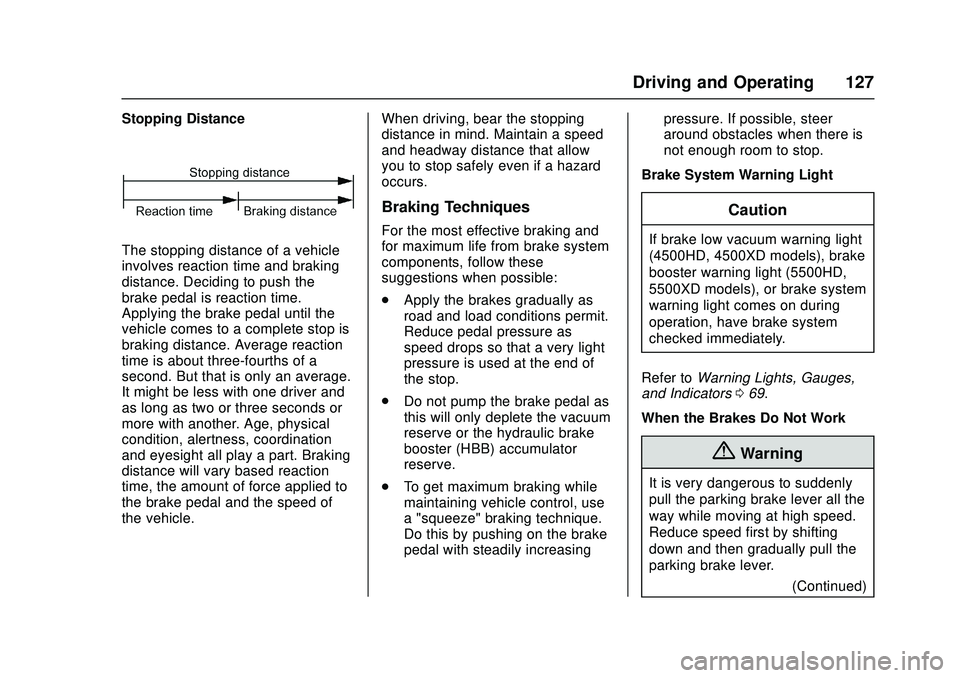
Stopping Distance
The stopping distance of a vehicle
involves reaction time and braking
distance. Deciding to push the
brake pedal is reaction time.
Applying the brake pedal until the
vehicle comes to a complete stop is
braking distance. Average reaction
time is about three-fourths of a
second. But that is only an average.
It might be less with one driver and
as long as two or three seconds or
more with another. Age, physical
condition, alertness, coordination
and eyesight all play a part. Braking
distance will vary based reaction
time, the amount of force applied to
the brake pedal and the speed of
the vehicle.When driving, bear the stopping
distance in mind. Maintain a speed
and headway distance that allow
you to stop safely even if a hazard
occurs.
Braking Techniques
For the most effective braking and
for maximum life from brake system
components, follow these
suggestions when possible:
.
Apply the brakes gradually as
road and load conditions permit.
Reduce pedal pressure as
speed drops so that a very light
pressure is used at the end of
the stop.
. Do not pump the brake pedal as
this will only deplete the vacuum
reserve or the hydraulic brake
booster (HBB) accumulator
reserve.
. To get maximum braking while
maintaining vehicle control, use
a "squeeze" braking technique.
Do this by pushing on the brake
pedal with steadily increasing pressure. If possible, steer
around obstacles when there is
not enough room to stop.
Brake System Warning Light
Caution
If brake low vacuum warning light
(4500HD, 4500XD models), brake
booster warning light (5500HD,
5500XD models), or brake system
warning light comes on during
operation, have brake system
checked immediately.
Refer to Warning Lights, Gauges,
and Indicators 069.
When the Brakes Do Not Work
{Warning
It is very dangerous to suddenly
pull the parking brake lever all the
way while moving at high speed.
Reduce speed first by shifting
down and then gradually pull the
parking brake lever. (Continued)
Page 129 of 358

Chevrolet Low Cab Forward Owner Manual (GMNA-Localizing-U.S.-
11254764) - 2018 - crc - 12/5/16
128 Driving and Operating
Warning (Continued)
You and others could be seriously
injured.
The exhaust brake should be turned
on as soon as service brake
malfunction is detected. This will
slow the engine speed. With the
engine speed under control and
providing the grade conditions
permit, the transmission can be
progressively downshifted using the
exhaust brake in each gear.
Eventually the exhaust brake should
slow the vehicle to a controllable
“crawl.” Gradually pull the parking
brake lever while firmly holding on
to the steering wheel. Stop the
vehicle on the side of the road. The
vehicle should not be driven further
until corrective measures are taken.
See Exhaust Brake 0201 and
Parking Brake 0200. Riding the Brake{Warning
"Riding the brake" by resting your
foot on the pedal, when you do
not intend to brake, can overheat
the brakes and wear out the
brake linings faster. This may also
damage the brakes and will waste
fuel. It can also result in reduced
braking performance.
You and others could be seriously
injured.
Applying the Parking Brake
Except in an emergency, do not
apply the parking brake until the
vehicle has come to a complete
stop. Applying the parking brake
before the vehicle has stopped can
cause a breakdown.
Refer to
Parking Brake 0200.
Parking Safely on a Slope
Avoid parking your vehicle on a
slope as much as possible and
choose a level and flat place. If you must park your vehicle on a slope,
be sure to set the parking brake
fully. Make sure that the vehicle
does not move, and block the
wheels with chocks for added
safety. Also, leave the vehicle in
gear to further ensure that it will not
move. Leave the steering wheel
turned such that the vehicle will be
stopped by an obstruction (for
example, the curb) in the unlikely
event that it moves.
Stopping and Parking with the
Engine Running
{Warning
When parking with the engine
running, first come to a complete
stop, then firmly apply the parking
brake, then move the selector
lever to the "P" (Park) position.
Unless you take these steps, any
unintended pressure on the
accelerator pedal could cause an
accident.
(Continued)
Page 131 of 358

Chevrolet Low Cab Forward Owner Manual (GMNA-Localizing-U.S.-
11254764) - 2018 - crc - 12/5/16
130 Driving and Operating
1. Hold the regular brake pedaldown with your right foot and
apply the parking brake all the
way before shifting the
transmission. Follow the
Parking Brake instructions in
this manual for your vehicle.
2. To move the selector lever to "P" (Park), hold in the button
on the lever and push the lever
all the way toward the front of
your vehicle.
3. Turn the key to "LOCK".
4. Remove the key and take it with you.
5. Before you leave the driver's seat, be sure the vehicle is not
moving, or check that your
vehicle is in Park by trying to
pull the selector lever out of "P"
(Park) by pulling the selector
lever toward you without
pushing the button. If you can
do this, it means that the
selector lever was not fully
locked into "P" (Park).Driving Down a Long Slope
When driving down a long slope,
use the exhaust brake together with
the foot brakes. Using the exhaust
brake and low-gears reduces the
work load on the foot brakes and
yields greater braking force. Even
so, use the foot brakes
appropriately to prevent the engine
over-revving.
Frequent use of the foot brakes can
cause vapor lock and brake fade,
resulting in reduced brake
effectiveness.
Brake Fade : Frequent use of the
brakes can cause the brakes to
overheat so that the frictional force
of the brake linings decreases and
the brakes become less effective
than normal. This phenomenon is
called brake fade.
Vapor Lock : If the brakes overheat
due to frequent use, the heat can
cause the brake fluid to boil so that
air bubbles are created in the brake
fluid. Pressing the brake pedal
simply compresses the air bubbles;
pressure is not transmitted to the
wheel cylinders, so the brakes' effectiveness sharply deteriorates.
This phenomenon is called
vapor lock.
Even so, you should be very careful
when using engine braking in a low
gear because the engine is likely to
over-rev.
See
Exhaust Brake 0201 and
Selector Lever 0194.
Do not adjust the exhaust brake
valve.
The engine should never be allowed
to exceed the governed speed.
Supplement the exhaust brake with
vehicle service brakes intermittently
and/or shift to higher transmission
gear to prevent engine overspeed.
A rule of thumb for gear selection is
that the vehicle should be driven
down a grade in the same gear that
would be used to climb that grade.
{Warning
To reduce the risk of personal
injury, before going down a steep
or long grade, reduce speed, turn (Continued)
Page 132 of 358

Chevrolet Low Cab Forward Owner Manual (GMNA-Localizing-U.S.-
11254764) - 2018 - crc - 12/5/16
Driving and Operating 131
Warning (Continued)
on the exhaust brake and shift the
transmission to the next lower
gear. This will help control your
speed. Do not hold the brake
pedal down too long or too often
while going down a steep or long
grade. This could cause the
brakes to get hot and not to work
as well. As a result, the truck will
not slow down at the usual rate.
Failure to take these steps could
result in loss of vehicle control.
You and others could be seriously
injured.
Brake Effectiveness When the
Vehicle Has Been Driven on a
Flooded Road or Washed
{Warning
When the vehicle is driven on a
flooded road, parked on a flooded
road or washed, water can get(Continued)
Warning (Continued)
into the brakes and reduce their
effectiveness. If the brakes do not
work well afterward, drive slowly
and gently press the brake pedal
several times until the brakes dry
out and start working normally.
Always do this after driving
through water or washing the
vehicle to help reduce the risk of
personal injury. Before parking
the vehicle in winter, press the
brake pedal several times in the
same way to get rid of moisture in
the brakes. Otherwise, the
moisture in the brakes may freeze
and make the vehicle immovable.
You and others could be seriously
injured.
If the vehicle must be driven on a
flooded road or is parked in an area
that becomes flooded, promptly
perform a check for the following
points:
. Effectiveness of the brakes .
Water-ingress or damage to
drum brakes, disc brakes
. Engine damage due to
water-ingress
. Shorting of electrical
components
. Oil level and degradation
(cloudiness) of the engine,
transmission, differential
. Greasing of each components
(lubrication)
Steering
Do Not Leave the Steering
Wheel Fully Turned for a
Long Time
{Warning
If you leave the steering wheel
fully turned for a long time, the oil
in the power steering oil pump will
become extremely hot. This
would cause poor lubrication, oil
tank damage and seal
deterioration, leading to power
(Continued)
Page 133 of 358
Chevrolet Low Cab Forward Owner Manual (GMNA-Localizing-U.S.-
11254764) - 2018 - crc - 12/5/16
132 Driving and Operating
Warning (Continued)
steering oil pump damage, power
steering unit damage and power
steering hose damage. As a
result the steering wheel could
become extremely hard to turn
and a fire or other accident could
occur.
You and others could be seriously
injured.
Steering Wheel
If the steering parts have excess
play or looseness or if any abnormal
condition is noted, have the steering
system checked immediately.
Driving on Wet Roads
Driving on Slippery Surface or
Driving in Bad Weather (Rain,
Icy Roads, Snowy Roads, etc.)
In bad weather, visibility is reduced
and slippery road surfaces increase
stopping distances. Drive more
slowly than you would in good
weather. Also, avoid sharp turns ofthe steering wheel and hard
braking. Use engine brakes together
with the foot brakes to decelerate.
Using the exhaust brake on a
slippery road surface could cause
the tires to slip.
You may not realize the surface is
slippery until the vehicle is skidding.
Learn to recognize warning clues—
such as enough water or ice on the
road to make a "mirrored surface"—
and slow down when there is any
doubt.
There is a risk of hydroplaning,
particularly where water tends to
collect on the road surface. Drive at
speeds that allow you to stay in
complete control.
If you cannot avoid driving on a
flooded road, first check the depth
of the water and then drive through
the water at a slow, constant speed.
There is a risk that water will get
into the engine's cylinders and
cause engine damage (water
hammering). Keep your speed
down, and drive with great care.
Hydroplaning :
If a vehicle is driven
at high speed on a road that is
covered with water, a layer of water
can form between the tires and road
surface, causing the tires to lose
their grip and slide across the water.
This phenomenon is called
hydroplaning. It is dangerous
because it makes the steering
wheel and brakes useless.
Refer to Wheels and Tires 0272.
Hill and Mountain Roads
Narrow or Congested Roads
When passing or overtaking a
vehicle on a narrow mountain road
or on a narrow or congested urban
road, pay careful attention to
obstacles on either side and to the
condition of the shoulder of
the road.
When turning, the rear wheels will
follow tighter curves than the front
wheels. Use the mirrors to confirm
safety.
Page 135 of 358
Chevrolet Low Cab Forward Owner Manual (GMNA-Localizing-U.S.-
11254764) - 2018 - crc - 12/5/16
134 Driving and Operating
SeeEngine Coolant 0231.
See Washer Fluid 0241.
See Battery 0247.
When Ice Prevents You from
Putting Your Key in the Door
or Opening the Door
If you try to force the key into the
door, you could bend it. And if you
try to pull the door open with undue
force, the rubber seal around the
door could come unstuck or become
damaged. Use warm water to melt
the ice, then quickly wipe it away
and open the door.
If the wipers, electric door mirrors,
or power windows freeze up, also
use warm water to melt the ice and
then operate the system. Otherwise,
you could damage the mechanism
and drain the battery. After that,
wipe the water away.
Before Driving in Cold Regions
Getting In and Out of the Vehicle
The step can get icy in cold regions.
Be careful not to slip when getting in
and out of the vehicle. Before Sitting in the Driver
’s Seat
Remove snow and ice from your
shoes when getting into the vehicle.
If you try to drive with snow on your
shoes, your shoes would slip on the
pedals and you would not be able to
press the pedals properly, meaning
that your driving would be
inconsistent. Also, the cabin could
become more humid, causing the
glass to fog up.
Check Fuel Level
Fuel consumption increases when
tire chains are used. Determine how
much fuel you need to reach your
destination and fill up the tank in
advance. Refer to Fuel for Diesel
Engines 0206.
Removing Snow from Glass
and Underbody
Do not use a sharp implement to
remove snow. Sharp edges could
damage rubber parts.
To maintain an adequate field of
view, use a plastic scraper to
remove snow and frost from the
glass surfaces. By using a plastic
scraper, you can remove the snow and frost without scratching the
glass. At this time, check whether
the wiper blades are frozen onto the
glass.
Also, look under the vehicle and
remove any lumps of ice that are
stuck to the underbody. Be careful
not to damage components.
Driving on Snowy or Frozen
Roads
On slippery roads, never accelerate
rapidly, brake hard, decelerate
rapidly or make sharp turns of the
steering wheel.
There is a risk of reduced grip
between the tires and road surface
and of increased braking distances.
The danger of icy road surfaces is
particularly great on bridges, in
shady places and where there are
puddles.
Keep your speed down and be sure
to use tire chains or winter tires on
snowy or frozen road surfaces.
Use engine brakes together with the
foot brakes to decelerate. Using the
exhaust brake on a slippery road
surface could cause the tires to slip.
Page 136 of 358
Chevrolet Low Cab Forward Owner Manual (GMNA-Localizing-U.S.-
11254764) - 2018 - crc - 12/5/16
Driving and Operating 135
Pay Attention to the Way the
Steering Wheel Turns and Feels
On snowy roads, water and snow
splashed up by the tires can freeze
and accumulate inside the fenders,
making the steering wheel hard to
turn. From time to time, get out of
the vehicle and remove any
accumulated snow.
Check the Brakes from Time
to Time
When the vehicle is driven or
parked on a snowy surface, ice can
form on the brakes, decreasing their
effectiveness. From time to time
while you are driving, press the
brake pedal lightly and check the
effectiveness of the brakes. Pay
attention to vehicles both ahead of
and behind you when checking the
brakes in this way.
Also, check the effectiveness of the
brakes as soon as possible when
starting to drive the vehicle after it
has been parked. If the brakes do
not work well, drive slowly and
gently press the brake pedal several
times until the brakes dry out and
start working normally.Parking in Cold Regions
When snow collects around the
wheels and the lights, try to remove
it before night falls.
Do not apply the parking brake in
extremely cold weather, such as in
temperatures or at below 0 °C
(32 °F). If you leave the parking
brake applied, the wires and brake
shoes could freeze up, making it
impossible for you to release the
parking brake. Be sure to park the
vehicle in gear.
Be sure to put chocks against the
tires.
Whenever possible, park in a
garage to help prevent parts from
freezing up and to help make the
engine easy to start.
{Warning
If you park in a place where there
is a lot of snowfall, snow
accumulating around the vehicle
could limit ventilation. Running
the engine with the vehicle in(Continued)
Warning (Continued)
these conditions could cause
exhaust gases to enter the cabin,
resulting in carbon monoxide
poisoning. Take preventive action
by, for example, clearing the snow
around the vehicle.
You and others could be seriously
injured.
Do not park under trees or under
the eaves of a building. Chunks of
ice could fall on the vehicle if you
park in such a place.
Cleaning the Vehicle after
Driving on Snowy Roads
. The vehicle speed sensors are
fitted on the wheels. When
removing snow, ice, and other
incrustation, take great care not
to damage the components.
. Do not use a sharp implement to
remove snow. Sharp edges
could damage rubber parts.
Refer to Antilock Brake System
(ABS) 0196.
Page 137 of 358

Chevrolet Low Cab Forward Owner Manual (GMNA-Localizing-U.S.-
11254764) - 2018 - crc - 12/5/16
136 Driving and Operating
Remove snow that has stuck to the
inside of the fenders and to the
brake hoses. Otherwise, it may
damage components. After driving
on a salted road, wash the
underside of the vehicle as soon as
possible to prevent the salt from
causing rust. Spraying water under
high pressure is an effective way to
get the salt off.
After washing the vehicle, wipe the
door openings dry.
If the Vehicle Is Stuck
When Driving on Bad Roads
Freeing the Vehicle from Sand,
Mud, Snow, and Ice
If your vehicle gets stuck in sand,
mud, snow or ice, move the selector
lever from "Second" to "Reverse".
Apply a light pressure to the
accelerator pedal while the
transmission is in gear. Remove
your foot from the accelerator and
press the brake pedal while shifting.
Do not race the engine. For best
traction, avoid spinning the wheels.
When you cannot avoid drivingthrough deep mud, using tire chains
is an effective way to avoid getting
stuck.
Do not allow wheels to spin freely in
mud, sand, snow, ice or other poor
road conditions. This free spinning
will damage the rear axle. Even
vehicles equipped with LSD (Limited
Slip Differential) have traction
limitations. If your vehicle gets stuck
and it is difficult to extricate,
immediately stop driving and have
the vehicle towed. Spinning wheels
for an extended period of time may
cause abnormal noises or
malfunction to LSD.
Do not spin wheels faster than
32 km/h (20 MPH). Damage may
result from excessive wheel
spinning, including tire, transmission
and/or rear axle malfunction.
When driving in sand or mud, avoid
hard braking, sudden acceleration
and sharp turns of the steering
wheel. Such actions could get the
vehicle stuck and make it difficult to
extricate.
After driving through deep mud: any
mud stuck to the vehicle can harm
the steering, brakes and powertrain.
Wash the vehicle and remove all
mud and other incrustation.
The vehicle speed sensors are fitted
on the wheels. When removing mud
and other incrustation, take great
care not to damage the
components.
Do not use a sharp implement to
remove mud. Sharp edges could
damage rubber parts.
Refer to
Antilock Brake System
(ABS) 0196 andExterior Care
0 293.
Page 144 of 358
Chevrolet Low Cab Forward Owner Manual (GMNA-Localizing-U.S.-
11254764) - 2018 - crc - 12/5/16
Driving and Operating 143
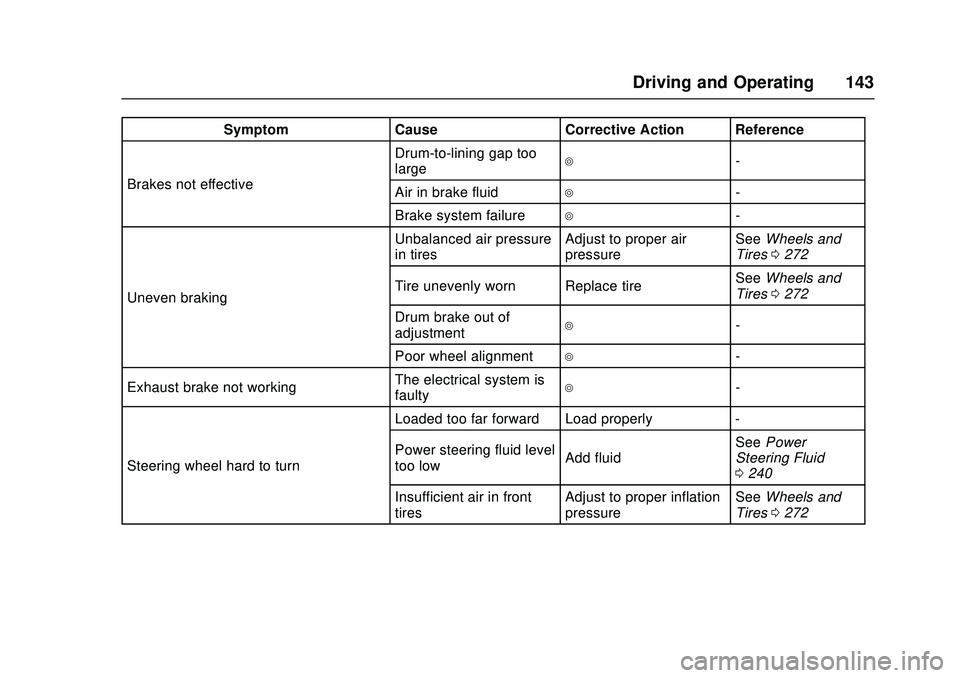
SymptomCauseCorrective Action Reference
Brakes not effective Drum-to-lining gap too
large
4-
Air in brake fluid
4-
Brake system failure
4-
Uneven braking Unbalanced air pressure
in tires
Adjust to proper air
pressureSee
Wheels and
Tires 0272
Tire unevenly worn Replace tire See
Wheels and
Tires 0272
Drum brake out of
adjustment
4-
Poor wheel alignment
4-
Exhaust brake not working The electrical system is
faulty
4-
Steering wheel hard to turn Loaded too far forward Load properly -
Power steering fluid level
too low
Add fluidSee
Power
Steering Fluid
0 240
Insufficient air in front
tires Adjust to proper inflation
pressureSee
Wheels and
Tires 0272
Page 148 of 358
Chevrolet Low Cab Forward Owner Manual (GMNA-Localizing-U.S.-
11254764) - 2018 - crc - 12/5/16
Driving and Operating 147
If There is a Fuel Leak
{Danger
Leaking fuel from the vehicle is
dangerous due to possible
combustion or explosion. Stop the
engine immediately.
You and others could be seriously
injured or killed.
Starting and
Operating
New Vehicle Break-In
Good vehicle care begins with
proper break-in. While every new
vehicle goes through rigid factory
and dealer inspection and tests
before delivery, the care you give
your vehicle during the initial
break-in period can pay off in longer
life, better performance and more
economical operation.
It is therefore always recommended
that during the initial 1 000 km
(600 mile) break-in period, the
following few simple precautions are
carefully observed.
Follow the recommendations listed
below:
.Warm up the engine by driving
easily for the first few minutes
before placing it under load.
. Do not drive for extended
periods at any one constant
speed, either fast or slow, during
the first 800 km (500 miles). .
Use the correct gear to maintain
the desired road speed without
lugging the engine.
. Avoid racing the engine,
full-throttle starts and aggressive
application of brakes when
stopping.
. Keep tires properly inflated for
the load carried.
. Check lubricant levels in the
engine and transmission weekly.
. Keep speeds below 80 km/h
(50 MPH) for the first 800 km
(500 miles).
. Use the lowest gear ratio
available when starting a loaded
vehicle and when climbing
slopes to avoid lugging the
engine.
. It is recommended that the
engine speed is restricted to
2,300 r/min.
Mechanical Driveshaft Brake
Burnish Procedure
It is recommended that the
driveshaft mounted parking brake
be burnished as part of the new