change time CHEVROLET LOW CAB FORWARD 2018 User Guide
[x] Cancel search | Manufacturer: CHEVROLET, Model Year: 2018, Model line: LOW CAB FORWARD, Model: CHEVROLET LOW CAB FORWARD 2018Pages: 358, PDF Size: 6.32 MB
Page 170 of 358

Chevrolet Low Cab Forward Owner Manual (GMNA-Localizing-U.S.-
11254764) - 2018 - crc - 12/5/16
Driving and Operating 169
3. Run the engine at idle. Be surethe accelerator pedal is not
pressed and the PTO switch (if
equipped) is OFF.
4. Press and hold the DPF switch until the amber checking PM
Level indicator light appears on
the DIC.
5. If Selectable regeneration is available, the selectable
(switch) regeneration required
warning light (amber) will
appear on the DIC. If this
indicator light does not appear
on the DIC, the PM level in the DPF filter is OK and DPF
regeneration is not needed at
this time.
6. Press and release the DPF switch to begin regeneration.
7. The selectable (switch) regeneration required warning
light (amber) will change to
regeneration in progress
indicator light.
8. Do not leave the vehicle during the regeneration. Regeneration
normally completes in about
20 minutes, if the engine is at operating temperature.
Regeneration may take longer
if the engine is cold.
9. When the regeneration in progress indicator light goes
out, the Selectable
regeneration is complete.
If the Selectable regeneration is
interrupted, a selectable (switch)
regeneration required warning light
(amber) will appear on the DIC. You
must complete the DPF
regeneration by performing the
Switch regeneration as soon as
possible when Selectable
regeneration is interrupted.
If you continue driving too long with
the selectable (switch) regeneration
required warning light (amber)
displayed on the DIC, the warning
light will change to red. The
selectable (switch) regeneration
required warning light (red) indicates
the DPF filter is nearly full of PM, a
condition which may be damaging
to the filter. DPF regeneration
should be completed immediately if
Page 197 of 358
Chevrolet Low Cab Forward Owner Manual (GMNA-Localizing-U.S.-
11254764) - 2018 - crc - 12/5/16
196 Driving and Operating
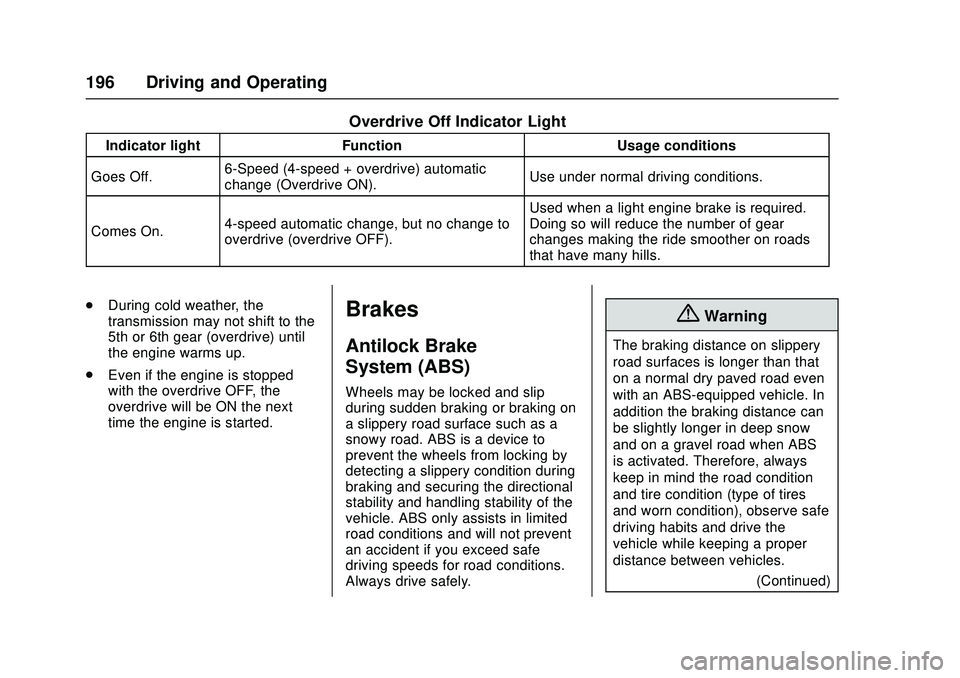
Overdrive Off Indicator Light
Indicator lightFunction Usage conditions
Goes Off. 6-Speed (4-speed + overdrive) automatic
change (Overdrive ON). Use under normal driving conditions.
Comes On. 4-speed automatic change, but no change to
overdrive (overdrive OFF). Used when a light engine brake is required.
Doing so will reduce the number of gear
changes making the ride smoother on roads
that have many hills.
. During cold weather, the
transmission may not shift to the
5th or 6th gear (overdrive) until
the engine warms up.
. Even if the engine is stopped
with the overdrive OFF, the
overdrive will be ON the next
time the engine is started.
Brakes
Antilock Brake
System (ABS)
Wheels may be locked and slip
during sudden braking or braking on
a slippery road surface such as a
snowy road. ABS is a device to
prevent the wheels from locking by
detecting a slippery condition during
braking and securing the directional
stability and handling stability of the
vehicle. ABS only assists in limited
road conditions and will not prevent
an accident if you exceed safe
driving speeds for road conditions.
Always drive safely.
{Warning
The braking distance on slippery
road surfaces is longer than that
on a normal dry paved road even
with an ABS-equipped vehicle. In
addition the braking distance can
be slightly longer in deep snow
and on a gravel road when ABS
is activated. Therefore, always
keep in mind the road condition
and tire condition (type of tires
and worn condition), observe safe
driving habits and drive the
vehicle while keeping a proper
distance between vehicles.
(Continued)
Page 207 of 358

Chevrolet Low Cab Forward Owner Manual (GMNA-Localizing-U.S.-
11254764) - 2018 - crc - 12/5/16
206 Driving and Operating
Exhaust Brake Function
Diesel Vehicles Equipped with
Exhaust Brake-interlocked Cruise
Automatic activation of the exhaust
brake during cruise control driving
suppresses an increase in the
speed on a downhill slope,
decreasing the need for the driver to
apply the regular brake pedal. The
exhaust brake does not activate
when the exhaust brake switch is
turn off.
The maximum slope angle at which
the system can control the vehicle
speed increase is different
depending on the load the vehicle is
carrying.
Automatic Activation and
Automatic Release of Exhaust
Brake
The exhaust brake is engaged when
the vehicle speed exceeds the set
speed on a downhill slope.
The exhaust brake is disengaged
when the vehicle slows down close
to the set.
Fuel
Fuel for Diesel Engines
Diesel Fuel Requirement and
Fuel System
Fuel Requirements
Use of fuels other than ultra
low-sulfur fuel may not conform to
emission regulations.
The fuel supply pump, injector or
other parts of the fuel system and
engine can be damaged if you use
any fuel or fuel additive other than
those specifically recommended by
the dealer.
To help avoid fuel system or engine
damage, pay attention to the
following:
.Some service stations mix used
engine oil with diesel fuel. Some
manufacturers of large diesel
engines allow this; however, for
your diesel engine, do not use
diesel fuel which has been
contaminated with engine oil.
Besides causing engine
damage, such fuel can also affect emission control. Before
using any diesel fuel, check with
the service station operator to
see if the fuel has been mixed
with engine oil.
. Do not use any fuel additive
(other than as recommended
under "Biocides" in Water in
Fuel 0209). At the time this
manual was printed, no other
fuel additive was recommended.
(See your authorized dealer to
find out if this has changed.)
. Take care not to run out of diesel
fuel. If you do run out of fuel,
you may need to bleed air out of
the supply pump to re-start the
engine after fuel has been filled.
Your vehicle is designed to use
either Number 1-D or Number 2-D
diesel fuel. However, for better fuel
economy, use Number 2-D diesel
fuel whenever possible. At
temperatures below -7 °C (20 °F),
Number 2-D fuel may pose
operating problems (see "Cold
Weather Operation" which follows).
At colder temperatures, use Number
1-D fuel (if available) or use a
Page 221 of 358

Chevrolet Low Cab Forward Owner Manual (GMNA-Localizing-U.S.-
11254764) - 2018 - crc - 12/5/16
220 Vehicle Care
contamination, it will cause a
decline in the performance of the
parts and such problems as seizure
or malfunctioning. Replenish or
change these liquids when
performing the checks (daily and
periodic checks) as required by the
relevant regulations or in
accordance with the Maintenance
Schedule (when either the specified
driving distance or period of time,
whichever comes first, has expired).
Confirm that all systems and
components are normal after
performing the work.
Do not leave the removed parts or
tools in the engine compartment.
They could damage the equipment if
caught in the belts or other moving
components.
Dirty water, dirt and other impurities
seriously impair the effectiveness of
the oil, grease and fluids, and
damage the parts. Exercise all due
caution to prevent waste or other
refuse from coming in contact with
parts or materials that have been
removed when changing or
replenishing them.Do not step on the engine or climb
onto it. You could cause an engine
failure by, for example, damaging
the cylinder head cover or various
connectors.
Electric Welding
Careless electric welding of vehicle
parts can cause welding current to
flow back through the vehicle’s
ground circuit and damage electrical
and electronic parts so that they do
not function normally. Whenever
electric welding is necessary,
consult your dealer.
Cab Tilting
Before Tilting the Cab (Single Cab
Model)
{Warning
To help avoid personal injury and
property damage:
(Continued)
Warning (Continued)
.Park the vehicle on level
ground and check that there
is enough space in front of
and above the cab.
. Set the parking brake firmly
and block the front wheels.
. Move the selector lever in
the "P" position.
. Secure loose articles in
the cab.
. Stop the engine.
. Close the cab door.
. Keep the area surrounding
the cab clear.
You and others could be seriously
injured.
Tilting the Cab 1. Check that all personnel are clear of the cab.
2. Read the label on the rear of the cab.
Page 233 of 358

Chevrolet Low Cab Forward Owner Manual (GMNA-Localizing-U.S.-
11254764) - 2018 - crc - 12/5/16
232 Vehicle Care
Replace rubber hoses whenever
they crack or are damaged; even
minor cracks allow engine coolant
solution to leak.
{Warning
If your engine cooling system
overheats, seeEngine
Overheating 0237. Continued
operation of the engine even for a
short time may result in a fire and
the possibility of personal injury
and/or severe vehicle damage.
You and others could be seriously
injured.
Your vehicle has an engine coolant
recovery system, expansion bottle
and/or an engine coolant reserve
tank system. Engine coolant in the
system expands with heat and
overflows into the reserve tank.
When the system cools, engine
coolant is drawn back into the
radiator.
The engine cooling system has
been filled at the factory with a
quality engine coolant. It is important to use proper engine
coolant to prevent damage to
engine cooling system components.
The engine cooling system is
designed to use engine coolant
rather than plain water. See
Recommended Fluids and
Lubricants
0326.
See the Maintenance Schedule to
find out when the engine coolant
must be replaced. Note that
changing the engine coolant is
needed to replenish the rust
inhibitors to make certain that all
parts of the engine cooling system
work well.
{Warning
Check, replenish or change the
engine coolant only after the
engine has sufficiently
cooled down.
Do not loosen or remove the cap
of the radiator or engine coolant
reserve tank cap when the engine (Continued)
Warning (Continued)
coolant is still hot. Hot vapor or
boiling water may burst out and
cause a burn.
When removing the radiator cap
or engine coolant reserve tank
cap, use a thick cloth to cover the
cap and turn it slowly.
Engine coolant is toxic and must
not be ingested. If the engine
coolant is mistakenly ingested,
seek prompt medical attention.
If the engine coolant gets in your
eyes, rinse your eyes immediately
with a large amount of water for
15 minutes or longer. Also, if your
eyes are still irritated or otherwise
feel abnormal, seek immediate
medical attention.
If the engine coolant gets on your
skin, rinse it off using a soap with
a large amount of water. Also,
if abnormality is seen, seek
medical attention.(Continued)
Page 234 of 358

Chevrolet Low Cab Forward Owner Manual (GMNA-Localizing-U.S.-
11254764) - 2018 - crc - 12/5/16
Vehicle Care 233
Warning (Continued)
Engine coolant is flammable, and
therefore, it must be kept away
from flames and other heat
sources. Engine coolant also
could ignite if it comes in contact
with a hot surface, such as the
exhaust manifold. Exercise
caution to prevent this from
happening.
You and others could be seriously
injured.
Preparing Engine Coolant
To prevent engine damage due to
freezing of the engine coolant and
to protect the cooling system from
corrosion, use a mixture of the
recommended type antifreeze and
water. If the engine of the vehicle is
at −30 °C (−22 °F) or above, the
coolant concentration should be
50%. Direct use of “50/50
Pre-diluted” product which is already
diluted to 50% concentration is
recommended. If the outside
temperature engine or vehicle is used at
−30 °C (−22 °F) or below,
coolant concentration of 55% is
recommended.
It is the owner ’s responsibility to:
. Maintain the engine cooling
system freeze protection at or
above −30 °C (−22 °F) (at or
below −30 °C (−22 °F) in colder
climates to ensure protection
against corrosion and loss of
engine coolant from boiling.
A 50/50 (55/45 for colder
climates) mixture of the
recommended type antifreeze
and water will provide freeze
protection to at or above −30 °C
(−22 °F), (at or below −30 °C
(−22 °F) in colder climates) and
boil protection to 128 °C
(262 °F). Periodic replacement
of engine coolant is needed to
replenish the anticorrosion
additives that wear out with use.
Engine coolant that has become
dark in color shows that it needs
to be changed.
. Use only the recommended
coolant. See Recommended
Fluids and Lubricants 0326. .
Do not use methanol-base
antifreeze, alcohol or plain water
alone in your vehicle at any time.
They will boil at a lower point
than that at which the engine
coolant temperature gauge will
warn of overheating, and they do
not provide proper protection
against corrosion.
Engine Coolant Quantity
For the quantity of engine coolant,
see Capacities and Specifications
0 335. After changing the engine
coolant, check that the engine
coolant is up to the specified level.
{Warning
For storage, close the cap of
coolant container securely and
keep it in a place inaccessible to
children.
You and others could be seriously
injured.
Using any coolant other than that
recommended by your dealer could
cause damage to the engine,
Page 243 of 358

Chevrolet Low Cab Forward Owner Manual (GMNA-Localizing-U.S.-
11254764) - 2018 - crc - 12/5/16
242 Vehicle Care
Follow the instructions provided with
the windshield washer fluid
regarding the ratio for mixing with
tap water.
Poor quality products, engine
coolant, and soapy water must not
be used. Failure to observe this
precaution can result in nozzle
blockage or damage to painted
surfaces.
The washer should never be used
while the tank is empty. Operating
the washer with the tank empty can
result in motor damage.
Brakes
For the most effective braking and
for maximum life from brake system
components, follow these
suggestions:
.Keep any obstructions from
interfering with brake pedal
travel.
. Keep tires properly inflated.
Improperly inflated tires can
reduce the efficiency of the
brakes. Follow the recommendations for
brake checks in the Maintenance
Schedule.
GM replacement brake lining
material is recommended for this
vehicle to maintain the balance
between front and rear brake
performance. GM replacement
brake parts have been carefully
selected to provide the proper brake
balance for purposes of both
stopping distance and controllability
over the full range of operating
conditions. Installation of front or
rear brake lining material with
performance different from that of
the replacement parts
recommended for this vehicle can
change the intended brake balance
of this vehicle.
Checking the Brake Electric
Vacuum Pump (4500HD/
4500XD Series)
1. Turn the engine control switch
to the "ON" position (do not
start the engine), and press the
brake pedal several times. 2. Check for the noisy sound of
the electric vacuum pump
inside the instrument panel at
the same time as vacuum
warning buzzer sound, and
check that the brake low
vacuum warning light
comes on.
3. Then, start the engine. The main vacuum pump driven by
the engine will start running.
If the electric vacuum pump
operation (noisy sound) and
the vacuum warning buzzer
stop, and the brake low
vacuum warning light goes off
thereafter, the operation is
normal.
4. If you cannot hear the noisy sound or the noisy sound stays
on all the time, have the
vehicle inspected by the
nearest dealer immediately.Hydraulic Brake Booster (HBB)
The 5500HD, 5500XD models are
equipped with an HBB system. HBB
is a brake booster device that
Page 244 of 358

Chevrolet Low Cab Forward Owner Manual (GMNA-Localizing-U.S.-
11254764) - 2018 - crc - 12/5/16
Vehicle Care 243
utilizes hydraulic pressure from the
HBB pump integral with the power
steering pump.
If the brake booster warning light
comes on or a warning buzzer
continues to sound, there may be a
problem with the HBB.
If this warning light comes on while
driving, immediately stop your
vehicle at a safe place well clear of
traffic and promptly contact the
nearest dealer for inspection.
Hydraulic brake booster (HBB)
characteristics
In the 5500HD, 5500XD models, an
unusual sound from under the
instrument panel may be heard from
the hydraulic system while brakes
are used. It does not mean trouble.
It is not a sign of malfunction.
If you pump the brakes with the
engine off, a squeaking sound can
be heard. This comes from the
auxiliary accumulator. It is not a
malfunction. With the engine
running, a similar sound can be
heard during sudden braking.Another characteristic of the HBB
system is that the brake pedal may
be pressed easily to the floor with
the vehicle at a stop. This is not a
sign of malfunction.
When the engine is running, the
system automatically charges the
accumulator whenever pressure has
been reduced after braking. Auto
charge may be activated without
braking, depending on temperature
changes in the accumulator. During
auto charge, a hissing and clicking
sound can be heard. This is not a
malfunction.
With the engine running, a booming
sound can be heard during hard
braking. This comes from the
brake-fluid pump. It is not a
malfunction.
Applying continuous hard braking
for a long time will lead to
considerable temperature rise in the
HBB pump. Such overworking of the
brakes is best avoided.
Vacuum or hydraulic power
assisted brakes
If the engine stops, do not pump the
brakes. The system is designed to
stop the vehicle with reserve power
assist if the brake pedal is held
down. This reserve is greatly
reduced each time you apply and
release the brakes. If, when you
turn the steering wheel during
braking, the vehicle does not turn,
release some pressure from the
brake pedal.
In a Vehicle Equipped with an
HBB, Do Not Keep the Brake
Pedal Pressed for an Extended
Period
Caution
Failure to follow the above
instruction will cause the oil inside
the HBB oil pump to get very hot.
This could damage the HBB tank
and deteriorate seals and also
could cause damage to the HBB
oil pump, HBB unit and/or HBB
(Continued)
Page 245 of 358
Chevrolet Low Cab Forward Owner Manual (GMNA-Localizing-U.S.-
11254764) - 2018 - crc - 12/5/16
244 Vehicle Care
Caution (Continued)
hosing. Eventual leakage of HBB
oil, sudden increase in brake
pedal resistance and fire could
unexpectedly result in an
accident.
Hydraulic Brake Booster (HBB)
Fluid (5500HD/5500XD Series)
The HBB system has been
designed to use Dexron VI ATF
fluid. If any other fluid is used with
this system, rubber components
may be damaged, oil may leak and
the system may malfunction. It is
important to remember that the fluid
used in the hydro-booster is
completely different in
characteristics from the brake fluid
used in the master and wheel
cylinders.
If hydro-booster fluid and brake fluid
from the master cylinder are
mistakenly mixed together and
used, rubber components will
deteriorate as a result of insufficient
lubrication. Any resultant oil leakage or system malfunction can in turn
lead to dragging brakes or other
major brake problems. As such,
mixing of these two fluids can
ultimately lead to vehicle fire or
other serious accidents.
When the pump operates while the
engine is running, the fluid in the
hydro-booster will become hot.
During normal braking, the
temperature in piping and within
the hydro-booster can rise above
100 °C (212 °F). For this reason,
special care will be required when
working with hydro-booster
components. If the hydro-booster is
to be removed from the vehicle,
shut off the engine and then allow at
least 30 minutes for it to cool down
before beginning this operation.
Even when the engine is stopped,
the hydro-booster's accumulator will
remain in a highly-pressurized
condition for a significant period of
time. Before removing the
hydro-booster or piping from the
vehicle, stop the engine and press
the brake pedal at least 10 times in
order to lower the accumulator
pressure to atmospheric pressure.This is of particular importance
when removing components such
as the accumulator or pressure
switch from the hydro-booster.
If these operations are attempted
while the accumulator is still at a
high pressure, hydro-booster fluid
may spray out.
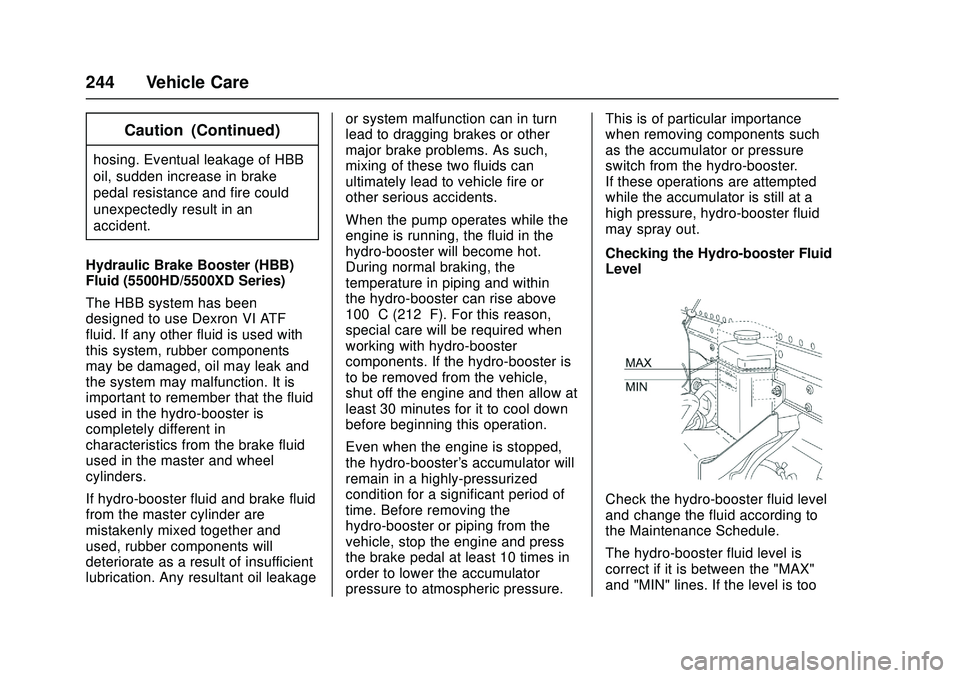
Checking the Hydro-booster Fluid
Level
Check the hydro-booster fluid level
and change the fluid according to
the Maintenance Schedule.
The hydro-booster fluid level is
correct if it is between the "MAX"
and "MIN" lines. If the level is too
Page 249 of 358

Chevrolet Low Cab Forward Owner Manual (GMNA-Localizing-U.S.-
11254764) - 2018 - crc - 12/5/16
248 Vehicle Care
Danger (Continued)
battery. Personal injury
(particularly to eyes) or property
damage may result from battery
explosion, battery fluid or
electrical (short circuit) burns. You
and others could be seriously
injured or killed.
If the negative cable is disconnected
from the negative terminal on the
battery within 3 minutes after turning
the engine control switch to the
"LOCK" position, the engine control
module may malfunction.
Checking the Battery
Your new vehicle is equipped with
DELKOR batteries. They need no
periodic electrolyte level
maintenance. Its top is permanently
sealed (except for two small vent
holes) and has no filler caps. You
will never have to add water.
Remember to check and recharge
the battery as necessary, as well as
keep connection clean. The hydrometer (green-eye test
indicator) in the top of each battery
(if equipped) provides information
for testing purposes only.
If the vehicle is not going to be
driven for 30 days or longer,
disconnect the ground cable from
the negative (–) terminal of the
batteries to prevent discharge.
For full power needs at replacement
time, a battery with the same
specifications, as shown on the
original battery's label, is
recommended.
{Warning
Battery posts, terminals and
related accessories contain lead
and lead compounds, chemicals
known to the State of California to
cause cancer and reproductive
harm. Wash hands after handling.
You and others could be seriously
injured.
Fuel Filter
Change the fuel filter in accordance
with the Maintenance Schedule or
when the fuel filter indicator light
(amber) comes on.
Drain the water when the water
separator (fuel filter) warning light
comes on. (Drain the water from the
chassis-side fuel filter and
engine-side fuel filter.)
Failure to replace the fuel filter when
needed may lead to fuel system
damage. Your authorized dealer can
inspect your fuel filter and replace
your fuel filter, if needed.